ebony

Ezekiel 27:15 reports traders who brought hovnim to Tyre. Coupled with ivory, the Hebrew word hovnim could have referred to either Asian or African products. In 1982 Zohary (Plants of the Bible. Cambridge University Press, 1982) stated that the identity of the hovnim in Ezekiel is unclear. He said that at best we can say that both Asian and African merchandise were shipped to Dedan, a Phoenician commercial center on the Arabian coast. Since then, however, Hepper (Baker Encyclopedia of Bible Plants, Baker Book House, 1992), who believes that trading with the Far East was less than many other scholars have alleged, has said that this tree is not the Asian Ebony Diospyros ebenum we know today but a leguminous tree Dalbergia melanoxylon, which grows all across Africa along the southern edge of the Sahara Desert. Evidence for this, he says, is that the Old Egyptian cognate hbny found in hieroglyphs refers to Dalbergia melanoxylon.

If hovnim are from Africa, they could be Dalbergia melanoxylon, as Hepper asserts, or one of the many species of the genus Diospyros found throughout the continent, such as Diospyros mespiliformis. The latter is a huge, widespread forest tree up to 35 meters (115 feet) tall. Dalbergia melanoxylon is a smaller, spiny tree reaching a height of 6‑7 meters (20‑23 feet). It inhabits the dry savanna areas from Ethiopia across to Senegal and as far south as southern Africa, where it is called “zebrawood.” The leaves are compound, with the leaflets nearly opposite one another on the spine. It has white flowers that hang in loose clusters, and around October they give way to flat, papery seedpods about 6 centimeters (2.5 inches) long and 1 centimeter (1/2 inch) wide. The Asian ebony, if that is what hovnim refers to, is found in India and Sri Lanka, grows to 10 meters (33 feet) tall, and has evergreen leaves. The inner part of the trunk is black, which makes it an attractive wood for carvers, who inlay the wood with ivory.

There are hundreds of species of ebony in tropical areas of the world (eighty in the Americas, ninety-four in Africa, and two hundred in Asia). In Africa the tree that produces most of the true ebony is Diospyros mespiliformis, which is found all the way from Senegal to the Red Sea and Arabia and southward to Southwest Africa and the Transvaal. In Nigeria it is called kanran or kanyan (Adamawa Fulfulde nelɓe). Surprisingly, both the Yoruba and Igbo Bibles in Nigeria have used eboni, perhaps reflecting the urbanization and Anglicization of those societies (or at least of the translators!). The Hausa word kanya correctly refers to the ebony tree. Diospyrus ebenum, found in India and Sri Lanka, might possibly have been on the world market in Bible times. A local word for this tree could be used in translations. If Hepper is correct, then the Dalbergia melanoxylon, locally known in Africa as “ebony” and also used for carving, should be used. Other transliteration possibilities are ebene (French) and ebenuz (Spanish).

Dalbergia species are also found in Central and South America under the names of palisander, kingwood, or tulipwood. A species in India is called blackwood or rosewood. In all these places the wood is used for radio cabinets, musical instruments, buttons, knife handles, chess pieces, and decorative carvings for tourists.

Dalbergia melanoxylon, photo by Nigel Hepper

Source: Each According to its Kind: Plants and Trees in the Bible (UBS Helps for Translators)
tamarisk

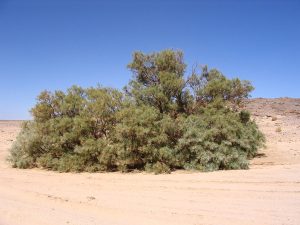
There are two main species of tamarisk referred to in the Bible, the Leafless Tamarisk Tamarix aphylla and the much more common Nile Tamarisk Tamarix nilotica. Both species are found throughout the plains and in the wadis (dry stream beds) of the Aravah and the Negev, where they tap water that has soaked into the ground after flash floods. Tamarisks can grow in salty soil, earning them the name “salt cedar” in some places. A third species grows only in the Jordan Valley. None of them has proper leaves but rather fleshy twigs, which are eaten by goats and sheep.

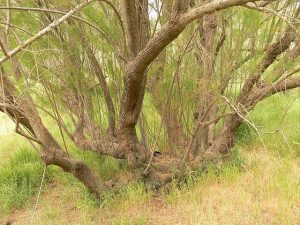
Description  The leafless tamarisk grows to a height of 10 meters (33 feet) and can be 1 meter (3 feet) across at the base. The more common Nile tamarisk is smaller and is really a shrub, branching right from the ground. Tamarisks grow in very dry places due to the fact that their roots extend far into the ground. The trunk is often twist-ed. The cedar-like branches hang down like those of the weeping willow. Bedouin shepherds have planted many of them throughout the Negev for their flocks.

The fact that Abraham planted a tamarisk and worshiped Yahweh there (Genesis 21:33) indicates that these trees, like oaks, were associated with the spirit world. According to Zohary (Plants of the Bible. Cambridge University Press, 1982), the “cedar” branches mentioned in the cleansing rituals of Leviticus 14:4 and Numbers 19:6 may possibly have been from tamarisks, although Phoenician juniper trees (very similar to cedar) were also available in some places on the journey of the wandering Israelites. Imported into the western United States, tamarisks have multiplied so fast in stream beds that they are now considered a costly nuisance. In some places they are used in making dyes and in processing leather.

The options for translating “tamarisk” are:

1. Transliterate from a major language, for example, tamarisiki, tamaris, esheli (Hebrew), or eteli/atali (Arabic).
2. Consider the function of the tree, which in Genesis was almost certainly connected to Abraham’s worship of God, and translate as “holy tree” perhaps with a footnote giving the Hebrew and/or English, especially if you have used “holy tree” in Gen 12.6 for “oak.”
3. Simply use “tree” with a footnote stating that the Hebrew specifies ’eshel, that is, tamarisk.

Leafless tamarisk, Wikimedia Commons
Nile tamarisk, Wikimedia Commons

Source: Each According to its Kind: Plants and Trees in the Bible (UBS Helps for Translators)
boxthorn

In the fable of the trees in Judges 9:14, all the trees come to ‘atad (in English Bible translations: thornbush or bramble) and ask it to become their king. Most scholars have generally agreed that this is probably a reference to the Boxthorn Lycium europaeum. Zohary (Plants of the Bible, Cambridge University Press, 1982) holds that it is more likely the Christ Thorn Ziziphus spina-christi. Both are thorny trees that are plentiful in the Near East, especially near Samaria in northern Israel, where Jotham, the teller of the fable, lived. The name “Christ thorn” (French couronne-du-Christ) reflects the tradition that this tree must also have been the source of the thorns that are referred to in the account of Christ’s crucifixion. The topic is widely debated, and there is little to confirm whether the “crown of thorns” came from this tree, or from one of many other prickly plants such as the thorny burnet, which is more common in the Jerusalem area. We advocate the majority opinion here, which is boxthorn (French lycie d’Europe).

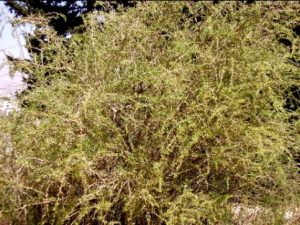
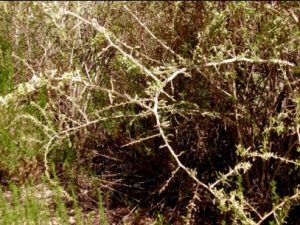
The boxthorn tree grows to 5 meters (17 feet) tall, has small leaves forming an oval crown, and has very sharp thorns. The yellowish green flowers give way to edible fruits about the size of grapes or cherries.

The word associations in Jotham’s fable are by no means clear, but he appears to use the ’atad as a tree that is neither attractive nor very useful. Indeed, its fruit is barely edible, and it does not produce usable wood, or even effective shade, since the leaves are fairly small and sparse. The ’atad is thorny, but whether that is significant in the fable is not clear. If the tree represents Abimelech (see Abimelech’s downfall), most readers would probably agree that he was a thorny character.

Jotham’s fable, being an allegory, allows the option for translators to substitute rhetorically equivalent species for the olive, fig, grapevine, and boxthorn. However, there may be no single word for “boxthorn” in the receptor language, so translators will end up using a generic phrase like “thorn tree” or substituting a thorny local tree or shrub, probably the most common one in their area. A common problem is that languages often do not have names for plants that are not useful. If transliterations are needed, ‘atad can be used from Hebrew, or translators can use a transliteration from a major language for a related type of tree.

Boxthorn, photo by Ray Pritz
Boxthorn branch, photo by Ray Pritz

Source: Each According to its Kind: Plants and Trees in the Bible (UBS Helps for Translators)
frankincense

The Hebrew and Greek that is translated in English as “frankincense” is translated in Lokạạ as ebạạm yạ insẹnsii or “sap of incense.” (Source: J.A. Naudé, C.L. Miller Naudé, J.O. Obono in Acta Theologica 43/2, 2023, p. 129ff. )


Frankincense Boswellia sacra is a yellow or reddish gum produced by one of the fifteen aromatic species of Boswellia. It was probably imported into Israel from Arabia, Africa, or Asia. Egyptian pictorial records indicate that Queen Hatshepsut travelled to a place called “Punt” (possibly Somalia or even India) and brought back specimens that look like Boswellia trees, planting them in her palace garden. Some people call frankincense olibanum (a Middle Eastern word meaning “incense”), but it is possible that olibanum may properly refer only to Boswellia serrata from India, which has a lemon/lime smell as opposed to the orange smell of true frankincense.

Today the best frankincense is reputed to come from Oman, but Yemen and Somalia also produce a lot of it. The name olibanum may come from the Arabic al-lubán (milk) or from the equivalent of “oil of Lebanon.” The Hebrew word levonah can mean either “white” or “Lebanese.”

Boswellia trees are actually shrubs reaching 3 meters (10 feet) in height, with multiple trunks coming from the ground. They have pinnate leaves and small greenish or white flowers. The gum of Boswellia trees comes out by itself in little drops from the branches and twigs, but it can also be extracted by cutting through the bark of the trunk. The resin appears in globs and hardens.

Frankincense was an ingredient of the incense burned in the Tabernacle of ancient Israel, and it was prescribed as part of their cereal offerings.

A classifier will be useful if available (for example, “resin of”). Transliterations of the word for frankincense from Hebrew (labona, lebonahi), Greek (libano), French (bosweli, olibán), or Arabic (akor, mager, mogar) will be more readable than those from English (firankinsensi).

Boswellia sacra, Wikimedia Commons

Source: Each According to its Kind: Plants and Trees in the Bible (UBS Helps for Translators)
papyrus

Although there has been considerable debate among botanists as to the identity of the various types of reed in the Bible, there is general agreement that the Hebrew word gome’ refers to the Papyrus Cyperus papyrus, based on etymological and practical grounds. As for the Hebrew word ’eveh, the phrase “skiffs of ’eveh” in Job 9:26 suggests that it refers to papyrus, since boats in Egypt were made of papyrus, apart from those made from wood. However, versions are divided between “papyrus” (New International Version) and “reed” (NRSVue, Revised English Bible) in this passage.

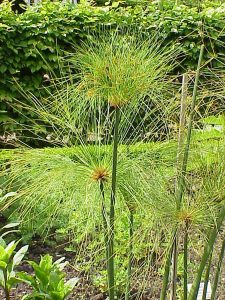
Papyrus is a very tall grass producing many flower stems that can be as much as 6 meters (20 feet) tall and 10 centimeters (4 inches) in diameter. The head at the top the stem separates into hundreds of branches that spread out like the top of a palm tree. Each one has small flowers. Papyrus was the most versatile grass in the Ancient Near East. In Egypt it was used to make boxes, mats, ropes, and especially paper. Perhaps its use in boats came to the mind of Jochebed when she wanted to save her infant son Moses from the wrath of the Pharoah (Exodus 2:3). Job’s companion Bildad uses papyrus as an example of a plant that needs water, and further as a slam at Job suggesting he must have sinned (Job 8:11). Isaiah 18:2 refers to “ambassadors by the Nile, in vessels of papyrus” as emblems of the great political power of Egypt. Poor people also used papyrus for barrels, huts, sandals, and clothing. Perhaps surprisingly, papyrus was not usually used for baskets. The baskets of the Egyptians, like those in sub-Saharan Africa today, were made of coiled construction using a core of date palm leaflets, fibers, or the split midrib, with a fiber wrapped around the core, like a guitar string.

There are over six hundred kinds of Cyperus growing in tropical and warm climates throughout the world, but many do not resemble the papyrus. For example, the tigernut sedge, found in West Asia and Africa and producing a tasty tuber (also called chufa or Zulu nut), belongs to the Cyperus genus. So also do the coco grass and several other types used for mats throughout Asia. The papyrus proper is now rare in Egypt but rampant in northern Uganda, where it is called sudd.

Most of the contexts where gome’ is found are rhetorical (Exodus 2:3 being the exception), opening the way for translators to substitute local equivalents. However, if the original plant name is replaced, it is usually good to document the original in a footnote, especially where the word identifies a particular area, as in Isaiah 18:1, where papyrus vessels are identified with “Ethiopia.” In Exodus 2:3 the mother of Moses did not use “bulrushes” (Revised Standard Version, King James Version) but papyrus, nor did she make a “basket” (NRSVue) but a “box” (tevah in Hebrew). If there is a word for “box,” it should be used. Otherwise, the general word for “basket” can be used, and a type of strong grass used for baskets should be used for the material. The following options are available for gome’:

1. use a local strong grass;
2. use a descriptive phrase such as “strong grass”;
3. use a generic word for “grass”;
4. leave the plant implicit as part of the verb “weave” or the noun “box/basket” in Exodus 2:3;
5. use “rush” (Revised English Bible), “papyrus reeds” (Living Bible), or “reeds” (Good News Bible).

If transliterations are needed for papyrus, some possibilities are French jonc and Portuguese/Spanish papiro.

Cyperus papyrus, Wikimedia Commons

Source: Each According to its Kind: Plants and Trees in the Bible (UBS Helps for Translators)

cumin

Two controversial seeds are mentioned in Isaiah 28:25 and 27: qetsach (see nigella) and kammon. The seeds referred to as kammon are probably those of cumin (also spelled “cummin”), which takes its Latin scientific name Cuminum cyminum from the Greek. It was common to the Mediterranean area (especially in Syria) and Ethiopia, possibly even native to Egypt, where it was used in cooking and also as medicine.

The cumin plant belongs to the same family as the carrot. It branches abundantly from the base and has similar leaves and flowers. However, the seeds have a much sharper smell than those of the carrot. Cumin is planted and harvested each year, reaching a height of perhaps 50-60 centimeters (20-24 inches).

In Isaiah 28 cumin is cited with other garden plants to show how different plants and their fruits require different care and processing. (Cumin and nigella, for example, are more easily damaged in threshing than hard cereal grains would be). It is part of a parable Isaiah tells to the proud Israelite leaders who thought they knew how God deals with people. Interestingly, farmers in Malta still thresh cumin in the way described by Isaiah. In New Testament times the Jewish authorities were not sure whether cumin should be tithed since it was not mentioned specifically in the Mosaic Law. They took no chances and insisted that people tithe their cumin. But then they ignored the need for justice and mercy, thereby incurring the condemnation of Jesus in Matthew 23:23.

Translators will either transliterate “cumin” from a major language, or they can seek an equivalent, depending on what they have done with the other terms (“mint” and “dill”) in Matthew 23:23. Simplified versions may use a generic phrase such as “all kinds of small garden plants.”

Cumin, Wikimedia Commons

Source: Each According to its Kind: Plants and Trees in the Bible (UBS Helps for Translators)
mustard

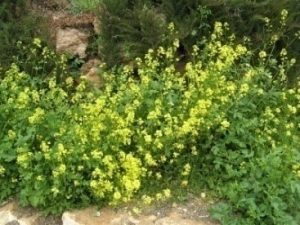
There is by no means full agreement about the precise identity of the plant in Jesus’ famous references to the mustard seed. Two types of mustard grow in the Holy Land and probably grew there in Bible times: Black Mustard Brassica nigra and White Mustard Sinapis alba. Both species were either cultivated or gathered in Bible times, probably more for the oil, which was used in medicine and cooking, than as a spice. Both types are cultivated today.

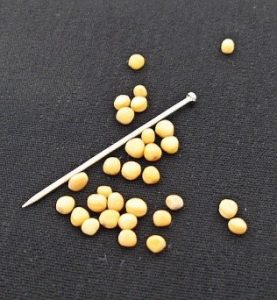
Mustard plants are related to some other well-known food plants, such as collards, broccoli, cauliflower, Brussels sprouts, rutabaga, and Chinese cabbage. They are planted and harvested each year. They grow to 2 meters (7 feet) in height and have branches like a tree. At the ends of the branches there are bright yellow flowers with four petals, like nearly all the members of the Brassicaceae family. The seeds are small among the seeds of garden plants, being about 2 millimeters (1/12 inch) in diameter, but they are not by any means the smallest of all seeds.

The point of the mustard seed parable of Jesus is that something small can produce something very large and complex, like the kingdom of God, or like the amazing deeds of a person with faith.

At least thirty kinds of mustard are known in the world, twenty-one of them in Europe. Others are found in Northeast Africa, India, Japan, and China. The quality in focus in all of the Gospel references is the smallness of the mustard seed compared to the large size of the resulting plant. The translator must keep that in mind, even if a relative of the mustard is found. If no effective equivalent is available, it will be necessary to transliterate “mustard” from a major language.

White mustard plants, photo by Nigel Hepper
Mustard seeds with pin, photo by Ray Pritz

Source: Each According to its Kind: Plants and Trees in the Bible (UBS Helps for Translators)

See also mustard seed.

pomegranate

The Hebrew and Greek that is translated as “pomegranate” in English was translated in the 1900 Kalaallisut (Greenlandic) translation (a newer version was published in 2000) as kingmernarssûp or “big lingonberry.” “The Greenlandic word kingmernarssûp (modern kimmernarsuup) derives from kingmernaĸ (modern kimmernaq) ‘lingonberry’ (Vaccinium vitis-idaea ). The lingonberry is the fruit of a shrub from the heath family which is native to the boreal forest and tundra in the Arctic regions of North America, Europe, and Siberia, including western and southern Greenland. The term for ‘lingonberry’ has been modified with the suffix –ssuaĸ (modern –suaq ‘big’), resulting in a descriptive term meaning ‘big lingonberry.’ (Modern Greenlandic uses the Danish loanword granatæble.)” (Source: Lily Kahn & Riitta-Liisa Valijärvi in The Bible Translator 2019, p. 125ff.)


The pomegranate Punica granatum has been grown from ancient times across the Middle East over to Iran and into northern India. It is widely cultivated throughout India and the drier parts of Southeast Asia, Malaya, the East Indies, and tropical Africa. Pomegranates are now found throughout the warm parts of southern Europe and across North Africa and Asia all the way to Nepal. Images of pomegranate fruits have been found in Pharaoh’s temple in Karnak, Egypt, dating from around 1480 B.C. In classical Latin the species name was malum punium (apple of Puni) or malum granatum (seedy apple). This has influenced the common name for pomegranate in many languages (for example, German Granatapfel, “seed apple”). The English word “pomegranate” itself comes from Latin pomum (fruit, apple) via Old French. The Arabic rummân (رمان) passed into some other languages, including Portuguese romã.

The pomegranate is a small tree, growing to about 3-5 meters (10-17 feet) tall, with narrow, dark green leaves and many thorny branches. It has a lovely red flower. The fruit is a bit smaller than an orange and has a hard skin, which must be cut open to get at the tightly-packed pockets of seeds inside, each seed enclosed in a little bag of juicy pulp. The end of the fruit has a distinctive flower-like shape. The hard skin, which turns from green to red as it ripens, is used as a tanning agent, for medicine, and for ink. The seeds were sometimes made into wine. Pomegranate trees live up to two hundred years.

The pomegranate was one of the seven “special” foods mentioned in Deuteronomy 8:8 that the Israelites would find in Canaan. The fruit was one of several brought back to the camp of the Israelites by the men who scouted out Canaan (Numbers 13:23). In Song of Songs 4:3 the bride of the king is said to have cheeks like halves of a pomegranate, a reference, probably, to their red color. The flower-shaped end of the pomegranate fruit made it an attractive decoration, for example on the fringe of the priests’ robes (Exodus 28:33f. and on the columns and furniture of the Temple (2 Kings 25:17).

In Jewish tradition the pomegranate stands for righteousness, because it is said to have 613 seeds, corresponding to the 613 commands of the Torah. For this reason and others many Jews eat pomegranates on the Jewish New Year Festival (Rosh Hashanah). Jewish tradition also holds that the pointed calyx of the pomegranate is the original “design” for a royal crown.
The Babylonians believed chewing pomegranate seeds before battle made them invincible. The Qur’an mentions pomegranates three times, twice as examples of the good things God creates, once as a fruit found in the Garden of Paradise.

The pomegranate is only recently being grown outside of the Mediterranean area. In West Africa it has not yet become a popular fruit. Where it is known at all, it is called rummân (from Arabic). In Song 4.3 and 6.7 the refer-ences to the pomegranate are rhetorical. There a cultural equivalent representing redness or beauty could be used. Elsewhere in the Bible transliteration is advised, following a major language. The word pome simply means “fruit,” so the basic word to transliterate from is granate (compare granada in Spanish). A possible expression is “garinada fruit.” The Latin phrase Punica granatum for pomegranate means the “grenade” of Punica (= Carthage), a city in present-day Tunisia. The Latin word granatum means “filled with many grains or seeds.” Reflecting this, Bambara of Guinea uses “karanati fruit.” One could also use the Hebrew rimmon as a base. Areas influenced by Arabic may find a word like rummân, for example, roomaanoo in Mandinka. A footnote could describe the fruit as similar to a guava, red and seedy.

Although the pomegranate has been introduced recently throughout Africa, it is not well-known, so the name will most likely need to be transliterated. As the English name is quite long, the translator is advised to translate from another source or look for ways to shorten it, such as “granata fruit.”

Pomegranate, Wikimedia Commons

Source: Each According to its Kind: Plants and Trees in the Bible (UBS Helps for Translators)