The Hebrew and Greek that is transliterated in English as “hyssop” is translated in Lokạạ as yisoki. Yisoki “is the name of a local bitter herb that is used for ritual cleansing in the traditional religion. It was, therefore, perceived by the translators as functionally adequate for ‘hyssop.’ The translation is thus symbolic in that it uses an indigenous Lokạạ botanical term and simultaneously indexical in that the translators believed that the translation points to the functional significance of the incipient term.” (Source: J.A. Naudé, C.L. Miller Naudé, J.O. Obono in Acta Theologica 43/2, 2023, p. 129ff. )
Likewise in Kweremfumbasi is used, a local plant that both looked similar to hyssop and is traditionally used for sprinkling in rituals. (Source: Pioneer Bible Translators, project-specific translation notes in Paratext)
The Phoenician Juniper Juniperus phoenicea is a lower-altitude cousin of the Grecian juniper. At present it is found scattered throughout the mountains of northern Sinai and southern Jordan, and Hepper notes that it occurs throughout the higher parts of Sinai and Arabia. In ancient times it may have been found throughout the Negev. Deuteronomy 2:36 refers to a town on the edge of the Wadi Arnon called Aroer, which is probably cognate with the Hebrew word ‘ar‘ar, indicating that these trees may have grown there. The identification of ‘ar‘ar/‘aro‘er as the Phoenician juniper is supported by the fact that Arabs in several countries call this juniper ‘ar‘ar. Since it is closely related to the cedars, some people also call it the “Phoenician cedar.” Note that Hebrew uses the same word ’erez to cover both the Phoenician juniper and the mighty cedar of Lebanon.
The Phoenician juniper is a short shrub or tree that may reach 5 meters (17 feet). It has tiny leathery leaflets and small berry-like cones.
We advocate translating ’erez as “juniper” in Leviticus and Numbers, if that species is known, or using a transliteration from a major language. The reference to ‘ar‘ar in Jeremiah 17:6 is poetic, and a cultural equivalent may be used; in a more literal version a transliteration may be used. Some scholars take the Hebrew word ‘aro‘er in the last line of Jeremiah 48:6 as meaning “juniper.”
The Hebrew, Aramaic, and Greek that are typically translated as “priest” in English (itself deriving from Latin “presbyter” — “elder”) is often translated with a consideration of existing religious traditions. (Click or tap for details)
Bratcher / Nida (1961) say this:
“However, rather than borrow local names for priests, some of which have unwanted connotations, a number of translations have employed descriptive phrases based on certain functions: (1) those describing a ceremonial activity: Pamona uses tadu, the priestess who recites the litanies in which she describes her journey to the upper or under-world to fetch life-spirit for sick people, animals or plants; Batak Toba uses the Arabic malim, ‘Muslim religious teacher;’ ‘one who presents man’s sacrifice to God’ (Bambara, Eastern Maninkakan), ‘one who presents sacrifices’ (Baoulé, Navajo (Dinė)), ‘one who takes the name of the sacrifice’ (Kpelle, and ‘to make a sacrifice go out’ (Hausa); (2) those describing an intermediary function: ‘one who speaks to God’ (Shipibo-Conibo) and ‘spokesman of the people before God’ (Tabasco Chontal).”
In Obolo it is translated as ogwu ngwugwa or “the one who offers sacrifice” (source: Enene Enene), in Mairasi as agam aevar nevwerai: “religious leader” (source: Enggavoter 2004), in Ignaciano as “blesser, one who does ritual as a practice” (using a generic term rather than the otherwise common Spanish loan word sacerdote) (source: Willis Ott in Notes on Translation 88/1982, p. 18ff.), and in Noongar as yakin-kooranyi or “holy worker” (source: Warda-Kwabba Luke-Ang).
For Guhu-Samane, Ernest Richert (in The Bible Translator, 1965, p. 81ff. ) reports this: “The [local] cult of Poro used to be an all-encompassing religious system that essentially governed all areas of life. (…) For ‘priest’ the term ‘poro father’ would at first seem to be a natural choice. However, several priests of the old cult are still living. Although they no longer function primarily as priests of the old system they still have a substantial influence on the community, and there would be more than a chance that the unqualified term would (in some contexts particularly) be equated with the priest of the poro cult. We learned, then, that the poro fathers would sometimes be called ‘knife men’ in relation to their sacrificial work. The panel was pleased to apply this term to the Jewish priest, and the Christian community has adopted it fully. [Mark 1:44, for instance, now] reads: ‘You must definitely not tell any man of this. But you go show your body to the knife man and do what Moses said about a sacrifice concerning your being healed, and the cause (base of this) will be apparent.'”
For a revision of the 1968 version of the Bible in Khmer Joseph Hong (in: The Bible Translator 1996, 233ff. ) talks about a change in wording for this term:
Bau cha r (បូជាចារ្យ) — The use of this new construction meaning “priest” is maintained to translate the Greek word hiereus. The term “mean sang (មាន សង្ឃ)” used in the old version actually means a “Buddhist monk,” and is felt to be theologically misleading. The Khmer considers the Buddhist monk as a “paddy field of merits,” a reserve of merits to be shared with other people. So a Khmer reader would find unthinkable that the mean sang in the Bible killed animals, the gravest sin for a Buddhist; and what a scandal it would be to say that a mean sang was married, had children, and drank wine.
Following are a number of back-translations as well as a sample translation for translators of Numbers 19:6:
Kupsabiny: “That priest must take a piece of cedar wood, a branch of hyssop and a red thread and throw (it) into the middle of the fire where the cow is burning.” (Source: Kupsabiny Back Translation)
Newari: “Then the priest must take some cedar wood, a hyssop plant and some red thread and throw them on top of the burning calf.” (Source: Newari Back Translation)
Hiligaynon: “Then Eleazar will-take a cut-off-piece of cedar wood, a cluster of hyssop plant, and a red cord/string/straw, and throw them all into the being-burned cow.” (Source: Hiligaynon Back Translation)
English: “Eliezer then must take a stick of cedar wood, a stalk of a plant named hyssop, and some scarlet/red yarn, and throw them into the fire where the cow is burning.” (Source: Translation for Translators)
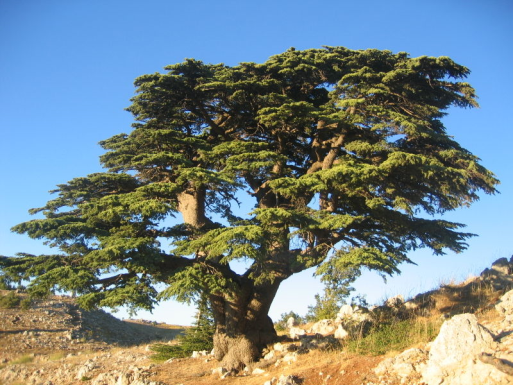
Long ago the majestic cedars of Lebanon (Cedrus libani) completely covered the upper slopes of the Lebanon Mountains on the western and northern sides. Now only a few pockets of these mighty cedars remain. At that time they were mixed, as they are today, with other trees such as Cilician fir, Grecian juniper, cypress, and Calabrian pine.
We know from 1 Kings that Solomon used cedar wood in his palace and in the Temple. Cedar was used for beams, boards, pillars, and ceilings. Historians tell us that the Assyrians also hauled cedars to their land for use in buildings. Nebuchadnezzar of Babylon also imported cedars from Lebanon. In some versions of Isaiah we read that people made idols of cedar and oak (44:14-20). Finally, when the Temple was rebuilt by the returning exiles (Ezra 3:7), they again cut down cedar trees to grace the house of God.
In 2 Samuel, 1-2 Kings, 1-2 Chronicles and Ezra, when Lebanon is specifically mentioned, there can be no doubt that ’erez is Cedrus libani, the “cedar of Lebanon,” although it is possible that sometimes the word was used loosely to include various evergreen trees.
In the description of the purification rituals (Leviticus 14:4 at al.), the word ’erez probably refers to the Phoenician juniper tree, since that was the only cedar-like tree in the Sinai Desert.
Description Cedar trees can reach 30 meters (100 feet) high with a trunk more than 2 meters (7 feet) in diameter. The leaves of true cedars are not flat like those of most trees, but consist of tufts of dark green, shiny spines. (The cedars in North America have a flatter type of spine than the biblical cedar.) The wood is fragrant and resistant to insects. Cedars bear cones and can live to be two or three thousand years old.
The cedar of Lebanon is famous for its large size (see Isaiah 2:13 et al.), and for the fragrance of its wood. Psalm 92:12 links the cedar to righteousness, that is, presumably, to its straightness and height above other trees. The cedar is the national emblem of Lebanon.
Cedrus species are found in the mountains of North Africa, in the Himalayas, in India, and in North America. Translators in these places, should, of course, use the local name in nonfigurative references. In sub Saharan Africa, translators can transliterate from Hebrew (’erez), Greek (kedar), English (sedar), or another major language, or they can take a generic solution such as “large, beautiful tree.” In poetic passages (wisdom literature and prophecy), some translators may wish to use a cultural equivalent with these traits. In Africa, according to Burkhill (The Useful Plants of West Tropical Africa, volume 4. Kew: Royal Botanic Gardens, 1985), the Pink Mahogany Guarea cedrata is also called the pink African cedar because of the cedar-like scent of its timber. Likewise, some people in India and Australia use “cedar” to refer to the toon because of its reddish wood. I do not recommend such substitutes in historical passages, since the ’erez is not related to these trees. In some figurative passages, however, the substitution could be effective, since all are large trees with reddish wood. However, each passage has to be evaluated to determine the intended effect of the image.
And the priest shall take cedarwood and hyssop and scarlet stuff: Here the text switches from the specific reference to Eleazar to the general expression the priest since the rules for this ritual are “for all time to come” (verse 10 in Good News Translation). The Hebrew word for cedar probably refers to the Phoenician juniper in this context. It is a short evergreen tree that may reach 5 meters (17 feet). It has tiny leathery leaflets and small berry-like cones. Its wood has a light red color and a fragrant smell. As A Handbook on Leviticus mentions at Lev 14.4, in many languages it will be necessary to know what quantity of cedarwood is intended. While we cannot be certain, it probably was a smaller piece that could be carried in one hand. In those languages where juniper trees are unknown, it may be necessary to render cedarwood as “a piece of wood with a strong fragrance,” “a piece of wood with a light red color,” or “a piece of wood called ‘juniper.’ ” The Hebrew word for hyssop refers to the marjoram plant, which is an aromatic bush that grows to a height of around 50-80 centimeters (20-32 inches). Revised English Bible and De Nieuwe Bijbelvertaling correctly say “marjoram.” Translators may say “a marjoram branch.” If the marjoram bush is unknown, another possible model is “a branch of an aromatic bush” or “a branch of a bush called ‘marjoram.’ ” Scarlet renders two Hebrew words, which are literally “scarlet-worm” (see 4.8, where these words occur in the reverse order). Revised Standard Version supplies the implied word stuff. Other possible renderings here are “a red cord” (Good News Translation), “some scarlet yarn” (New Living Translation), and “a dark red piece of cloth.” Because of its color it is probably associated with the blood in the ritual in verse 5. According to Olson (page 120), each of these three additives function as powerful cleansing agents, or ritual detergents, that become part of the ingredients of the resulting ashes.
Quoted with permission from de Regt, Lénart J. and Wendland, Ernst R. A Handbook on Numbers. (UBS Helps for Translators). Miami: UBS, 2016. For this and other handbooks for translators see here .


Leave a Reply
You must be logged in to post a comment.