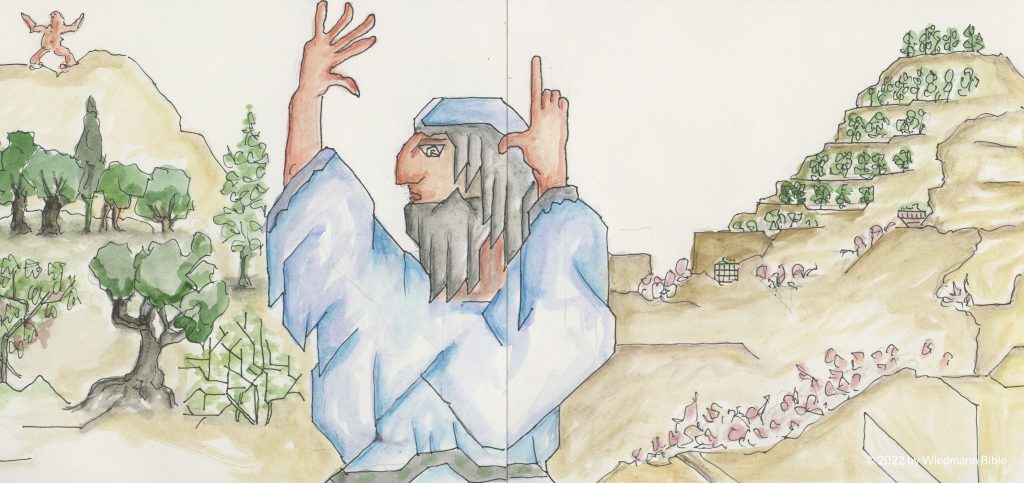
Image taken from the Wiedmann Bible. For more information about the images and ways to adopt them, see here .
For other images of Willy Wiedmann paintings in TIPs, see here.

וַיֹּאמְר֥וּ כָל־הָעֵצִ֖ים אֶל־הָאָטָ֑ד לֵ֥ךְ אַתָּ֖ה מְלָךְ־עָלֵֽינוּ׃
14So all the trees said to the bramble,
‘You come and reign over us.’
In the fable of the trees in Judges 9:14, all the trees come to ‘atad (in English Bible translations: thornbush or bramble) and ask it to become their king. Most scholars have generally agreed that this is probably a reference to the Boxthorn Lycium europaeum. Zohary (Plants of the Bible, Cambridge University Press, 1982) holds that it is more likely the Christ Thorn Ziziphus spina-christi. Both are thorny trees that are plentiful in the Near East, especially near Samaria in northern Israel, where Jotham, the teller of the fable, lived. The name “Christ thorn” (French couronne-du-Christ) reflects the tradition that this tree must also have been the source of the thorns that are referred to in the account of Christ’s crucifixion. The topic is widely debated, and there is little to confirm whether the “crown of thorns” came from this tree, or from one of many other prickly plants such as the thorny burnet, which is more common in the Jerusalem area. We advocate the majority opinion here, which is boxthorn (French lycie d’Europe).
The boxthorn tree grows to 5 meters (17 feet) tall, has small leaves forming an oval crown, and has very sharp thorns. The yellowish green flowers give way to edible fruits about the size of grapes or cherries.
The word associations in Jotham’s fable are by no means clear, but he appears to use the ’atad as a tree that is neither attractive nor very useful. Indeed, its fruit is barely edible, and it does not produce usable wood, or even effective shade, since the leaves are fairly small and sparse. The ’atad is thorny, but whether that is significant in the fable is not clear. If the tree represents Abimelech (see Abimelech’s downfall), most readers would probably agree that he was a thorny character.
Jotham’s fable, being an allegory, allows the option for translators to substitute rhetorically equivalent species for the olive, fig, grapevine, and boxthorn. However, there may be no single word for “boxthorn” in the receptor language, so translators will end up using a generic phrase like “thorn tree” or substituting a thorny local tree or shrub, probably the most common one in their area. A common problem is that languages often do not have names for plants that are not useful. If transliterations are needed, ‘atad can be used from Hebrew, or translators can use a transliteration from a major language for a related type of tree.
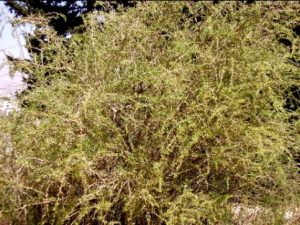
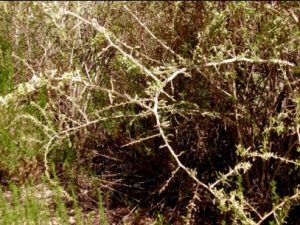
Source: Each According to its Kind: Plants and Trees in the Bible (UBS Helps for Translators)
The inclusive “we” specifically includes the addressee (“you and I and possibly others”), while the exclusive “we” specifically excludes the addressee (“he/she/they and I, but not you”). This grammatical distinction is called “clusivity.” While Semitic languages such as Hebrew or most Indo-European languages such as Greek or English do not make that distinction, translators of languages with that distinction have to make a choice every time they encounter “we” or a form thereof (in English: “we,” “our,” or “us”).
For this verse, the Jarai and the Adamawa Fulfulde translation both use the exclusive pronoun, excluding the bramble.
Following are a number of back-translations as well as a sample translation for translators of Judges 9:14:
Like a number of other East Asian languages, Japanese uses a complex system of honorifics, i.e. a system where a number of different levels of politeness are expressed in language via words, word forms or grammatical constructs. These can range from addressing someone or referring to someone with contempt (very informal) to expressing the highest level of reference (as used in addressing or referring to God) or any number of levels in-between. One way Japanese shows different degree of politeness is through the choice of a benefactive construction as shown here in the widely-used Japanese Shinkaiyaku (新改訳) Bible of 2017.
Here, natte (なって) or “become” is used in combination with kudasaru (くださる), a respectful form of the benefactive kureru (くれる). A benefactive reflects the good will of the giver or the gratitude of a recipient of the favor. To convey this connotation, English translation needs to employ a phrase such as “for me (my sake)” or “for you (your sake).” (Source: S. E. Doi, see also S. E. Doi in Journal of Translation, 18/2022, p. 37ff. )
Then all the trees said to the bramble …: The trees offered kingship to the three most important trees in Israel, but each one refused. So now they turn to one of the lowest plants, the bramble. Since this tree is the last in the series, the Hebrew waw conjunction rendered Then may be translated “Finally” (Contemporary English Version, New International Version) or “Lastly.” There is a slight change in expression here as all the trees participate. Jotham is making a very big contrast here, as he moves from the valuable plants in Israel, to one of the lowest and unappreciated bushes. Unlike the other trees mentioned here, the bramble or thorn bush is not a useful plant, which produces thorns instead of edible fruit. About the only thing brambles are good for is to burn, and even then, they burn quickly and so are not a good source of firewood. Translators need to find a good equivalent in their language. Good News Translation says “thorn bush.”
Come you, and reign over us: See verse 9.10.
Quoted with permission from Zogbo, Lynell and Ogden, Graham S. A Handbook on Judges. (UBS Helps for Translators). Miami: UBS, 2019. For this and other handbooks for translators see here .
No comments yet.
Leave a Reply
You must be logged in to post a comment.