The phrase in Exodus 2:3 that is translated in some English versions as “tar (or: bitumen) and pitch” is rendered in Falam Chin with a phrase meaning “resin and beeswax.”
See also pitch.

וְלֹא־יָכְלָ֣ה עוֹד֮ הַצְּפִינוֹ֒ וַתִּֽקַּֽח־לוֹ֙ תֵּ֣בַת גֹּ֔מֶא וַתַּחְמְרָ֥ה בַחֵמָ֖ר וּבַזָּ֑פֶת וַתָּ֤שֶׂם בָּהּ֙ אֶת־הַיֶּ֔לֶד וַתָּ֥שֶׂם בַּסּ֖וּף עַל־שְׂפַ֥ת הַיְאֹֽר׃
3When she could hide him no longer she got a papyrus basket for him and plastered it with bitumen and pitch; she put the child in it and placed it among the reeds on the bank of the river.
The phrase in Exodus 2:3 that is translated in some English versions as “tar (or: bitumen) and pitch” is rendered in Falam Chin with a phrase meaning “resin and beeswax.”
See also pitch.

Hand colored stencil print on washi by Sadao Watanabe (1979).
Image taken with permission from the SadaoHanga Catalogue where you can find many more images and information about Sadao Watanabe.
For other images of Sadao Watanabe art works in TIPs, see here.

Image taken from He Qi Art . For purchasing prints of this and other artworks by He Qi go to heqiart.com .
For other images of He Qi art works in TIPs, see here.
The Hebrew that is typically translated as “basket” in English is translated in the English translation by Everett Fox (first ed. 1983) as “little-ark.”
Fox explains (Translator’s Preface, p. XVIIIf.): “A powerful example of the (…) allusion occurs near the beginning of Exodus. Baby Moses, floating precariously yet fetus-like on the Nile, is one of the enduring images in the book, as children have long attested. Modern English readers, however, are seldom aware that the Hebrew word for Moses’s floating cradle — rendered by virtually all standard translations as ‘basket’ — is the same as the one used in Gen. 6:14ff. to describe Noah’s famous vessel (teiva). Preserving the connection between the two, as I have tried to do in the Exodus passage with ‘little-ark’ (and which, incidentally, the authors of the King James Version did with ‘ark’), is to keep open the play of profound meaning that exists between the two stories.”
See also papyrus.
The Hebrew word suf probably designates more than one species of the cattail, also called “reed-mace” and “bulrush.” There are two in Israel: Typha domingensis and Typha latifolia. Both species like to stand in the slow-moving water on the edge of rivers and streams. The reference to suf (“weeds”) in Jonah 2:5 supports Zohary’s conjecture (Plants of the Bible. Cambridge University Press, 1982) that suf may be a collective name for many water plants. Suf is paired with qaneh (“reeds”) in Isaiah 19:6, so it is almost certainly the cattail since both are found in marshes and slow streams.
The cattail reaches 3 meters (10 feet) in height and is notable for its soft, fuzzy brown seed head that eventually disintegrates into fluffy material that blows away in the wind and floats on the water. The plant also spreads through its thick roots, which creep along the bottom of shallow lakes and streams. Its leaves are long, erect, and sharply pointed.
In Bible times, as now, the leaves of cattails were used for baskets and mats. The thick roots are edible, as are the pollen and the young green stalks. The cattails of Exodus are famous as the plants among which the mother of Moses hid her son in his little floating basket.
Most kinds of cattail are found in Europe and North America, where the leaves are used for mats and chair seats. Some typha species in India (Typha elephantina) are used for making paper and ornaments. Translators who live near rivers may have other reed-like plants that can be used, keeping in mind that there are four reed-like plants mentioned in the Bible (see “Papyrus,” “Reed,” and “Rush”). In Exodus 2:3 and 2:5 a number of English versions, including the NRSVue use the generic word “reeds.” In communities that are unfamiliar with waterside vegetation, generic expressions such as “tall grass” or “tall stalks of grass” may be effective. The basic options for rendering suf in Exodus and Isaiah are:
1. a local grass that grows in streams and rivers;
2. a generic word such as “grass”;
3. a descriptive phrase such as “tall grass.”
The word suf has a different sense in Jonah 2:5. In this passage the plants are living in the water without roots or are perhaps rooted in the bottom of a shallow sea. So translations typically use “seaweed,” a plant with long, grass-like leaves that is often not attached to the soil under the sea.
The Hebrew expression yam suf (literally “sea of reeds”) has been translated somewhat inaccurately by the Septuagint translators and many others as “Red Sea.” A Handbook on Exodus recommends following the Hebrew, which is literally “Sea of Reeds,” or the modern equivalent “Gulf of Suez” as in the Good News Bible, unless there is a strong tradition in the receptor culture for “Red Sea.” If “Red Sea” is used, then a footnote should be added, giving “Sea of Reeds” as the literal meaning of the Hebrew text.

Source: Each According to its Kind: Plants and Trees in the Bible (UBS Helps for Translators)
In Jonah 2:5, it is translated as “ocean grass” in Newari (source: Newari Back Translation).
Although there has been considerable debate among botanists as to the identity of the various types of reed in the Bible, there is general agreement that the Hebrew word gome’ refers to the Papyrus Cyperus papyrus, based on etymological and practical grounds. As for the Hebrew word ’eveh, the phrase “skiffs of ’eveh” in Job 9:26 suggests that it refers to papyrus, since boats in Egypt were made of papyrus, apart from those made from wood. However, versions are divided between “papyrus” (New International Version) and “reed” (NRSVue, Revised English Bible) in this passage.
Papyrus is a very tall grass producing many flower stems that can be as much as 6 meters (20 feet) tall and 10 centimeters (4 inches) in diameter. The head at the top the stem separates into hundreds of branches that spread out like the top of a palm tree. Each one has small flowers. Papyrus was the most versatile grass in the Ancient Near East. In Egypt it was used to make boxes, mats, ropes, and especially paper. Perhaps its use in boats came to the mind of Jochebed when she wanted to save her infant son Moses from the wrath of the Pharoah (Exodus 2:3). Job’s companion Bildad uses papyrus as an example of a plant that needs water, and further as a slam at Job suggesting he must have sinned (Job 8:11). Isaiah 18:2 refers to “ambassadors by the Nile, in vessels of papyrus” as emblems of the great political power of Egypt. Poor people also used papyrus for barrels, huts, sandals, and clothing. Perhaps surprisingly, papyrus was not usually used for baskets. The baskets of the Egyptians, like those in sub-Saharan Africa today, were made of coiled construction using a core of date palm leaflets, fibers, or the split midrib, with a fiber wrapped around the core, like a guitar string.
There are over six hundred kinds of Cyperus growing in tropical and warm climates throughout the world, but many do not resemble the papyrus. For example, the tigernut sedge, found in West Asia and Africa and producing a tasty tuber (also called chufa or Zulu nut), belongs to the Cyperus genus. So also do the coco grass and several other types used for mats throughout Asia. The papyrus proper is now rare in Egypt but rampant in northern Uganda, where it is called sudd.
Most of the contexts where gome’ is found are rhetorical (Exodus 2:3 being the exception), opening the way for translators to substitute local equivalents. However, if the original plant name is replaced, it is usually good to document the original in a footnote, especially where the word identifies a particular area, as in Isaiah 18:1, where papyrus vessels are identified with “Ethiopia.” In Exodus 2:3 the mother of Moses did not use “bulrushes” (Revised Standard Version, King James Version) but papyrus, nor did she make a “basket” (NRSVue) but a “box” (tevah in Hebrew). If there is a word for “box,” it should be used. Otherwise, the general word for “basket” can be used, and a type of strong grass used for baskets should be used for the material. The following options are available for gome’:
1. use a local strong grass;
2. use a descriptive phrase such as “strong grass”;
3. use a generic word for “grass”;
4. leave the plant implicit as part of the verb “weave” or the noun “box/basket” in Exodus 2:3;
5. use “rush” (Revised English Bible), “papyrus reeds” (Living Bible), or “reeds” (Good News Bible).
If transliterations are needed for papyrus, some possibilities are French jonc and Portuguese/Spanish papiro.
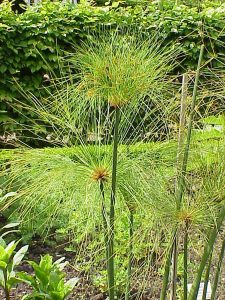
Source: Each According to its Kind: Plants and Trees in the Bible (UBS Helps for Translators)
Following are a number of back-translations as well as a sample translation for translators of Exodus 2:3:
The Hebrew conjunction waw (And) is better translated as “But,” since it introduces a change from the situation of verse 2. When she could hide him no longer means that she was not able to keep it a secret that she was protecting her three-month old baby boy. The reason is not given, but perhaps the child’s behavior and crying was becoming louder.
She took for him a basket means only that the mother “got” a basket (New English Bible and others). It does not suggest that she was the one who made or wove the basket.
The basket made of bulrushes was woven from a plant called papyrus. It was one of several types of reeds or “tall grass” that grew in the shallow water along the brink or “edge” of the Nile River. In cultures where papyrus is unknown, translators may express reeds as “tall grass” (see Good News Translation). The shape and size of the basket are not indicated, but it was a kind that could be made to float in water. (The same Hebrew word is used in Gen 6.14 for Noah’s ark.) Verse 6 indicates that it had a cover and could be closed. Therefore it may have been a common household item used as a place for storing personal and family things, or even food or produce. Translators in many languages will have a variety of words for baskets according to the size and material used, and they should pick a term which describes a basket large enough to hold a baby.
The bitumen and pitch were two thick, sticky substances used for sealing cracks in vessels of wood and reed. The distinction between the two is not clear, but the bitumen was probably a mineral substance, like asphalt, and the pitch probably came from certain plants. If bitumen and pitch are unknown, they may be combined as “tar” (Good News Translation), since the scientific identification is not important here. Their purpose, of course, is important, so Good News Translation adds “to make it watertight.” If tar is unknown, a translator may say, for example “a sticky substance to keep it from sinking,” or even “fixed the basket so that it would not sink.”
The mother placed it among the reeds at the river’s brink. This suggests that the basket was actually floating in water, for the reeds grew in the shallow water “at the edge of the river.” The word for reeds is a general term that includes bulrushes. (See the comment above.)
Quoted with permission from Osborn, Noel D. and Hatton, Howard A. A Handbook on Exodus. (UBS Helps for Translators). New York: UBS, 1999. For this and other handbooks for translators see here .
No comments yet.


Leave a Reply
You must be logged in to post a comment.