The Hebrew, Latin and Greek that is translated “boat” or “ship” in English is translated in Chichimeca-Jonaz as “that with which we can walk on water” (source: Ronald D. Olson in Notes on Translation January, 1968, p. 15ff.), in Chitonga as a term in combination with bwato or “dugout canoe” (source: Wendland 1987, p. 72), and in Tangale as inj am or “canoe-of water” (inj — “canoe” — on its own typically refers to a traditional type of carved-out log for sleeping) (source: Andy Warren-Rothlin).
In Kouya it is translated as ‘glʋ ‘kadʋ — “big canoe.”
Philip Saunders (p. 231) explains how the Kouya team arrived at that conclusion:
“Acts chapter 27 was a challenge! It describes Paul’s sea voyage to Italy, and finally Rome. There is a storm at sea and a shipwreck on Malta, and the chapter includes much detailed nautical vocabulary. How do you translate this for a landlocked people group, most of whom have never seen the ocean? All they know are small rivers and dugout canoes.
“We knew that we could later insert some illustrations during the final paging process which would help the Kouya readers to picture what was happening, but meanwhile we struggled to find or invent meaningful terms. The ‘ship’ was a ‘big canoe’ and the ‘passengers’ were ‘the people in the big canoe’; the ‘crew’ were the ‘workers in the big canoe’; the ‘pilot’ was the ‘driver of the big canoe’; the ‘big canoe stopping place’ was the ‘harbour’, and the ‘big canoe stopping metal’ was the ‘anchor’!”
In Lokạạ it is translated as ukalangkwaa, lit. “English canoe.” “The term was not coined for the Bible translation, but rather originated in colonial times when the English arrived in Nigeria on ships. The indigenous term for a canoe was modified to represent the large, ocean-going ship of the English.” (Source: J.A. Naudé, C.L. Miller Naudé, J.O. Obono in Acta Theologica 43/2, 2023, p. 129ff. )
Vultures and eagles were much more common in the ancient world than they are today. In fact since the end of World War II in 1945 the world’s population of vultures and eagles has been reduced by over sixty percent. This is due mainly to a) calcium deficiencies as a result of eating animals in which there were high concentrations of the insecticide DDT, b) eating poisoned rats, and c) the reduction in the amount of carrion due to both the disappearance of wild animals since the invention of the modern rifle, and the modern garbage disposal systems.
Click or tap here for the rest of this entry in United Bible Societies’ All Creatures Great and Small: Living things in the Bible
Nesher: As is the case with many Hebrew bird names, the word nesher refers both to one particular bird and to a general class of birds. It seems likely that nesher refers specifically to the largest of the local birds of prey, namely the Griffon Vulture Gyps fulvus, but since this word also refers to large birds of prey, it also has a general reference to all or any of them. Thus this category of large birds probably also includes the Lappet-faced Vulture Torgos tracheliotus negevensis, (now fairly uncommon, but previously very numerous), the Golden Eagle Aquila chrysaetos, the Imperial Eagle Aquila heleiaca, the Steppe Eagle Aquila nipalensis, and possibly the Black or Verreaux’s Eagle Aquila verreauxii. The last mentioned bird has only been breeding in modern Israel in the last thirty-five years, but some ornithologists believe that it may have lived there in ancient times, since it is associated closely with the hyrax, its favorite prey.
‘Ozniyah: There is considerable doubt about the meaning of this word. Its meaning is basically derived from its position in the list of unclean birds, and this makes a type of vulture more likely than the osprey. Since the Black Vulture Aegypius monachus is slightly smaller than the lappet-faced vulture and the bearded vulture, this seems to be the most likely candidate. It probably represents eagles and buzzards of the same size as itself, that is, some of the eagles mentioned above. In modern Hebrew ‘ozniyah is the name for the lappet-faced and black vultures.
‘Ayit: There is general agreement that the word ‘ayit in the Bible is a word that includes in its meaning both eagles and vultures. However, it probably does not include smaller birds of prey, such as the hawk, sparrow hawk, or smaller falcons. In the contexts in which it occurs it is clear that carrion-eating birds of prey are meant, rather than all birds of prey. Therefore the English expression “birds of prey” is too inclusive, but the term “carrion birds” is probably more correct.
The word ‘ayit is usually taken to be derived from a Hebrew root meaning “to scream”, hence “the screamer”, and is obviously a bird in Genesis 15:11 and other passages. However, there are also scholars who relate ‘ayit to a different Hebrew root meaning “to attack greedily”.
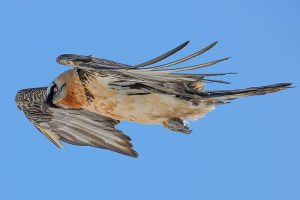
Peres, a word derived from a Hebrew root meaning “to tear apart” or “to break”, probably refers to the Bearded Vulture or Lammergeir Gypaëtus barbatus, which looks much like an eagle. It probably represents a grouping of eagles and vultures slightly smaller than those mentioned above under nesher and would include the Black-breasted Snake Eagle (also called the Short-toed Eagle or the Black-chested Harrier Eagle) Circaetus gallicus (alternatively Circaetus pectoralus) and the Booted Eagle Hieraeetus pennatus, as well as one or two others.
Racham refers to something that is black and white. The position of the name in the list of unclean birds would indicate that it is a waterside bird. This narrows the choice to two possibilities, the Egyptian Vulture Neophron percnopterus and the Osprey Pandion haliatus. In modern Hebrew racham is the name for the Egyptian vulture.
The Egyptian vulture is smaller than the other vultures mentioned above. It has long, untidy, light orange-brown feathers on its neck and head, with a bare yellow face and yellow beak that is longer and less hooked than most vultures. The rest of the body and wings are white with black wing tips. In flight the body and the front half of the wings are white, with the wing tips and the back half of the wings black.
While this vulture does eat carrion, it is usually the scraps dropped by larger vultures, since its beak is not strong enough to tear skin and meat easily. It usually scavenges scraps on beaches or rubbish dumps and eats the eggs of ground-nesting waterside birds such as plovers, sandpipers, curlews, and others, which it breaks by knocking them with a large stone.
Aetos: This is the usual Greek word for any kind of eagle.
Aquila: This is the usual Latin word for any kind of eagle.
True eagles have feathers on the lower part of their legs, but vultures, snake-eagles, hawks, and others usually have no such feathers. Vultures have slightly longer beaks and longer necks than eagles, and their heads and necks are usually either bald or have sparse down covering them rather than proper feathers.
Griffon vulture: This is the largest of the Gyps vultures, having a wingspan of about 2.5 meters (8 feet), and weighing up to 10 kilograms (22 pounds). It has a thick hooked black beak. Its head and neck are covered in fine down, and it always looks as though it is frowning. It has a tuft of feathers on its back between its shoulders. The head, neck, and chest are gray and fawn, and its back is dark brown with darker feathers on the edges of its wings. When it is soaring, its body and the leading edges of its wings appear light brown with a broad dark band on the trailing edge of the wings. Like all true vultures, it has featherless legs.
Griffons live in fairly large groups and roost and nest together on high rock ledges, and, like most other vultures of large size, they have to wait until mid-morning when there is warm air rising up from the ground before they can fly. They then soar in spirals, going higher and higher.
They have very specialized eyes that enable them to see great distances. A proverb quoted in the Talmud says, “A vulture in Babylon sees a carcass in Israel.” They keep watch to find any dead or dying animals, and at the same time they keep track of other vultures flying nearby. They soar fairly slowly, without beating their wings. As soon as one stops spiraling and heads toward its prey, it gathers speed quickly in a shallow dive, still not beating its wings, but often reaching high speeds. The Hebrew name nesher may reflect the swishing sound made by its wings when it is flying this fast. Other vultures will notice this movement and will start to follow.
In African countries where both griffon and lappet-faced vultures live, griffons usually arrive at a carcass in fairly large numbers, with the lappet-faced vultures arriving in pairs. Often a dead cow will attract twenty griffons or more and perhaps four lappet-faced vultures. It is likely that this ratio was the case in ancient Israel too.
The griffons attack the stomach and other soft parts of the carcass and thrust their heads deep into the body to eat the liver and other soft organs before starting on the softer meat, eating “from the inside out.” They eat very quickly and can consume a kilogram (2 pounds) of meat in about two minutes. After gorging themselves it is difficult for them to fly, and they need to run and hop along the ground before getting airborne. If there is no obvious danger, they prefer to remain on the ground or to perch on logs or in nearby trees after eating.
Lappet-faced vulture: This vulture is almost as big as the griffon in terms of height and wingspan but has a lighter build. They live singly or in pairs in the Negev and roost and nest in the tops of flat-topped trees such as acacias. The lappet-faced vulture has a yellowish beak, which is thicker and stronger than that of the griffon, and this enables it to eat skin, sinews, and tough meat. The head, face, and neck are covered with bare red skin. The head and neck have thick wrinkles. The rest of the body is dark brown or black with white thighs and shoulders. When they are soaring they appear to be uniformly black except for a thin white streak on the leading edge of the wings, with the white thighs (usually referred to by bird watchers as their “white pants”) clearly visible.
At a carcass they feed “from the outside in,” tearing the skin and eating it before starting on the meat. Lappet-faced vultures are very aggressive and dominate the griffons at a carcass they are sharing. Although carrion is their main food, they also sometimes kill their own prey, mainly small mammals such as young gazelles or hares.
Black vulture: The black vulture, as its name suggests, is black all over apart from the bare head and neck, which are a bluish gray. When viewed from below it appears completely black.
Large eagles: The golden, imperial, and Verreaux’s eagles mentioned above are all very large and have a wingspan of at least 2 meters (6 feet). They are not mainly scavengers, but may occasionally join vultures at a carcass. Generally their prey is small mammals, such as baby gazelles, lambs, hyraxes, hares, and young ibexes, as well as occasional game birds such as partridges and doves.
Bearded vulture: Also known as the lammergeir, this bird is unique among vultures, as it has feathered legs like an eagle. It is smaller than the vultures mentioned above. Its head, neck, and body are an orange-brown, and it has a black stripe running from the back of its head, through its eye to the beak, where it ends in a short bristly black beard on both sides of the beak. Its back and wings are dark brown. In flight it is easily recognized by its coloring and its large diamond shaped tail. It usually feeds when other vultures have eaten, and it has the unique habit of carrying bones high into the air and then dropping them onto a large rock to break them so that it can eat the marrow and the bone fragments. It will use the same rock for this purpose for many years.
Both eagles and vultures are associated with large size and great strength. Especially important is their ability to fly great distances at high speed, without even beating their wings. Both Egyptian and Assyrian deities had the eagle or vulture as their symbol, and this, as well as their diet of meat, meant that these birds were “unclean” to the Jews. The famous mummy of Tutankhamen, the young Egyptian king, was found with a large collar made of gold and colored glass adorning his neck and shoulders, in the form of a flying vulture representing the goddess Nekhbet. The eagle in Scripture is also a symbol of protection, and in Deuteronomy the eagle is a metaphor for God.
As carrion-eating birds of prey, eagles and vultures symbolized death in battle, in which the corpses were not buried. They are listed among the unclean birds.
The vulture or eagle was a symbol of healthy, long life. In actual fact these birds can live for a great many years. One fairly reliable report from Austria refers to an eagle kept in captivity for 104 years. Some scholars relate the Hebrew association of long life and the eagle to the ancient Arabian myth about the phoenix, usually portrayed as some sort of eagle, which flew to the sun every five hundred years, was consumed by the sun’s fire, and emerged reborn from its own ashes.
By the time of the New Testament the eagle, besides the symbolism mentioned above, had also become a symbol of the power of the Roman Empire.
The context will usually indicate whether vultures or eagles are intended by the author. When there is reference to speed and swooping down on the prey, the eagle is intended, but when there is reference to eating dead bodies, the vulture is intended. When the text speaks of flying high or nesting in safety on high cliffs, either eagles or vultures fit the context.
Three linguistic situations are possible: a) Languages in which the same word is used for both vultures and eagles (for example, Lisu, Lahu, and other Tibeto-Burman languages). Here there is no need to differentiate between them, except where both Hebrew words appear together. b) Languages in which there are no generic words for vultures or eagles, but each individual subspecies has its own name (as with many southeastern Bantu languages). In these cases it is best to choose the biggest vulture or eagle for nesher and a slightly smaller one for peres. c) Languages in which there are two generic words, one for vultures and another for eagles (as is the case in English). Here the context will determine the choice.
Care should be taken in those contexts where the nest is referred to as high on a cliff face, since some species of vulture and eagle nest in trees. In these cases a cliff-nesting alternative should be chosen, even if it is a smaller bird of prey.
‘Ozniyah: Probably a word for the black vulture or a type of medium-sized eagle. An expression meaning “small vulture” is probably the best equivalent.
Another name for an eagle or vulture of similar size as the black vulture can be used in the lists of unclean birds for ‘ozniyah, or it can be included, along with peres, in a general expression covering both fairly large vultures and eagles.
‘Ayit: In languages that do not have a single word including both eagles and vultures, but where both types of bird are found, such as in Africa and the Middle East, it is better to use a simple phrase meaning “eagles and vultures.” A phrase such as “scavenging birds of prey,” or simply “vultures,” could also be used.
True vultures are not found in the Americas or Australasia, but a word for “buzzards,” or, in the case of the Americas, “condors” can substitute for “vultures.” Elsewhere a phrase such as “eagles that eat dead things” or a borrowed word can be used.
Peres: The bearded vulture is found in the mountainous regions of southern Europe, Central and South Asia, and eastern and southern Africa. The medium-sized short-toed eagle is found throughout Eastern Europe, the Middle East, and Africa. The booted eagle is found all over Europe, Asia, and Africa. Elsewhere, the name for a medium-sized vulture or eagle can be used to translate peres.
In Africa there are many vultures closely related to the griffon vulture, and the lappet-faced vulture is common in most areas of the African continent. The African griffons include the White-backed Vulture Gyps africanus(alternately Gyps bengalensis), which nests in trees, the Cape Vulture Gyps coprotheres, and Ruppell’s Vulture Gyps ruppelli. The local word for any of these would be a good equivalent in contexts where the text refers to vultures.
Griffons are also found in central and eastern Europe and on the Indian sub-continent. The condors of Latin America and California would be local equivalents. The Wedge-tailed Eagle Aquila audax of Australia would be an equivalent there.
Golden and imperial eagles are found in most of western Europe as well as Israel.
African equivalents of the golden and imperial eagles would be the Black or Verreaux’s Eagle Aquila verreauxii and the Martial Eagle Polemaetus bellicosus.
The Steppe Eagle Aquila nipalensis migrates across Israel to as far south as the northern parts of South Africa. It is also found in eastern Europe, Kazakhstan, Central Asia, and South Asia.
In North America the Bald Eagle Haliaeetus leucocephalus would be an equivalent in some contexts of the Hebrew nesher.
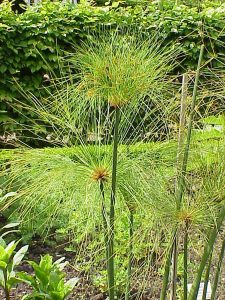
Although there has been considerable debate among botanists as to the identity of the various types of reed in the Bible, there is general agreement that the Hebrew word gome’ refers to the Papyrus Cyperus papyrus, based on etymological and practical grounds. As for the Hebrew word ’eveh, the phrase “skiffs of ’eveh” in Job 9:26 suggests that it refers to papyrus, since boats in Egypt were made of papyrus, apart from those made from wood. However, versions are divided between “papyrus” (New International Version) and “reed” (NRSVue, Revised English Bible) in this passage.
Papyrus is a very tall grass producing many flower stems that can be as much as 6 meters (20 feet) tall and 10 centimeters (4 inches) in diameter. The head at the top the stem separates into hundreds of branches that spread out like the top of a palm tree. Each one has small flowers. Papyrus was the most versatile grass in the Ancient Near East. In Egypt it was used to make boxes, mats, ropes, and especially paper. Perhaps its use in boats came to the mind of Jochebed when she wanted to save her infant son Moses from the wrath of the Pharoah (Exodus 2:3). Job’s companion Bildad uses papyrus as an example of a plant that needs water, and further as a slam at Job suggesting he must have sinned (Job 8:11). Isaiah 18:2 refers to “ambassadors by the Nile, in vessels of papyrus” as emblems of the great political power of Egypt. Poor people also used papyrus for barrels, huts, sandals, and clothing. Perhaps surprisingly, papyrus was not usually used for baskets. The baskets of the Egyptians, like those in sub-Saharan Africa today, were made of coiled construction using a core of date palm leaflets, fibers, or the split midrib, with a fiber wrapped around the core, like a guitar string.
There are over six hundred kinds of Cyperus growing in tropical and warm climates throughout the world, but many do not resemble the papyrus. For example, the tigernut sedge, found in West Asia and Africa and producing a tasty tuber (also called chufa or Zulu nut), belongs to the Cyperus genus. So also do the coco grass and several other types used for mats throughout Asia. The papyrus proper is now rare in Egypt but rampant in northern Uganda, where it is called sudd.
Most of the contexts where gome’ is found are rhetorical (Exodus 2:3 being the exception), opening the way for translators to substitute local equivalents. However, if the original plant name is replaced, it is usually good to document the original in a footnote, especially where the word identifies a particular area, as in Isaiah 18:1, where papyrus vessels are identified with “Ethiopia.” In Exodus 2:3 the mother of Moses did not use “bulrushes” (Revised Standard Version, King James Version) but papyrus, nor did she make a “basket” (NRSVue) but a “box” (tevah in Hebrew). If there is a word for “box,” it should be used. Otherwise, the general word for “basket” can be used, and a type of strong grass used for baskets should be used for the material. The following options are available for gome’:
1. use a local strong grass;
2. use a descriptive phrase such as “strong grass”;
3. use a generic word for “grass”;
4. leave the plant implicit as part of the verb “weave” or the noun “box/basket” in Exodus 2:3;
5. use “rush” (Revised English Bible), “papyrus reeds” (Living Bible), or “reeds” (Good News Bible).
If transliterations are needed for papyrus, some possibilities are French jonc and Portuguese/Spanish papiro.
Following are a number of back-translations as well as a sample translation for translators of Job 9:26:
Kupsabiny: “They hurry along at an amazing speed just like an antelope, or like an eagle that hurries for something to eat.” (Source: Kupsabiny Back Translation)
Newari: “It is moving quickly like a little boat of bamboo reeds, like an eagle attacking its victim, going down in one swoop.” (Source: Newari Back Translation)
Hiligaynon: “Yes, my life passes-by swiftly; just-as swiftly as a swift ship or an eagle that is swooping.” (Source: Hiligaynon Back Translation)
English: “My life goes by very rapidly, like a boat made from reeds sailing swiftly, or like an eagle that swoops down to seize a small animal.” (Source: Translation for Translators)
Job returns to the theme of the swiftness with which life passes away. In 7.6 he said “My days are swifter than a weaver’s shuttle.” He now uses the figure of a runner. My days are swifter than a runner: the word runner is found also in 2 Samuel 18.19-33, where the runner is a bearer of an urgent message for the king. Good News Translation avoids the analogy of the runner and says “My days race by.” This line may also be rendered “the days of my life pass swiftly” or “my days are all quickly gone.” They flee away repeats the thought of the first line without using a parallel comparison. They see no good is an idiomatic way of saying the days are without happiness, or nothing good happens during the passage of the days. In many languages days cannot be described as being able to see, like people, and so we may have to restructure this expression to say, for example, “nothing good happens to me” or “my days pass by without anything good happening to me.”
They go by like skiffs of reed: the comparison shifts from the runner on land to small, speedy boats made of reeds. The word for reed is used only here. The more common term is “papyrus” as in 8.11 and in Isaiah 18.2. Skiffs of reed or papyrus were Nile boats whose sides were made of papyrus reeds and which were known for their swift travel on the river. Line a may be rendered, for example, “My days go quickly like fast sailing boats.” In areas where sailing boats are unknown, the comparison may be shifted to any swift water craft; for example, “My days flow swiftly like a fast dugout.” Where boats are completely unknown it may be necessary to drop the image and say, for example, “My life is very soon over” or “The days of my life come quickly to an end.”
Like an eagle swooping on the prey: the third analogy shifts again, from water to the air. This time the comparison is to the eagle or hawk pictured as swooping down out of the sky to snatch its prey. Prey translates the Hebrew “food,” and Good News Translation attempts to be more specific still with “rabbit.” Translators may find it necessary to substitute another bird of prey. The pictures of the runner, the skiff, and the eagle all emphasize the swiftness of the passing of time, and so whatever comparisons are used, they must be characterized by swiftness of movement.
Quoted with permission from Reyburn, Wiliam. A Handbook on Job. (UBS Helps for Translators). New York: UBS, 1992. For this and other handbooks for translators see here .




_Photo_by_Giles_Laurent.jpg)


Leave a Reply
You must be logged in to post a comment.