reed

There are two general types of reed in Israel, the Common Reed Phragmites australis and the Giant Reed Arundo donax, and it is impossible to say which one is intended in a given biblical context.

The English word “cane” comes from the Hebrew word qaneh. Qaneh is the most general Hebrew word of the many referring to reeds and rushes. Like the English word “reed,” it may refer to a specific type of reed or be a general name for several kinds of water plant. This word is also used to refer to the stalk of grain in Pharaoh’s dream (Genesis 41:5, Genesis 41:22), to the shaft and branches of the golden lampstand in the Tabernacle (Exodus 25:31 et al.), to the beam of a scale (Isaiah 46:6), to the upper arm of a person (Job 31:22), to a measuring stick (Ezekiel 40:3 et al.), and to aromatic cane (Song of Songs 4:14 et al.).

The Greek word kalamos is also used to refer to a measuring stick (Revelation 11:1 et al.) and to a pen (3 John 1:13 and 3 Maccabees 4:20).

The common reed is a tall grass with stiff, sharply-pointed leaves and a plume-like flower head that reaches to more than 2 meters (7 feet). It grows in lakes and streams, the roots creeping across the bottom of the lake to produce new leaves and stalks.

The giant reed is similar to the common reed but tends to grow not in the water but on the river banks. Its majestic plumes can reach up to 5 meters (17 feet) in height on hollow stalks that look like bamboo.

Reeds of both kinds were used for baskets, mats, flutes, pens, arrows, and roof-coverings. Isaiah 42:3 says that the Messiah will be gentle with weak people (“a bruised reed he will not break”), in contrast to the typical iron-fisted tyrants of the day. The Pharaoh is likened to an undependable reed staff in 2 Kings 18:21 et al. In 1 Kings 14:15 Israel is compared to a reed shaking in the water.

The common reed of the Mediterranean area has relatives in Europe, India, Japan, and North America. It is thought to be the only species of the genus Phragmites (although some botanists divide it into three species). It is very important for conservationists, because it provides habitat for many kinds of animals and birds. In North America the weaker native type is being overtaken by more robust types from Europe, which are now threatening other kinds of marsh plants. In Japan people eat the young shoots of reeds. Native Americans used to eat the seeds.

Translators living near lakes and rivers will be able to find an equivalent, if not a relative, of the reed. Others can be generic and use “grass” or a phrase such as “tall grass growing in the water.”

Common reed, photo by Rob Koops

Source: Each According to its Kind: Plants and Trees in the Bible (UBS Helps for Translators)

In Newari it is translated as “bamboo.” (Source: Newari Back Translation)

aloe

The New Testament aloe must be distinguished from that mentioned in some versions of the Old Testament. In Numbers 24:6, Psalm 45:8; and some other places aloe refers to chips of fragrant wood from the agarwood tree found in northern India. However, the New Testament reference to aloe is to the true aloe Aloe vera. This aloe originated in southern Africa, Arabia, and Madagascar. The gel-like substance in the leaves of the aloe has been used as medicine for centuries, especially to treat burns and abrasions of the skin. It is also used as a laxative, and in modern times as an ingredient in all kinds of skin creams, soaps, shampoo, and even as a drink (in Asia), or as an additive to tea.

The leaves of aloe plants are stiff, fleshy spines that come out like fat knife blades from the center of the plant. They have spiny margins and are mostly solid green in color, but some are spotted or blotched. Most aloes have no visible stem, but some do have stems, and can reach a height of more than a meter (3 feet). The plants produce clusters of small red or yellow tube-like flowers that are borne on a stalk.

Aloes are native to southern Africa, Madagascar and Arabia, but are now found in tropical countries throughout the world. Translators in those areas will have local names for the plant. Since the one reference to aloe is a non-rhetorical passage, a transliteration from a major language is advised, but it will depend on what is done with myrrh, the other word in the pair.

Aloe vera, photo by Rob Koops

Source: Each According to its Kind: Plants and Trees in the Bible (UBS Helps for Translators)

almond

The almond is one of a group of fruit-bearing trees (Prunus) that also includes plums, cherries, peaches, and apricots. There are fifteen species of wild almond in Iran, two wild species in Israel, and one cultivated one (Prunus dulcis, also called Amygdalus communis). They are plentiful now in the hills of Israel, and probably were so in Bible times, even in the hot, dry Negev.

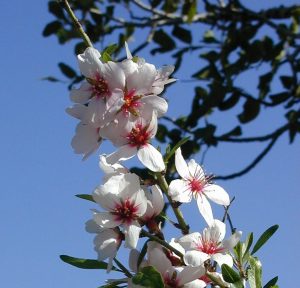
The almond tree grows to around 4 meters (13 feet) tall. It loses its leaves in winter and then, before the new leaves appear in spring, a profusion of white or pink flowers appears. The flowers are quite flat, with oval petals. The fuzzy fruit, about the size of a date palm fruit, comes about ten weeks later. The seed (“nut” in English) is fifty percent oil, and can be eaten raw but is usually roasted.

Three passages make reference to physical features of the almond tree. In Exodus 25:33f. and 37:19f. 20 we find the Hebrew word meshuqad (“almond-like”) referring to the shape of the almond blossom. The flat almond flower made a reasonable model for the lamp holders at the top of the branches of the lampstand in the Tabernacle.

The writer of Ecclesiastes 12:5 uses the profusion of white blossoms on the almond tree as a symbol of old age. The comparison is of course to the white hair of the elders.

In Jeremiah 1:11 the author makes use of the similarity of the Hebrew name shaqed (“almond”) to the word shoqed (“watching” or “wakeful”) to emphasize that Yahweh is “watching” over Israel (see almond tree / watching). Some commentators add to this that since the almond is the first of the trees to blossom in the spring—even before the leaves emerge — it was “waking up early,” and God, likewise, is an “early help” in time of trouble.

The Prunus family has members in various parts of the world, such as Prunus salicina in China and Prunus munsoniana in eastern North America. However, the branches and fruit of many of these are so different from the true almond that in non-figurative passages local names will not really be usable. In a passage such as Genesis 30:37, a transliteration from a major language is recommended; for example, shaked/lus (Hebrew), lawus (Arabic), amande (French), amendoa (Portuguese), almendra (Spanish), and alimondi. In English the “l” is not pronounced, so “almond” may be transliterated amond. Elsewhere, where the tree is used figuratively, as in Exodus and Ecclesiastes (see below), translators can use a blossom with a similar shape and color.

Almond tree, photo by Gloria Suess
Almond flowers, photo by Ray Pritz

Source: Each According to its Kind: Plants and Trees in the Bible (UBS Helps for Translators)

rush

The Lake Rush Scirpus lacustris and the Soft Rush Juncus effusus are two of many types of rush (or sedge) that grow in swampy areas of the Mediterranean area.

Rushes do not have leaves. They are stalks that grow in sandy, waterside soil. They reach a meter (3 feet) or less in height. Tiny flowers form in clusters on the side of the stalk below the top.

Rushes were used for the walls and partitions of homes, as well as for mats and baskets.

There are at least two hundred species of Juncus. Translators who live near streams will have no problem finding types of rush that will be close or equivalent to the biblical types. Elsewhere, translators can use “tall plant that grows in water.” In the rhetorical context of Isaiah 58:5 (“bow down his head like a rush”), a translator can substitute a plant that suits the description of “bowing down.”

Rush, photo by Nigel Hepper

Source: Each According to its Kind: Plants and Trees in the Bible (UBS Helps for Translators)

fir

The Cilician fir Abies cilicica grew abundantly in the forests of Lebanon along with cedars, evergreen cypresses, and Grecian junipers. The Hebrew word berosh probably included fir, cypress, and juniper. According to 1 Kings 5:8 and elsewhere, berosh was used in King Solomon’s building projects. The reference in Ezekiel 27:5 to the use of berosh for the timbers/planks of ships could well be talking about fir trees since they are very straight, but the association of berosh there with Mount Senir rather favors the Grecian juniper, which was abundant there.

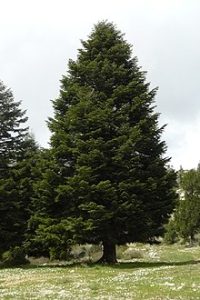
The Cilician fir is a tall and almost perfectly straight evergreen tree, in the same family with pines, cedars, and cypresses. It can reach a height of 25 meters (82 feet). Its flat seeds are contained in cones that fall from the tree when mature. Firs are the major source for turpentine, used by painters to dilute paint and clean brushes.

The Abies genus is represented throughout the world in temperate climates at high altitudes (for example, in Kenya, Japan, and North America). Since there are no firs or anything quite like them in tropical Africa, translators can use a transliteration, for example, firi or pir. In Ezekiel 27:5 we recommend following Zohary by rendering berosh as “fir.” The majority of English translations are divided among “fir,” “cypress,” and “pine.” In 1-2 Kings and 2 Chronicles we recommend rendering berosh as “fir” or “juniper.” Elsewhere berosh may be considered a generic word referring to cypress, fir, pine, or all of them together. In those places a general word for this type of cone-bearing tree should be used.

Cilician fir in North Lebanon, Wikimedia Commons

Source: Each According to its Kind: Plants and Trees in the Bible (UBS Helps for Translators)

See also cypress.

Grecian juniper

A tall evergreen, the Grecian Juniper Juniperus excelsa, also known as the Eastern Savin, grew in the mountains of Lebanon along with cedars, firs, and cypress (the Hebrew word berosh probably covered all three of these trees). The association of berosh with Mount Senir in Ezekiel 27:5 argues for the Grecian juniper there, since Mount Senir was known to have plenty of Grecian junipers. Lebanese people up to today refer to the juniper as brotha, a likely cognate with berosh. King Solomon undoubtedly hauled these trees to Jerusalem along with cedars and firs to use in constructing his palace and the Temple of Yahweh.

The Grecian juniper is a conical tree reaching a height of 20 meters (65 feet). Its “leaves” are round rather than flat, and the fruit is an inedible seed-bearing, fleshy cone.

There is no single Hebrew or Greek word that refers specifically to the Grecian juniper. In our discussion of cypress and fir, we have advocated translating berosh generically or as “fir” or “juniper” in 1-2 Kings and 2 Chronicles (where it is typically associated with Lebanon or cedar). If no generic word is available in the receptor language, a descriptive phrase such as “strong, beautiful tree/wood” can be used. In poetical passages, local poetic equivalents could be considered.

Grecian juniper, photo by Ray Pritz

Source: Each According to its Kind: Plants and Trees in the Bible (UBS Helps for Translators)

cinnamon

True cinnamon Cinnamomum verum (or Cinnamomum zeylanicum) is a tree found mostly in Sri Lanka, India, and Burma. The Hebrew word qinnamon may ultimately derive from an early form of the Malaysian/Indonesian expression kayu manis, meaning “sweet wood.” As in the case of cassia, there is debate about whether the cinnamon mentioned in the Old Testament could have been imported from the Far East or whether there was perhaps a spice from Arabia or Africa that was named qinnamon, because this name was known at the time of writing. Some scholars believe that there was trade between India and Egypt as early as the second millennium B.C. In fact, the renowned Egyptian queen Hatshepsut is thought to have brought myrrh or frankincense trees from “Punt,” which could have been Somalia or even India, in 1490 B.C. However, she apparently did not bring cinnamon trees, nor are cinnamon and cassia among the spices found in the tombs of Egypt. So the true identity of the biblical cinnamon is still in question.

The true cinnamon tree grows to 10 meters (33 feet) in height. The stem branches plentifully. The leathery leaves are 10-15 centimeters (4-6 inches) in length and have three light-colored, radiating veins. The spongy outer bark is scraped off, revealing a fragrant pale brown inner bark. This inner bark carries the cinnamon flavor. It is cut off and dried, and the bark curls to form little scrolls. The small flowers have an unpleasant smell.

According to Exodus 30:23, cinnamon was an ingredient of the holy oil used to anoint the Tabernacle, ark, and priests. The temptress of Proverbs 7:17 perfumes her bed with it, together with myrrh and aloes. Today the bark of cinnamon is ground into powder and used as a spice for food and as an ingredient in incense and perfume. Even the leaves and unripe berries (“buds”) are marketed as condiments.

Translators in Asia will be able to use their own word for cinnamon. They will even be able to distinguish between cassia and cinnamon. In other areas it is best to transliterate from Hebrew qinnamon or a major language. Since the bark was ground into powder, the words “bark” or “powder” may be useful as classifiers. In Exodus 30:23 and 24 translators will need two words for the closely related cassia and cinnamon.

Cinnamon tree with bark removed, Wikimedia Commons

Source: Each According to its Kind: Plants and Trees in the Bible (UBS Helps for Translators)

cassia

Zohary (Plants of the Bible. Cambridge University Press, 1982) is confident that the substance referred to by the Hebrew words qiddah and qetsi‘ah is oil or powder derived from the leaves, twigs, or bark of the cassia Cinnamomum cassia, a tree found in East Asia. The name “cassia” may possibly come from the Khasi people of north-eastern India and Bangladesh; earlier they lived in the area of Assam and Burma and were involved in the ancient cassia trade. So cassia oil may have been brought into Israel from East Asia. However, with respect to “cassia” and “cinnamon” in Exod 30:23 and 24, Hepper (Baker Encyclopedia of Bible Plants: Flowers and Trees, Fruits and Vegetables, Ecology. Baker Book House, 1992) argues that these spices were probably not Asian spices as has often been supposed. Quoting research by Lucas and Harris on ancient Egyptian materials, he says that there is no evidence of these Asian spices in tombs in Egypt. If they were being transported by the deprived Israelites, why were they not used by the more prosperous Egyptians? Further, how was Moses to have access to these substances in remote Sinai? Hepper favors southern Arabia and northeastern Africa as sources for fragrant barks and resins.

Asian cassia trees grow to 10 meters (33 feet) tall. They have distinctive opposite leaves with three lighter-colored veins or ribs radiating from the base. Their rather small flowers droop in bunches.

Cassia is closely related to the well-known spice, cinnamon. In fact, much of the “cinnamon” sold in North America is cassia. Europeans and South Americans tend to use the real cinnamon from Sri Lanka and elsewhere. Since cassia is native to East Asia, translators there will know it by a local name. Since the passages that refer to cassia are non-rhetorical, translators elsewhere may transliterate this term from a major language. Cassia is of the genus Cinnamomum, which is completely different from the genus Cassia of which there are many species in Africa. So transliterations based on “cassia” are potentially misleading in Africa. To avoid a wrong association with African cassia (which is not aromatic), African translators could do one of the following:

1. transliterate from the Hebrew qiddah;
2. transliterate from English (kasiya) and write a footnote saying this tree has no relationship to the cassia tree of Africa;
3. substitute a well-known sweet-smelling gum.

Cassia, Wikimedia Commons

Source: Each According to its Kind: Plants and Trees in the Bible (UBS Helps for Translators)