sycamore, sycomore

The Hebrew and Greek that is translated as “sycamore” in English is translated in Chichewa as mkuyu or “fig tree.” (Source: Wendland 1987, p. 72)


The use of “sycomore” might be preferable to “sycamore,” since the “o” spelling preserves the Latin (sycomorus) and Greek (sukomorea) better and is used in French.

The Sycomore Fig Ficus sycomorus, also called the Mulberry Fig (compare German Maulbeerfeigenbaum), is a type of fig that is found especially in lowland areas in the Mediterranean region. It was known in Egypt as early as 3000 B.C. but also in the Indus Valley in India.

The prophet Amos identified himself as “a dresser of sycamore trees” (Amos 7:14). It is possible that this refers to the practice of making a cut in the immature fruit, which has the effect of accelerating the growth of the fruit. Hepper (Baker Encyclopedia of Bible Plants: Flowers and Trees, Fruits and Vegetables, Ecology. Baker Book House, 1992) reports that this sudden growth is caused by ethylene gas released when the fruit is cut.

The sycomore fig is not a tall tree (up to 10 meters [33 feet]) but has large low, spreading branches — just right for a short man to climb up in order to see over a crowd of taller people (see the story of Zacchaeus in Luke 19:4). The fruit, while edible, is not as juicy or sweet as the more common variety. The most unusual thing about the fruit is that it grows in bunches right on the trunk and branches of the tree rather than among the leaves.

In 1 Kings 10:27 the sycomore is used as an image of something plentiful. The last half of this verse says “he [King Solomon] made cedar as plentiful as the sycamore of the Shephelah.” Translators should take care with the logic here. The verse does not say that Solomon would introduce cedars into the lowlands (the Shephelah), but rather that just as there are plenty of sycomores in the lowlands, there will be plenty of cedars in the land of Israel.

Translators need to deal with both sycomore and fig at the same time. If the translation leans toward foreignization, the translator may want to transliterate both fig and sycomore (sikomori, for example). It may be useful to use the full name sycomore fig in some cases. If a local type of fig is known, the translator could use the local name for the domestic fig (Hebrew te’enah, Greek sukē), and add the word “wild” or “lowland” when referring to the sycomore fig (Hebrew shiqmah, Greek sukomorea).

Where figs are totally unknown, transliterations can be made from an international language, for example, French (sycomore), Spanish (sicomoro), or Hebrew (shiqmah). In contrast to the regular fig, the sycomore grows in the lower elevations (Shephelah), a fact that could potentially come into use in a translation (for example, “lowland fig”).

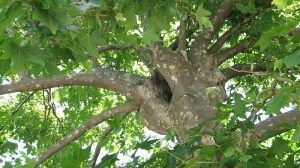
Sycomore fig, Wikimedia Commons

Source: Each According to its Kind: Plants and Trees in the Bible (UBS Helps for Translators)

oak

Three species of oak are found in Israel, the main ones being the Tabor oak and the Kermes (or common) oak. Both go by the name ’elon or ’allon in Hebrew. The similarity to the Hebrew word ’el (“god”) is significant, since these trees have long been associated with worship and with burial. Since the Tabor oak is the biggest, it is likely that ’elon and ’allon most often refer to that one. English versions have sometimes mistakenly translated the Hebrew word ’elah (“terebinth”) as “oak.”

According to Hepper (Baker Encyclopedia of Bible Plants, Baker Book House, 1992), forests of Kermes oak (Quercus calliprinos or Quercus coccifera) covered the hill country of Israel from Carmel to Samaria in biblical times. The Kermes oak forest is the most familiar and important type of vegetation in Israel.

The Tabor Oak Quercus macrolepsis (= Quercus aegilops = Quercus ithaburensis = Valonea oak in Israel) apparently replaced the original common oak during the Arab period (800–1400 A.D.), but has itself been nearly destroyed in more recent times by the efforts of charcoal makers, limestone burners, and the Turkish rail-way. Tabor oaks are deciduous and are found mostly in Carmel.

The large Tabor oak reaches a height of 25 meters (82 feet), branching at around 5.5 meters (18 feet). The Kermes oak is more like a large shrub, normally branching at ground level. The Tabor oak loses its leaves every winter; the Kermes oak is evergreen and prickly.

Oaks were used to mark grave sites (see Genesis 35:8), and it is possible that the references to “oak of Moreh” or “oaks of Mamre” may hint at burial sites of famous people. They were probably also important in divination, if the reference in Judges 9:37 (see Translation commentary on Judges 9:37) to a “Diviners’ Oak” can be taken as typical. References to people named Allon (1 Chronicles 4:37) or Elon (Genesis 46:14 et al.) may suggest that the oak was a symbol of strength or beauty, or both.

Oaks grow mainly in temperate areas (Europe, North America, North Asia, and Japan) and the Mediterranean area, including North Africa. Translators in tropical areas will not have a local variety as an option. In historical contexts, therefore, it will be necessary to transliterate from a major language. In poetic contexts such as the prophets, the oak typically represents a large and very strong tree, and a local species with those characteristics can be considered.

Tabor oak, photo by Ray Pritz
Kermes oak, Wikimedia Commons

Source: Each According to its Kind: Plants and Trees in the Bible (UBS Helps for Translators)

plane

Zohary (Plants of the Bible. Cambridge University Press, 1982) confidently equates the ‘armon of Ezekiel 31:8 with Oriental Plane Platanus orientalis, mostly on the basis of the fact that Arabs call it dilba, which is derived from the Aramaic. The name ‘armon may come from the Hebrew word ‘erom meaning “naked,” referring to the way the bark peels off, leaving the seemingly naked trunk.

Plane trees may have been abundant in the past, if the common name “Wadi Dilb” is related to the Arabic dilba. In the present day, plane trees are fairly common in the upper Jordan Valley and its tributaries. It is widespread throughout the eastern Mediterranean region and in the hills of Iraq and Iran.

The plane tree is large and wide-spreading, with big branches and lobed, hairy leaves shaped like a hand. In Israel it can reach a height of 20 meters (66 feet) and the trunk 50 centimeters (2 feet) in diameter. Its flowers are small and green. The small seeds are contained in round, bristly fruits, which, when open, release the seeds with plumes that carry them great distances on the wind.

In Genesis 30:37 Jacob presumably chose to use branches of the plane tree because its bark can easily be peeled off in strips, exposing the white or yellow inner layer. In ancient times the plane tree was praised as a shade tree by the Greeks, Romans, and Persians. Ezekiel 31:8 associates planes, cedars, and beroshim (“cypresses” or “Grecian junipers”) with the “garden of God,” suggesting special beauty. In Sirach 24:14 wisdom is compared to the plane as a beautiful, big tree.

True plane trees are limited to Europe and North America, apart from the species that grows in the eastern Mediterranean region and Iran. (A wild maple tree in Britain is misleadingly called a “plane.”) Translators in Asia, Latin America, and Africa will have no local species available for the story of Jacob’s goat-breeding experiment in Genesis 30:37 and will have to consider a transliteration in keeping with the other trees mentioned there (poplar and almond). However, the passage in Ezekiel 31:8, where the plane is used in a metaphorical context, leaves room for local equivalents. Egypt, in this passage, is compared to a mighty cedar, against which other trees, such as the plane and the fir, do not match up. Rendering “plane” here will depend on what the translator does with the other trees.

Platanus orientalis, Wikimedia Commons

Source: Each According to its Kind: Plants and Trees in the Bible (UBS Helps for Translators)
nigella

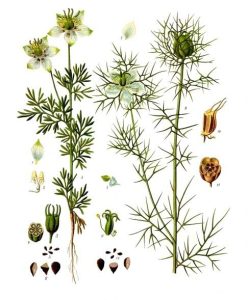
The English versions of Isaiah 28:25 and 27 reveal the confusion of the translators who have encountered the Hebrew word qetsach. It has been rendered “fitches,” “dill,” “fennel,” and “caraway.” Against all of these renderings, Zohary (Plants of the Bible. Cambridge University Press, 1982) confidently asserts that the word qetsach refers to the nigella plant Nigella sativa, also called by the names “nutmeg flower,” “black cumin,” “black seed,” “charnushka,” and “kalonji.” The Aramaic and Arabic equivalent is qatscha. Jews, Arabs, and Europeans use nigella seeds to decorate cakes and bread up to the present. It is also used as a spice in cooking.

Nigella is planted and harvested annually. It grows to around 30 centimeters (1 foot) in height and has a lacy leaf like dill or carrot and a greenish-blue flower with five petals. The base of the flower becomes a seedpod that contains many round, black, sharp-smelling seeds.

Nigella is used by Isaiah as one of several species in a parable he tells to the leaders of Israel. A farmer, he says, does not destroy the results of one season’s work while preparing for that of the next season. This is spoken to know-it-all scoffers who claim that God’s ways are completely fixed. Against that Isaiah says that God’s ways are according to the conditions of his creatures, as a farmer plants and harvests according to the needs of the various crops.

The abundance of names for nigella is an indication of its popularity around the world. Fortunately the Latin name nigella is now replacing the confusing name “black cumin.” This is good because cumin is a totally different plant. Likewise, “nutmeg flower” and “black caraway” are losing favor. So translators can avoid the confusion brought on by the English by transliterating from a major language.

Nigella, Wikimedia Commons

Source: Each According to its Kind: Plants and Trees in the Bible (UBS Helps for Translators)
willow

There are two kinds of willow in Palestine, the White Willow Salix alba being the northern one, and the Common Willow Salix acmophylla being the southern, more heat-tolerant one. In the Jordan Valley the willow gives way to the salt-tolerant Euphrates poplar as the river gets close to the Dead Sea. Some confusion of names arises from the fact that the Euphrates poplar has two kinds of leaves. The younger shoots produce a narrow leaf like the willow, and the mature shoots produce a wider, ovate leaf.

The willow is found along streams, where it can grow to a height of 6 meters (20 feet). It has long, narrow leaves which drop during the winter and the tiny green flowers appear around October.

If “willow” is indeed the correct translation of ‘aravah in Leviticus (23:40), then it is one of the four species recommended for use in building shelters for the Festival of Shelters. In Job it is the habitat of the mysterious Behemoth that no man can tame. In Isaiah and Ezekiel it is a metaphor for something that grows luxuriantly.

Over three hundred Salix species are found around the world in temperate regions. They are sometimes known as ossiers or sallows. At least one Salix species (Safsaf Willow Salix subserrata) is found in sub-Saharan Africa in addition to being found in Egypt, Libya, and Israel. Flora of West Tropical Africa lists three other species. People who make round, thatched houses use thin, flexible sticks from a shrub to form the concentric rings that hold the radial sticks (either bamboo or sorghum stalks) in place. Some of these may be willows, and if so, the local word would be appropriate in the biblical context where shelters are being constructed.

In Isaiah 44:4 and Ezekiel 17:5 the willow is symbolic of quick growth and may require an appropriate local equivalent of a thriving plant.

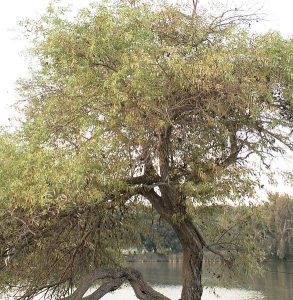
Salix acmophilla, Wikimedia Commons

Source: Each According to its Kind: Plants and Trees in the Bible (UBS Helps for Translators)
apple

The Wild Apple (or Crab Apple) Malus sylvestris is the ancestor of the sweet fruit we know today Malus domestica. The domestication may have occurred in what is now Iran, Armenia, Turkey, or Syria. Apples have grown in Europe, in western Asia, and probably in Turkey and Lebanon, for several thousand years. The question for Bible scholars is whether the puny, rather tart fruit of the wild apple merits the glowing description we find in Proverbs 25:11: “. . . like apples of silver in a set-ting of gold,” and in Song of Songs 2:5: “Sustain me with raisins, refresh me with apples; for I am sick with love.” With that doubt in mind, some scholars have suggested that the tapuach, whose pleasant smell is noted in Song of Songs 7:8, is the apricot. Zohary (Plants of the Bible. Cambridge University Press, 1982) favors the apple on linguistic grounds, citing the Arabic cognate tuffach, which refers to the apple, and Egyptian records from 1298–1235 B.C. that refer to taph (probably the same as tapuach) growing in the Nile Valley. It is possible that improved varieties had already been developed in biblical times. Zohary points out that the apricot appeared in the region much later than the apple.

The apple tree reaches to 5-10 meters (17-33 feet), has a rounded crown, and bears a round fruit about the size of an orange. In the spring the tree is completely covered with pink flowers, which gradually give way to the green of the leaves as they develop. The fruit can be greenish, yellow, or red.

Apples grow well only in temperate climates where the tree is frozen part of the year, so there are no close native relatives in tropical Africa or Asia. However, fruits grown in Europe and South Africa are being shipped to many African countries, and so have become well-known, at least in the cities, usually by a name from a major international language. We recommend transliteration from a well-known language (for example, tufa [Arabic], pom/pomier [French], manzano [Spanish], masa/masiyera [Portuguese], and apel [English]), although translators seeking literary equivalence may wish to find a cultural substitute in the Proverbs and Song of Songs passages.

Apple trees, photo by Ray Pritz

Source: Each According to its Kind: Plants and Trees in the Bible (UBS Helps for Translators)

See also apples on the tree of the knowledge of good and evil.

date palm

More than forty types of date palm (Phoenix dactylifera) are found in dry tropical countries all the way from the Canary Islands, across Africa to India. They probably originated in the Middle East, where they are still found in abundance. In Leviticus 23:40 we read that the branches of date palms were to be used for the Festival of Shelters, and in John 12:13 people welcomed Jesus with date palm leaves. In the latter case there is a legitimate question of where they got the leaves, since Jerusalem is rather too high and cold for date palms. But the same could be asked about the prophetess Deborah’s palm (Judges 4:5), which was located between Ramah and Bethel, scarcely lower than Jerusalem. Jericho was known as the “city of palm trees” (temarim in Hebrew). Date fruits were eaten fresh or dried and pressed into “cakes,” and they were sometimes made into a drink. It is possible that in Deuteronomy 8:8 the Hebrew word devash that we normally take as “honey” refers to a syrup made from dates. The leaves were and are used for mats, baskets, fences, and roofs. Date palms are now cultivated intensively in the Jordan and Aravah valleys, around the Dead Sea, and on the coastal plain of Israel. The word “date” entered English from Latin dactylus via Old French datil. Latin got it from Greek daktylos, meaning “finger.”

The date palm typically grows to a height of 10-20 meters (33-66 feet) and has a cluster of immense leaves at the top. Each year, old leaves wither and droop, and people who own palms cut the old branches off. The tightly packed bunch of immature leaves is called lulav in Hebrew. Date palms start bearing fruit at around five to eight years of age. The sweet fruits, a little smaller than a human thumb, grow in large bunches. Inside the soft fruit is a very hard seed about 2.5 centimeters (1 inch) long. Date palm trees are either male or female, and there are places where the trees of one sex grow but no fruit is seen, because they lack pollination. Farmers prefer to propagate them by cultivating the suckers that grow at the base of the tree, rather than from seeds, which would produce too many male trees. The fruit appears on the female tree in the summer (June-August).

In Song of Songs 7:7 we find the palm used as a symbol of elegance and grace. In Psalm 92:1214 we are told that the righteous will flourish like the palm tree, but Job 15:32 says the wicked will wither like a dry palm branch. In 1 Maccabees 13:37 the palm branch is a symbol of peace, but in 1 Maccabees 13:51 it is a symbol of victory (so also John 12.13; Rev 7.9; 2 Macc 10.7).

Translators living along the West African coast often substitute the oil palm or the coconut palm for the date palm, which is found normally in desert areas. Others are familiar with the fan palm (Borassus, “ruhn palm”) but they should note that the shape of the leaf of the fan palm is quite different from that of the date palm. I am not aware of a non-European language that has a generic word for palm. Since the function of palm branches in the Festival of Shelters is to build rough shelters, the type of palm tree does not make a lot of difference. The same is true for references where the image of the palm is used as a decoration, as in the description of the Temple (see 1 Kings 6:29 et al.). In cases where the fruit is mentioned, a transliteration is recommended, either from the Hebrew word tamar or from a major language.

In locations where oil and coconut palm trees are found, but no date palms, the oil palm is to be preferred. In places where no palms are found, it is still possible that the date fruit is found in markets, particularly in Muslim-dominated areas, where it may be a popular item for breaking the fast during Ramadan. In northern Nigeria, a dwarf species of date palm (Phoenix reclinata) grows in ravines and bears small edible fruits much like the big palm. At least one translation there (Berom) makes use of the local name.

It would seem then that if the date palm is not known at all, the options here are:

1. use the word for oil or coconut palm (and consider writing a footnote that indicates that the Hebrew words tamar and tomer and the Greek word phoinix refer to a similar tree that has a quite different fruit);
2. transliterate from Hebrew (tomera, tamara) and Greek (fonis, fowinik);
3. transliterate from a major language, for example, nakhal/temer (Arabic), dattier (French), datil/palmera (Spanish), mtende (Swahili), khajoor (खजूर) (Hindi), and hǎizǎo (海枣 / 海棗) (Chinese);
4. use a generic phrase appropriate to the context, for example, “beautiful tree.”

Date palm, photo by Ray Pritz

Source: Each According to its Kind: Plants and Trees in the Bible (UBS Helps for Translators)

In Chichewa, gwalanga, the word for the local fan palm is used for translation. In rural areas people use the leaves for vegetables. (Source: Mawu a Mulungu mu Chichewa Chalero Back Translation)

terebinth

The Hebrew words ’elah and ’alah refer to any of three species of terebinth mentioned in the Bible: 1) the Atlantic terebinth Pistacia atlantica, 2) the Palestinian terebinth Pistacia palaestina, and 3) the Lentisk Terebinth Pistacia lentiscus, also called the mastic tree.

According to Zohary (Plants of the Bible, Cambridge University Press, 1982), the Atlantic terebinth, also called the teil tree, is found in the Negev, Lower Galilee, and the Dan Valley. Hepper (Baker Encyclopedia of Bible Plants, Baker Book House, 1992) says it was once abundant in Gilead, the trunk and bark being a possible source for aromatic resin (mastic) exported to Egypt. It is a dry-land tree that grows in the border areas between ever-green woodlands and the dwarf-shrub steppes (note “valley of Elah” in 1 Samuel 17:2 et al.). The nuts of the Atlantic terebinth are used for dyeing and tanning animal skins, but they can be eaten if roasted. They are often sold in Arab markets, are bigger than the nuts of the Palestinian terebinth, and are quite different from the true pistachio nuts.

The Palestinian terebinth is found mostly on wooded hills, often together with the common oak. Its little round nuts can be eaten whole, fresh, or roasted, and it is probably these nuts (boten) that were carried to Egypt by the sons of Jacob (Genesis 43:11).

The lentisk terebinth is a shrub or bush that grew in the hills of Gilead, and may be the source of the “balm/resin” (tsori in Hebrew) carried by the Ishmaelites in Genesis 37:25, and by the sons of Jacob to Egypt along with pistachio nuts in Genesis 43:11. The fact that Genesis 37:25 et al. all mention Gilead in connection with the resin tsori, suggests that its source was a plant unique to Palestine. That is why it could be used to trade for goods from Egypt. The references in Jeremiah (8:22 and 46:11) presumably refer to the salve made from the terebinth resin.

Terebinths look like oaks but have pinnate leaves. The Atlantic terebinth may reach a height of 10 meters (33 feet). The Palestinian terebinth species is shorter, reaching to 5 meters (17 feet). The lentisk terebinth, or mastic (gum) tree, is a small shrub or tree 1-3 meters (3-10 feet) in height that produces a sweet-smelling resin when the stem or branches are cut. The resin dries into hard lumps, which are then ground and dissolved in olive oil for medicinal use, per-fume, incense, varnish, and glue.

Both of the larger terebinths were revered by ancient Israelites and other peoples. They built shrines and altars in the terebinth groves, and sometimes buried people there. The resin of the lentisk terebinth was highly prized for its medicinal value, which is why the Ishmaelites and the sons of Jacob were carrying them as trade goods to Egypt. Sirach 24:16 uses the wide-spreading branches terebinth as a metaphor for wisdom.

Pistacia palaestina, Wikimedia Commons
Pistacia atlantica, Wikimedia Commons
Mastic resin hanging from mastic (Pistacia lentiscus) tree, Wikimedia Commons

Source: Each According to its Kind: Plants and Trees in the Bible (UBS Helps for Translators)