plant / gourd / ivy

The Hebrew term for the plant that is translated in a variety of ways in English, including “vine,” “gourd,” or simply “plant” or “bush” has a long history of controversial translations.

Law (2013, p. 170) quotes from one of the letters of Augustine (354-430 AD) who was a strong defender of the Ancient Greek Septuagint translation: “In Oea [ancient city in present-day Tripoli, Libya], a bishop read from Jerome’s translation of Jonah, and because of the strange new rendering he almost lost his congregation. The [Greek] Bible of the church had ‘gourd’ (kolokýnthi / κολοκύνθῃ) in Jonah 4:6, but Jerome had changed it to the Latin word for ‘ivy’ [hedera]. The congregation in attendance fumed upon hearing the new translation and accused it of being ‘Judaized.’ Jews were called in to explain the rendering, and they claimed that Jerome was wrong and the Septuagint was right all along. Whether this actually happened is irrelevant. Augustine has either reported a real event or has created a literary fiction, but either way he provides a window into the struggle of parting with the church’s Bible in favor of Jerome’s new translation.”

This divergence in opinion can be seen up to the present day. Older Catholic versions that are based one the Latin Vulgate (for instance the English Douay-Rheims or the translation by Knox) will use a word for a climbing plant such as “ivy” or “vine,” other translations use a large variety of translations, including the “safe” choice “plant.” In the UBS handbook Plants and Trees in the Bible, Koops (2012, p. 127) says: “The identity of Jonah’s qiqayon plant has been debated since the days of St. Jerome and St. Augustine. [Several scholars] advocate the castor oil plant (Ricinus communis) as the qiqayon. But the King James Version’s ‘gourd’ has a long history, including its use in the Septuagint. The Vulgate translated qiqayon as hedera (‘ivy’) but that rendering has not had further botanical support. In 1955 an in-depth study of the literature going back as far as St. Jerome was made and its author votes hesitantly for the gourd (colocynth). Some scholars even suggest it could be an Assyrian word inserted in the story just to make it sound foreign, or even a made-up word.”

In Newari it is translated as “pumpkin plant” (source: Newari Back Translation).

See also cucumber, melon, and bottle gourd / calabash.
pods

The Greek in Luke 15:16 that is translated as “pods” in English is translated in Elhomwe as makattha, a term given to all kind of peelings, which are given to pigs. (Source: project-specific translation notes in Paratext)

In the German New Testament translation by Berger / Nord (publ. 1999) with Johannisbrotbaum-Schoten or “carob pods,” the kind of pods that likely would have been fed to pigs in Palestine.

The Carob Ceratonia siliqua is a very common tree found throughout the Mediterranean area and also in Arabia, Somalia, and Oman. It is native to Israel, where it was called charuv, according to Jewish religious writings of the first few centuries after Christ. Arabs call it kharrub.

In Bible times, as now, carob trees were found in the coastal plain and in the foothills (Shephelah) and on the eastern slopes of Galilee and Samaria. The carob seed pods are filled with a sweet moist pulp that was popular with poor people. The pods were also used to feed animals. That is probably the basis for Jesus’ statement that the prodigal boy in the parable looked hungrily at the carob keration (“pods”) that he had to feed to the pigs (Luke 15:16).

The carob tree is an evergreen with dark green leaves and many low leafy branches that hide a short trunk. The crown of the tree is round and may reach as high as 12 meters (40 feet). As is the case of the acacia, the date palm and the fig, the carob tree is a lonely representative of a large tropical family (in this case the pea sub-family Caesalpinioideae) that found its way into parts of Israel many millennia ago. The trees in this family are legumes, that is, they put nitrogen into the soil by way of little nodules on the roots. As the tree ages, the trunk be-comes twisted. In contrast to many other trees of the Bible lands, this one bears flowers in autumn, and the seed pods form the following summer. The mature pod is dark brown and about 15-25 centimeters (6-10 inches) in length and 2.5-3.5 centimeters (1-1.5 inches) broad.

If indeed the “pods” of Luke 15.16 were carob pods, it would certainly indicate that they were not considered high-class food. The tree is also called “St. John’s bread” on the belief that John the Baptist must have eaten these fruits when he lived in the desert of Judea. It is quite likely that John did eat carob pods. However, the suggestion that the “locusts” in Mark 1:6 were locust bean pods is not correct, since John probably did eat locusts, as some people in the world still do today. Ironically, carob pod pulp, which was once the “food of the poor” has become, in the last few years, an expensive “health food” in England and America! The word “carat” used in weighing diamonds comes from the Greek name of this tree, since the seeds were used as a standard for measurement. They typically weigh about two hundred milligrams.

Since the Greek word for carob does not actually occur in Luke 15:16, and keration could possibly refer to some other sort of pods, we cannot actually name a species here. If translators have a word for the edible seed pods of trees, they should use it. Otherwise they will have to use something like “fruit of wild trees.” In study notes translators may wish to refer to major language terms, for example, French caroube, Spanish algarrobo, Portuguese alfarroba, and Arabic kharrub.

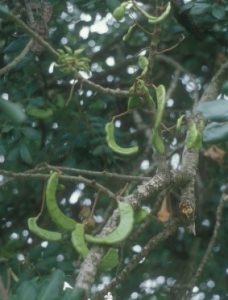
Carob pods, photo by Gloria Suess

Source: Each According to its Kind: Plants and Trees in the Bible (UBS Helps for Translators)

all kinds of scented wood

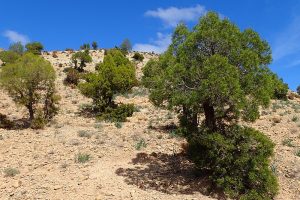
The Thyine tree Tetraclinis articulata is also called “thuja” or “thuya,” and, confusingly, “citron” or “citrus” in different parts of the world. Similar to the well-known arborvitae, the thyine is found mainly in the Mediterranean area and across North Africa (Morocco, Algeria). It is a coniferous tree related to cypresses, pines, and cedars. Its identification in the book of Revelation is based on the Greek spelling, thuinos. In some places it is called the sandarac tree on the basis of the clear varnish (sandarac) that is made from the resin. The Romans, who used the wood for cabinet work, called it “citrus” for some strange reason, though apart from the yellow fruit, it bears no resemblance to true citrus trees.

The thyine can reach a height of 9 meters (30 feet). It has scaly leaves like cedars and cypresses, reddish brown bark, and sweet-smelling wood that is resistant to insects.

Tetraclinis articulata, Wikimedia Commons

Source: Each According to its Kind: Plants and Trees in the Bible (UBS Helps for Translators)

mulberry

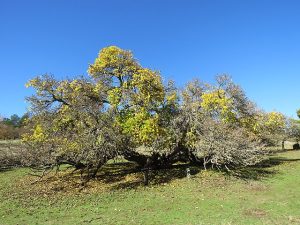
The references to mulberry in the Scriptures are all controversial. However, Zohary (Plants of the Bible. Cambridge University Press, 1982) on the basis of cognate words in Sumerian (messikanu, sukannu) confidently associates the Hebrew word mesukan in Isaiah 40:20 with the mulberry tree, as did Thompson before him. Further, they take the Greek word sucaminos in Luke 17:6 as also cognate with Sumerian sukannu. Like the apple, the pomegranate, the fig and the pistachio, the Black Mulberry Morus nigra may have been introduced into the Holy Land from one of the neighboring countries like Persia (now Iran).

The black mulberry is a large, broad tree (6 meters [20 feet] high) that produces flowers and leaves in spring and loses its leaves every year in winter. The crown is broad and low. The trunk gets twisted as it grows old and may rot away, only to be replaced by another one from the same root. People pile stones up in order to support the low branches of old trees. The leaves are stiff, rough, and hairy. The flowers are pollinated by the wind, and the fruit is a rather tart, black berry about the size of a large cashew nut. In Europe and North America, people use mulberries mostly to make pies and wine. A different species, the white mulberry, has a whitish fruit.

The black mulberry tree is similar in size and shape to the sycomore fig. In fact, the translators of the Greek Septuagint introduced considerable confusion by translating the Hebrew word shiqmah as sucaminos (1 Kings 10:27 et al.)

There are at least eighteen subspecies of mulberry in the world, distributed from China to North America. In the Middle East area two have been cultivated, the black mulberry and the white mulberry. The black mulberry grows well in what is now Iran, and it may have been introduced into Canaan from there. In areas where the mulberry tree is found, the local name should be used in Luke 17:6. Where it is not found (for example, most of Africa), transliteration from a major language is advised, for example, muluberi or sikamayin. (French mûrier, Spanish mora, Portuguese amoreira, Arabic tut).

Black mulberry, Wikimedia Commons

Source: Each According to its Kind: Plants and Trees in the Bible (UBS Helps for Translators)

See also mulberry tree.

wormwood

The Hebrew word la‘anah refers literally to a plant, but it is only used figuratively in the Old Testament, as something representing intense bitterness. Despite very little evidence, commentators and botanists have agreed that this word may refer to a substance derived from the white wormwood bush, which is found abundantly in the the deserts of the Holy Land.

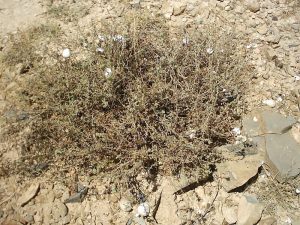
White Wormwood Artemisia herba-alba is a bush less than half a meter (18 inches) high, with finely divided fuzzy leaves. These leaves drop at the end of the cool rainy season of Israel and are replaced with something like scales in the hot season. The flowers appear in clusters of two to four around September/October and mature into small, hairy fruits. When the plant matures, the leaves and flowers are dried to make a very bitter tea, or ground into powder, paste, or oil that is used in medicine.

Most of the references to wormwood in the Old Testament are paired with the Hebrew word for “poison/gall” (ro’sh) and are used metaphorically to represent painful experience and sorrow. In Revelation 8:11 a star named Wormwood (apsinthos in Greek) makes a third of the water on earth bitter and poisonous. The leaves of wormwood have a very bitter taste. In small quantities it was used as an anesthetic, and Europeans use it in concocting alcoholic drinks (absinthe, vermouth). It is also used to repel moths and fleas, and as an intestinal worm expeller.

The white wormwood of the Holy Land is found throughout the Middle East, North Africa (Egypt, Morocco) and Southwest Europe, but there are at least 300 species of Artemisia throughout the world, usually in dry areas. A Chinese type (huang huahaosu) is used as medicine against malaria. Artemisia cina and Artemisia maritima are found in Eurasia, where they produce santonica, an anti-worm medicine. Artemisia tilesii is used by the Inuits like codeine. The sagebrush plants of the American West also belong to this genus and were used by Native Americans for various conditions.

Most languages have words for plants that have bitter leaves and/or roots. Since all of the references to wormwood in the Old Testament are metaphorical, these plants can be used to convey the essential component of the passages. As noted above, most of the references to la‘anah are coupled with ro’sh, so the two must be dealt with together in those passages. If particular plants are not available, phrases such as “bitter fruit,” “bitter spice,” or “bitter thing” can be used.

White wormwood, Wikimedia Commons

Source: Each According to its Kind: Plants and Trees in the Bible (UBS Helps for Translators)

See also turn to wormwood.

millet

To illustrate the siege of Jerusalem, Ezekiel is instructed to make a loaf of bread out of wheat, barley, beans, lentils, millet (dochan in Hebrew), and spelt in Ezekiel 4:9. In Arabic millet is called dukhn or dochna, suggesting that the Hebrew word dochan could indeed be millet. Some scholars believe that Millet Panicum miliaceum or Panicum callosum was first domesticated in Ethiopia, but others say in India or the East Indies. From one of those places it was carried into Mesopotamia around 3000 B.C. If that is so, it may have been known to the people of Israel during their stay in Egypt as well as after the conquest of Canaan. In Ezekiel 27:17 a reference is made to pannag, which Moldenke (Plants of the Bible. Chronica Botanica. Ronald Press, 1952) takes as possibly referring to millet, on the basis of the fact that in Syriac pannag refers to millet. However, Hepper (Baker Encyclopedia of Bible Plants: Flowers and Trees, Fruits and Vegetables, Ecology. Baker Book House, 1992) says that neither millet nor sorghum reached the Mediterranean area before the Christian era, making it unlikely that dochan or pannag refer to either millet or sorghum.

Today millet is used throughout the world for porridge, alcoholic beverages, and as animal food. It is not good for bread, which may be significant in the incident mentioned in Ezekiel 4:9.

If indeed millet was grown at all in Old Testament times, it would have been a short variety less than 1 meter (3 feet) in height. It has a single head on a stalk, with many tiny seeds, so the Latin name is miliaceum (“million seeds”).

There are six hundred kinds of Panicum species growing in the warm and tropical zones of the world, many of them domesticated, and two in Europe. Translators who do not have a local word for millet will need to use a transliteration from a major language, for example, French millet, Portuguese miliyo, and Spanish mijo. Since the references to millet are part of lists in non-rhetorical contexts, there is no need to look for a cultural equivalent.

Panicum miliaceum, Wikimedia Commons

Source: Each According to its Kind: Plants and Trees in the Bible (UBS Helps for Translators)

beans

Commentators and translators are unanimous in identifying the Hebrew word pol as the Broad Bean Vicia faba or Faba vulgaris. Beans were cultivated in the Middle East for millennia, and they probably originated there. No wild species are now known, and it is quite possible that the ancestors of the bean are extinct. Samples of beans have been found in excavations at Jericho dating to 7,000 8,000 years ago.

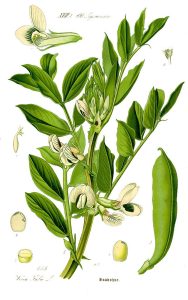
The broad bean is an erect plant, not a vine, reaching to 1 meter (3 feet) in height. The stem branches only in the upper part. It has no tendrils like many types of bean have today. The flowers are white, and when they ripen, they form pods containing 3-6 large flat beans of a cream or tan color.

Special significance  In 2 Samuel 17:28 people bring food, including beans, to King David as he flees from his son Absalom. In Ezekiel 4:9 Ezekiel is instructed to publicly make “bread” out of wheat, barley, beans, and lentils — whatever he could find — the point probably being that good quality bread will soon be scarce in Jerusalem.

There are at least two hundred species of the genus Vicia to which the broad bean belongs. Vicia itself is part of the vast family of legumes. It is possible that the Hebrew word pol actually refers to more than one type of bean, including what we now know as peas. Since beans and peas are known around the world, translators will probably be able to find a local equivalent. In both contexts (2 Samuel and Ezekiel) the word is used in a list of items, and if a local species of bean is not available to the translator, a transliteration should be used.

Vicia faba, Wikimedia Commons

Source: Each According to its Kind: Plants and Trees in the Bible (UBS Helps for Translators)

lentils

Scholars are agreed that the Hebrew word ‘adashah refers to the lentil Lens culinaris (formerly known as Lens esculenta). The Arabic word ‘adas, as well as several references in post-biblical Hebrew, confirm this identification, as does the Greek Septuagint. Seeds found in excavations dating to the sixth or seventh millennium B.C. show that the lentil is one of the first species to be cultivated by humans. In those excavations lentils are often found together with seeds of wheat and barley.

The lentil is a low-branched plant with a weak stem. It has tendrils, like pumpkins and squashes, and pinkish flowers that develop into a pod like a bean. The pod is very short with only one seed inside, about the size of a small pea. In one type of lentil the pea is reddish brown, hence the reference to “red” stew in Genesis 25:30. The pods are often in pairs or sets of three. In the Holy Land lentils grow in the cold season (November-March).

In Ezekiel 4:9 the strange bread, made from six kinds of grains and legumes including lentils, was probably intended to show that food would become scarce and that the people would have to eat whatever they could find. The lentil is typically used in soups and stews, as it was when Jacob used it to trick his brother Esau into giving up his rights as the firstborn son. Lentils were among the foodstuffs brought to David by local people when he was pursued by Absalom.

 Lentils are now widespread in Asia, India, and North Africa. In places where they are not known, we suggest using the word for a local type of bean rather than a transliteration. However, in Ezekiel 4:9 “beans” are also mentioned, so a possible rendering for “beans and lentils” is “different kinds of beans.” In Genesis 25:34 a generic expression for “pottage of lentils” would be appropriate, such as “bean soup,” “bean stew,” or “vegetable soup.” If a transliteration from a major language is desired, consider Arabic adas; French cristallin, lentille; Spanish lenteja; Portuguese lentilha; and Swahili adesi.

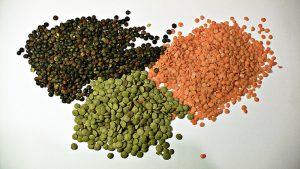
3 types of lentil, Wikimedia Commons

Source: Each According to its Kind: Plants and Trees in the Bible (UBS Helps for Translators)