The Hebrew word la‘anah refers literally to a plant, but it is only used figuratively in the Old Testament, as something representing intense bitterness. Despite very little evidence, commentators and botanists have agreed that this word may refer to a substance derived from the white wormwood bush, which is found abundantly in the the deserts of the Holy Land.
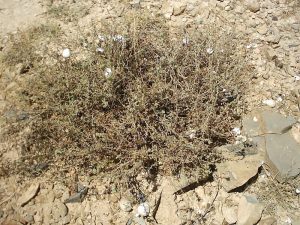
White Wormwood Artemisia herba-alba is a bush less than half a meter (18 inches) high, with finely divided fuzzy leaves. These leaves drop at the end of the cool rainy season of Israel and are replaced with something like scales in the hot season. The flowers appear in clusters of two to four around September/October and mature into small, hairy fruits. When the plant matures, the leaves and flowers are dried to make a very bitter tea, or ground into powder, paste, or oil that is used in medicine.
Most of the references to wormwood in the Old Testament are paired with the Hebrew word for “poison/gall” (ro’sh) and are used metaphorically to represent painful experience and sorrow. In Revelation 8:11 a star named Wormwood (apsinthos in Greek) makes a third of the water on earth bitter and poisonous. The leaves of wormwood have a very bitter taste. In small quantities it was used as an anesthetic, and Europeans use it in concocting alcoholic drinks (absinthe, vermouth). It is also used to repel moths and fleas, and as an intestinal worm expeller.
The white wormwood of the Holy Land is found throughout the Middle East, North Africa (Egypt, Morocco) and Southwest Europe, but there are at least 300 species of Artemisia throughout the world, usually in dry areas. A Chinese type (huang huahaosu) is used as medicine against malaria. Artemisia cina and Artemisia maritima are found in Eurasia, where they produce santonica, an anti-worm medicine. Artemisia tilesii is used by the Inuits like codeine. The sagebrush plants of the American West also belong to this genus and were used by Native Americans for various conditions.
Most languages have words for plants that have bitter leaves and/or roots. Since all of the references to wormwood in the Old Testament are metaphorical, these plants can be used to convey the essential component of the passages. As noted above, most of the references to la‘anah are coupled with ro’sh, so the two must be dealt with together in those passages. If particular plants are not available, phrases such as “bitter fruit,” “bitter spice,” or “bitter thing” can be used.
Following are a number of back-translations of Revelation 8:11:
Uma: “The name of that star, Bitter. The water of one third of all the rivers became bitter, and many people died because they drank that bitter water.” (Source: Uma Back Translation)
Yakan: “That star was called ‘Bitter’ because one part of the rivers/waters became bitter and many people died when they drank that water because it had become very bitter.” (Source: Yakan Back Translation)
Western Bukidnon Manobo: “The name of the star was Bitter. And a third of the waters on the earth became bitter. Many people died because of that water because it was very bitter.” (Source: Western Bukidnon Manobo Back Translation)
Kankanaey: “That star, it was named Bitter. Its result was that a third of the water became-bitter, and many people died on account of their having drunk it.” (Source: Kankanaey Back Translation)
Tagbanwa: “The name of that star was Bitter, and that third part of the water became truly bitter. Many were the people who died after drinking from it.” (Source: Tagbanwa Back Translation)
Tenango Otomi: “This large star is named ‘the poison which is bitter.’ There in the waters where it arrived the water became bitter. Very many people died upon drinking the bitter water.” (Source: Tenango Otomi Back Translation)
Wormwood: the name of the star derives from its effect on the water; it turned the water sour and bitter, so that it killed many of those who drank it. Wormwood itself is a bitter drug, made from an aromatic plant (Artemisia absinthium). The drug is not poisonous, but passages like Jer 9.15; 23.15 show that it was considered poisonous. Where a proper noun is lacking for this plant, the generic word “Bitterness” or “Bitter Drug” may be used as the name of the star (see “bitter” at the end of the verse). “Harsh-Tasting Substance” is another possible translation.
The water in one third of all rivers and fountains became wormwood (or, as Good News Translation translates, “turned bitter”). In many languages it will be helpful to say “a third of the fresh water.” It is somewhat strange that not all the people who drank of the water died, only many of them.
Quoted with permission from Bratcher, Robert G. and Hatton, Howard A. A Handbook on The Revelation to John. (UBS Handbook Series). New York: UBS, 1993. For this and other handbooks for translators see here .
Wormwood:Wormwood is a plant with a very bitter taste. The plant is also named “absinthe” or “artemisia.” The name Wormwood does not refer to wood that has been eaten by worms.
The name focuses on the very bitter taste of this plant. The star was called Wormwood because it turned the waters very bitter. You may want to:
• Use the name of a very bitter plant or food in your area.
• Name the star for its bitter taste. For example:
“Bitterness” (Good News Translation)
• Use the major language word. If people are not familiar with this word, explain it in a footnote. An example footnote is:
The name “Wormwood” refers to a plant that is very bitter.
8:11b
A third of the waters: This phrase refers to the same third as the “third of the rivers and…springs” in 8:10c. For example:
⌊That⌋ third of the rivers -or-
The rivers and springs ⌊that the star fell on⌋
bitter: The taste of bitterness is unpleasant. Unsweetened chocolate, raw coffee beans, and some unripe fruit are bitter. Some medicines, such as quinine, are also very bitter.
8:11c
many people died from the bitter waters: The people died because they drank the bitter water. It was harmful or poisonous.
In some languages it is more natural to explain in the translation that the people drank the bitter water. For example:
many people died from drinking the water that was bitter. (New Century Version) -or-
many people died from drinking the water, because it had turned bitter. (Good News Translation) -or-
many people drank this bitter water, and they died.
Living Water is produced for the Bible translation movement in association with Lutheran Bible Translators. Lyrics derived from the ESV® Bible (The Holy Bible, English Standard Version®).



Leave a Reply
You must be logged in to post a comment.