barley

Barley Hordeum distichum or Hordeum vulgare is a type of grass like wheat and rice. It has been cultivated in the Middle East for thousands of years and is now one of the most prominent seed crops grown in the world. Twenty species are known, of which eight are European. Barley needs less rain than wheat does, so in the Holy Land it was typically found in the drier areas above the coastal plain and near the desert. From 2 Kings 7:1 and Revelation 6:6 we know that barley was considered inferior to wheat and was often used to feed animals, as it is today. When the wheat supply ran out, people had to make their bread with barley. Barley was gathered before wheat, the harvest coming around March or April in the lower regions and in May in the mountains (see Exodus 9:31 et al.). In Egypt and in ancient Greece barley was used to make beer.

Barley plants look like wheat or rice. They are less than 1 meter (3 feet) tall, and have a single head on each stalk, with six rows of kernels, although the biblical kind may have had only two rows. The head bends at a down-ward angle when it is ripe.

In the story of Gideon and the Midianites in Judges 7:13, “a cake of barley” representing the (despised) Israelite army tumbles into the Midianite camp and knocks down the tent (representing the nomadic Midianites).

Barley is a plant of temperate zones, like Europe and the Near East; it does not grow well in the tropics. However, barley has been recently introduced along with wheat into many parts of the world for brewing beer and other malted drinks. It is also known to have grown in Korea as early as 1500 B.C. along with wheat and millet. It is becoming known in Malay as barli. Except for the reference in Judges, all references to barley in the Bible are non-rhetorical, so unrelated cultural equivalents are discouraged. Some receptor language speakers may coin a name for it as in Malay, or the translator can use a transliteration from Hebrew (se‘orah), Latin (horideyo), or from a major language (for example, Arabic sha’ir, Spanish cebada, French orge, Portuguese cevada, Swahili shayiri), together with a classifier, if there is one (for example, “grain of shayir”).

Barley, Wikimedia Commons

Source: Each According to its Kind: Plants and Trees in the Bible (UBS Helps for Translators)

See also barley bread.
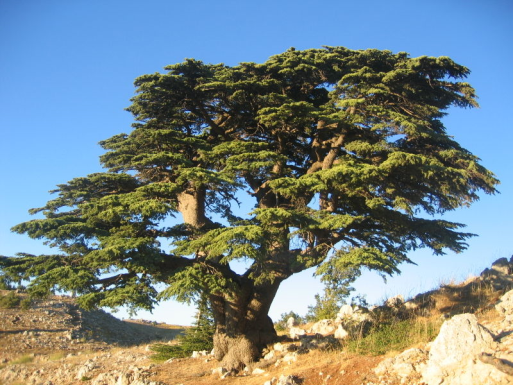
cedar

Long ago the majestic cedars of Lebanon (Cedrus libani) completely covered the upper slopes of the Lebanon Mountains on the western and northern sides. Now only a few pockets of these mighty cedars remain. At that time they were mixed, as they are today, with other trees such as Cilician fir, Grecian juniper, cypress, and Calabrian pine.

We know from 1 Kings that Solomon used cedar wood in his palace and in the Temple. Cedar was used for beams, boards, pillars, and ceilings. Historians tell us that the Assyrians also hauled cedars to their land for use in buildings. Nebuchadnezzar of Babylon also imported cedars from Lebanon. In some versions of Isaiah we read that people made idols of cedar and oak (44:14-20). Finally, when the Temple was rebuilt by the returning exiles (Ezra 3:7), they again cut down cedar trees to grace the house of God.

In 2 Samuel, 1-2 Kings, 1-2 Chronicles and Ezra, when Lebanon is specifically mentioned, there can be no doubt that ’erez is Cedrus libani, the “cedar of Lebanon,” although it is possible that sometimes the word was used loosely to include various evergreen trees.

In the description of the purification rituals (Leviticus 14:4 at al.), the word ’erez probably refers to the Phoenician juniper tree, since that was the only cedar-like tree in the Sinai Desert.

Description  Cedar trees can reach 30 meters (100 feet) high with a trunk more than 2 meters (7 feet) in diameter. The leaves of true cedars are not flat like those of most trees, but consist of tufts of dark green, shiny spines. (The cedars in North America have a flatter type of spine than the biblical cedar.) The wood is fragrant and resistant to insects. Cedars bear cones and can live to be two or three thousand years old.

The cedar of Lebanon is famous for its large size (see Isaiah 2:13 et al.), and for the fragrance of its wood. Psalm 92:12 links the cedar to righteousness, that is, presumably, to its straightness and height above other trees. The cedar is the national emblem of Lebanon.

Cedrus species are found in the mountains of North Africa, in the Himalayas, in India, and in North America. Translators in these places, should, of course, use the local name in nonfigurative references. In sub Saharan Africa, translators can transliterate from Hebrew (’erez), Greek (kedar), English (sedar), or another major language, or they can take a generic solution such as “large, beautiful tree.” In poetic passages (wisdom literature and prophecy), some translators may wish to use a cultural equivalent with these traits. In Africa, according to Burkhill (The Useful Plants of West Tropical Africa, volume 4. Kew: Royal Botanic Gardens, 1985), the Pink Mahogany Guarea cedrata is also called the pink African cedar because of the cedar-like scent of its timber. Likewise, some people in India and Australia use “cedar” to refer to the toon because of its reddish wood. I do not recommend such substitutes in historical passages, since the ’erez is not related to these trees. In some figurative passages, however, the substitution could be effective, since all are large trees with reddish wood. However, each passage has to be evaluated to determine the intended effect of the image.

Cedar of Lebanon, Wikimedia Commons

Source: Each According to its Kind: Plants and Trees in the Bible (UBS Helps for Translators)

cypress

The Hebrew word berosh probably covered cypress, fir, and juniper; we are including here only those instances of berosh that possibly refer specifically to the cypress. The Cypress Cupressus sempervirens, native to Israel, was once common in the mountains of Judea. It also grew abundantly in Lebanon along with cedars, firs, and Grecian junipers. Cypresses also grew in Judea, Gilead and Edom, and do so up to the present day.

A comparison of English versions reflects the disagreement among scholars on the identification of the coniferous trees. For example, the Hebrew word berosh in 1 Kings 5:8 is translated as “cypress,” “pine,” “juniper,” or “fir.”

The disagreement here arises from the fact that berosh is probably a generic term, and it should probably be translated generically, if possible, or differently according to the context. We take the word berosh in 1-2 Kings and 2 Chronicles, where it is usually paired with ’erez (“cedar”) and/or Lebanon, to refer to the Cilician fir or to the Grecian juniper rather than to the cypress (see fir and Grecian juniper). In the few other places where it occurs, it may refer to any one of the three conifers. The logic here is that since cypresses grew in Judea, King Solomon would not need to import them from Lebanon. However, it could also be argued that Lebanon may have produced better specimens than King Solomon could find in Israel and he might have imported some of them. In either case, this does not argue against berosh as a generic term.

Closely related to the pines, firs and cedars, the cypress may reach 9-15 meters (30-50 feet) high. It has small scale-like leaves and round cones. The tall, narrow specimens that are common today in Israel and other countries are a modern variety (pyramidalis) that has been specially developed.

Cypress, photo by Ray Pritz
Cypress branch with seed cones, photo by Nigel Hepper

Source: Each According to its Kind: Plants and Trees in the Bible (UBS Helps for Translators)