grain

The Greek and Hebrew that is translated in English as “grain” (or: “corn”) is translated in Kui as “(unthreshed) rice.” Helen Evans (in The Bible Translator 1954, p. 40ff. ) explains: “Padddy [unthreshed rice] is the main crop of the country and rice the staple diet of the people, besides which [grain] is unknown and there is no word for it, and it seemed to us that paddy and rice in the mind of the Kui people stood for all that corn meant to the Jews.” “Paddy” is also the translation in Pa’o Karen (source: Gordon Luce in The Bible Translator 1950, p. 153f. ).

Other translations include: “wheat” (Teutila Cuicatec), “corn” (Lalana Chinantec), “things to eat” (Morelos Nahuatl), “grass corn” (wheat) (Chichimeca-Jonaz) (source: Viola Waterhouse in Notes on Translation August 1966, p. 86ff.), “millet” (Lambya) (source: project-specific notes in Paratext), “food” (Nyamwezi) (source: Pioneer Bible Translators, project-specific notes in Paratext)or ntimumma lujia / “seeds for food” (Lokạạ — “since Lokạạ does not have specific terms for maize and rice that can be described as grains”) (source: J.A. Naudé, C.L. Miller Naudé, J.O. Obono in Acta Theologica 43/2, 2023, p. 129ff. )
beans

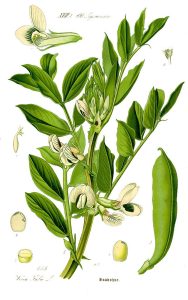
Commentators and translators are unanimous in identifying the Hebrew word pol as the Broad Bean Vicia faba or Faba vulgaris. Beans were cultivated in the Middle East for millennia, and they probably originated there. No wild species are now known, and it is quite possible that the ancestors of the bean are extinct. Samples of beans have been found in excavations at Jericho dating to 7,000 8,000 years ago.

The broad bean is an erect plant, not a vine, reaching to 1 meter (3 feet) in height. The stem branches only in the upper part. It has no tendrils like many types of bean have today. The flowers are white, and when they ripen, they form pods containing 3-6 large flat beans of a cream or tan color.

Special significance  In 2 Samuel 17:28 people bring food, including beans, to King David as he flees from his son Absalom. In Ezekiel 4:9 Ezekiel is instructed to publicly make “bread” out of wheat, barley, beans, and lentils — whatever he could find — the point probably being that good quality bread will soon be scarce in Jerusalem.

There are at least two hundred species of the genus Vicia to which the broad bean belongs. Vicia itself is part of the vast family of legumes. It is possible that the Hebrew word pol actually refers to more than one type of bean, including what we now know as peas. Since beans and peas are known around the world, translators will probably be able to find a local equivalent. In both contexts (2 Samuel and Ezekiel) the word is used in a list of items, and if a local species of bean is not available to the translator, a transliteration should be used.

Vicia faba, Wikimedia Commons

Source: Each According to its Kind: Plants and Trees in the Bible (UBS Helps for Translators)

lentils

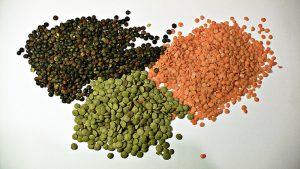
Scholars are agreed that the Hebrew word ‘adashah refers to the lentil Lens culinaris (formerly known as Lens esculenta). The Arabic word ‘adas, as well as several references in post-biblical Hebrew, confirm this identification, as does the Greek Septuagint. Seeds found in excavations dating to the sixth or seventh millennium B.C. show that the lentil is one of the first species to be cultivated by humans. In those excavations lentils are often found together with seeds of wheat and barley.

The lentil is a low-branched plant with a weak stem. It has tendrils, like pumpkins and squashes, and pinkish flowers that develop into a pod like a bean. The pod is very short with only one seed inside, about the size of a small pea. In one type of lentil the pea is reddish brown, hence the reference to “red” stew in Genesis 25:30. The pods are often in pairs or sets of three. In the Holy Land lentils grow in the cold season (November-March).

In Ezekiel 4:9 the strange bread, made from six kinds of grains and legumes including lentils, was probably intended to show that food would become scarce and that the people would have to eat whatever they could find. The lentil is typically used in soups and stews, as it was when Jacob used it to trick his brother Esau into giving up his rights as the firstborn son. Lentils were among the foodstuffs brought to David by local people when he was pursued by Absalom.

 Lentils are now widespread in Asia, India, and North Africa. In places where they are not known, we suggest using the word for a local type of bean rather than a transliteration. However, in Ezekiel 4:9 “beans” are also mentioned, so a possible rendering for “beans and lentils” is “different kinds of beans.” In Genesis 25:34 a generic expression for “pottage of lentils” would be appropriate, such as “bean soup,” “bean stew,” or “vegetable soup.” If a transliteration from a major language is desired, consider Arabic adas; French cristallin, lentille; Spanish lenteja; Portuguese lentilha; and Swahili adesi.

3 types of lentil, Wikimedia Commons

Source: Each According to its Kind: Plants and Trees in the Bible (UBS Helps for Translators)

wheat

Two kinds of wild wheat have grown in the open deciduous oak woodland in the northern part of the Fertile Crescent for several thousand years: Einkorn Wheat Triticum monococcum and Emmer Wheat Triticum dicoccum. Both came into cultivation together with barley. Just before the time of the Romans, the Naked Bread Wheat or Hard Wheat Triticum durum started replacing the hulled varieties. This then became the favorite type of wheat for bread and macaroni. Spelt is a sub-member of the Triticum aestivum species.

In NRSVue and some other versions, the generic Hebrew word bar has been rendered “wheat” in Jeremiah 23:28 et al. This is legitimate, since the grain referred to by bar was probably wheat. However, it might be better to say “grain” in these passages.

The most important early wheat for the Israelites was emmer, probably the only wheat known in Egypt, and referred to in Hebrew as chittah. However, according to Hepper (Baker Encyclopedia of Bible Plants: Flowers and Trees, Fruits and Vegetables, Ecology. Baker Book House, 1992), the seven-headed wheat of the Egyptian king’s dream (Genesis 41:5ff.) suggests that there may also have been Triticum turgidum (rivet wheat) in the emmer group. The Hebrew word kusemeth probably refers to a type of emmer wheat that the Egyptians called swt.

Wheat is a type of grass like rice and barley, growing to around 75 centimeters (2.5 feet) in height and having a head with many small grains in rows.

Bread made from wheat was the staple food for the people of ancient Israel, so God punished them by breaking “the staff of bread” (see, for example, Ezekiel 4:16).

If wheat is unfamiliar, translators can transliterate from a major language in non-rhetorical contexts (for example, English witi, Portuguese trigo, French ble or froment, Swahili ngano, Arabic kama/alkama). The transliteration may add a generic tag such as “grain.” The New Testament passages are mostly rhetorical, opening the possibility for a metaphorical equivalent.

Wheat head, photo by Gloria Suess

Source: Each According to its Kind: Plants and Trees in the Bible (UBS Helps for Translators)

complete verse (2 Samuel 17:28)

Following are a number of back-translations as well as a sample translation for translators of 2 Samuel 17:28:

  • Kupsabiny: “Those people took cloths to David for sleeping on, basins and pots, wheat and other foods, beans and peas.” (Source: Kupsabiny Back Translation)
  • Newari: “brought and gave them bedding and blankets, utensils and cups. They also brought and gave wheat, barley, flour and roasted grain, beans and dal,” (Source: Newari Back Translation)
  • Hiligaynon: “They brought something-to-sleep-on, bowls, pots, wheat, barley, flour, roasted grain, seeds that can-be-cooked, lentils,” (Source: Hiligaynon Back Translation)
  • English: “brought sleeping mats, bowls, clay pots, barley, wheat flour, parched grain, beans, and lentils to them.” (Source: Translation for Translators)

barley

Barley Hordeum distichum or Hordeum vulgare is a type of grass like wheat and rice. It has been cultivated in the Middle East for thousands of years and is now one of the most prominent seed crops grown in the world. Twenty species are known, of which eight are European. Barley needs less rain than wheat does, so in the Holy Land it was typically found in the drier areas above the coastal plain and near the desert. From 2 Kings 7:1 and Revelation 6:6 we know that barley was considered inferior to wheat and was often used to feed animals, as it is today. When the wheat supply ran out, people had to make their bread with barley. Barley was gathered before wheat, the harvest coming around March or April in the lower regions and in May in the mountains (see Exodus 9:31 et al.). In Egypt and in ancient Greece barley was used to make beer.

Barley plants look like wheat or rice. They are less than 1 meter (3 feet) tall, and have a single head on each stalk, with six rows of kernels, although the biblical kind may have had only two rows. The head bends at a down-ward angle when it is ripe.

In the story of Gideon and the Midianites in Judges 7:13, “a cake of barley” representing the (despised) Israelite army tumbles into the Midianite camp and knocks down the tent (representing the nomadic Midianites).

Barley is a plant of temperate zones, like Europe and the Near East; it does not grow well in the tropics. However, barley has been recently introduced along with wheat into many parts of the world for brewing beer and other malted drinks. It is also known to have grown in Korea as early as 1500 B.C. along with wheat and millet. It is becoming known in Malay as barli. Except for the reference in Judges, all references to barley in the Bible are non-rhetorical, so unrelated cultural equivalents are discouraged. Some receptor language speakers may coin a name for it as in Malay, or the translator can use a transliteration from Hebrew (se‘orah), Latin (horideyo), or from a major language (for example, Arabic sha’ir, Spanish cebada, French orge, Portuguese cevada, Swahili shayiri), together with a classifier, if there is one (for example, “grain of shayir”).

Barley, Wikimedia Commons

Source: Each According to its Kind: Plants and Trees in the Bible (UBS Helps for Translators)

See also barley bread.

Translation commentary on 2 Samuel 17:28 - 17:29

The subject of the sentence is still the three men mentioned in the previous verse. It may be wise to say “These men” in some languages. The list of provisions brought to David and his army includes bedding, household utensils, and numerous different food items.

Beds: this represents a singular collective noun in the Hebrew text; other textual evidence has “mattresses and coverings…,” which is apparently what Revised English Bible follows: “mattresses and blankets.” In many languages this will be best translated by using “sleeping mats” and “blankets” (Contemporary English Version). However, Critique Textuelle de l’Ancien Testament gives a {B} rating to the Masoretic Text and argues that the longer reading found in the Septuagint is a later addition to the text.

Basins: these were wide-mouthed containers probably made of wood or metal.

Earthen vessels: these were containers made of clay. The expression may be translated “earthenware” (New American Bible), “crockery” (New Jerusalem Bible), “clay pots” (Good News Translation), “pottery jars” (Contemporary English Version), or “articles of pottery” (New International Version).

Wheat: see 4.6 as well as 1 Sam 6.13; 12.17; and Ruth 2.23.

Barley: see 14.30 as well as Ruth 2.23.

Meal: as in 1 Sam 1.24 and 28.24, this refers to “flour” made by grinding wheat.

The Hebrew term for parched grain occurs twice in the Hebrew text—in the position in which it occurs in Revised Standard Version and again after lentils. This duplication is reflected in King James Version, New American Standard Bible, New Jewish Publication Society’s Tanakh, and Traduction œcuménique de la Bible. But the second occurrence is omitted by the ancient Greek and Syriac versions. And it is likewise dropped from many modern translations, including Good News Translation, New Revised Standard Version, New International Version, Revised English Bible, New Jerusalem Bible, and New American Bible. Translators are advised to translate the meaning parched grain or “roasted grain” only once in this list. For the translation of this same term elsewhere in the Old Testament, compare Ruth 2.14; 1 Sam 17.17; 25.18.

Lentils: in addition to this reference, lentils are mentioned in 23.11, Gen 25.34, and Ezek 4.9. These are flat, edible seeds of a plant that is widely cultivated in the Near East. In some languages they will be considered a kind of bean. So the two items, beans and lentils, may have to be translated as “beans of different sorts.”

Curds: when milk is churned or “pressed,” it eventually separates into two parts. The more watery part is called “whey,” and the thicker, congealed lumps are called curds. Pro 30.33 indicates that “pressing milk produces curds.” This is still a part of the regular diet of people living in the Near East. The King James Version rendering “butter” is generally acknowledged to be inaccurate, as indicated by the fact that the New King James Version has “curds.” Translators may have to resort to a rather lengthy descriptive expression to translate the meaning here. Or it may be necessary to translate curds and cheese together as “different kinds of foods made from milk” or something similar. While the terms curds and cheese are separated by the word sheep in the Hebrew list, the two food items made from milk go together logically in the minds of many people. For this reason it may be better to put them together in translation even where separate terms are found. New Jerusalem Bible has “cow’s cheese and sheep cheese.” On the assumption that the Hebrew words have been copied in the wrong order, Osty-Trinquet corrects this verse to read “honey, curds, and cheese of sheep and of cattle.” It is, of course, possible that these men brought David and his men cheese made from both cow’s milk and from sheep’s milk. But there is no good reason to abandon the Masoretic Text, so translators should say “sheep” rather than “cheese from sheep.”

Cheese from the herd: the word for cheese here is not the same as in 1 Sam 17.18, but in most languages it will be impossible to distinguish the two terms. They both refer to a solid food product made by straining out the watery part and adding salt to the remaining curds. The resulting mass was then shaped into balls or disks and dried in the sun. As indicated above, curds and cheese may have to be translated together as “different foods made from milk.”

For they said …: this provides an explanation as to why the three men brought these items to David and his army. Although it is given in the form of a direct quotation, many translators may prefer to make it an indirect statement, as Good News Translation and New Jewish Publication Society’s Tanakh have done. And in some cases it may be more natural to shift this explanation to the beginning of verse 28 before listing the items they brought.

The word translated people refers to David’s army. New Jerusalem Bible translates “the army,” while New Jewish Publication Society’s Tanakh has “the troops.”

Quoted with permission from Omanson, Roger L. and Ellington, John E. A Handbook on the First and Second Books of Samuel, Volume 2. (UBS Helps for Translators). New York: UBS, 2001. For this and other handbooks for translators see here .