cantaloupe / muskmelon

NRSVue renders the Hebrew words qishshu’ah and miqshah as “cucumber.” Zohary (Plants of the Bible. Cambridge University Press, 1982) argues forcefully that these words refer to the Muskmelon Cucumis melo or cantaloupe, and that “garden cucumbers did not exist in Egypt in biblical times” (page 86). Hepper (Baker Encyclopedia of Bible Plants: Flowers and Trees, Fruits and Vegetables, Ecology. Baker Book House, 1992) concurs with this.

Cultivated muskmelons started out in and around Persia (now Iran) before moving into northern India, Kashmir, and Afghanistan. Although truly wild forms of Cucumis melo have not been found in those regions, several related wild species have been noted.

A picture of offerings presented at a funeral in Egypt around 2400 B.C. contains fruit that some experts take to be muskmelons. The Greeks appear to have known the fruit in the third century B.C., and in the first century after Christ it was definitely described by the Roman philosopher Pliny, who said it was something new in Campania in Italy. The Greek physician Galen, in the second century A.D., wrote of its medicinal qualities, and Roman writers of the third century gave directions for growing it and preparing it with spices for eating. The Chinese apparently did not know the muskmelon until it was introduced to their country around the beginning of the Christian Era from the regions west of the Himalayas.

The muskmelon vine has round leaves and tendrils and creeps along the ground like a pumpkin or cucumber. It has tendrils and yellow flowers that develop into a fruit 10-40 centimeters (4-16 inches) in diameter. The fruit becomes yellowish or light green when ripe. The muskmelon is so named because of the distinctive smell of its ripe fruits. “Musk” is a Persian word for a kind of perfume; “melon” is a French word, from the Latin melopepo, meaning “apple-shaped melon.” Latin took words of similar meaning from Greek.

According to Numbers 11:5, the wandering Israelites remembered muskmelons and other tasty food that they had enjoyed in Egypt and complained to Moses. Isaiah 1:8 uses the melon patch (after harvest) as a picture of abandonment, dereliction, and desolation.

Many varieties of muskmelon are known around the world in warm countries. If it is not known, it may be translated contextually. Numbers 11:5 is non-rhetorical, and a transliteration from a major language is recommended (for example, French cantaloupe, Spanish and Portuguese cantalupo, Arabic abd el lawi). However, the reference to the temporary shelter in the melon patch in Isa 1.8 is metaphorical, so a cultural equivalent representing a lonely or abandoned place could be considered. In this verse translators should keep in mind its parallel images, which are “a booth in a vineyard” and “a besieged city.”

Muskmelon (cantaloupe) fruit, photo by Rob Koops

Source: Each According to its Kind: Plants and Trees in the Bible (UBS Helps for Translators)
watermelon

Most scholars believe the Hebrew word ’avattiach refers to the common watermelon Citrullus vulgaris/lanatus, and it should be so identified since there are other types of melons, such as the muskmelon, with which it should not be confused. In fact, until recently, some botanists thought that this word referred to the muskmelon. Watermelons probably originated in Africa (possibly in the Kalahari) and were probably domesticated in the Neolithic Period. They have been cultivated in Egypt since prehistoric times and are used for food, drink, and medicine. Even the seeds are eaten. The Arabic cognate batekh/batikh is used for both the muskmelon and the watermelon.

The watermelon plant is a vine like a pumpkin or a squash. The fruits vary widely in size, shape and color, some being striped, others being plain colored (mostly dark or light green).

According to Numbers 11:5, watermelons were among the fruits that the wandering Israelites remembered from Egypt when they complained to Moses.

By now watermelons are a fairly common sight in the cities of the world. Where the fruit is marketed, there will be a name for it, often based on a major language (for example French pastèque; Spanish sandía; Portuguese melancia; Arabic batekh, batikh; and Swahili tikiti).

Source: Each According to its Kind: Plants and Trees in the Bible (UBS Helps for Translators)

rue

In the Holy Land at the time of Jesus there was only one wild species of rue common, the Mountain Rue Ruta chalepensis, and it is likely the one referred to by Jesus in his rebuke of the Pharisees in Luke 11:42. Rue is common throughout the Middle East, from Syria to Sinai up to the present. Because of its strong smell it is used in cooking and in medicine up to the present. It was used by the Greeks, Romans, and Jews against snakebite and the stings of bees, wasps and scorpions, not to mention its effectiveness against insanity, epilepsy, and even “the evil eye.”

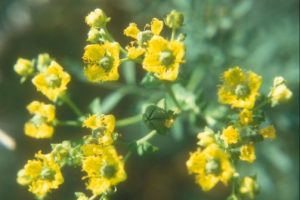
Rue is a small, shrubby plant that produces many branches at ground level, with many yellow flowers and very sharp-smelling leaves. It can reach up to 1 meter (3 feet) in height.

The ancient Jewish Talmud states that cultivated plants should be tithed. It is possible that the disagreement between Jesus and the Pharisees arose because by New Testament times the people were cultivating rue, dill, and similar plants that had not been cultivated before, and the Pharisees then applied the laws of the Talmud to these little plants, thus complicating the lives of the common people, while at the same time they ignored issues of justice and compassion.

Depending on what translators do with “mint” in Luke 11:42, they may find a cultural substitute for “rue” or a generic phrase for “mint and rue and every herb.” Since the context is not rhetorical and the plant genus is limited to the Middle East, a transliteration of “rue” will be appropriate. Transliterations can be made from the Greek pēganon or from a major language.

Rue flowers, photo by Gloria Suess

Source: Each According to its Kind: Plants and Trees in the Bible (UBS Helps for Translators)

fennel (galbanum)

Although its identity in the Bible is uncertain, galbanum is probably a gum resin from a plant called Fennel Ferula galbaniflua, which grows in India, Iran and Afghanistan, and especially in the high mountains of Iran. The fennel is related to the parsley family. Today most commercial galbanum comes from Lebanon and Iran.

The fennel plant can grow to 1.5 meters (5 feet) in height. It has fine, shiny leaflets, a thick smooth stem, and a flower head like an umbrella. The seeds are shiny and very small. The plant has a milky juice that comes out by it-self from the joints or oozes out from the stem when it is cut. It forms aromatic greenish or yellowish beads when it dries. The taste is bitter and the smell is strong. A kind of fennel grows in Galilee (Ferula communis), but it does not yield the galbanum resin. Another kind, known from Roman coins from Carthage, grew in North Africa under the name silphion (probably Ferula tingitana).

According to Exodus 30:34, galbanum resin was part of the incense prescribed by Moses for burning in the Tabernacle. In Assyria it was used as a fumigant. It could have been the “gum” mentioned in Genesis 37:25. The Roman writer Pliny considered it a powerful remedy.

Translation  Since fennel is not well known, most translators will need to transliterate from a major language. Some possibilities are:

1. transliteration from Hebrew: helibena, elbenahi, lebena;
2. transliteration from Latin via English: galbanum;
3. substitution of a local type of gum, adding chelbenah or galbanum as a tag or in a footnote.
4. transliteration of the name of the plant with a classifier: gum of ferula (French), feneli (English), hinojo/ferula (Spanish).

Fennel, Wikimedia Commons

Source: Each According to its Kind: Plants and Trees in the Bible (UBS Helps for Translators)
henna

Henna Lawsonia inermis grew wild in the oases by the Dead Sea in Old Testament times. It is also known as “Egyptian privet” and is common in the hot, drier parts of Africa, southern Asia, and northern Australia. Although henna was, and is, primarily used because of its coloring properties derived from the dried leaves, in Song of Songs 1:14 the writer mentions its flowers, which are indeed pretty and fragrant. They are in a “cluster” (’eshkol in Hebrew), which could be taken as a woven object parallel to the little bag of myrrh in verse 13 or as a garland, or simply as a clump of flowers in the cultivated terraces above En-Gedi. The reference to henna in Song of Songs 4:13 is strange since it is in the plural form in Hebrew (kefarim), parallel to the yet stranger Hebrew word neradim (from nerd; see spikenard). Neither of these plants has significant fruit, so the verse can be taken as a glorious concoction of romantic images of spices and flowers.

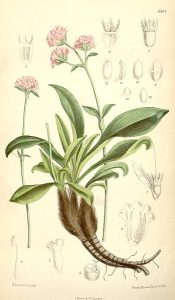
Henna is a shrub that reaches 2‑3 meters (7‑10 feet) in height. It has opposite leaves and many fragrant white flowers. The leaves yield a red juice that people in many countries use for coloring the skin and hair.

The context is clearly metaphorical in both references to henna, so there is the possibility of substituting locally known equivalents. In places where henna is known only as an agent for coloring the hair, skin or fingernails, it may be important to substitute, or to create a note stating that the smell and beauty of the flowers are in focus. In Song of Songs 4:13 most translations ignore the plural, perhaps assuming that it is influenced by the word “fruits” earlier. Alternatively, a transliteration can be used based on a major language. The recent resurgence in skin decoration (“mehndi”) using henna may make it easier to find a known word.

Red henna flower, Wikimedia Commons

Source: Each According to its Kind: Plants and Trees in the Bible (UBS Helps for Translators)

spikenard / nard

The name “spikenard” seems to be gaining ground over “nard” in global English. The Hebrew and Greek words for spikenard could have referred to a variety of substances from a variety of plants. Zohary (Plants of the Bible. Cambridge University Press, 1982) takes the New Testament spikenard to be the same as the Old Testament one, namely Nardostachys jatamansi from India. Hepper (Baker Encyclopedia of Bible Plants: Flowers and Trees, Fruits and Vegetables, Ecology. Baker Book House, 1992) doubts the Indian origin of most biblical spices and suggests that the references in Song of Songs may be to the Camel Grass Cymbopogon schoenanthus, which grows in the deserts of Arabia and North Africa. Assyrians called it lardu. However, if the writing of Song of Songs is late, the Indian origin of spikenard mentioned there is quite possible. The Greek expression nardos pistikos in Mark 14:3 and John 12:3 is rendered “pure nard” by NRSVue, but the meaning of pistikos is debatable. It may in fact come from the Sanskrit picita, the local name of the spikenard plant. In Arabic spikenard is called sunbul Hindi (“Indian spike”).

The spikenard plant is a leafy bush less than a meter (3 feet) high, with fragrant-smelling, short stems and a tuft of three narrow leaflets at the tip of each stem. The pink flowers are umbrella-shaped. The rhizomes (tubers) are pounded to extract pungent, pale orange or yellow oil.

The two references to spikenard in Song of Songs 4:13 and 4:14 are metaphorical, the bride being referred to as a luxurious garden or park filled with all kinds of lovely spice plants and trees. The spikenard there is mentioned first in the plural in Hebrew, paired with a plural form of henna, as though they are plants or trees, or perhaps the fruit of trees. Then its singular form is paired with saffron, followed by calamus and cinnamon. Spikenard was a luxury item in ancient Egypt, the Near East, and Rome. A Chinese medical text written around 1100 A.D. notes the calming effect of spikenard incense. It is still used in incense sticks (senko) in China and as a medicine. It is also used in Japan as an ingredient of the incense used in the Plum Blossom Festival. In John 12:3 spikenard is cited as the “costly perfume” used by Mary, the sister of Lazarus, to anoint Jesus.

For the metaphorical references in Song of Songs a cultural equivalent of spikenard is appropriate. The references in Mark and John are of course non-rhetorical and should be translated with a local name for spikenard where possible or transliterated where translators feel it is important to be concordant throughout. A transliteration such as “naridi” is recommended.

Spikenard Wikimedia Commons

Source: Each According to its Kind: Plants and Trees in the Bible (UBS Helps for Translators)

liquidambar (Oriental sweetgum𖺗 storax)

The Hebrew word tsori (“balm”) may be the basis for the word “storax,” which Zohary (Plants of the Bible. Cambridge University Press, 1982) takes to be a name for the dried resin of the liquidambar Liquidambar orientalis, a tree that is also called kataf or nataf in Hebrew.

The Hebrew word nataf does not occur outside of Exodus 30:34 in the Bible. The Septuagint renders it staktē, which NRSVue transliterates as “stacte.” According to Zohary, nataf is a synonym of tsori (= storax), which is found six times in the Bible. The liquidambar (or storax) is a tree that used to grow widely in the Middle East and Turkey.

The liquidambar tree grows to 10 meters (33 feet) tall, and has deeply incised leaves with five points and round yellow flowers on a 4 centimeter (2 inch) stalk. The fruits are prickly. The sticky gray-brown gum is produced by making cuts in the trunk of the tree.

The Jeremiah and Ezekiel references indicate that tsori was medicinal. We conclude from Exodus 30:34 that it was aromatic. Genesis 37:25 shows that it was highly valued in trade with Egypt.

The genus Liquidambar was widespread many thousands of years ago, according to fossil evidence, but it disappeared from Europe when the glaciers came. The surviving species, apart from orientalis in the Middle East, are formosana in South China and Taiwan and styraciflua in the eastern United States and Central America.

The references to tsori in Genesis and Ezekiel are non-rhetorical, as is nataf in Exodus. If Zohary is correct, and the translator wants to be specific, then a transliteration of “storax” may be used in these passages. Alternatively, in Exodus 30:34 translators can use a generic expression such as “resin” or “gum resin”; that is, they can use their local word for the globs of hardened sap that come from trees that produce it.

If a word for “sweet-smelling healing ointment” exists, it can be used for tsori in Genesis. Tsori is the second of three spices the Ishmaelite traders carried in Genesis 37:25, the other two being neko’th (“gum”) and lot (“myrrh” or “resin”). Translators can cover all three words with a phrase such as “different kinds of sweet-smelling medicine and incense.” Transliteration is also possible, from Hebrew tsori or Arabic nakaa/nakati. “Balm” in English is not a good basis for transliteration.

Liquidambar trunk, Wikimedia Commons

Source: Each According to its Kind: Plants and Trees in the Bible (UBS Helps for Translators)

opobalsamum (balsam; balm)

The Hebrew word bosem, which is often rendered “balm” (derived from “balsam”), can refer to any type of aromatic healing substance, but it also designates the product of a particular tree, the balsam or opobalsamum Commiphora gileadensis. Arabs call it balasam or balasham. In the Talmud it is called afarsimon. Excavations near En Gedi have uncovered an ancient processing plant for balsam oil.

The opobalsamum tree likes a desert or semi-desert climate. It grows to 2‑3 meters (7‑10 feet) tall and has small, wrinkled, three-part leaves, white flowers, and pea-sized red berries that have a fragrant yellow seed inside. The bark of younger branches is gray, turning brown with age. The resin appears by itself in green droplets from the stems and branches, but collectors also make cuts in the branches to speed the process. The droplets turn from green to brown, clump together, and fall to the ground, where they are collected.

In Bible times, balsam oil was used in holy anointing oil, as medicine, and as an ingredient of perfume.

A generic word or phrase for sweet-smelling substances is appropriate to render bosem, although where a specific name for the balsam tree is available, as in southwestern Arabia and Somalia, this could also be used. At least one hundred species of the genus Commiphora are spread throughout dry areas of the world. Translators in some areas will know the plants; others may know only the dried resin of Commiphora sold in spice markets.

Balsam tree, Photo by Nigel Hepper

Source: Each According to its Kind: Plants and Trees in the Bible (UBS Helps for Translators)