saffron crocus

Our experts agree on the identification of the Hebrew word karkom with the saffron crocus Crocus sativus, but there are others who identify it as the Indian plant Turmeric Curcuma longa on the basis of its Arabic name kurkum or kurkam. However, according to Moldenke (Plants of the Bible. Ronald Press. 1952), Arabic kurkum refers to the plant, and the product from it is called saferan, from which we get the English word “saffron” (compare Arabic asfar, meaning “yellow”). Saffron is now widely known as a food additive and dye, but in Bible times it was also considered a perfume and medicine. It comes from the reddish-purple flowers of the crocus, which grew throughout Asia Minor in Bible times. Since then it has been widely cultivated in Europe, England, and America. The English word “crocus” comes from Hebrew karkom via Greek krokos.

Archeological records indicate that saffron was cultivated in the seventh century B.C. in Assyria and later in Crete (Bronze Age). Saffron-based paint has been found in fifty thousand year old pictures in what is today Iraq. The Sumerians used saffron for medicine and magical potions and traded it with other kingdoms. International trade reached a peak with the Minoans in the second millennium B.C. Use of saffron spread into Asia via the Persians and/or the Mongol invaders, and today Buddhist monks in India wear saffron-colored robes. Merchants in the Middle East sell dried safflower (Carthamus tinctorius) as saferan, but real saffron comes only from crocus flowers. The fake saffron is appropriately called alazor bastardo in Spanish and safran batard in French.

Crocus plants have long, tapered grasslike leaves growing from an onion-like bulb under the ground. They grow to less than 13 centimeters (5 inches) in height and have beautiful reddish or purple flowers.

In Bible times saffron was used as perfume and as medicine, but today it is mostly known as a coloring agent for cloth and food. One reason why it was costly is that it takes about six hundred flowers to produce a few drops of oil.

Since Bible times the saffron crocus has been grown mostly in the Mediterranean basin, but it also thrives in India, Oceana, and North Africa, so in those places local words will likely be found. Elsewhere, transliteration from a major language is recommended.

Crocus sativus, Wikimedia Commons

Source: Each According to its Kind: Plants and Trees in the Bible (UBS Helps for Translators)

See also crocus.

cattail (reed-mace𖺗 bulrush)

The Hebrew word suf probably designates more than one species of the cattail, also called “reed-mace” and “bulrush.” There are two in Israel: Typha domingensis and Typha latifolia. Both species like to stand in the slow-moving water on the edge of rivers and streams. The reference to suf (“weeds”) in Jonah 2:5 supports Zohary’s conjecture (Plants of the Bible. Cambridge University Press, 1982) that suf may be a collective name for many water plants. Suf is paired with qaneh (“reeds”) in Isaiah 19:6, so it is almost certainly the cattail since both are found in marshes and slow streams.

The cattail reaches 3 meters (10 feet) in height and is notable for its soft, fuzzy brown seed head that eventually disintegrates into fluffy material that blows away in the wind and floats on the water. The plant also spreads through its thick roots, which creep along the bottom of shallow lakes and streams. Its leaves are long, erect, and sharply pointed.

In Bible times, as now, the leaves of cattails were used for baskets and mats. The thick roots are edible, as are the pollen and the young green stalks. The cattails of Exodus are famous as the plants among which the mother of Moses hid her son in his little floating basket.

Most kinds of cattail are found in Europe and North America, where the leaves are used for mats and chair seats. Some typha species in India (Typha elephantina) are used for making paper and ornaments. Translators who live near rivers may have other reed-like plants that can be used, keeping in mind that there are four reed-like plants mentioned in the Bible (see “Papyrus,” “Reed,” and “Rush”). In Exodus 2:3 and 2:5 a number of English versions, including the NRSVue use the generic word “reeds.” In communities that are unfamiliar with waterside vegetation, generic expressions such as “tall grass” or “tall stalks of grass” may be effective. The basic options for rendering suf in Exodus and Isaiah are:
1. a local grass that grows in streams and rivers;
2. a generic word such as “grass”;
3. a descriptive phrase such as “tall grass.”

The word suf has a different sense in Jonah 2:5. In this passage the plants are living in the water without roots or are perhaps rooted in the bottom of a shallow sea. So translations typically use “seaweed,” a plant with long, grass-like leaves that is often not attached to the soil under the sea.

The Hebrew expression yam suf (literally “sea of reeds”) has been translated somewhat inaccurately by the Septuagint translators and many others as “Red Sea.” A Handbook on Exodus recommends following the Hebrew, which is literally “Sea of Reeds,” or the modern equivalent “Gulf of Suez” as in the Good News Bible, unless there is a strong tradition in the receptor culture for “Red Sea.” If “Red Sea” is used, then a footnote should be added, giving “Sea of Reeds” as the literal meaning of the Hebrew text.

Cattail, Wikimedia Commons

Source: Each According to its Kind: Plants and Trees in the Bible (UBS Helps for Translators)

In Jonah 2:5, it is translated as “ocean grass” in Newari (source: Newari Back Translation).

broom tree

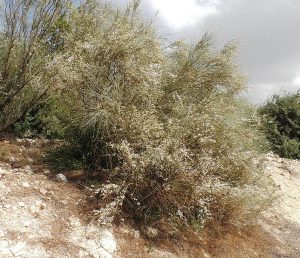
A number of scholars identify rothem as the White Broom Retama raetam, a tough desert shrub found in the Holy Land and Arabia. Earlier, Moldenke (Plants of the Bible. Chronica Botanica. Ronald Press, 1952) contended that rothem refers to a parasitic plant called dog’s club. In the story of Elijah’s flight from Jezebel, the mention of the broom tree in 1 Kings 19:4 provides detail to the image of desolation brought to mind by the word “wilderness” earlier in the verse. The references to rothem in Psalm 120:4 (“. . . with glowing coals of the broom tree”) and Job 30:4 (“. . . and to warm themselves the roots of the broom”) have led scholars to conclude that it is indeed the broom shrub, since it makes a very hot fire, due to the oil in the stems and leaves. The place name Rithmah (“place of rothem”) referred to in Numbers 33:18f. may also refer to the broom. The white broom is found on hills, rocky places, ravines and sandy places throughout the Holy Land, especially near the Dead Sea, in Gilead, on Mount Carmel, in the Syrian desert, and on the Phoenician coast.

The white broom, which is more of a large bush than a shrub, can reach a height of 2 meters (7 feet). It has many small branches, few leaves, and clusters of white flowers that make the shrub a beautiful sight on a hillside.

In 1 Kings 19:4 the New Jerusalem Bible renders rothem as “furze bush,” also known as “gorse,” in an attempt to use a name known to English gardeners, but neither “gorse” nor “furze” are familiar to botanically ignorant city-dwellers of the twenty-first century. Hence, some modern versions use a generic term in 1 Kings, such as “large bush” (Contemporary English Version), “tree” (Good News Bible, and “bush” (New Century Version). In areas where plants are still known by species names, translators can select a shrub that grows in dry, barren areas (assuming it is big enough to offer shade), or transliterate from the Hebrew (rothem) or a major language (for example, retem in Arabic). Otherwise, they can use “small tree” or “shrub.”

In Psalm 120:4 a local kind of wood that produces a very hot fire could be used, since the text is rhetorical, and needs an image of something very hot.

The reference to broom in Job 30:4 poses major textual and exegetical problems, which explains the variety of renderings in modern Bibles. NRSVue reads “they pick mallow and the leaves of bushes, and to warm themselves the roots of the broom.” Good News Bible and the New International Version have these poor folk eating the roots of the broom tree. However, reliable sources tell us that the root of the broom tree is poisonous. That is why Moldenke suggested that it must be another plant, namely the parasite Dog’s Club Cynomorium coccineum, which grows up out of the roots of the broom tree. However, there is good evidence that the writer intended to say the roots were “burned” (as in NRSVue), not “eaten” (as in Good News Bible and New International Version).

Broom bush, Wikimedia Commons

Source: Each According to its Kind: Plants and Trees in the Bible (UBS Helps for Translators)

In the Contemporary Chichewa translation (2002/2016) it is translated as “mopane tree .” These trees grow in Southern African countries. They can grow up to 18 meters high and their leaves have a butterfly shape. They’re good for firewood and timber as they are in the category of hardwood trees because they can live for up to 100 years. (Source: Mawu a Mulungu mu Chichewa Chalero Back Translation)

cotton

Cotton Gossypium herbaceum has been grown and woven in the Indus Valley (now Pakistan) for at least five thousand years. Pieces of cotton cloth that old have been found there. However, it was not grown in the land of Israel until a few centuries before Christ.

The story of Esther takes place in Babylon in the time of Ahasuerus (= Xerxes) 485–465 B.C. By that time both cotton and flax products were probably traded back and forth throughout the Babylonian Empire, and the cultivation of both was probably expanding, although the area of India, Pakistan, and Babylonia would have been the area of largest production. Herodotus, in the fifth century B.C., mentions “trees that bear wool” from India.

The writer of Esther describes fabric made from karpas, a Hebrew word that comes from Sanskrit, a language spoken long ago in India, where cotton was domesticated. That may be evidence that karpas probably refers to cotton alone, particularly since the Hebrew word buts is probably used for “linen” in the same verse.

Isaiah 19:9, an oracle about Egypt, refers to the “weavers of white cotton [choray],” parallel to “workers in combed flax.” This supports the contention that cotton was well established in Egypt in Old Testament times, at least by the time of the Israelite monarchy.

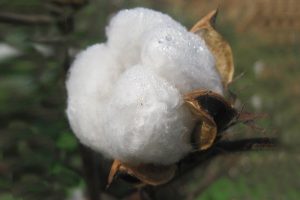
The original Indian and Arabian type of cotton (“Levant cotton”) grows to 2 meters (7 feet) in height, with soft, lobed leaves (like its relatives the hibiscus and the hollyhock). The mallow-like flowers are yellow with a purple center. When the flower matures, the boll underneath puffs out and eventually splits, revealing a mass of fine white filaments that we know as “cotton wool.”

Cotton is now grown extensively throughout the world, especially in warm, dry areas. The Tree Cotton Gossypium arboreum is native to North Africa and is now grown in Upper Egypt. Another species, Upland Cotton Gossypium barbadense, grows in the West Indies. Egypt, India, China, and Nigeria all raise cotton in great quantities since it is their most important textile. If a transliteration of cotton from a major language is needed, adaptations of the following are advised: French cotonnier; Portuguese algodão, algodeiro; Spanish algodonero; Arabic kutun; and English cotton.

Even if the translator’s people do not actually grow cotton, they know it from the cloth sellers and will have a name for it. Failing that, a transliteration from a major language is recommended.

Cotton ball, Wikimedia Commons

Source: Each According to its Kind: Plants and Trees in the Bible (UBS Helps for Translators)

See also snow (color).

bottle gourd / calabash

The Bottle Gourd or Calabash Lagenaria siceraria was one of the first plants to be domesticated by human beings. It has been used for food, for medicine, and for various utensils and musical instruments. It is indigenous to Africa but was probably introduced into Asia and the Americas about ten thousand years ago, with or without the help of humans. The name of the genus comes from the Latin word lagoena, meaning “flask” (almost certainly the first Roman flasks were dried gourds). The species name is derived from the Latin word for “dry,” suggesting that the fruit is usable in its dried form. Although the people of the Bible lands undoubtedly used the split bottle gourds in their homes as bowls or “dippers,” as we find in Africa and Asia, the only references we have are to the image of the gourd in the artwork carved into the cedar of King Solomon’s palace (1 Kings 6:18) and in the decorating of the giant bronze basin that stood in front of the Temple (1 Kings 7:24).

The bottle gourd is a climbing vine like a cucumber or pumpkin. Its stem is square, ribbed, and hairy, and can grow up to 5 meters (17 feet) long. The leaves are heart-shaped, the size of a human hand, and slightly lobed. The flowers are yellow with five petals, giving way to fruits that may be of many different shapes depending on the variety. Most gourds are globular at one end, with a protrusion that may be elongated, making them very useful, when cut in half, as big spoons in the kitchen.

Gourds or calabashes have been used as containers, or, when split, as dipping devices, for thousands of years. They have also been used for musical instruments. The pulp of most kinds is very bitter and is poisonous in some cases. Some kinds are used in medicine in some countries, for purges, expelling worms, and for chest pains and headache. In southern Africa the leaves are eaten as a vegetable, as are the young, unripe fruits.

Translators in temperate or tropical areas of Africa and Asia will have a word for these gourds. If the only gourd people are familiar with is round like a ball, then an illustration may help in the text, or a footnote can describe the special shape of the Holy Land gourd, insofar as we know it. The bottle gourd is related to the wild gourd mentioned in 2 Kings 4:39, which poisoned a group of prophets.

Bottle gourd, photo by Nigel Hepper

Source: Each According to its Kind: Plants and Trees in the Bible (UBS Helps for Translators)

See also plant / gourd / ivy.

poplar

There are several species of poplar in the Middle East, and that has given rise to some controversy over which one is referred to by a particular Hebrew word. Two kinds of poplar were common in Israel in Bible times, the white poplar and the Euphrates poplar.

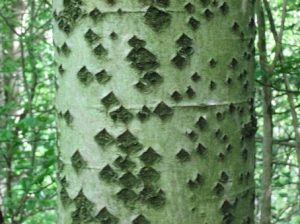
In Genesis 30:37 (see also plane) Jacob’s magical recipe for multiplying sheep and goats relied on the light inner wood of the white poplar Populus alba, a tree that grows along riverbanks in Israel. This softwood tree with gray bark was used for timber and for making tools and rafters. In some places the bark is used as medicine.

The Euphrates poplar Populus euphratica likewise grows along riverbanks, but it is much more widespread in the Middle East than the white poplar, and that makes it a natural candidate for the reference in Psalm 137:2, which says “On the ‘aravim [‘willows’ in RSV and NRSVue] there we hung up our lyres.” This is further strengthened by the fact that in Iraq this poplar is called gharab, which is cognate with ‘aravah.

The white poplar is a tall tree reaching perhaps 20 meters (66 feet). Its seeds are dispersed by the wind in bunches of long, silky hair. The Euphrates poplar is also tall. It has two types of leaves. When young, it produces a narrow leaf like a willow; when it matures, its leaves are broader. This has led to some confusion among scholars as to the identity of willows and poplars mentioned in the Bible.

Populus species (cottonwood, aspen) are known throughout Europe and North America. In Africa, apart from North Africa and South Africa where a number of kinds of poplars have been introduced from Europe, there do not seem to be any Populus species. Where Populus species are known, and if the inner bark is known to be white, they could be used in Genesis, but keep in mind that another tree of the same family (willow) is mentioned in Leviticus 23:40. Where Populus species are not known, we advocate transliterating from a major language in Genesis 30:37 (for example, popula, populari, hawur [Arabic], or abele [French]), since this is a historical setting rather than a rhetorical one.

Euphrates poplar, Wikimedia Commons
White poplar trunk, Wikimedia Commons

Source: Each According to its Kind: Plants and Trees in the Bible (UBS Helps for Translators)

Phoenician juniper (coastal juniper)

The Phoenician Juniper Juniperus phoenicea is a lower-altitude cousin of the Grecian juniper. At present it is found scattered throughout the mountains of northern Sinai and southern Jordan, and Hepper notes that it occurs throughout the higher parts of Sinai and Arabia. In ancient times it may have been found throughout the Negev. Deuteronomy 2:36 refers to a town on the edge of the Wadi Arnon called Aroer, which is probably cognate with the Hebrew word ‘ar‘ar, indicating that these trees may have grown there. The identification of ‘ar‘ar/‘aro‘er as the Phoenician juniper is supported by the fact that Arabs in several countries call this juniper ‘ar‘ar. Since it is closely related to the cedars, some people also call it the “Phoenician cedar.” Note that Hebrew uses the same word ’erez to cover both the Phoenician juniper and the mighty cedar of Lebanon.

The Phoenician juniper is a short shrub or tree that may reach 5 meters (17 feet). It has tiny leathery leaflets and small berry-like cones.

We advocate translating ’erez as “juniper” in Leviticus and Numbers, if that species is known, or using a transliteration from a major language. The reference to ‘ar‘ar in Jeremiah 17:6 is poetic, and a cultural equivalent may be used; in a more literal version a transliteration may be used. Some scholars take the Hebrew word ‘aro‘er in the last line of Jeremiah 48:6 as meaning “juniper.”

Phoenician juniper, photo by Ray Pritz

Source: Each According to its Kind: Plants and Trees in the Bible (UBS Helps for Translators)

myrtle

The Myrtle Myrtus communis is found in the mountains of the Galilee region up to the present, as well as in North Africa and throughout the Middle East. In the apocalyptic passage Isaiah 41:19 it is listed with cedars, acacias, and olives, and we are told that in the new age these verdant trees will replace the thorny bushes of the wilderness. The Arabic as (آس) and the Akkadian asu (𒊍 / 𒀀𒋢𒌝) are cognates of the Hebrew word hadas. The leaves and flowers of the myrtle are used in weddings and in medicine. The wood is used for walking sticks and furniture. The bark and roots yield tannin, used up to the present day in Russia and Turkey to prepare leather.

The myrtle shrub is an evergreen with fragrant leaves and normally grows to a height of 2-3 meters (7-10 feet). It has leathery, dark green leaves, pretty white flowers, and bluish black berries, which have a sweet smell.

Nehemiah 8:15 tells us that branches of the myrtle and other trees were used to make shelters for the Festival of Shelters, a practice still followed by Jews today. The Isaiah references associate the myrtle with a time of renewal and goodness. Taken together we may conclude that when Zechariah situates his vision of horses and riders “among the myrtles,” he is thinking of a sacred place, a place of God’s presence, possibly even a “gateway to heaven,” although the use of the definite article may also point to a particular place that Zechariah and his readers knew about. Some commentators hold that the myrtles in Zechariah’s vision represent the people of Israel. Note that these myrtles are said to be growing in some kind of depression in the ground, whether a valley or ravine, which may itself be symbolic of a negative national experience, perhaps even the Babylonian Exile, as some have suggested.

Myrtles are part of the gigantic Myrtaceae family that includes at least three thousand species throughout the world, including the guava, the eucalyptus, and the clove. Close relatives of the myrtle, however, may be hard to find, so a transliteration from a major language may be the best option. In the poetical Isaiah passages the handling of hadas will depend on what the translator does with the other names of trees in the list, whether they use literary equivalents or transliterations. In Nehemiah, transliteration is advised, unless, of course, myrtle or a close relative of it is known. In Zechariah, since we do not know the significant features of the myrtle that the writer had in mind, it is difficult to make an appropriate descriptive equivalent. However, a transliteration or a generic phrase such as “shrubs” or “small, leafy trees” may be used.

Myrtle flowers, photo by Nigel Hepper
Myrtle branch, photo by Gloria Suess

Source: Each According to its Kind: Plants and Trees in the Bible (UBS Helps for Translators)