Western Bukidnon Manobo: “high sacrificer” (source: Western Bukidnon Manobo Back Translation)
Tagbanwa as “Most-important Priest of God” (source: Tagbanwa Back Translation)
Bariai: “Big leader of offerings” (source: Bariai Back Translation)
In Khoekhoe the translation for “high priest” is only capitalized when it refers to Jesus (as is Hebrews 2:17 et al.). (Source: project-specific notes in Paratext)
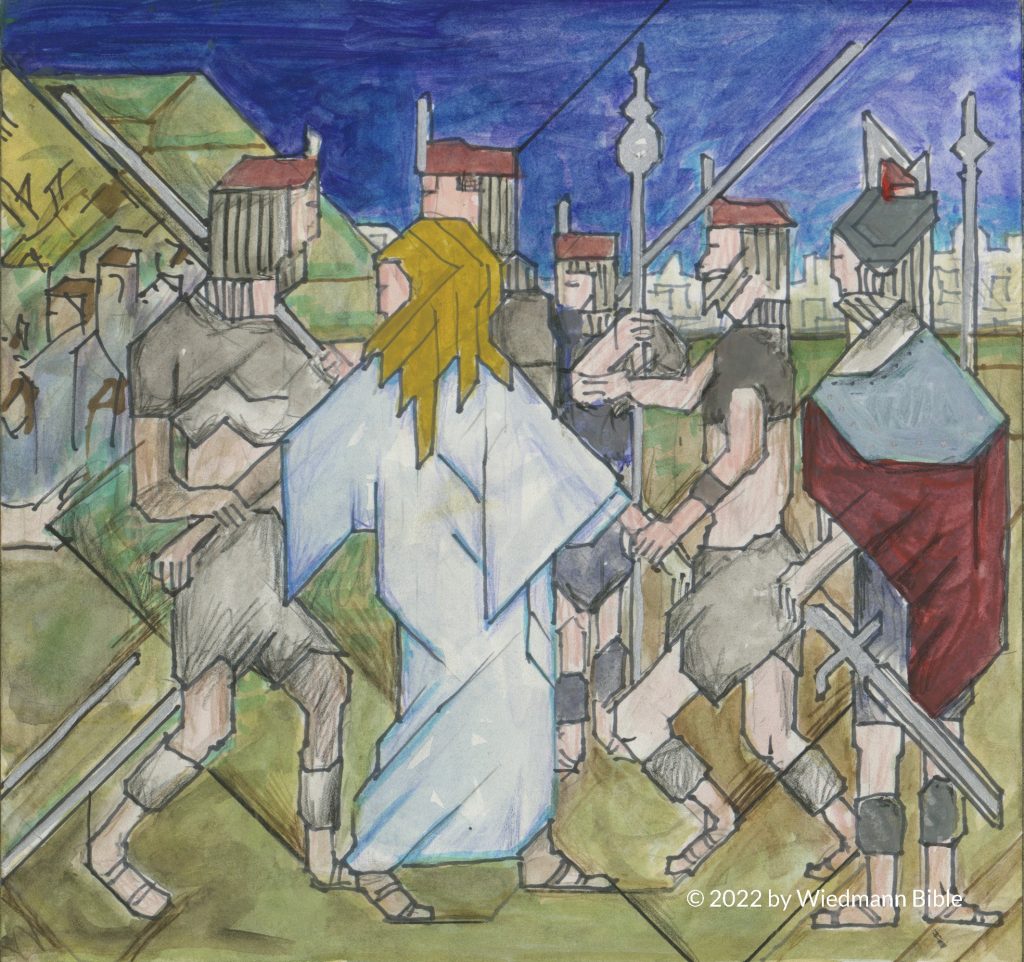
Orthodox Icons are not drawings or creations of imagination. They are in fact writings of things not of this world. Icons can represent our Lord Jesus Christ, the Virgin Mary, and the Saints. They can also represent the Holy Trinity, Angels, the Heavenly hosts, and even events. Orthodox icons, unlike Western pictures, change the perspective and form of the image so that it is not naturalistic. This is done so that we can look beyond appearances of the world, and instead look to the spiritual truth of the holy person or event. (Source )
Following is a hand colored stencil print on momigami of Peter by Sadao Watanabe (1970):
Image taken with permission from the SadaoHanga Catalogue where you can find many more images and information about Sadao Watanabe. For other images of Sadao Watanabe art works in TIPs, see here.
Following are a number of back-translations of Luke 22:54:
Noongar: “They arrested Jesus and took him away to the house of the High Priest, and Peter followed them.” (Source: Warda-Kwabba Luke-Ang)
Uma: “From there, they really did arrest him, and they took him to the house of the High Priest. Petrus followed at a distance.” (Source: Uma Back Translation)
Yakan: “Then they seized Isa and took him away to the house of the leading priest. Petros followed Isa but from a distance.” (Source: Yakan Back Translation)
Western Bukidnon Manobo: “Then they arrested Jesus and they took him to the house of the high priest. And Peter, he followed — however, not very closely.” (Source: Western Bukidnon Manobo Back Translation)
Kankanaey: “Then they arrested Jesus and took him to the house of the highest priest. As for Pedro, he followed at a measurable distance (lit. space-between).” (Source: Kankanaey Back Translation)
Tagbanwa: “Without anything further, Jesus was taken by those who arrested him to the house of the Most-important Priest. As for Pedro, he followed-along-at-a-distance(usually implies to check on safety of one being followed).” (Source: Tagbanwa Back Translation)
Barclay Newman, a translator on the teams for both the Good News Bible and the Contemporary English Version, translated passages of the New Testament into English and published them in 2014, “in a publication brief enough to be non-threatening, yet long enough to be taken seriously, and interesting enough to appeal to believers and un-believers alike.” The following is the translation of Luke 22:54-65:
Peter kept his distance after Jesus was arrested
and led away to the house of the high priest.
Some people were sitting around a fire
in the courtyard of the house, and Peter joined them.
“This man was with Jesus!” blurted out a servant girl.
“I don’t even know the guy!” insisted Peter.
“You’re one of them!” someone said with a smirk.
“Not me!” denied Peter.
An hour or so later, another man swore,
“This man was with Jesus—they’re both from Galilee.”
“I don’t know what you’re talking about!”
came Peter’s denial.
At that very moment, while Peter was still speaking,
he heard the sound of a rooster crowing.
The Lord looked in Peter’s direction,
and Peter remembered those solemn words,
“Before a rooster crows tomorrow morning,
you’ll say three times you don’t even know me.”
Peter left and wept bitterly.
Meanwhile, the guards insulted and struck Jesus.
They put a blindfold on him and sneered as they said,
“Tell us who hit you?”
And this was not the worst they did to him.
Living Water is produced for the Bible translation movement in association with Lutheran Bible Translators. Lyrics derived from the ESV® Bible (The Holy Bible, English Standard Version®).
sullabontes de auton ēgagon ‘after arresting him they led (him) away.’ Subject is probably the persons mentioned in v. 52. agō is used here in the meaning ‘to lead away,’ ‘to take into custody.’
eisēgagon eis tēn oikian tou archiereōs ‘they brought him to the house of the high priest.’ eisagō is a general term without specific judicial connotation. oikia refers to the official residence of the high priest. For archiereus cf. on 3.2.
ho de Petros ēkolouthei makrothen ‘and Peter followed at a distance,’ descriptive imperfect, denoting an act which accompanied the events related in the preceding clause. The range of makrothen ‘at a distance’ is determined by the fact that he had to keep far enough away to remain unnoticed, i.e. outside the light of the torches.
Translation:
They seized him and led him away. Since the persons mentioned in v. 52 are initiators rather than direct agents the clause may have to be rendered, ‘had him seized and led away,’ ‘ordered their men to take hold of him and lead him away.’
Bringing him to often better as a main clause, e.g. “They brought him to” (New English Bible), or, ‘they had him brought to.’
Followed, i.e. went along after the crowd cf. a rendering such as, ‘walked far behind in coming’ (Sranan Tongo, similarly Zarma). If an object is obligatory, one can best add ‘them’ or another reference to those who led Jesus away.
At a distance, cf. on 15.20.
Quoted with permission from Reiling, J. and Swellengrebel, J.L. A Handbook on the Gospel of Luke. (UBS Handbook Series). New York: UBS, 1971. For this and other handbooks for translators see here . Make sure to also consult the Handbook on the Gospel of Mark for parallel or similar verses.
In 22:33 Peter said that he would never leave Jesus or be unfaithful to him. But in 22:34 Jesus predicted that actually Peter would say three times that he did not know Jesus. After Jesus was arrested, Peter followed Jesus to the house of the high priest and waited in the courtyard. Three different people said that Peter had been with Jesus, and three times Peter said he did not know Jesus. But then a rooster crowed, and Peter suddenly remembered what Jesus had said. Peter wept with great sorrow because he had denied that he knew Jesus his Lord.
Some other examples of headings for this section are:
Peter Denies Jesus (New Revised Standard Version) -or-
Jesus’ Condemnation and Peter’s Denials (NET Bible) -or-
Peter Says He Doesn’t Know Jesus (New Century Version)
There are parallel passages for this section in Matthew 26:57–58, 26:69–75, Mark 14:53–54, 14:66–72, and John 18:12–18, 18:25–27.
Paragraph 22:54–57
22:54a
Then: The Greek word that the Berean Standard Bible translates as Then is a common conjunction that can be translated in different ways. Here it introduces what happened after Jesus spoke to the crowd. Many English versions introduce this next event with Then or “So.” Other versions do not have a conjunction. Introduce this event in a natural way in your language.
they seized Jesus: The phrase they seized Jesus indicates that the temple guards (police) held Jesus firmly in their hands so that he could not leave. They arrested him and made him their prisoner.
In many languages it may be necessary to make clear who arrested Jesus. The people who actually took hold of him were the officers of the temple guard, who were mentioned in 22:52b. Refer back to them in a natural way in your language.
Here are some other ways to translate the clause they seized Jesus:
• Use an active clause with subject and object. For example:
the captains of the temple guard seized/grabbed Jesus -or-
the temple guards/police arrested Jesus
• Use a passive verb. For example:
Jesus was arrested (Contemporary English Version)
Translate the clause in a natural way in your language.
22:54b–c
led Him away, and took Him into the house of the high priest: This clause has the two verbs led and took. The first verb refers to leading Jesus out of the garden. The second verb refers to taking him to the high priest’s house. Some versions put the second verb in a separate sentence. For example:
…led him away. They brought him to the high priest’s house (Revised English Bible)
These verbs do not imply that the guards took Jesus violently. They forced Jesus to go with them, but he did not resist them.
In some languages it may be more natural to use only one verb to describe the actions. For example:
and led him away to the chief priest’s house (God’s Word) -or-
and they took him to the house of the High Priest
Translate the actions in a natural way in your language.
into the house of the high priest: This house, where the high priest lived, was probably large. It is likely that it had an open courtyard with rooms around it.
the high priest: The term high priest occurred in 22:50. You should translate it in the same way here. See the note at 22:50 for more information.
22:54c
And Peter followed at a distance: The clause And Peter followed at a distance indicates that Peter walked behind the people who were taking Jesus to the high priest’s house. Peter did not get close to them as he walked. He stayed far enough from them so that they would not notice him. Some other ways to translate this clause are:
Peter followed but not very close -or-
Peter followed ⌊them⌋ from a ⌊safe⌋ distance -or-
Peter went along behind ⌊Jesus and his captors⌋, but he did not come near them



Leave a Reply
You must be logged in to post a comment.