The Greek and Hebrew that is translated with “mule” in English is translated in Swahili with nyumbu which also is a homonym for “wildebeest,” potentially causing confusion.
In Kutu it is translated with “big donkey” because there is no other adequate term in Kutu. (Source: Pioneer Bible Translators, project-specific translation notes in Paratext)
In the HausaCommon Language Bible it is translated jakin-doki or “donkey-horse,” since mules are also not known in Nigeria. (Source: Andy Warren-Rothlin)
The word pirdah refers to the female mule while pered can refer to either the male or the female. In biblical times mules were used for riding and as pack animals while horses were mainly used to pull military chariots. They appear to have been introduced into Canaan much later than horses. Mules are not mentioned in the Bible until the time of David while horses are mentioned in the Joseph story and in Deuteronomy 17:16 where the king is forbidden to acquire them. Technically the owning of mules was not prohibited although the breeding of them would have fallen under the prohibition of Leviticus 19:19, which forbade the cross-breeding of animals. The Israelites thus seem to have relied on mules imported from neighboring countries.
The mule is not an animal found naturally anywhere, but is the result of people breeding male donkeys with female horses. It is also possible to breed male horses with female donkeys, but the offspring, technically called “hinnies”, not “mules”, are usually smaller than mules. Mules are bigger and stronger than donkeys and are much more resistant to disease than either horses or donkeys. They are usually dark brown with bigger ears than the parent horse.
Although there are male and female mules they are infertile and not able to breed. This makes the stronger males much easier to handle than stallions.
Although the mule in English is associated with stubbornness this is not usually the case in other cultures since mules are very easy to handle if treated properly. In Psalms 32:9 the mule is linked to the horse as both being animals that lack sufficient understanding and need to be guided in the right direction.
Even in languages of societies that know mules, they are often referred to as “horse-donkeys”, or “donkey-horses”. This seems to be a good translation solution even in languages that have no word for mule.
Both the Hebrew and Greek names are probably general terms for gazelle. At least two types of gazelle the Dorcas Gazelle Gazella dorcas and the Palestine or Arabian Gazelle Gazella arabica were found in the Middle East. They are still to be found in secluded areas.
Gazelles are small to medium sized plains antelopes, inhabiting savannah plains and semideserts. Both sexes have horns, except for the female impala, which is without horns. The horns of the gazelle species mentioned above are lyre-shaped about 25-50 centimeters (10-20 inches) in length. Gazelles are reddish brown with almost white underparts. They are long-legged and graceful and are expert jumpers. They live in small herds of up to about thirty. Females become sexually active at one year and bear young every year. This high rate of reproduction ensures their survival. They feed on both grass and the leaves of acacia and other bushes.
A breeding herd consists of one dominant breeding male and a group of females. The other males are chased from the herd when they become sexually active and they then form bachelor herds. These bachelor herds are the prime target for human and animal hunters since they provide a convenient source of meat while leaving the breeding cycle intact. In biblical times gazelles were trapped in nets or snares or were shot with bows and arrows.
The gazelle was seen as the cleanest of game animals since it met all the requirements of the Law concerning cloven hooves and cud-chewing. It was also a symbol of speed grace and beauty (the Hebrew root means beauty) and of female sexuality and fertility.
Where a language distinguishes between male and female animals, tsvi should be translated by the male form and tsviyah by the female form.
In East Africa where gazelles are well-known, a generic word for gazelles or the specific word for one of the smaller gazelles, such as the Thompson’s Gazelle Gazella thompsonii, is suitable. Elsewhere in Africa where the impala is known, the word for this antelope can be used.
Elsewhere, the word for a small antelope or deer that lives in herds can be used for the references that are literal, and the word for some swift, graceful antelope or deer can be used in the contexts where speed, grace, or beauty are being symbolized. As usual, in areas where gazelles, antelopes, and deer are unknown, a transliteration from the dominant international language or from the Hebrew original can be used. In such cases a description should be given in the glossary.
Although the majority of English versions have roebuck, which is the male form of roe deer many biblical zoologists reject this rendering. They argue that roe deer while being fairly common in biblical times live singly or in pairs for part of the year but not in herds they are extremely shy and difficult to hunt as they live in thick undergrowth and seldom leave it. They are rarely even seen in areas where they live. Thus the argument goes it would have been almost impossible for large numbers of roe deer to have been brought to Solomon’s table on a daily basis as recorded in 1 Kings 4:23. However others argue that trapping roe deer would have been easy even though hunting was not.
The consensus among the zoologists supports the translation “bubal hartebeest” which was well known and could easily have been kept in semi-domesticated herds as were deer [Note that bubal hartebeest are now extinct]. In Egypt and to a lesser extent in Sinai the bubal hartebeest was depicted in murals and stone carvings and many mummified hartebeests have also been found in Egyptian sites. Both Canaanite and Israelite archeological sites have yielded hartebeest bones in fairly large quantities. They have even been found in close proximity to Canaanite altars suggesting that the Canaanites sacrificed them.
The Hebrew name yachmur is probably derived from a root ch-m-r, which means “red” and is the same root from which the Hebrew name for a donkey is derived. The bubal hartebeest is both red and remarkably like a horned donkey. It is also known as the red hartebeest. The word “hartebeest” is a word borrowed from Dutch and literally means “deer-cow”.
Interestingly, the Septuagint translates yachmur as bubalos “water buffalo”, which was an animal well known to the Israelites. Water buffalo were domesticated in Babylonia and Syria and were found in the marshes of northern Israel around Lake Huleh. However this translation has no support among modern scholars. The name bubal in bubal hartebeest is derived from this same Greek word.
Roe Deer capreolus capreolus are small deer, the adult males having short horns that have three prongs. Their fur is brownish in summer and gray in winter. They live singly or in pairs in the undergrowth of forests and thick woodland, never moving more than one or two meters (3-6 feet) from cover, even when feeding.
The Bubal or Red Hartebeest alcelaphus buselaphus is a large antelope about 1.5 meters (5 feet) high at the shoulder. Both males and females have very long faces with a large lump on the head from which sprout short thick horns. These curve upward and forward for half their length and then angle sharply backwards. Hartebeests are reddish brown in color.
They are plains animals and graze in herds often among gazelles zebras or other antelope. Although they look slightly ungainly with their sloping backs hartebeests are very good runners and can sustain high speed for as much as 10 kilometers (6 miles) easily outrunning any other animal over this distance.
These animals were once found all over North Africa and the plains of the land of Israel where they were known as “wild cows” by Bedouin. In some Jewish versions of the Bible yachmur is translated as “wild cow”. The bubal hartebeest has disappeared from those areas, but it is still found in the Kalahari semidesert in Botswana and in adjacent areas in Angola Namibia Zambia and Zimbabwe. Very similar hartebeests alcelaphus lelwel and alcelaphus cokei are also found in Chad, Sudan, Uganda, Kenya and Tanzania. In the latter two countries they are known by their Swahili name “kongoni”.
If the interpretation “roe deer” is chosen, then the local name for this deer can be used, where roe deer are known. In areas where roe deer are not known, names for other similar small deer can be used, as for instance: India, Myanmar (Burma), and Southeast Asia: Muntjak or Barking Deer muntiacus muntiacus; Latin America: Pampas Deer blastocerus bezoarticus of Brazil and Argentina. In areas of Africa where deer are not known, the name of a small solitary antelope, such as one of the duikers, can be used. Elsewhere an expression such as “small deer” (in contrast to “large deer” for the fallow deer), or a transliteration, can be used.
If the choice is for red or bubal hartebeest the following possibilities exist: Botswana, Zambia, Zimbabwe: the local word for Red Hartebeest alcelaphus buselaphus; East Africa: the Coke’s Hartebeest or Kongoni alcelaphus cokei; Chad and Sudan: Lelwel Hartebeest alcelaphus lelwel; Southern Africa: Cape Hartebeest alcelaphus caama, Tsessebe damaliscus lunatus, Bontebok damaliscus pygargus, or Blesbok damaliscus albifrons. Elsewhere a name like “wild cow” can be used.
The Hebrew, Latin and Greek that is translated in English as “reptiles” or “creeping things” or similar is translated as “those which crawl along upon their stomach” in San Mateo del Mar Huave, “those that crawl the way they travel” in Chichimeca-Jonaz, and “animals that crawl on the ground” in Lalana Chinantec. (Source: Viola Waterhouse in Notes on Translation August 1966, p. 86ff.)
In Nyamwezi it is translated as as vitundwa vya ku’yu’mba or “creatures that move.” (Source: Pioneer Bible Translators, project-specific translation notes in Paratext)
The Hebrew words zachal and remes literally mean “creeping [things]” or “crawling [things]”, which is the Hebrew way of referring to small unclean creatures, reptiles in particular. The Greek word herpeton is also a general word for reptile; it includes snakes and lizards. All of the Hebrew, Greek, and Latin words usually exclude fish.
The Hebrew words carry the connotation of uncleanness.
In languages which have a word meaning “reptile”, this will fit most contexts. In languages which do not, phrases such as “snakes and lizards”, “wriggling things”, and so forth could be used.
The Hebrew that is translated as “ostrich” in English was translated in the 1900 Kalaallisut (Greenlandic) translation (a newer version was published in 2000) as ĸatigagtûssatdlo or “back-like ones.” “The Greenlandic translation of the term for ‘ostriches’ is a descriptive term based on the noun ĸatigak (modern qatigak) ‘back,’ followed by the participial suffix –toĸ (modern –toq), and then the suffix –usaĸ (modern –usaq) ‘something resembling,’ the entire word meaning ‘some- thing resembling something that has a back.’” (Source: Lily Kahn & Riitta-Liisa Valijärvi in The Bible Translator 2019, p. 125ff.)
Both of the Hebrew words refer to the ostrich, and some scholars believe that they are really the singular and plural forms of the same word, written slightly differently as the result of a spelling mistake by a scribe. In ancient Hebrew writing they are very similar.
The word renanim may be related to a verb root that means “to call loudly”, a reference to the booming call of the male ostrich.
The Ostrich Struthio camelus is the largest living bird on earth. It cannot fly, because it has underdeveloped wings. It has a long neck and long legs and is about 2 meters (6 feet) tall. The head and neck are almost bald, being covered in short bristles. The male’s body is black with long white feathers on its wings. Its tail is white, gray, or light brown. The females are a uniform grayish brown.
Ostriches feed mainly on seeds, fallen fruit, and shoots and may occasionally eat a lizard or a frog. They also pick up and swallow small pebbles to aid their digestion. They live in small flocks of about twenty, of which four or five are males. They have very unusual nesting habits. The nest is nothing more than a large shallow hollow scraped in the sand. As many as ten females may lay their eggs in the one nest. Only one female and one male will incubate the eggs, however, with the female on the nest in the daytime, and the male taking over later in the afternoon. This is probably because the black male has better camouflage at night. Since ostriches breed at any time of the year, there are often three or four nests occupied by a flock.
During the day a female that is sitting on the eggs will leave the nest to feed. If any danger threatens, she will also leave the eggs and try to lure the threatening animal or human away from the nest. Since the eggs will keep warm in the hot sand the female may be away from the nest for a long time. Once the chickens are hatched, they follow the female that incubated them for a while, but females with chicks will fight among themselves until all the chicks of the flock are taken over by one dominant female. At any sign of danger, the chicks lie motionless under a bush, while the “mother” will try to lure the danger away.
Male ostriches make a series of deep booming hoots that can be heard great distances and which are often mistaken for the roar of a lion. (Fauna and Flora of the Bible is misleading in the statement that ostriches make a “hoarse complaining cry” at night.)
Even though there are only two certain references to ostriches in the Bible, both mention the heartless cruelty of this bird. This is probably a reference to the fact that a) most females lay eggs and then show no further interest in them, leaving them to another to incubate, b) the incubating female may leave the nest for long periods, and c) the hatched chicks are left to one female to care for, regardless of which other females laid the eggs or incubated them. Taken as a whole this seems to be contrary to all “natural motherly instincts.”
In savannah Africa where ostriches are well known there will be local words for ostrich. In Australasia the emu and cassowary are close equivalents, but a footnote may be needed, especially in the case of the cassowary, to indicate that the nesting habits of the ostrich are different, and since it lives in open savannah it can run much faster than the cassowary. Elsewhere a borrowing from the dominant language of the area may be necessary.
Job 39:13: This verse is difficult to make sense of in Hebrew. The general consensus among commentators is that it means something like “The wings of the ostrich beat rapidly [or, joyfully], but they certainly are not comparable to the wings of a stork.” The reference in Job 39:13 to the ostrich laughing at the horse and rider is a reference to the fact that ostriches can outrun horses. In some cultures this may need an explanatory footnote.
Coney: The seventeenth century English word “coney” was the common word at that time for the rabbit, “rabbit” being used at that time only for the baby rabbit. In later English, “rabbit” came to be used for the adults as well. “Coney” then dropped out of use except among fur traders. However it is certain that the Hebrew word shafan does not mean “rabbit” so the King James Version translation “coney” was incorrect. In the nineteenth century, Bible readers perhaps not being sure what a “coney” was, came to identify the “coney” with the Syrian hyrax, probably as the result of hearing preachers describe the animal. To these readers then “coney” acquired a new meaning that it had nowhere else. The use of “coney” is thus both archaic and incorrect.
Badger: Two types of badger live in the land of Israel. The more common is Meles meles and the second is the ratel or Honey Badger Mellivora capensis. The ratel eats anything from small mammals to lizards, insects, snails, fruit, honey and any dead animal or bird. But the animal referred to in Leviticus 11:5 and Deuteronomy 14:7 eats only vegetation and in Psalm 104:18 and Proverbs 30:26 it is associated with rocks as its natural habitat. Shafan therefore cannot be the badger or the ratel Thus those versions using “badger” are likewise incorrect.
Rock badger: Mystery surrounds the name “rock badger”. There was no known animal popularly called a “rock badger” prior to the release of the Brown, Driver, and Briggs translation of Gesenius’ Hebrew Lexicon in 1906. In this lexicon apparently for the first time, “rock badger” appears as the translation of the Hebrew shafan. It is unclear why they coined this new word in preference to the more common “rock rabbit”, but it was probably the result of translating the Cape Dutch klip dassie (“little rock badger”) too literally. However “rock badger” has been used by most English translators ever since. Both “coney” and “rock badger” are, however, not only basically meaningless to most readers but are also incorrect.
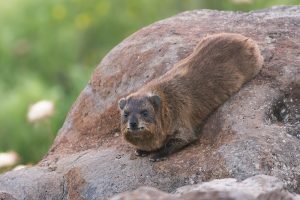
The animal referred to by the Hebrew word shafan is undoubtedly the Syrian Rock Hyrax Procavia capensis syriaca. This identification was first made by Canon Tristram in 1867 and has been confirmed many times since. It is a very common animal in the Middle East and Africa eats only vegetation and lives among the rocks.
In southern and eastern Africa other subspecies of the Hyrax Procavia capensis and the Yellow-spotted Hyrax Heterohyrax brucei are sometimes called “rock rabbit”, but are more usually called by the Afrikaans name “dassie”.
Hyraxes are found only in the Middle East and Africa. They are the size of small rabbits, but there the similarity ends. Hyraxes are unique in many ways. They have small round ears, no visible tail, and short legs. They look a bit like giant guinea pigs or cane rats, but they are not really rodents. They live mainly on leaves and herbs. The structure of their jaws, teeth, and feet and the size of their prehistoric ancestors link them to the rhinoceros and elephant.
Two of their top front teeth develop into small tusks which sometimes protrude from the side of their mouth. They have four toes on their front feet and three on the back feet. These toes do not have claws but each has a small hoof-like nail. The soles of their feet are perpetually clammy, being lubricated by a special gland. This enables them to run up almost vertical rock faces and climb trees with ease. In the middle of their back they have another large gland covered with an oval patch of hairs of a different color. These hairs can be raised as an alarm signal.
For such small mammals hyraxes have a very long gestation period of seven months. They live in fairly large family groups and since they are unable to regulate their body temperature by perspiring they huddle together in cavities under rocks when the weather is cold and lie stretched out in breezy locations in the shade of the rocks or trees when it is hot. They are thus only active and visible when the temperature is neither very hot nor cold.
They are quite vocal creatures, communicating by a variety of grunts, whistle-like alarm squeals, and territory-marking barks.
The Syrian rock hyrax is a fawny gray color with a yellowish back patch. Today they are easily seen in the wadis of the Judean Desert and in many parts of Galilee. They are also found in the Sinai, Arabian Peninsula, Syria and Lebanon.
In Leviticus 11:5 and Deuteronomy 14:7 hyraxes are said to “chew the cud”. This is not factually correct but they often look as if they are chewing endlessly. The reasons for them being declared “unclean” are strictly religious. As vegetation eaters they are no more a health hazard than for example goats or sheep. They actually spend a lot of time cleaning themselves.
Apart from being viewed as “unclean” animals there is one additional significance associated with the hyrax. Being virtually defenseless and easy prey for hawks, leopards, and human beings, the hyrax in Proverbs 30:26 symbolizes a combination of defenselessness and wisdom. It is defenseless but wise enough to seek the protection of the rocks which in turn are symbolic of the timeless protective stability of God.
Hyraxes are distributed over a wide area of eastern, western, central, and southern Africa. It is thus not usually difficult to find a word for hyrax in this region. In many eastern and southeastern Bantu languages the word for hyrax is mbira, mbila, mpila, or some similar derivative. It is usually classified in these languages as a type of rat.
Outside of the Middle East and Africa, however, it is difficult to find a word that will be both accurate and well known. Phrases such as “cliff rabbits” or “rock rabbits” are sometimes acceptable, but the best solution is probably to transliterate either the Hebrew word shafan or the scientific general name “hyrax”, and to include a fuller description in a footnote or in a glossary.
In the passages in Leviticus and Deuteronomy the translator is obliged to translate the writer’s view that the hyrax is a cud-chewing animal, even though this may not be factually correct.
The word tsavu‘a occurs only twice in the Bible one of them being in the phrase ‘ayit tsavu‘a (Jeremiah 12:9). The word ‘ayit is usually taken to mean a screamer and in Genesis 15:11 it is obviously a bird hence the interpretation “bird of prey.” tsavu‘a is taken to mean “speckled blotched”. Thus the “speckled screamer” is taken by some scholars to mean “speckled bird of prey” and by others to mean “hyena.” However, there are also scholars who relate ‘ayit to a different Hebrew root that means “to attack greedily” and take ‘ayit to mean “prey” or even “carrion”. These latter scholars interpret ‘ayit tsavu‘a to mean “prey for hyenas” or “carrion for hyenas.” It is recommended that this exegesis be followed. Another possible rendering of the phrase could even be a place of scavenging hyenas.
There is considerable doubt about the meaning of the Hebrew word tsiyim and different translations have marmots, wild animals, wild cats, desert animals and even sharks and dolphins. It is clear that the word refers to a specific dangerous wild animal (possibly which lives in the desert) often associated with destruction and with jackals. Although not mentioned at all in the English versions there are many scholars zoologists among them who interpret this word as referring to the hyena.
The uncertainty surrounding the word relates to the fact that nobody is sure what other Hebrew words tsiyim is related to. Some relate it to a word for “desert”, thus “desert creature”. This interpretation does not exclude the hyena and in fact since the references seem to be to a specific animal rather than to desert animals in general the contexts would all fit “hyena” well. The trend among scholars today is to associate it with a word that disappeared early from Hebrew meaning “to wail or yelp”. The fairly obvious conclusion from this would be that the word means “the wailer”, that is the hyena.
The Striped Hyena Hyaena hyaena has been a very well-known and common animal in the Middle East since time immemorial. One would expect to find references to it in the Bible.
Hyenas emerge at night from holes and hollows under logs. They are best known as scavengers. They eat carcasses and bones of all kinds and forage in refuse dumps around cities, towns, and villages. However, they also hunt and are opportunistic, killing young goats, sheep, and baby gazelles. They often occupy abandoned houses or tombs.
Their weird calls at night vary from loud whoops and howls when they mark territory and contact family members to moans when they chase away rival scavengers and to yelps and wails when they are frightened away by humans or other predators.
The striped hyena is also found in northeast Africa the Arabian Peninsula and India. Like all hyena species it looks like a big dog with a large head. Its front legs are longer than its back legs and it has a stiff upright mane that stretches from between its ears all the way down its back to the end of its tail. It is a brownish gray color with dark indistinct stripes that become spots and blotches on its neck.
Since we cannot be one hundred percent sure that tsiyim refers to hyenas neither can we be sure of the connotations of the word. However from what is known about hyenas and their significance to other Semitic peoples we can draw some conclusions. As scavengers that eat carcasses hyenas thrive in times of famine or war. They are thus associated with both types of catastrophe. Their weird noises at night are often associated with demons and stories abound of ghosts that return in the form of hyenas. And finally probably because they are known to eat human corpses that have not been properly buried most people view them with repugnance. Anywhere in the Middle East to call someone a hyena is a terrible insult.
A different, but very similar species of hyena, the Spotted Hyena Crocuta crocuta, is found throughout eastern, central, and southern Africa. Another species, the Brown Hyena Hyaena brunnea, is found in southwestern Africa. In these areas, therefore, a word for hyena will be easy to find.
In areas where some kind of wild scavenging dog or wolf is known, the name for this animal can be used. Elsewhere one may use a phrase like “wild dog” or a transliteration and give a fuller description in the glossary or word list.
Owls are found worldwide except in the Antarctic and on some islands. They are active at night and are characterized by flat faces and short hooked beaks that they can open very wide. They swallow their prey whole and later regurgitate the undigested parts as small balls. They also have the ability to turn their heads more than 180 degrees.
There are two basic owl families, both of which are found in the land of Israel. One family is the Tytonidae, which are the Barn and Grass Owls. They have heart-shaped whitish faces, usually outlined by a dark line, and small dark eyes. The other family is the Strigidae, the typical owls. This family contains a large variety of species, all of which have large eyes that may vary in color from light brown through orange to yellow. This family includes the eared or horned owls, the fairly rare fishing owls, and owls that vary in size from the midget scops owl (less than 20 centimeters [8 inches]) through to the giant eagle owl (over 70 centimeters [28 inches]).
Eight species of owl are fairly common in the land of Israel. Most are very seldom seen by humans, but they are quite well known by their different and distinct calls. In biblical times the nights would have been much quieter than in most modern places, and the strange night sounds probably would have interested people, causing some speculation about what was making the sound. The different owls would thus probably have had different names even if people had never seen them. In fact it is unlikely that they would have been able to associate most of the calls with the owls that were seen.
Some scholars have linked bath ya‘anah with the word ya‘en, which is the ostrich. In view of the contexts in which the word occurs, however, it does not seem that this is a likely interpretation. In the biblical contexts it can be seen that the bath ya‘anah is linked with jackals, deserted ruins, and wailing sounds. It also seems to be reliant on water (compare Isaiah 43:20). None of these are contexts into which the ostrich would fit easily. Furthermore, while it is easy to see the reason why certain birds are listed as unclean, from their diet or association with foreign deities, it is not easy to see why ostriches would be included in the list. They are basically vegetarian, like domestic fowls. The only possible reason would be that since they cannot fly, they were considered somehow “unnatural,” as was the bat.
Other scholars have derived the name from an Arabic word meaning “desert,” and still others from an Aramaic word meaning “greedy.” Hasting’s Dictionary of the Bible suggests that it refers to the eagle owl, and from its position in the list of unclean birds this seems a distinct possibility. The “desert-owl” of New English Bible and Revised English Bible is not a distinct species but a general word for owls that live away from towns.
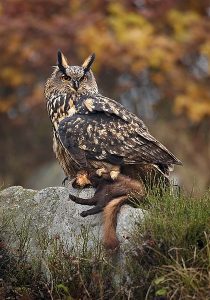
Eagle owls are the giants in the owl family. The European Eagle Owl Bubo bubo is the largest owl in the Middle East, standing over 75 centimeters (30 inches) tall. The corresponding owl in the land of Israel is a pale fawn color, spotted, has ear tufts, and is best known by its loud, deep hooting at night. It roosts by day in deep shade in acacia trees, caves, tombs, and ruined buildings. It feeds on small mammals, including hares, baby gazelles, lambs, rats and mice, and large roosting birds, especially wild and domestic ducks. It is sometimes seen when it is roosting during the day, or when disturbed in a cave or old tomb, but it is seldom seen at night, except in modern times when it is sometimes seen on roads late at night.
In the Bible this owl is associated with death, mourning, and ruin, as well as being listed as an unclean bird.
Eagle owls of one species or another are found in southern and eastern Europe and throughout Africa and South and Southeast Asia. Large owls of a slightly different kind are found in Australasia. The two most common African eagle owls are the Spotted Eagle Owl Bubo africanus and the Giant Eagle Owl Bubo lacteus (known as Verreaux’s eagle owl in East Africa). The Asian Eagle Owl Bubo indicus is found in hilly wooded or forested country away from towns. The largest Australian owl is the Great Scrub Owl Ninox strenua. A word for any of these owls, or a phrase meaning “giant owl”, would be a close local equivalent to use in the lists of unclean birds. In other contexts, a phrase such as “large owls” would be sufficient.