The Hebrew that is translated as “rock badger” (or: “rock hyrax”) in English is translated in a West African language as “boulder goat.” (See this blog entry )
In Hiligaynon it is translated as “animals which chews again their cud/food/what-they-ate but their hooves do-not-have splitting, just-like a camel and a rabbit” (source: Hiligaynon Back Translation).
Coney: The seventeenth century English word “coney” was the common word at that time for the rabbit, “rabbit” being used at that time only for the baby rabbit. In later English, “rabbit” came to be used for the adults as well. “Coney” then dropped out of use except among fur traders. However it is certain that the Hebrew word shafan does not mean “rabbit” so the King James Version translation “coney” was incorrect. In the nineteenth century, Bible readers perhaps not being sure what a “coney” was, came to identify the “coney” with the Syrian hyrax, probably as the result of hearing preachers describe the animal. To these readers then “coney” acquired a new meaning that it had nowhere else. The use of “coney” is thus both archaic and incorrect.
Badger: Two types of badger live in the land of Israel. The more common is Meles meles and the second is the ratel or Honey Badger Mellivora capensis. The ratel eats anything from small mammals to lizards, insects, snails, fruit, honey and any dead animal or bird. But the animal referred to in Leviticus 11:5 and Deuteronomy 14:7 eats only vegetation and in Psalm 104:18 and Proverbs 30:26 it is associated with rocks as its natural habitat. Shafan therefore cannot be the badger or the ratel Thus those versions using “badger” are likewise incorrect.
Rock badger: Mystery surrounds the name “rock badger”. There was no known animal popularly called a “rock badger” prior to the release of the Brown, Driver, and Briggs translation of Gesenius’ Hebrew Lexicon in 1906. In this lexicon apparently for the first time, “rock badger” appears as the translation of the Hebrew shafan. It is unclear why they coined this new word in preference to the more common “rock rabbit”, but it was probably the result of translating the Cape Dutch klip dassie (“little rock badger”) too literally. However “rock badger” has been used by most English translators ever since. Both “coney” and “rock badger” are, however, not only basically meaningless to most readers but are also incorrect.
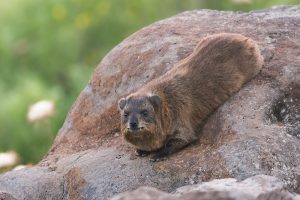
The animal referred to by the Hebrew word shafan is undoubtedly the Syrian Rock Hyrax Procavia capensis syriaca. This identification was first made by Canon Tristram in 1867 and has been confirmed many times since. It is a very common animal in the Middle East and Africa eats only vegetation and lives among the rocks.
In southern and eastern Africa other subspecies of the Hyrax Procavia capensis and the Yellow-spotted Hyrax Heterohyrax brucei are sometimes called “rock rabbit”, but are more usually called by the Afrikaans name “dassie”.
Hyraxes are found only in the Middle East and Africa. They are the size of small rabbits, but there the similarity ends. Hyraxes are unique in many ways. They have small round ears, no visible tail, and short legs. They look a bit like giant guinea pigs or cane rats, but they are not really rodents. They live mainly on leaves and herbs. The structure of their jaws, teeth, and feet and the size of their prehistoric ancestors link them to the rhinoceros and elephant.
Two of their top front teeth develop into small tusks which sometimes protrude from the side of their mouth. They have four toes on their front feet and three on the back feet. These toes do not have claws but each has a small hoof-like nail. The soles of their feet are perpetually clammy, being lubricated by a special gland. This enables them to run up almost vertical rock faces and climb trees with ease. In the middle of their back they have another large gland covered with an oval patch of hairs of a different color. These hairs can be raised as an alarm signal.
For such small mammals hyraxes have a very long gestation period of seven months. They live in fairly large family groups and since they are unable to regulate their body temperature by perspiring they huddle together in cavities under rocks when the weather is cold and lie stretched out in breezy locations in the shade of the rocks or trees when it is hot. They are thus only active and visible when the temperature is neither very hot nor cold.
They are quite vocal creatures, communicating by a variety of grunts, whistle-like alarm squeals, and territory-marking barks.
The Syrian rock hyrax is a fawny gray color with a yellowish back patch. Today they are easily seen in the wadis of the Judean Desert and in many parts of Galilee. They are also found in the Sinai, Arabian Peninsula, Syria and Lebanon.
In Leviticus 11:5 and Deuteronomy 14:7 hyraxes are said to “chew the cud”. This is not factually correct but they often look as if they are chewing endlessly. The reasons for them being declared “unclean” are strictly religious. As vegetation eaters they are no more a health hazard than for example goats or sheep. They actually spend a lot of time cleaning themselves.
Apart from being viewed as “unclean” animals there is one additional significance associated with the hyrax. Being virtually defenseless and easy prey for hawks, leopards, and human beings, the hyrax in Proverbs 30:26 symbolizes a combination of defenselessness and wisdom. It is defenseless but wise enough to seek the protection of the rocks which in turn are symbolic of the timeless protective stability of God.
Hyraxes are distributed over a wide area of eastern, western, central, and southern Africa. It is thus not usually difficult to find a word for hyrax in this region. In many eastern and southeastern Bantu languages the word for hyrax is mbira, mbila, mpila, or some similar derivative. It is usually classified in these languages as a type of rat.
Outside of the Middle East and Africa, however, it is difficult to find a word that will be both accurate and well known. Phrases such as “cliff rabbits” or “rock rabbits” are sometimes acceptable, but the best solution is probably to transliterate either the Hebrew word shafan or the scientific general name “hyrax”, and to include a fuller description in a footnote or in a glossary.
In the passages in Leviticus and Deuteronomy the translator is obliged to translate the writer’s view that the hyrax is a cud-chewing animal, even though this may not be factually correct.
Following are a number of back-translations as well as a sample translation for translators of Leviticus 11:5:
Kupsabiny: “Do not eat a rock badger because (it) chews the cud but the hooves are not divided. It, too, is not clean as far as you are concerned.” (Source: Kupsabiny Back Translation)
Newari: “And the hyrax — Even though it chews the cud, it’s hoofs are not split. It is unclean for you.” (Source: Newari Back Translation)
Hiligaynon: “But you (plur.) may- not -eat the animals which chews again their cud/food/what-they-ate but their hooves do-not-have splitting, just-like a camel and a rabbit. You (plur.) also may- not -eat the pig, for even-if its hoof is-split, it does- not -chew again its cud/what- it -ate. You (plur.) are-to-consider these animals dirty/unclean. You (plur.) are- not -to-eat their meat or even touch their dead bodies.” (Source: Hiligaynon Back Translation)
English: “Rock badgers chew their cuds but do not have split hooves, so they are unacceptable for you to eat.” (Source: Translation for Translators)
Click or tap here to see the rest of this insight.
Like a number of other East Asian languages, Japanese uses a complex system of honorifics, i.e. a system where a number of different levels of politeness are expressed in language via words, word forms or grammatical constructs. These can range from addressing someone or referring to someone with contempt (very informal) to expressing the highest level of reference (as used in addressing or referring to God) or any number of levels in-between.
One way Japanese shows different degree of politeness is through the choice of a formal plural suffix to the second person pronoun (“you” and its various forms) as shown here in the widely-used Japanese Shinkaiyaku (新改訳) Bible of 2017. In these verses, anata-gata (あなたがた) is used, combining the second person pronoun anata and the plural suffix -gata to create a formal plural pronoun (“you” [plural] in English).
Nevertheless: the transition word is important here. It marks a sharp contrast between what may be eaten (verse 3) and what must not be eaten (verses 4-6). An American Translation and New Jerusalem Bible have “However,” while New American Bible and Good News Translation have “but.” New International Version attempts to mark the contrast by beginning a new paragraph at this point, but a good translation of the transition word will probably be better in most languages.
You shall not eat: used with the negation, this verb form takes the character of a strong prohibition (compare verse 2), which is made clearer in Good News Translation, “you must not eat.”
The camel: the use of the singular to represent the entire class of animals is common in Hebrew but unnatural and unacceptable in many other languages. It will give the wrong impression if used in translation.
Since camels are unknown in many parts of the world, a borrowed word may have to be used and explained in a footnote or glossary. It is also advisable to use illustrations in order to help the reader. Technically, the word used here refers to a “dromedary,” which has only one hump on its back and is somewhat smaller than a camel. But in ordinary English the term “camel” is used for both the dromedary and the camel. If the receptor language distinguishes between the two, then the word for dromedary should be used.
The animal referred to in English as rock badger is a small grass-eating animal found in the Near East and North Africa. It is about the size of a rabbit and normally lives in groups in rocky terrain. Neither the badger nor the hare actually chew the cud as cows do, but by the way their jaws move they give the appearance of doing so, and for this reason they are excluded from the edible animals. On the other hand, some writers have suggested that the word usually translated hare is really some other animal that actually does “chew the cud.” But this not taken seriously by Old Testament scholars.
There were several species of hare or “rabbits” in Palestine. They are members of the rodent family and have ears that are longer than those of other rodents.
The three animals mentioned here do not constitute a complete list but merely serve as examples. For this reason, in some languages it may be advisable to add “for example” at the most natural place in verses 4-6.
Is unclean to you: this expression is found in verses 5 and 6 in Revised Standard Version but is rendered only once in Good News Translation. The passive construction of Good News Translation leaves implicit the words to you. But this may be translated as in New English Bible, “you shall regard it as unclean.”
Verses 4-6 contain a great deal of repetition which may be eliminated in languages where such style is considered heavy or awkward. Good News Translation provides a good model for reducing the repetition.
Quoted with permission from Péter-Contesse, René and Ellington, John. A Handbook on Leviticus. (UBS Helps for Translators). New York: UBS, 1990. For this and other handbooks for translators see here .


Leave a Reply
You must be logged in to post a comment.