ibex / wild goat / mountain goat

The wild goat found in the land of Israel is the Nubian Ibex Capra ibex nubiana. It has existed in the mountains of this region from time immemorial and until fairly recently it was a very common animal. It was and to some degree still is found in the mountainous parts of Israel the Sinai Peninsula Arabia and Egypt. A closely related species Capra walie is found in Ethiopia and Eritrea.

However the ibex is the only type of wild goat now found in Israel. One other type once lived there but disappeared in the Stone Age long before the time of Abraham. Both ya‘el and ’aqo are the Hebrew names for this animal. Thus versions which include two types of wild goat in the list of clean animals in Deuteronomy 14:5 are probably not correct.

The Nubian ibex is a fairly large wild goat, with adults being about ninety centimeters (3 feet) high at the shoulder. It is a grayish color for most of the year but turns browner in winter. Males have thick long horns over 130 centimeters (4 feet) in length which curve backwards in a semicircle. The horns of the females are much slimmer and shorter, reaching a length of only about 40 centimeters (15 inches). Only the last few centimeters of the horns are smooth, the rest being ringed with ridges. These ibexes live in small herds in the mountains and prefer cliffs and crags, where they live off the bushes that grow on the ledges. Ibex meat is moister and more tender than that of gazelle or deer, and they have been a favorite game animal for many centuries.

The “Wild Goat Rocks” mentioned in 1 Samuel 24:2 is probably the rocky area around the pools and streams of Nahal Arugot near En Gedi. The area has been declared a nature reserve, and the ibexes and other indigenous animals are protected there. The name En Gedi itself, which means “Oasis of the Kid” or “Spring of the Kid”, probably refers to a young ibex.

The ibex is closely associated with remote high mountains and in both Hebrew and Arabic culture it became viewed as the most remote of all animals (compare Job 39:1). This is probably the reason why so many English translations render ya‘el as “mountain goat”. Although not referred to in the Bible ibexes are also known for their surefootedness on rocky ledges.

However to both of the above-mentioned cultures the female ibex was a symbol of grace and beauty grace being associated with the perfect balance with which ibexes stand walk and jump on the cliff faces and beauty probably being associated with their large human-like eyes. In English and many other cultures this poses a problem in Proverbs 5:19, because in these cultures goats are not positive symbols of beauty. In some Tibeto-Burman cultures the wild serow goat is viewed as the ugliest of all animals. In these languages to refer to a woman as a “wild goat” would be an insult. This is the reason why the English versions have “doe” rather than “wild goat”.

In sub-Saharan Africa there are no true wild goats. The closest equivalent animal is a small cliff-dwelling antelope, the Klipspringer Oreotragus oreotragus. The local name of this common, well-known animal has been used to translate ya‘el and ’aqo in many African translations.

In the remaining countries where no indigenous wild goats are found, or where specific words for such do not exist, a phrase equivalent to wild goat or wild mountain goat is usually used. The latter expression is probably the better choice, because in West Africa particularly bush goat is the word for the duiker, a small antelope not associated with mountains.

Proverbs 5:19: This verse occurs in the middle of a series of proverbs dealing with the value of sexual restraint and faithfulness within marriage. The writer/editor exhorts his readers to find sexual fulfillment with their wives alone. A wife is then referred to as “a lovable [or attractive] deer, a graceful ibex.”
As mentioned above in the Discussion: subsection of this section, there are many cultures in which to call a woman a “wild goat” would be an insult rather than a compliment. Where this is the case, a more suitable animal metaphor should be found which denotes gracefulness and can function as the parallel expression for “deer”.
Deuteronomy 14:4,5: The use of two words for wild goat in this list of clean animals should be avoided. However, it is advisable to translate ’aqo (that is, the seventh name in the list) as “ibex” or “wild goat.”
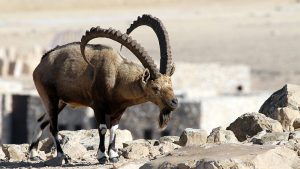
Nubian Ibex, Wikimedia Commons

Source: All Creatures Great and Small: Living things in the Bible (UBS Helps for Translators)
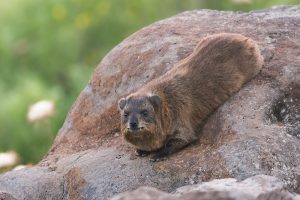
hyrax

Coney: The seventeenth century English word “coney” was the common word at that time for the rabbit, “rabbit” being used at that time only for the baby rabbit. In later English, “rabbit” came to be used for the adults as well. “Coney” then dropped out of use except among fur traders. However it is certain that the Hebrew word shafan does not mean “rabbit” so the King James Version translation “coney” was incorrect. In the nineteenth century, Bible readers perhaps not being sure what a “coney” was, came to identify the “coney” with the Syrian hyrax, probably as the result of hearing preachers describe the animal. To these readers then “coney” acquired a new meaning that it had nowhere else. The use of “coney” is thus both archaic and incorrect.

Badger: Two types of badger live in the land of Israel. The more common is Meles meles and the second is the ratel or Honey Badger Mellivora capensis. The ratel eats anything from small mammals to lizards, insects, snails, fruit, honey and any dead animal or bird. But the animal referred to in Leviticus 11:5 and Deuteronomy 14:7 eats only vegetation and in Psalm 104:18 and Proverbs 30:26 it is associated with rocks as its natural habitat. Shafan therefore cannot be the badger or the ratel Thus those versions using “badger” are likewise incorrect.

Rock badger: Mystery surrounds the name “rock badger”. There was no known animal popularly called a “rock badger” prior to the release of the Brown, Driver, and Briggs translation of Gesenius’ Hebrew Lexicon in 1906. In this lexicon apparently for the first time, “rock badger” appears as the translation of the Hebrew shafan. It is unclear why they coined this new word in preference to the more common “rock rabbit”, but it was probably the result of translating the Cape Dutch klip dassie (“little rock badger”) too literally. However “rock badger” has been used by most English translators ever since. Both “coney” and “rock badger” are, however, not only basically meaningless to most readers but are also incorrect.

The animal referred to by the Hebrew word shafan is undoubtedly the Syrian Rock Hyrax Procavia capensis syriaca. This identification was first made by Canon Tristram in 1867 and has been confirmed many times since. It is a very common animal in the Middle East and Africa eats only vegetation and lives among the rocks.
In southern and eastern Africa other subspecies of the Hyrax Procavia capensis and the Yellow-spotted Hyrax Heterohyrax brucei are sometimes called “rock rabbit”, but are more usually called by the Afrikaans name “dassie”.

Hyraxes are found only in the Middle East and Africa. They are the size of small rabbits, but there the similarity ends. Hyraxes are unique in many ways. They have small round ears, no visible tail, and short legs. They look a bit like giant guinea pigs or cane rats, but they are not really rodents. They live mainly on leaves and herbs. The structure of their jaws, teeth, and feet and the size of their prehistoric ancestors link them to the rhinoceros and elephant.

Two of their top front teeth develop into small tusks which sometimes protrude from the side of their mouth. They have four toes on their front feet and three on the back feet. These toes do not have claws but each has a small hoof-like nail. The soles of their feet are perpetually clammy, being lubricated by a special gland. This enables them to run up almost vertical rock faces and climb trees with ease. In the middle of their back they have another large gland covered with an oval patch of hairs of a different color. These hairs can be raised as an alarm signal.

For such small mammals hyraxes have a very long gestation period of seven months. They live in fairly large family groups and since they are unable to regulate their body temperature by perspiring they huddle together in cavities under rocks when the weather is cold and lie stretched out in breezy locations in the shade of the rocks or trees when it is hot. They are thus only active and visible when the temperature is neither very hot nor cold.

They are quite vocal creatures, communicating by a variety of grunts, whistle-like alarm squeals, and territory-marking barks.

The Syrian rock hyrax is a fawny gray color with a yellowish back patch. Today they are easily seen in the wadis of the Judean Desert and in many parts of Galilee. They are also found in the Sinai, Arabian Peninsula, Syria and Lebanon.

In Leviticus 11:5 and Deuteronomy 14:7 hyraxes are said to “chew the cud”. This is not factually correct but they often look as if they are chewing endlessly. The reasons for them being declared “unclean” are strictly religious. As vegetation eaters they are no more a health hazard than for example goats or sheep. They actually spend a lot of time cleaning themselves.

Apart from being viewed as “unclean” animals there is one additional significance associated with the hyrax. Being virtually defenseless and easy prey for hawks, leopards, and human beings, the hyrax in Proverbs 30:26 symbolizes a combination of defenselessness and wisdom. It is defenseless but wise enough to seek the protection of the rocks which in turn are symbolic of the timeless protective stability of God.

Hyraxes are distributed over a wide area of eastern, western, central, and southern Africa. It is thus not usually difficult to find a word for hyrax in this region. In many eastern and southeastern Bantu languages the word for hyrax is mbira, mbila, mpila, or some similar derivative. It is usually classified in these languages as a type of rat.

Outside of the Middle East and Africa, however, it is difficult to find a word that will be both accurate and well known. Phrases such as “cliff rabbits” or “rock rabbits” are sometimes acceptable, but the best solution is probably to transliterate either the Hebrew word shafan or the scientific general name “hyrax”, and to include a fuller description in a footnote or in a glossary.

In the passages in Leviticus and Deuteronomy the translator is obliged to translate the writer’s view that the hyrax is a cud-chewing animal, even though this may not be factually correct.

Hyrax, Wikimedia Commons

Source: All Creatures Great and Small: Living things in the Bible (UBS Helps for Translators)

See also rock badger.

complete verse (Psalm 104:18)

Following are a number of back-translations as well as a sample translation for translators of Psalm 104:18:

  • Chichewa Contempary Chichewa translation, 2002/2016:
    “Tall mountains are for the birds;
    in the cracks of stones are hiding places for rock rabbit.” (Source: Mawu a Mulungu mu Chichewa Chalero Back Translation)
  • Newari:
    “Wild goats live in the high mountains,
    and badgers hide in crevices in the rocks.” (Source: Newari Back Translation)
  • Hiligaynon:
    “The wild goats stay in the high mountains,
    and the badgers animals hiding in the rocks.” (Source: Hiligaynon Back Translation)
  • Laarim:
    “The wild goats stay on tall mountains,
    and hyraxes hide on the top of the mountains.” (Source: Laarim Back Translation)
  • Nyakyusa-Ngonde (back-translation into Swahili):
    “Katika milima mirefu ndimo ambamo wamo mbawala,
    katika miamba ndimo wanajificha pelele.” (Source: Nyakyusa Back Translation)
  • English:
    “High up in the mountains the wild goats live, and hyraxes/ badgers live in the crags/ crevices in the rocks.” (Source: Translation for Translators)

Translation commentary on Psalm 104:16 - 104:18

The psalmist now describes Yahweh’s provision for the needs of plants and animals. In verse 16 Good News Translation has reversed the lines in order to make easier the identification of “the LORD’s own trees” as the cedars of Lebanon (for which see 29.5). Some take the Hebrew “the trees of Yahweh” to mean “gigantic trees” (as “mountains of God” in 36.6 is interpreted). The verb in verse 16a is simply “are satisfied” (as in verse 13b), which is taken by most to refer to plentiful rain; but New English Bible has “are green and leafy.” New Jerusalem Bible and New Jerusalem Bible translate “drink their fill.”

Verse 16b picks up the subject from verse 16a and identifies it further. In many languages this technique requires a different kind of structure from that found in English. It is often possible to say, for example, “The cedars of Lebanon are the LORD’s own trees, which he planted; these trees get plenty of rain.”

There are differences of opinion about the trees in verse 17b; some think they are junipers (New Jerusalem Bible, Dahood), others, cypresses (Bible en français courant, Traduction œcuménique de la Bible) or pines (New International Version). Some (Weiser, New English Bible, Bible de Jérusalem, New Jerusalem Bible, Biblia Dios Habla Hoy) emend the Hebrew text to get “on top of them” (that is, on top of the cedars of Lebanon of verse 16).16-18 Hebrew Old Testament Text Project (“C” decision) favors the emendation “on their top,” in justification of which it refers to Factors 8 (“Misunderstanding of linguistic data”) and 9 (“Misunderstanding of historical data”).

Further information on the animals includes the following: Hebrew tsippor may mean “sparrow”; however, there are numerous varieties of this small bird, which belongs to the weaverbird family. The translator may use the term for the common house or English sparrow. Although this bird is found across the world, it is largely restricted to the temperate zones. Where the sparrow is not known, a commonly known local bird which nests where people live may be used. It is always possible to use the generic term for birds (see Revised Standard Version and Good News Translation). In areas where some variety of the stork is not found, the translator may use another long-legged, long-necked bird, preferably one that nests in twig platforms built at the tops of trees, on rock ledges, or on roof tops. In many language areas the wild goat will not be familiar, and a substitute animal may not be available. In such cases it may be necessary to borrow the term from another language and to provide an illustration. It should be noted that badgers, or even “rock badgers” (New Jerusalem Bible, Good News Translation, New English Bible), is not quite accurate, since the badger is a carnivorous, burrowing animal; the more accurate name in English is “hyrax,” a herbivorous animal, that does not burrow; it lives in colonies in rocky regions (see Pro 30.26). The translation adaptation made for wild goat also applies to badgers.

Quoted with permission from Bratcher, Robert G. and Reyburn, William D. A Handbook on the Book of Psalms. (UBS Helps for Translators). New York: UBS, 1991. For this and other handbooks for translators see here .