Low German translation by Johannes Jessen, publ. 1933, republ. 2006: “steppe”
Yakan: “the lonely place” (source: Yakan Back Translation)
Western Bukidnon Manobo: “a land where no people lived” (source: Western Bukidnon Manobo Back Translation)
Kankanaey: “the place with no inhabitants” (source: Kankanaey Back Translation)
Matumbi uses various term: lubele (desert, sandy place without water) — used in John 11:54, lupu’ngu’ti (a place where no people live, can be a scrub land, a forest, or a savanna) — used in Mark 1:3 et al.), and mwitu (a forest, a place where wild animals live) — used in Mark 1:13 et al.) (Source: Pioneer Bible Translators, project-specific notes in Paratext)
Chichewa Contemporary translation (2002/2016): chipululu: a place uninhabited by people with thick forest and bush (source: Mawu a Mulungu mu Chichewa Chalero Back Translation)
Note that in Luke 15:4, usually a term is used that denotes pastoral land, such as “eating/grazing-place” in Tagbanwa (source: Tagbanwa Back Translation).
The Hebrew, Latin and Greek that is translated in English as “wild animal” or similar is translated in Newari as “animal that lives in the jungle.” (Source: Newari Back Translation)
Note that this quote in the New Testament is not taken from the Hebrew Bible but from the Greek Septuagint (LXX) which translates into English as “chosen race.” (Translation by NETS — for the Greek version see the title’s tooltip)
The Hebrew that is translated as “jackal” in English was translated in the 1900 Kalaallisut (Greenlandic) translation (a newer version was published in 2000) as qimmit nujuartat or “wild dogs.” (Source: Lily Kahn & Riitta-Liisa Valijärvi in The Bible Translator 2019, p. 125ff.)
Owls are found worldwide except in the Antarctic and on some islands. They are active at night and are characterized by flat faces and short hooked beaks that they can open very wide. They swallow their prey whole and later regurgitate the undigested parts as small balls. They also have the ability to turn their heads more than 180 degrees.
There are two basic owl families, both of which are found in the land of Israel. One family is the Tytonidae, which are the Barn and Grass Owls. They have heart-shaped whitish faces, usually outlined by a dark line, and small dark eyes. The other family is the Strigidae, the typical owls. This family contains a large variety of species, all of which have large eyes that may vary in color from light brown through orange to yellow. This family includes the eared or horned owls, the fairly rare fishing owls, and owls that vary in size from the midget scops owl (less than 20 centimeters [8 inches]) through to the giant eagle owl (over 70 centimeters [28 inches]).
Eight species of owl are fairly common in the land of Israel. Most are very seldom seen by humans, but they are quite well known by their different and distinct calls. In biblical times the nights would have been much quieter than in most modern places, and the strange night sounds probably would have interested people, causing some speculation about what was making the sound. The different owls would thus probably have had different names even if people had never seen them. In fact it is unlikely that they would have been able to associate most of the calls with the owls that were seen.
Some scholars have linked bath ya‘anah with the word ya‘en, which is the ostrich. In view of the contexts in which the word occurs, however, it does not seem that this is a likely interpretation. In the biblical contexts it can be seen that the bath ya‘anah is linked with jackals, deserted ruins, and wailing sounds. It also seems to be reliant on water (compare Isaiah 43:20). None of these are contexts into which the ostrich would fit easily. Furthermore, while it is easy to see the reason why certain birds are listed as unclean, from their diet or association with foreign deities, it is not easy to see why ostriches would be included in the list. They are basically vegetarian, like domestic fowls. The only possible reason would be that since they cannot fly, they were considered somehow “unnatural,” as was the bat.
Other scholars have derived the name from an Arabic word meaning “desert,” and still others from an Aramaic word meaning “greedy.” Hasting’s Dictionary of the Bible suggests that it refers to the eagle owl, and from its position in the list of unclean birds this seems a distinct possibility. The “desert-owl” of New English Bible and Revised English Bible is not a distinct species but a general word for owls that live away from towns.
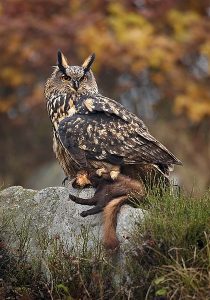
Eagle owls are the giants in the owl family. The European Eagle Owl Bubo bubo is the largest owl in the Middle East, standing over 75 centimeters (30 inches) tall. The corresponding owl in the land of Israel is a pale fawn color, spotted, has ear tufts, and is best known by its loud, deep hooting at night. It roosts by day in deep shade in acacia trees, caves, tombs, and ruined buildings. It feeds on small mammals, including hares, baby gazelles, lambs, rats and mice, and large roosting birds, especially wild and domestic ducks. It is sometimes seen when it is roosting during the day, or when disturbed in a cave or old tomb, but it is seldom seen at night, except in modern times when it is sometimes seen on roads late at night.
In the Bible this owl is associated with death, mourning, and ruin, as well as being listed as an unclean bird.
Eagle owls of one species or another are found in southern and eastern Europe and throughout Africa and South and Southeast Asia. Large owls of a slightly different kind are found in Australasia. The two most common African eagle owls are the Spotted Eagle Owl Bubo africanus and the Giant Eagle Owl Bubo lacteus (known as Verreaux’s eagle owl in East Africa). The Asian Eagle Owl Bubo indicus is found in hilly wooded or forested country away from towns. The largest Australian owl is the Great Scrub Owl Ninox strenua. A word for any of these owls, or a phrase meaning “giant owl”, would be a close local equivalent to use in the lists of unclean birds. In other contexts, a phrase such as “large owls” would be sufficient.
Following are a number of back-translations as well as a sample translation for translators of Isaiah 43:20:
Kupsabiny: “The animals of the bush shall honor me together with the jackals and eagle owls, because I shall give water in the desert. Rivers shall flow in the desert so that my people whom I have chosen can get water.” (Source: Kupsabiny Back Translation)
Newari: “The jackals and owl, and other animals in the wilderness will honor me, for to my own people, to the ones I have chosen, [I will make] water for drinking [flow] in the wilderness, and I will make floods flow on the dry ground.” (Source: Newari Back Translation)
Hiligaynon: “Even the wild animals will-honor me including the wild dogs and owls, for I will-provide springs in the desert, so-that my chosen people have-something-to-drink.” (Source: Hiligaynon Back Translation)
Click or tap here to see the rest of this insight.
Like a number of other East Asian languages, Japanese uses a complex system of honorifics, i.e. a system where a number of different levels of politeness are expressed in language via words, word forms or grammatical constructs. These can range from addressing someone or referring to someone with contempt (very informal) to expressing the highest level of reference (as used in addressing or referring to God) or any number of levels in-between.
One way Japanese shows different degree of politeness is through the choice of a first person singular and plural pronoun (“I” and “we” and its various forms) as shown here in the widely-used Japanese Shinkaiyaku (新改訳) Bible of 2017. The most commonly used watashi/watakushi (私) is typically used when the speaker is humble and asking for help. In these verses, where God / Jesus is referring to himself, watashi is also used but instead of the kanji writing system (私) the syllabary hiragana (わたし) is used to distinguish God from others.

.jpg)
Leave a Reply
You must be logged in to post a comment.