hornet / wasp

There is little doubt among scholars that the Hebrew and Greek words refer to both hornets and wasps.

Hornets and wasps are closely related species, with the hornets being larger than the wasps. Like bees they both belong to the zoological order Hymenoptera, which means that they have stiff, transparent, membrane-like wings. The hornets are usually black or brown; some species have yellow bands. Wasps are often greenish and may also have yellow or light green bands. The larger hornets can be 30-40 millimeters (1-1.5 inches) long.
Both hornets and wasps are characterized by having a long narrow waist between the thorax (chest) and the abdomen (stomach). All have a sting that, because of their large size, can be very painful, even dangerous. Unlike bees, hornets and wasps do not have a detachable sting and can sting repeatedly. They feed on insects, caterpillars, and spiders, and many types sting their prey and then deposit the paralyzed but still living insect or spider near the hornet’s eggs, as a readily available source of food for the larvae when they hatch from the eggs. Some species actually lay their eggs on the paralyzed victim.

One of the most dangerous varieties is the Oriental Black Ground Hornet Vespa orientalis, which establishes large underground nests. They are large shiny black hornets, and when their nest is disturbed they emerge in numbers and attack any animal or person nearby. They are very sensitive to vibration, and a single animal or person walking nearby is enough to arouse them. Once they begin to sting, the smell of the sting arouses them even further, and they may remain in this angry state for hours, with each fresh sting stimulating their ferocity afresh. Some of their victims may end up paralyzed or may even die.

Black ground hornets are found across tropical Africa, through the Middle East, and across Asia to eastern China. In many of these countries known black ground hornet nest sites are marked in some way, such as with a sharpened stick pointing to the nest, as a warning to passersby.

It is little wonder that hornets are a symbol in the Bible for a dangerous enemy or an attacking army.

Although hornets or wasps are found in most warm countries, some large dangerous-looking hornets are relatively harmless. For instance, the black house hornet found all over Africa does not live in swarms but on its own. It makes mud nests on walls or under a roof. It is large and has a sting, but it is not aggressive and very seldom stings any person or animal. Thus care should be taken by translators to choose the name of a hornet that both lives in swarms and is dangerous. In cases where all local hornets or wasps are relatively harmless, a descriptive phrase meaning “warrior hornet”, “war hornet”, “army hornet”, “death hornet” or something similar can be used.

Source: All Creatures Great and Small: Living things in the Bible (UBS Helps for Translators)
chameleon

This word appears in the list of unclean birds as well as in the list of lizards, and it seems quite clear that an owl and a reptile had the same name. Giving quite different creatures the same name is a common phenomenon in many languages. For instance, in English the word “cob” is used for a male swan as well as for a type of riding horse, and “sable” is the name of a small carnivorous animal as well the name of a large antelope; in Dutch “duiker” is the name of both the cormorant (a bird) and a type of antelope.

The Hebrew name tinshemeth is derived from a verb that means “to pant or to breathe loudly”. This makes it very likely that the reference is to the chameleon. When annoyed, hurt, or in danger, the chameleon turns black, inflates its large lungs, making itself look bigger, and then opens its mouth, puffing and hissing like a snake. See also tinshemeth / barn owl.

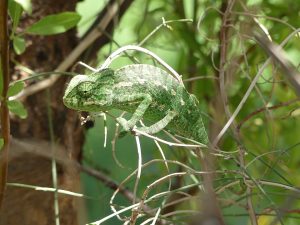
The Chameleon Chamaeleo chamaeleon is a very interesting lizard. It lives in vegetation. It is basically green but can change color to match its environment. It can become brown, pale yellow, or gray, and can vary the shade at different points of its body so as to become mottled or to have patches of dark and light color. This gives it good camouflage in vegetation. It is slow moving, often moving only one limb at a time in a series of wavering movements, mimicking the movement of twigs in the breeze. It has opposed claws on each foot, enabling it to hold very tight and to walk along thin twigs.

It has small scales and many small wart-like lumps on its tough skin. It has a row of pointed scales down its spine. Some species of chameleon have horn-like protrusions on their heads and faces.

The chameleon’s eyes are unique. It has an eyelid that completely covers the eye except for a small hole for the chameleon to see through. The chameleon can move this aperture around with each eyelid working independently of the other, and this enables it to look in two directions at once. It feeds on insects by catching them with its long, sticky, elastic tongue, which it flicks at the prey. The chameleon is also able to use its tail to wrap around twigs and other things to support itself when the wind blows or when climbing at a steep angle. It can hang by this tail from a twig or small branch and often uses this technique to move from a higher branch to a lower one.

It is listed as an unclean animal.

Chameleons are found all over Africa except in desert areas, and in some parts of tropical Asia. Where chameleons are not known, it may be necessary to borrow a word from the dominant language of the area, or from Hebrew, as Jerusalem Bible has done. A phrase such as “slow lizard” or “puffer lizard” is another option.

Chamaeleo chamaeleon, Wikimedia Commonsb

Source: All Creatures Great and Small: Living things in the Bible (UBS Helps for Translators)

cobra

There is general agreement among modern scholars that the word pethen refers to the cobra, since the word is closely associated with snake charming, which requires a snake that can raise the front part of its body vertically, something a viper cannot do. The words tsif‘oni and tsefa‘ are also probably references to a type of cobra. This can be well supported by the contexts in which the word occurs, in which reference is made to the fact that it lives in holes and lays eggs. These contexts would rule out any of the vipers.

There is some evidence that pethen was the earlier name for the cobra, and tsefa‘ and tsif‘oni were later names. Something similar is the case with English, where “cobra” has been in use only for the last one hundred years, and previously “asp” was used.

“Adder” is used as the name for some of the subspecies of viper and is probably not the best word to translate these three Hebrew words.

Cobras are characterized by their ability to spread the ribs in their neck area, so as to form a broad flat profile called the hood. This makes the snake look much thicker than it really is. Cobras also have short fixed fangs in the front of their mouths. The cobra that is found in the land of Israel is the Desert Cobra or Walter Innes’s snake (Walterinnesia aegyptia), while the cobra found in Egypt is the Egyptian Cobra Naja haje. The cobra is a large snake, reaching 2 meters (6 feet) in length, and about 50 millimeters (2 inches) in diameter. It is dark brown with a yellowish underside. In some areas where it is found it has broad yellowish bands, which give it its alternative English name, banded cobra. When it rears up and spreads its hood, the hood has a yellowish background, but displays a broad dark brown horizontal stripe.

Its bite is very poisonous, and it takes quick effect, acting on the nervous system. The cobra feeds on mice, gerbils, birds, bird’s eggs, lizards, frogs, and other snakes. It hunts by following scent trails, which it senses with its tongue. When within range of its prey, it raises its head slowly vertically, and suddenly strikes at the unsuspecting victim. It lives mainly in grassland and where the vegetation is fairly thick. It takes cover in rat holes, holes in eroded banks, hollow trees, under logs, and among exposed roots. It may lay its eggs in any of these sheltered places. In cold weather it coils itself up to preserve its body heat.

The cobra, besides being a symbol of lurking danger, was also closely associated with Egypt. In some poetic passages, therefore, it is a metaphor for the enemies of Israel, Egypt in particular.

The Egyptian cobra is found all over Africa, and a local word should not be difficult to find. In South and Southeast Asia a word for the King Cobra Naja hannah or one of the other cobras would be a good equivalent. In areas where these cobras are symbols of good luck and the presence of a deity, the Hebrew symbolism might need to be explained in a footnote. In other parts of the world, if cobras are unknown, the name of a local long poisonous snake of a type different from vipers and adders is a possible choice.

In passages where snakes are referred to as “stinging”, it is not necessary to use a verb meaning literally “to sting”. This is just the Hebrew way of referring to the bite of a snake. In many languages the verb used for a snake’s bite is different from the one used to refer to the bite of something else, such as a dog.

Desert cobra, Wikimedia Commons
Egyptian cobra, Wikimedia Commons

Source: All Creatures Great and Small: Living things in the Bible (UBS Helps for Translators)

See also flying fiery serpent, adder / serpent / asp / viper, and serpent.

gecko

Translations generally agree that ’anaqah indicates the gecko. There are many different species of gecko in the land of Israel, ranging from the fairly large Rock Gecko Ptyodactylus hasselquistii to the small Turkish Gecko or Mediterranean Gecko Hemidactylus turcicus, which is only about 10 centimeters (4 inches) long. ’Anaqah is probably a general word for all kinds of gecko. The word is related to a verb meaning “to cry out”, and it is this that gives the clue to the identification of the name.

Geckos are the only lizards that call. The name “gecko” is borrowed from the Malay word getjok, which mimics the call of one type of gecko. In many languages the names for the different kinds of gecko also mimic their two syllable calls. For instance, in Thai the giant gecko is called tuk-gae (ตุ๊กแก) and the house gecko ching-chok (จิ้งจก).

Besides their distinctive calls, all geckos are characterized by the knobs on the end of their toes. These pads are covered in microscopic hairs that catch on any slight roughness of the surface and enable the geckos to walk upside down on ceilings and overhangs.

Geckos feed on ants, moths, beetles, flies, mosquitoes, and other insects. The males often fight, and one may end up with the detached tail of the other in its mouth. This too may be eaten. Some of the larger geckos also eat small lizards and small snakes.

Geckos are listed as unclean. In the context of Proverbs 30:28 the gecko is a symbol of an insignificant creature that associates freely with royalty.

Geckos are found throughout Africa, the Middle East, southeastern Europe, Asia, and the tropical parts of Australia. In these areas it will not be hard to find a local word. In areas where they are not found, a word borrowed from Hebrew or the dominant language of the area can usually be combined with the word for lizard; for example, “anaka lizard” or “gecko lizard”.

While King James Version has “spider” for semamith at Proverbs 30:28, other translations and commentators are unanimous in interpreting this word as “lizard”. It probably is a reference to the house gecko, which is the most common lizard found inside houses. Most modern commentators take the verb to be a passive in this verse, that is, “the lizard, which can be held [or, caught] in the hand.”

Rock gecko, Wikimedia Commons

Source: All Creatures Great and Small: Living things in the Bible (UBS Helps for Translators)

Leviathan

The Hebrew and Greek that is translated in English as “Leviathan” is translated in Poqomchi’ as “monster crocodile” (source: Ronald Ross), in Kalanga as “a monster of the sea called Leviathan” (source: project-specific notes in Paratext), and in Hiligaynon as “the dragon Leviatan” (source: Hiligaynon Back Translation).


Scholars are divided in the details of the meaning of this word, but all are agreed that it refers to a monster that lives in water. The word seems to be related to a Hebrew root that means “to twist.” Some believe that the notion of livyathan is related to ancient Egyptian beliefs about a mythical monster crocodile that was thought to be responsible for the annual flooding of the Nile and for causing eclipses of the sun. The passages in Job 41:1 and Psalms 74:14 support this view. In Psalms 74:13 and 14 livyathan occurs in parallel with another word tannin, which refers to a monster that lives in the water. In Ezekiel 29:3 tanim is described as having powerful jaws and scales. The similarity to a crocodile has been noted by many commentators.

Others relate this monster to Babylonian myths about the chaos dragon Tiamat. The Ugaritic texts refer to a similar monster called lotan, which is the Ugaritic form of livyathan. It seems possible that this is the reference in Isaiah 27:1. The probability is that the name is used in both senses in the Bible.

There is general agreement among Jewish scholars that tannin is the more generic word for “sea monster”, while behemoth and livyathan are the names of two of those monsters. This is reflected in 2 Esdras 6:49 and 52, where leviathan is clearly a proper name for one of these monsters.

Crocodiles are the largest of all reptiles. The species found in the Nile valley is the Nile Crocodile Crocodylus niloticus. In biblical times these crocodiles also lived in the larger rivers of the land of Israel, and another species lived in the Tigris and Euphrates rivers in Mesopotamia.

Crocodiles look like enormous lizards with large teeth, and they often reach more than 5 meters (16 feet) in length. Their skin is covered in thick fleshy scales. They live in rivers and in river estuaries and come out of the water onto land to sun themselves for long periods each day. When they are in the water they can stay submerged for ten minutes or more.

They feed on fish that they catch in the water, or lie in wait, wholly or partly submerged until some animal or person comes to drink. They then leap out of the water and seize their prey and throw or drag it into the water where they drown it. They then wedge the prey under a log or between rocks or reeds and tear large pieces from the carcass by seizing the flesh in their teeth and twisting themselves over and over until the flesh comes loose. They then swallow the meat without chewing it. In areas where these crocodiles live, people are killed every year by them.

The monster crocodile of the Egyptians, however, was not a real crocodile but a mythical one of gigantic proportions, which was associated with the annual flooding of the Nile River. It was believed to be so big that whenever it entered the Nile, it caused the river to overflow its banks.

Leviathan symbolized the Egyptian nation and probably its gods; it also symbolized the two mighty nations of Assyria and Babylon. Thus it symbolized the great enemies of Israel.

In most translations the word is transliterated from the Hebrew rather than translated, but the name by itself conveys little to the average reader. In languages where crocodiles are well known, the more meaningful expression “the giant crocodile Leviathan” can be used in the Job and Psalms passages. Then, in the Isaiah passage, where the text itself identifies Leviathan as a serpent (or reptile), the name can be used by itself. In some societies, where there are beliefs about mythical monster serpents or crocodiles associated with the flooding of rivers, the local name for the mythical monster can be used, with a footnote to indicate that in Hebrew the monster’s name is livyathan and that it represented the enemies of Israel.

Source: All Creatures Great and Small: Living things in the Bible (UBS Helps for Translators)
ibex / wild goat / mountain goat

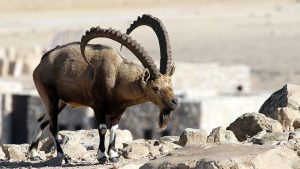
The wild goat found in the land of Israel is the Nubian Ibex Capra ibex nubiana. It has existed in the mountains of this region from time immemorial and until fairly recently it was a very common animal. It was and to some degree still is found in the mountainous parts of Israel the Sinai Peninsula Arabia and Egypt. A closely related species Capra walie is found in Ethiopia and Eritrea.

However the ibex is the only type of wild goat now found in Israel. One other type once lived there but disappeared in the Stone Age long before the time of Abraham. Both ya‘el and ’aqo are the Hebrew names for this animal. Thus versions which include two types of wild goat in the list of clean animals in Deuteronomy 14:5 are probably not correct.

The Nubian ibex is a fairly large wild goat, with adults being about ninety centimeters (3 feet) high at the shoulder. It is a grayish color for most of the year but turns browner in winter. Males have thick long horns over 130 centimeters (4 feet) in length which curve backwards in a semicircle. The horns of the females are much slimmer and shorter, reaching a length of only about 40 centimeters (15 inches). Only the last few centimeters of the horns are smooth, the rest being ringed with ridges. These ibexes live in small herds in the mountains and prefer cliffs and crags, where they live off the bushes that grow on the ledges. Ibex meat is moister and more tender than that of gazelle or deer, and they have been a favorite game animal for many centuries.

The “Wild Goat Rocks” mentioned in 1 Samuel 24:2 is probably the rocky area around the pools and streams of Nahal Arugot near En Gedi. The area has been declared a nature reserve, and the ibexes and other indigenous animals are protected there. The name En Gedi itself, which means “Oasis of the Kid” or “Spring of the Kid”, probably refers to a young ibex.

The ibex is closely associated with remote high mountains and in both Hebrew and Arabic culture it became viewed as the most remote of all animals (compare Job 39:1). This is probably the reason why so many English translations render ya‘el as “mountain goat”. Although not referred to in the Bible ibexes are also known for their surefootedness on rocky ledges.

However to both of the above-mentioned cultures the female ibex was a symbol of grace and beauty grace being associated with the perfect balance with which ibexes stand walk and jump on the cliff faces and beauty probably being associated with their large human-like eyes. In English and many other cultures this poses a problem in Proverbs 5:19, because in these cultures goats are not positive symbols of beauty. In some Tibeto-Burman cultures the wild serow goat is viewed as the ugliest of all animals. In these languages to refer to a woman as a “wild goat” would be an insult. This is the reason why the English versions have “doe” rather than “wild goat”.

In sub-Saharan Africa there are no true wild goats. The closest equivalent animal is a small cliff-dwelling antelope, the Klipspringer Oreotragus oreotragus. The local name of this common, well-known animal has been used to translate ya‘el and ’aqo in many African translations.

In the remaining countries where no indigenous wild goats are found, or where specific words for such do not exist, a phrase equivalent to wild goat or wild mountain goat is usually used. The latter expression is probably the better choice, because in West Africa particularly bush goat is the word for the duiker, a small antelope not associated with mountains.

Proverbs 5:19: This verse occurs in the middle of a series of proverbs dealing with the value of sexual restraint and faithfulness within marriage. The writer/editor exhorts his readers to find sexual fulfillment with their wives alone. A wife is then referred to as “a lovable [or attractive] deer, a graceful ibex.”
As mentioned above in the Discussion: subsection of this section, there are many cultures in which to call a woman a “wild goat” would be an insult rather than a compliment. Where this is the case, a more suitable animal metaphor should be found which denotes gracefulness and can function as the parallel expression for “deer”.
Deuteronomy 14:4,5: The use of two words for wild goat in this list of clean animals should be avoided. However, it is advisable to translate ’aqo (that is, the seventh name in the list) as “ibex” or “wild goat.”

Nubian Ibex, Wikimedia Commons

Source: All Creatures Great and Small: Living things in the Bible (UBS Helps for Translators)

camel

The Hebrew, Latin and Greek that is translated in English as “camel” is translated in Muna as “water buffalo.” René van den Berg explains: “Camels are unknown; the biggest known animal is the water buffalo (though now rare on Muna).”

In Bislama is is translated as buluk: “cow” / “bull” (source: Ross McKerras) and in Bahnar as aseh lăk-đa which is a combination of the Vietnamese loan word for “camel” (lăk-đa) and the Bahnar term for “horse” (aseh) to communicate that the camel is a beast of burden (source: Pham Xuan Tin in The Bible Translator 1952, p. 20ff. ).

In the 1900 Kalaallisut (Greenlandic) translation (a newer version was published in 2000) it was as ĸatigagtôĸ or “big-backed ones.” “Katigagtôĸ (modern qatigattooq), which has the literal meaning of ‘something with a big back.’ It comprises the noun ĸatigak (modern qatigak) ‘back’ combined with the suffix –tôĸ (modern –tooq) ‘something possessing a big X.’” (Source: Lily Kahn & Riitta-Liisa Valijärvi in The Bible Translator 2019, p. 125ff.)

In Luke 18:25, Mark 10:25, and Matthew 19:24 some versions of the Peshitta translation in Syriac Aramaic (Classical Syriac) show an ambiguity between the very similar words for “camel” and “rope.” Some translations of the Peshitta, therefore, use the “rope” interpretation, including the Classical Armenian Bible (մալխոյ for “rope”), the English translation by George Lamsa (publ. 1933) (It is easier for a rope to go through the eye of a needle), or the Dutch translation by Egbert Nierop (publ. 2020) (het voor een kabel eenvoudiger is het oog van een naald binnen te gaan).

In the above-mentioned three verses, it is translated in Noongar as “kangaroo” (source: Warda-Kwabba Luke-Ang).


There were two types of camel known in Bible times the most common being the Arabian Dromedary camelus dromedarius, which was indigenous to the area. The two-humped Bactrian Camel camelus bactrianus was also known and prized, but it was imported from Central Asia.

Camels belong to the same family as the South American llama, vicuna, alpaca, and guanaco, but camels are much larger and have a big fatty hump on their backs. Bactrian camels may reach a height of about two meters (6.5 feet), while dromedaries are even bigger. Dromedaries are a uniform light fawn color, while Bactrian camels are darker, especially in winter when they grow longer fur.

Camels do not have hooves but a large footpad with two broad toes ideally suited to walking on sand. In other ways too they are ideally suited to life in desert areas. They store excess food in their humps and this makes it possible for them to go a long time without eating. Special blood cells also enable them to go without water for long periods. They also have a very efficient digestive system and can extract the maximum amount of nutrition from apparently dry vegetation. This adaptation to harsh environments means that camels can make long journeys through dry areas which would be beyond the abilities of other types of pack animal such as donkeys. Camels were used for riding and for carrying heavy loads. They were also used to pull carts.

In winter the fur of camels thickens and grows longer and then when summer comes they shed their winter fur in large wads. These wads of camel hair are collected and twisted into cords and ropes or spun into thread which is then used for weaving coarse cloth. This cloth was usually used for making tents but it was sometimes used for making outer robes.

Camels’ milk was used as food and drink but their meat was considered unclean by the Israelites.

In spite of the fact that camels were considered to be unclean for food they were a symbol of wealth and commerce. People or nations with many camels were automatically viewed as commercially successful and wealthy as the possession of camels opened up the possibility of transporting goods long distances and engaging in trade.

In areas where camels are not known, the word is often transliterated from Hebrew or the dominant language of the area. However, in some languages descriptive names have been invented. In some South American languages names meaning “hump-backed llama” or “big alpaca with a hump” have been used. Elsewhere expressions such as “hump-backed horse” have been used. A fuller description should usually be included in a glossary or word list.

Source: All Creatures Great and Small: Living things in the Bible (UBS Helps for Translators)

For information on the domestication of camels, see Early camel incidents in the Hebrew Bible .

Click or tap here to see a short video clip about camels (source: Bible Lands 2012)

dugong

This animal is only mentioned in Scripture with regard to the leather made from its skin. It is clear that its hide made very good leather. The King James Version’s “badger” and Revised Standard Version’s “goat” are almost certainly mistranslations. New English Bible’s “porpoise” has more support since an Arabic word very similar to the Hebrew refers to the porpoise or dolphin. However catching sufficient porpoises to make a covering for the tabernacle would have been problematic for the Israelites since these animals live entirely in the sea while the Israelites were not a seagoing nation.

However, some local Bedouin tribes that live near the sea have for centuries made sandals and other articles from the skins of an animal called dugong and many modern scholars interpret tachash as referring to this animal. New International Version and New English Bible (margin) have “sea cow”. The dugong, which swims slowly and feeds on underwater weeds near the shore, is fairly easy to catch in nets.

The Dugong (Dugong dugong) is a large animal about 3 meters (10 feet) long, which lives in the sea, usually in small herds of twelve to fifteen animals. They swim slowly and feed in fairly shallow water on underwater weeds near mouths of rivers. They sometimes even move a short distance up the river. They need to come to the surface every few minutes to breathe, and they sometimes come out of the water to lie on rocks or sandbanks.

Although they have flippers rather than legs and a tail that looks like that of a large fish dugongs are mammals. They have soft fur. They do not lay eggs but give birth to babies and feed them on milk from their breasts. They are found in fairly large numbers even today in the Gulf of Aqaba and the Red Sea and are also found along the tropical coasts of East Africa, South Asia, Madagascar, Malaysia, Indonesia, Papua New Guinea, Australia and the Solomon Islands. They have also been reported in Taiwan.

Dugongs are distantly related to seals. They are pale gray in color and the male has small tusks in its upper jaw. They are harmless and unsuspicious animals and are easy to catch. Dugong skins are fairly thick soft and long-wearing and make high quality leather. The fur is usually left on the leather.

Three very similar animals are the Senegal Manatee Trichechus senegalensis, which is found in West Africa, the Caribbean Manatee Trichechus manatus, which is found on the coasts and in the lagoons of the Caribbean islands and Florida, and the South American Manatee Trichechus inunguis, which is found in the Amazon and Orinoco rivers.

Where dugongs and manatees are known, the best choice will be the word for one of the three mentioned in the previous paragraph. In areas where they are not known, the word for the seal can be used. Where seals are also not known, a more general expression such as “good soft leather” or “furs” is better than trying to name the animal. It is the skin rather than the animal that is in focus in all cases.

Dugong, Wikimedia Commons

Source: All Creatures Great and Small: Living things in the Bible (UBS Helps for Translators)

See also fine leather.