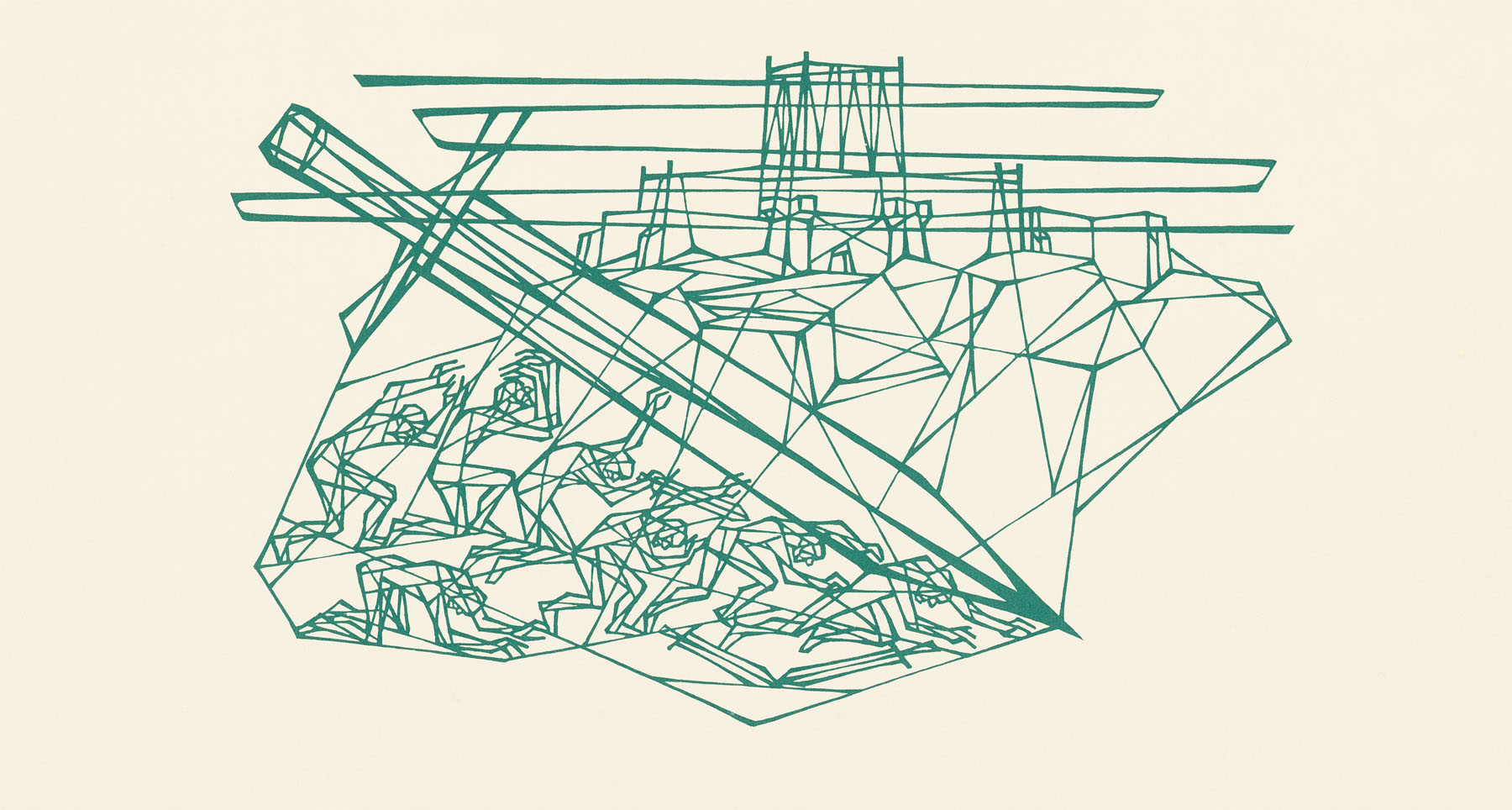
Drawing by Ismar David from The Psalms: A new English translation, linked with permission from Ismar David Archive .
For other images of Ismar David drawings, see here.

תְּ֭רֹעֵם בְּשֵׁ֣בֶט בַּרְזֶ֑ל כִּכְלִ֖י יוֹצֵ֣ר תְּנַפְּצֵֽם׃
9You shall break them with a rod of iron
and dash them in pieces like a potter’s vessel.”
Drawing by Ismar David from The Psalms: A new English translation, linked with permission from Ismar David Archive .
For other images of Ismar David drawings, see here.
The Hebrew in Psalm 2:9 that is translated as “iron rod” or similar in English is translated in the Contemporary Chichewa translation (2002/2016) as ndodo yaufumu or “yokes.” In Chewa culture, this is a rod that is carried by a chief or king. It is a symbol of power and authority. It can either be wooden or metal. Sometimes it is decorated with some ornaments. (Source: Mawu a Mulungu mu Chichewa Chalero Back Translation)
In the 1852 translation of the Psalms into Javanese by Johann F.C. Gericke, the translator attempted to highlight the different voices and sections of the psalm by using different language styles or sociolects of Javanese. Ngoko , a “top-down” register, was used when senior people communicated to people junior in age or rank, and kromo , a “bottom-up” and more ornate register, was used to address superiors and elders. According to Gericke (quoted in Solleveld, cited below) “If one sought to use one and the same language in the entire Psalm, no Javanese would understand it. The difference between Kromo and Ngoko is often as big as between Dutch and Polish.”
(Source: Floris Solleveld in A Tale of Two Translators from the Global Bible project)
Source for Javanese language registers and the different sections of Psalm 2.
Following are a number of back-translations as well as a sample translation for translators of Psalm 2:9:
You shall break them … and dash them in pieces: both statements describe how the king of Israel will defeat and destroy the Gentile nations. The second verb implies a more thorough destruction than the first one; so Good News Translation “break” and “shatter … in pieces.” One of the most common techniques to achieve intensification in biblical parallelism is the use of the simile in the second clause. The intensification of poetic effect is made here also by the contrast of breaking with an iron rod and the shattering of a fragile clay pot. The translator’s ability to maintain the degree of contrast will depend on the verbs used and the existence of clay pots, well known for their tendency to be easily smashed. It may not be natural to use this figurative language, and so the following may be better: “You will defeat (or, subdue) them … you will destroy them completely.” The verb in line a of the Masoretic text is “break”; but the same consonants of the Masoretic text, with different vowels, which are given in the margin of the text, mean “to rule,” and this is how the Septuagint, Syriac, and Vulgate translate it (also New American Bible, New International Version, and Bible en français courant). And this is the form also in which the text is used in Revelation 2.27; 12.5; 19.15.
A rod of iron is a figure of the ruthless power the king will use to defeat the pagan nations (New Jerusalem Bible “with an iron mace”). In some languages it is unnatural to speak of “breaking” nations with an instrument. Other figures of speech which are natural in the language may be found which will symbolize despotic rule; for example, “to trample with the feet” or “to strike with the fist.”
A potter’s vessel: “pottery” (New International Version), “a clay pot” (Good News Translation, New English Bible), “pots” (New Jerusalem Bible). This was easily broken and could not be put back together. Here it is a figure of complete and permanent destruction.
In most areas of the world, potter’s vessel can be translated as a “clay pot.” However, where clay pots are not made and known, a substitute, breakable article of local manufacture may be used.
Quoted with permission from Bratcher, Robert G. and Reyburn, William D. A Handbook on the Book of Psalms. (UBS Helps for Translators). New York: UBS, 1991. For this and other handbooks for translators see here .
The following are presentations by the Psalms: Layer by Layer project, run by Scriptura . The first is an overview and the second an introduction into the poetry of Psalm 2.
Copyright © Scriptura
Copyright © Scriptura
Copyright © Scriptura
Copyright © Scriptura
John Wu Ching-hsiung (1899-1986) was a native of Ningbo, Zhejiang, a renowned jurist who studied in Europe and the United States, and served as a professor of law at Soochow University, as a judge and the Acting President of the Shanghai Provisional Court, and as the Vice President of the Commission for the Drafting of the Constitution of the Republic of China, before becoming the Minister of the Republic of China to the Holy See. Wu has written extensively, not only on law but also on Chinese philosophy, and has also written his autobiography, Beyond East and West, in English. Wu was a devout Catholic and had a personal relationship with Chiang Kai-shek (1887-1975). Wu began translating the the Psalms in 1938, and was encouraged by Chiang to translate the entire New Testament, which he corrected in his own handwriting. (…) John Wu Ching-hsiung’s translation of the Psalms (first draft in 1946, revised in 1975) was translated into Literary Chinese in the form of poetic rhyme, with attention paid to the style of writing. According to the content and mood of the different chapters of the original psalm, Wu chose Chinese poetic forms such as tetrameter, pentameter, heptameter [4, 5 or 7 syllables/Chinese characters per stanza], and the [less formal] Sao style, and sometimes more than two poetic forms were used in a single poem. (Source: Simon Wong)
“Nothing could have been farther from my mind than to translate the Bible or any parts of it with a view to publishing it as an authorized version. I had rendered some of the Psalms into Chinese verse, but that was done as a part of my private devotion and as a literary hobby. When I was in Hongkong in 1938, I had come to know Madame H. H. Kung [Soong Ai-ling], and as she was deeply interested in the Bible, I gave her about a dozen pieces of my amateurish work just for her own enjoyment. What was my surprise when, the next time I saw her, she told me, “My sister [Soong Mei-ling] has written to say that the Generalissimo [Chiang Kai-shek] likes your translation of the Psalms very much, especially the first, the fifteenth, and the twenty-third, the Psalm of the Good Shepherd!”
“In the Autumn of 1940, when I was in Chungking, the Generalissimo invited me several times to lunch with him and expressed his appreciation of the few pieces that he had read. So I sent him some more. A few days later I received a letter from Madame Chiang [Soong Mei-ling], dated September 21, 1940, in which she said that they both liked my translation of the few Psalms I had sent them. ‘For many years,’ she wrote, ‘the Generalissimo has been wanting to have a really adequate and readable Wen-li (literary) translation of the Bible. He has never been able to find anyone who could undertake the matter.’ The letter ends up by saying that I should take up the job and that ‘the Generalissimo would gladly finance the undertaking of this work.’
“After some preliminary study of the commentaries, I started my work with the Psalms on January 6, 1943, the Feast of the Epiphany.
“I had three thousand years of Chinese literature to draw upon. The Chinese vocabulary for describing the beauties of nature is so rich that I seldom failed to find a word, a phrase, and sometimes even a whole line to fit the scene. But what makes such Psalms so unique is that they bring an intimate knowledge of the Creator to bear upon a loving observation of things of nature. I think one of the reasons why my translation is so well received by the Chinese scholars is that I have made the Psalms read like native poems written by a Chinese, who happens to be a Christian. Thus to my countrymen they are at once familiar and new — not so familiar as to be jejune, and not so new as to be bizarre. I did not publish it as a literal translation, but only as a paraphrase.
“To my greatest surprise, [my translation of the Psalms] sold like hot dogs. The popularity of that work was beyond my fondest dreams. Numberless papers and periodicals, irrespective of religion, published reviews too good to be true. I was very much tickled when I saw the opening verse of the first Psalm used as a headline on the front page of one of the non-religious dailies.”
A contemporary researcher (Lindblom 2021) mentions this about Wu’s translation: “Wu created a unique and personal work of sacred art that bears the imprint of his own admitted love and devotion, a landmark achievement comparable to Antoni Gaudi’s Basilica of the Sagrada Família in Barcelona, Spain. Although its use is still somewhat limited today, it continues to attract readers for the aforementioned qualities, and continues to be used in prayers and music by those who desire beauty and an authentic Chinese-sounding text that draws from China’s ancient traditions.”
The translation of Psalm 2 from the 1946 edition in the so-called Sao style (the 1946 edition did not have verse numbers either and underlined proper names):
順與逆
何列邦之擾攘兮。何萬民之猖狂。 世酋蠭起兮。跋扈飛揚。共圖背叛天主兮。反抗受命之王。 曰吾儕豈長甘羈絆兮。盍解其縛而脫其繮。
在天者必大笑兮。笑蜉蝣之不知自量。 終必勃然而怒兮。以懲當車之螳螂。 主曰吾已立君於西溫聖山之上兮。 君曰吾將宣聖旨於萬方。主曾告予兮。爾為予新得之元良。 予必應爾所求兮。如聲斯響。普天率土兮。莫非吾兒之宇疆。 爾當執鐵杖以粉碎群逆兮。有如瓦缶與壺觴。
嗚呼世之侯王兮。盍不及早省悟。鳴呼世之法吏兮。盍不自守法度。 小心翼翼以事主兮。寓歡樂於敬懼。 心悅誠服以順命兮。免天帝之震怒。何苦自取滅亡兮。自絕於康莊之大路。須知惟有委順兮。能邀無窮之福祚。
Transcription into Roman alphabet with the particle xī, that is characteristic for the Sao style, highlighted:
shùn yǔ nì
hé liè bāng zhī rǎo rǎng xī 。 hé wàn mín zhī chāng kuáng 。 shì qiú fēng qǐ xī 。 bá hù fēi yáng 。 gòng tú bèi pàn tiān zhǔ xī 。 fǎn kàng shòu mìng zhī wáng 。 yuē wú chái qǐ cháng gān jī bàn xī 。 hé jiě qí fù ér tuō qí jiāng 。
zài tiān zhě bì dà xiào xī 。 xiào fú yóu zhī bù zhī zì liáng 。 zhōng bì bó rán ér nù xī 。 yǐ chěng dāng chē zhī táng láng 。 zhǔ yuē wú yǐ lì jūn yú xī wēn shèng shān zhī shàng xī 。 jūn yuē wú jiāng xuān shèng zhǐ yú wàn fāng 。 zhǔ zēng gào yú xī 。 ěr wéi yú xīn dé zhī yuán liáng 。 yú bì yīng ěr suǒ qiú xī 。 rú shēng sī xiǎng 。 pǔ tiān shuài tǔ xī 。 mò fēi wú ér zhī yǔ jiāng 。 ěr dāng zhí tiě zhàng yǐ fěn suì qún nì xī 。 yǒu rú wǎ fǒu yǔ hú shāng 。
wū hū shì zhī hóu wáng xī 。 hé bù jí zǎo shěng wù 。 míng hū shì zhī fǎ lì xī 。 hé bù zì shǒu fǎ dù 。 xiǎo xīn yì yì yǐ shì zhǔ xī 。 yù huān lè yú jìng jù 。 xīn yuè chéng fú yǐ shùn mìng xī 。 miǎn tiān dì zhī zhèn nù 。 hé kǔ zì qǔ miè wáng xī 。 zì jué yú kāng zhuāng zhī dà lù 。 xū zhī wéi yǒu wěi shùn xī 。 néng yāo wú qióng zhī fú zuò 。
With thanks to Simon Wong.
No comments yet.
Leave a Reply
You must be logged in to post a comment.