Elsa Tamez (in The Bible Translator 2008, p. 59ff. ) explains: “A literal translation of this verse: ‘Let anyone with ears to hear listen!’ (Luke 8:8) is not appropriate for the Deaf community; it is difficult to understand and it can easily be misunderstood. Deaf people have ‘ears to hear’ but they cannot hear.”
In Tzotzil it is translated as “You all who with one heart want to learn, think about what I said,” in San Mateo Del Mar Huave as “Every one of you have heard this story. Now put it in your hearts,” in Gwichʼin as “He that will hear me, let him pay attention to me” (source: B. Moore / G. Turner in Notes on Translation 1967, p. 1ff.), and in the German New Testament translation by Berger / Nord (publ. 1999) as Denkt gut darüber nach or “Think about it carefully.”
Willy Wiedmann rendered this phrase artistically in the following way:
The Greek in Luke 8:8 that is often translated in English as “he called out” is translated in Mandarin Chinese (Union Version) as “he said with a loud voice” and in the English translation by Heinz Cassirer (publ. 1989) “he cried out loud” both emphasizing Jesus’ loud voice that is described in Luke’s gospel but not in the parallel passage in Mark 4:9.
The Greek that is typically translated with a generic expressions such as “he who,” “whoever,” or “if anyone” in English is translated with the plural form (“they”) in Daga. “A literal translation of these conveys the idea that one specific unnamed individual is being discussed. Thus, for instance, in John 5:24 ‘he who hears my word and believes in him who sent me has eternal life’ meant in Daga that there was one fortunate individual to whom it applied.”
Following are a number of back-translations of Luke 8:8:
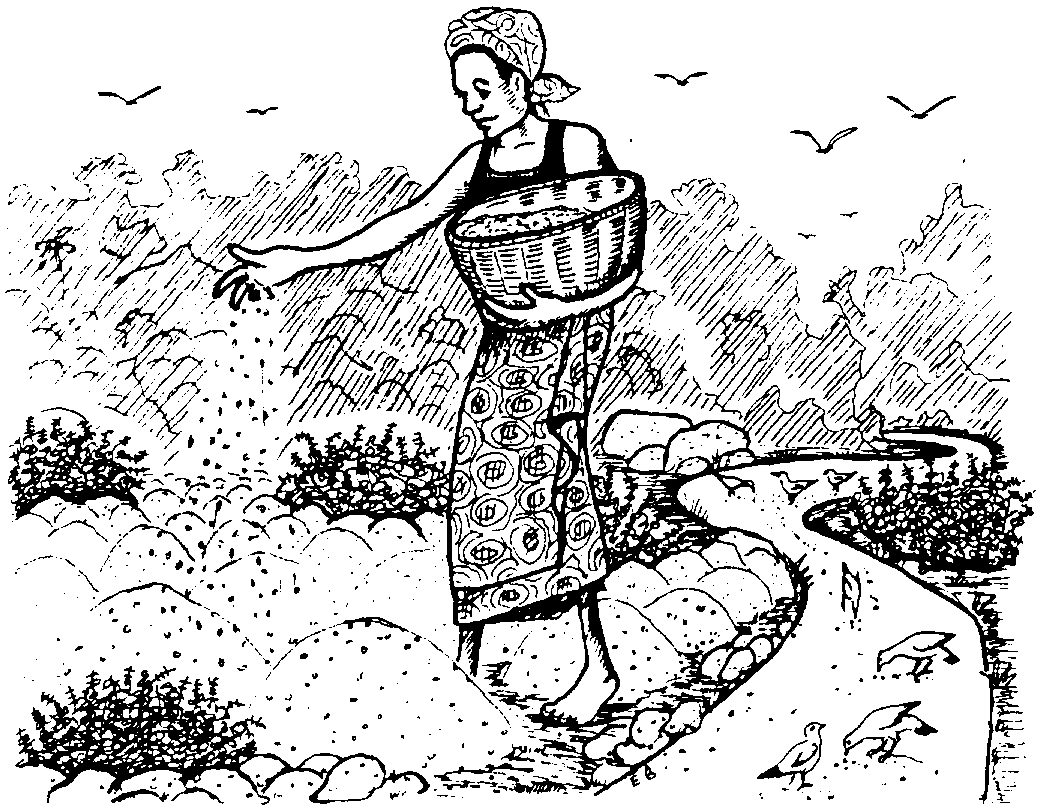
Noongar: “But some seeds fell into the good ground; the seeds grew and gave more seeds, many, many seeds.’ And Jesus finished his story saying, ‘Then listen if you have ears.'” (Source: Warda-Kwabba Luke-Ang)
Uma: “There was also seed that fell in fertile [lit, fat] ground. That seed grew, it was very fertile, its fruit one hundred times from its seed.’ After that parable, Yesus said: ‘Whomever of you has ears, listen well!'” (Source: Uma Back Translation)
Yakan: “Other seeds also fell into good soil. These seeds sprouted and grew and bore fruit. It’s yield was very much.’ Then Isa spoke he said, ‘Amey-amey (a stern warning; intensifier in command) listen if something is said to you.'” (Source: Yakan Back Translation)
Western Bukidnon Manobo: “There was also that which he planted which fell on good ground, and it sprouted and it thoroughly brought forth fruit a hundred fold.’ And then Jesus spoke again, ‘You must understand this which you have heard.'” (Source: Western Bukidnon Manobo Back Translation)
Kankanaey: “But as for others, they fell in good soil, then they grew and bore-fruit one hundred each.’ Jesus concluded saying, ‘You who are listening, think-about what you have heard.'” (Source: Kankanaey Back Translation)
Tagbanwa: “But what got scattered on good soil fruited well. There were a hundred grains on each stalk.’ Jesus added on, saying, ‘Well, since what ears are for is listening, it’s necessary that you listen well to this which I am saying.'” (Source: Tagbanwa Back Translation)
Click or tap here to see the rest of this insight.
Like a number of other East Asian languages, Japanese uses a complex system of honorifics, i.e. a system where a number of different levels of politeness are expressed in language via words, word forms or grammatical constructs. These can range from addressing someone or referring to someone with contempt (very informal) to expressing the highest level of reference (as used in addressing or referring to God) or any number of levels in-between.
One way Japanese shows different degree of politeness is through the usage of an honorific construction where the morpheme are (され) is affixed on the verb as shown here in the widely-used Japanese Shinkaiyaku (新改訳) Bible of 2017. This is particularly done with verbs that have God as the agent to show a deep sense of reverence. Here, iw-are-ru (言われる) or “say” is used.
Living Water is produced for the Bible translation movement in association with Lutheran Bible Translators. Lyrics derived from the ESV® Bible (The Holy Bible, English Standard Version®).
epesen eis tēn gēn tēn agathēn ‘fell into good soil.’ The article, again, is generic. agathēn is somewhat emphatic by position.
hekatontaplasiona ‘a hundredfold,’ adverb, going with the phrase epoiēsen karpon ‘bore fruit’ as a whole. Returns of hundredfold are not extraordinary.
tauta legōn ephōnei ‘saying this he cried.’ ephōnei, after legōn, indicates a raising of the voice.
Translation:
Yielded a hundredfold, or, ‘it-bore-fruit so-that its grains were in-hundreds’ (Balinese), ‘(it, i.e. its ears) became-full, one sowing-seed became hundred’ (Tae’ 1933), ‘it produced fruit a hundredfold (in-proportion-to what had been sown)’ (Tae’ rev.). A hundredfold may have to be rendered analytically, e.g. ‘ten-times-ten of fruit’ (Kele), and approximately, e.g. ‘forty of a second sixty of fruits’ (Ekari), or generically, e.g. ‘very many (fold),’ and cf. ‘when they fruit-ed, really heavy, to that extent the thickness of their fruit’ (Tboli), ‘complete it gave grains’ (Tzeltal).
As he said this, he called out, or, ‘and in a loud voice he added’ (Willibrord), ‘thus he said, then he spoke again rather loudly’ (Balinese).
He who has ears to hear, let him hear. A rendering may easily sound ridiculous; hence adjustments such as, ‘those who not in vain have ears…’ (Tzeltal), ‘ear-road they-have those hear’ (Enga), ‘if you can hear at all you had better listen.’ Batak Toba shifts to a restrictive sentence with the second person pronoun, ‘you, all-who have-ears that can-hear, ear (imperative of a verb derived from the noun ‘ear,’ and meaning ‘to hear-intently,’ ‘to grasp-the-sense-of’) this parable.’ At its first occurrence the verb (for which cf. on 1.41) refers to the faculty of hearing, at the second to the actual hearing of, or listening to something (i.e. ‘my words,’ or, ‘this parable’).
Quoted with permission from Reiling, J. and Swellengrebel, J.L. A Handbook on the Gospel of Luke. (UBS Handbook Series). New York: UBS, 1971. For this and other handbooks for translators see here . Make sure to also consult the Handbook on the Gospel of Mark for parallel or similar verses.



Leave a Reply
You must be logged in to post a comment.