The Greek that is translated as “thorns” in English is translated in Low German with Dießeln or “thistles” which are familiar to speakers of Low German (translation by Johannes Jessen, publ. 1933, republ. 2006).
See also thistles.

καὶ ἕτερον ἔπεσεν ἐν μέσῳ τῶν ἀκανθῶν, καὶ συμφυεῖσαι αἱ ἄκανθαι ἀπέπνιξαν αὐτό.
7Some fell among thorns, and the thorns grew with it and choked it.
The Greek that is translated as “thorns” in English is translated in Low German with Dießeln or “thistles” which are familiar to speakers of Low German (translation by Johannes Jessen, publ. 1933, republ. 2006).
See also thistles.
The parable of The Parable of the Sower is illustrated for use in Bible translations in West Africa by Wycliffe Cameroon like this:
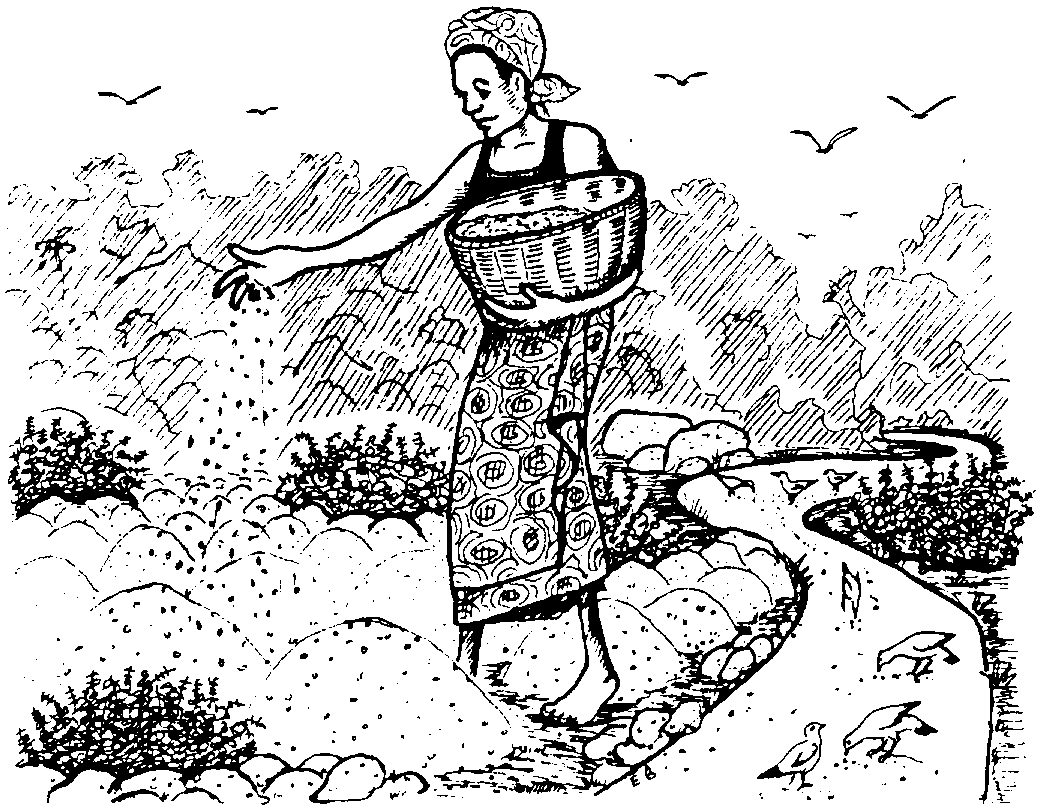
Illustration 1999 Mbaji Bawe Ernest, © Wycliffe Bible Translators, Inc. Used with permission.
Following are a number of back-translations of Luke 8:7:
Exegesis:
en mesō tōn akanthōn lit. ‘in the midst of the thorns,’ hence ‘among the thorns.’ For akantha cf. on 6.44.
sumphueisai hai akanthai apepnixan auto ‘as the thorns grew up with (the seed) they smothered it,’ implying that the thorns still had to come up at the time of the sowing, or, were at least very small (cf. Mk. 4.7 and Plummer). sumphuō.
apopnigō (also v. 33) ‘to choke,’ ‘to smother,’ synonymous with the simple verb pnigō.
Translation:
Among thorns, or, ‘in the place where thorns habitually grow’ (Fon). Tboli uses a local equivalent, ‘that area where fet (the weed that is most dreaded in the rice fields) will sprout again and grow (lit. will break out).’
Choked it, or, ‘pressed it to death’ (Bahasa Indonesia KB), ‘killed it’ (Sranan Tongo), ‘hindered its growth’ (Marathi).
Quoted with permission from Reiling, J. and Swellengrebel, J.L. A Handbook on the Gospel of Luke. (UBS Handbook Series). New York: UBS, 1971. For this and other handbooks for translators see here . Make sure to also consult the Handbook on the Gospel of Mark for parallel or similar verses.
8:7a
Other seed fell among thorns: The phrase among thorns probably refers to soil where roots or seeds of thorny plants were present. So when the grain began to grow up, the thorn plants grew up with it. Here are some ways to translate the phrase among thorns:
• Translate this in a general way:
other seeds fell among thorns
• Translate more specifically:
Some other seeds fell where thornbushes grew up (Contemporary English Version)
-or-
Other seeds fell where thorns habitually grow
-or-
Other seeds fell on soil with thorn seeds/roots
thorns: The Greek word that the Berean Standard Bible translates as thorns refers to any kind of thorny plant. Some ways to translate thorns here are:
• Use a general term in your language for thorny plants or for undesirable plants that compete with grain. For example:
thorny plants/bushes
-or-
weeds
• Use a specific word that describes a hardy, fast-growing plant from your area that is annoying to farmers. If this plant has thorns, that is good but not essential.
8:7b
which grew up with it: The thorn plants grew up along with the young grain plants. The Berean Standard Bible has supplied it, but in some languages it may be more natural to supply a form such as “them” or “the grain plants.”
choked the seedlings: The Greek phrase that the Berean Standard Bible translates as choked the seedlings refers to the way in which the thorns crowded out the grain plants. This caused the grain not to have enough room, soil, water, or sunlight to grow well. Some other ways to translate this are:
crowded the ⌊grain/good⌋ plants
-or-
kept the grain from growing to maturity
The thorns may have choked the grain plants so severely that they died or only so that they did not yield any grain. The point in the parable is that the plants did not yield any grain for the farmer to harvest. Jesus’ comment in 8:14c (“their fruit does not mature”) implies that they did not yield any grain.
Note that the Berean Standard Bible has supplied the seedlings where the Greek text has the pronoun “it.” This may be helpful in other languages also.
© 2009, 2010, 2013 by SIL International®
Made available under the terms of a Creative Commons Attribution-ShareAlike 4.0 License (CC BY-SA) creativecommons.org/licenses/by-sa/4.0.
All Scripture quotations in this publication, unless otherwise indicated, are from The Holy Bible, Berean Standard Bible.
BSB is produced in cooperation with Bible Hub, Discovery Bible, OpenBible.com, and the Berean Bible Translation Committee.
No comments yet.
Leave a Reply
You must be logged in to post a comment.