The parable of The Parable of the Sower is illustrated for use in Bible translations in West Africa by Wycliffe Cameroon like this:
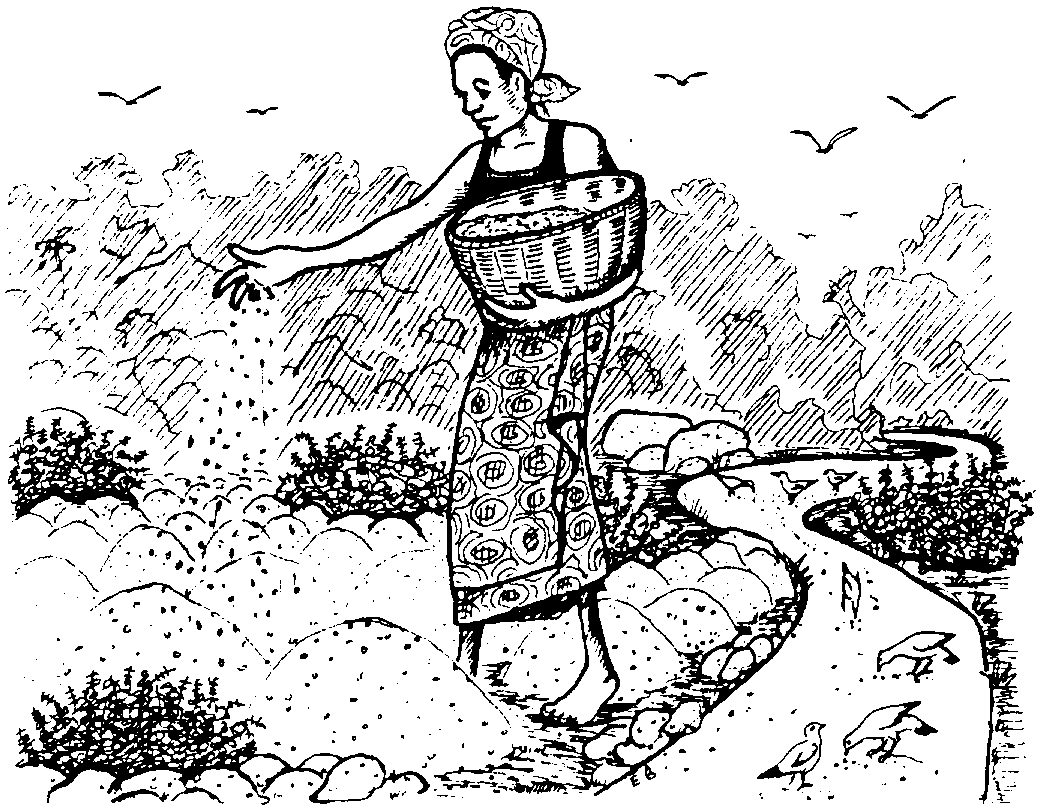
Illustration 1999 Mbaji Bawe Ernest, © Wycliffe Bible Translators, Inc. Used with permission.

καὶ ἕτερον κατέπεσεν ἐπὶ τὴν πέτραν, καὶ φυὲν ἐξηράνθη διὰ τὸ μὴ ἔχειν ἰκμάδα.
6Some fell on rock, and as it grew up it withered for lack of moisture.
The parable of The Parable of the Sower is illustrated for use in Bible translations in West Africa by Wycliffe Cameroon like this:
Illustration 1999 Mbaji Bawe Ernest, © Wycliffe Bible Translators, Inc. Used with permission.
Following are a number of back-translations of Luke 8:6:
Exegesis:
heteron katepesen epi tēn petran ‘some fell upon the rock.’ The article tēn is generic. petra means here ‘rocky ground,’ i.e. rock with a thin covering of soil. katapiptō.
kai phuen exēranthē ‘and after coming up, it withered.’
phuō (also v. 8) ‘to grow,’ ‘to come up.’
xērainō ‘to dry up,’ ‘to wither.’
dia to mē echein ikmada lit. ‘because of (its) not having moisture,’ i.e. ‘because it had no moisture.’
ikmas ‘moisture of the soil.’
Translation:
On the rock, or, ‘in rocky soil,’ ‘(in ground) where stones were lying,’ ‘in hard clay soil’ (Fon).
As it grew up, it withered away, or, ‘it sprouted (at first), but then it dried up’ (cf. Willibrord).
Because it had no moisture, or, ‘because it (i.e. the seed) had/received no moisture’ (Sranan Tongo, Bahasa Indonesia 1968), ‘for there was no water-for-it’ (Tae’); or, ‘because the soil had no moisture, or, was not humid’ (cf. Good News Translation).
Quoted with permission from Reiling, J. and Swellengrebel, J.L. A Handbook on the Gospel of Luke. (UBS Handbook Series). New York: UBS, 1971. For this and other handbooks for translators see here . Make sure to also consult the Handbook on the Gospel of Mark for parallel or similar verses.
8:6a
Some fell on rocky ground: Some of the seeds fell on ground that had a layer of rock underneath it. This layer of rock was probably not loose rocks mixed with dirt, but solid rock with shallow soil on top. Some ways to translate this are:
Other seed fell on shallow soil with underlying rock. (New Living Translation (1996))
-or-
Some seeds fell on ground that had only a thin layer of soil over rock.
Some: The Greek word that the Berean Standard Bible translates as Some is literally “others.” It refers to another group of seeds.
8:6b
when it came up, the seedlings withered: The Greek word that the Berean Standard Bible translates as when it came up means “it grew.” It indicates that the seeds sprouted and started growing into young plants. The word withered indicates that the young plants “dried up” or “died.” Other ways to translate these actions are:
seeds…started growing. But the plants…soon dried up (Contemporary English Version)
-or-
When the plants came up, they withered (God’s Word)
-or-
and when the plants sprouted, they dried up (Good News Translation)
Be sure to speak of seeds becoming plants and beginning to grow in a natural way in your language.
because they had no moisture: The reason why the plants dried up was that they did not have enough water. The plants did not have enough water because the soil was shallow. It was not because there was not enough rain. In some languages it may be helpful to make this clear. For example:
the/this soil could not provide/hold enough water
© 2009, 2010, 2013 by SIL International®
Made available under the terms of a Creative Commons Attribution-ShareAlike 4.0 License (CC BY-SA) creativecommons.org/licenses/by-sa/4.0.
All Scripture quotations in this publication, unless otherwise indicated, are from The Holy Bible, Berean Standard Bible.
BSB is produced in cooperation with Bible Hub, Discovery Bible, OpenBible.com, and the Berean Bible Translation Committee.
No comments yet.
Leave a Reply
You must be logged in to post a comment.