The Greek and Hebrew phrases that are often translated as “birds of the air” in English “refer to the undomesticated song birds or wild birds, to be distinguished in a number of languages from domesticated fowl. In Tzeltal these former are ‘field birds’.” (source: Bratcher / Nida)
Q’anjob’al also uses an established term for non-domesticated birds. Newberry and Kittie Cox (in The Bible Translator 1950, p. 91ff. ) explain: “Qʼanjobʼal has two distinct terms, one to identify domesticated birds and the other non-domesticated birds. The additional descriptive phrase ‘of the air’ seemed entirely misleading, for Qʼanjobʼal speakers had never heard of such creatures. Actually, of course, all that was necessary was the term for non-domesticated birds, for that is precisely the meaning of the Biblical expression.”
In Elhomwe they are just translated as “birds” or “birds of the bush” (i.e., wild birds) to “not give the impression that these are special type of birds.” (Source: project-specific translation notes in Paratext)
The Greek that is translated as “sow” in English is translated in Teutila Cuicatec as “sow wheat.” Unless a specific seed is mentioned, the Teutila Cuicatec reader assumes that it was chili pepper, since this is the only seed that they plant by broadcast sowing. However, since birds do not eat chili seed, nor does it produce such high yields, it was necessary to specify that wheat was sown. (Source: B. Moore / G. Turner in Notes on Translation 1967, p. 1ff.)
The now commonly-used English idiom “fall by the wayside” (meaning failing or falling behind at something) was first coined in 1560 in the Geneva Bible. (Source: Crystal 2010, p. 276)
For other idioms in English that were coined by Bible translation, see here.
Following are a number of back-translations of Luke 8:5:
Noongar: “‘One day, a man went out planting seeds. He planted the seeds in the ground, but some seeds fell on the path. People trod the seeds and birds ate them.” (Source: Warda-Kwabba Luke-Ang)
Uma: “‘There was a sower [who] went sowing. In his sowing, there was seed [sowed-thing] that fell in the middle of the road [lit., eye of the road], and so it was stepped on by people and pecked by birds.” (Source: Uma Back Translation)
Yakan: “‘There was a person who went to his field to broadcast seed. As he broadcasted some seed happened to fall on the way. So-then it was stepped on and the birds went and ate it.” (Source: Yakan Back Translation)
Western Bukidnon Manobo: “‘There was a person who went to his field in order to plant. And of that which he planted there was some which fell on the path and was trodden on by people and birds ate it.” (Source: Western Bukidnon Manobo Back Translation)
Kankanaey: “He said, ‘On one-occasion, there was a person who went to broadcast seed in his swidden. While he was broadcasting the seed, some fell on the path and people were-stepping on it while moreover birds were-pecking-it-up.” (Source: Kankanaey Back Translation)
Tagbanwa: “‘There was a person who scattered his planting-seeds. Well since the way he planted was by scattering (seed), some got scattered on the pathway, which is why it got trodden on, and as-soon-as-he-turned-his-back, it was eaten by the birds.” (Source: Tagbanwa Back Translation)
Living Water is produced for the Bible translation movement in association with Lutheran Bible Translators. Lyrics derived from the ESV® Bible (The Holy Bible, English Standard Version®).
exēlthen ho speirōn tou speirai ton sporon autou ‘a sower went out to sow his seed.’ The clause has a ring of solemnity because of the threefold repetition of a word from the same root. In ho speirōn the force of the article is generic; hence ‘a sower’ in many translations (cf. Revised Standard Version). tou speirai is final articular infinitive, ‘in order to sow.’
sporos (also v. 11) ‘seed.’
en tō speirein auton lit. ‘during his sowing,’ i.e. ‘as he sowed.’ auton refers to ho speirōn.
ho men epesen ‘some (seed) fell.’ ho is neuter though it refers to the masculine sporos. ho men is continued, not by ho de, but by kai heteron in vv. 6, 7, 8, also in the neuter.
para tēn hodon ‘by the side of the road,’ or ‘on the road,’ preferably the latter, as the next verb shows.
katepatēthē ‘was trodden on,’ ‘was trampled,’ cf. on 12.1.
ta peteina tou ouranou katephagen auto ‘the birds of the air ate it up.’ The phrase ta peteina tou ouranou (also 9.58; 13.19; and cf. Gen. 1.26; Ps. 8.9) has become a stereotype in which the genitive tou ouranou has lost its specific meaning; hence the rendering ‘birds.’ auto in the neuter refers to ho men at the beginning of v. 5.
Translation:
A sower went out to sow his seed is redundant in specific references to the process; hence some of the terms may have to be rendered more generically, or even omitted, which results e.g. in, ‘a man (or, farmer/husbandman) went out to sow his seed, or, to scatter-sow.’ Went out, i.e. from his house or settlement towards his fields; the verb indicates ingressive aspect. His seed. Some languages distinguish between ‘seed’ (as found on the plant) and ‘sowing-seed,’ e.g. Tae’ (lit. ‘pip/grain’ and ‘what-has-been-threshed-out’); in others the normal object of ‘to sow’ is the name of the plant sown, i.e. here ‘wheat/grain’ (for the rendering of which cf. on 3.17). The possessive may have to be described, e.g. ‘the seed he used,’ ‘the seed of his fields,’ but more often the form, if rendered at all, is better left unpossessed.
Some, or, ‘some seed,’ ‘a part (of the seed)’; in some Indonesian languages the idiom is, ‘there-was seed that’ (Bahasa Indonesia RC), ‘there-was one part (lit. one-half, which can be used also when the item is divided into more than two parts)’ (Malay). The fourfold ‘some’ in vv. 5-8 may require differentiation, e.g. ‘there-was one-part that … (twice), there-was also one-part that…, there-was again one-part that…’ (Bahasa Indonesia).
Along the path, preferably, ‘on the path,’ or, ‘toward the path’ (Sundanese, Batak Toba). For path cf. on 3.4.
And was trodden under foot, or with an indefinite active form, ‘and/there people (or, the passers-by) trod on it.’
The birds of the air, or simply, ‘the birds’ (see Exegesis), specifically the undomesticated birds (cf. 9.58), which is sometimes expressed ‘wild birds,’ ‘field birds.’
Devoured, preferably, ‘pecked up’ (Javanese).
Quoted with permission from Reiling, J. and Swellengrebel, J.L. A Handbook on the Gospel of Luke. (UBS Handbook Series). New York: UBS, 1971. For this and other handbooks for translators see here . Make sure to also consult the Handbook on the Gospel of Mark for parallel or similar verses.
In this verse Jesus began his parable. In some languages there may be a certain way to begin a parable. If that is true in your language, consider whether it is natural to begin this parable in that way.
8:5a
A farmer went out to sow his seed: The Greek word that the Berean Standard Bible translates as farmer is literally “one who sows/plants (seed).” Some English versions use a more specific term that reflects the Greek form. Others use a general term and allow the verb “sow” to explain what he was doing. This is the first time the farmer is mentioned in the parable. Introduce him here in a natural way in your language for this context. For example:
A sower went out to sow his seed (Revised Standard Version) -or-
Once there was a man who went out to sow grain (Good News Translation)
went out to sow his seed: The verb went out indicates that the farmer went to his field. In some languages a word such as out may not be necessary. He went to the place where he hoped to grow grain, and he carried many seeds with him.
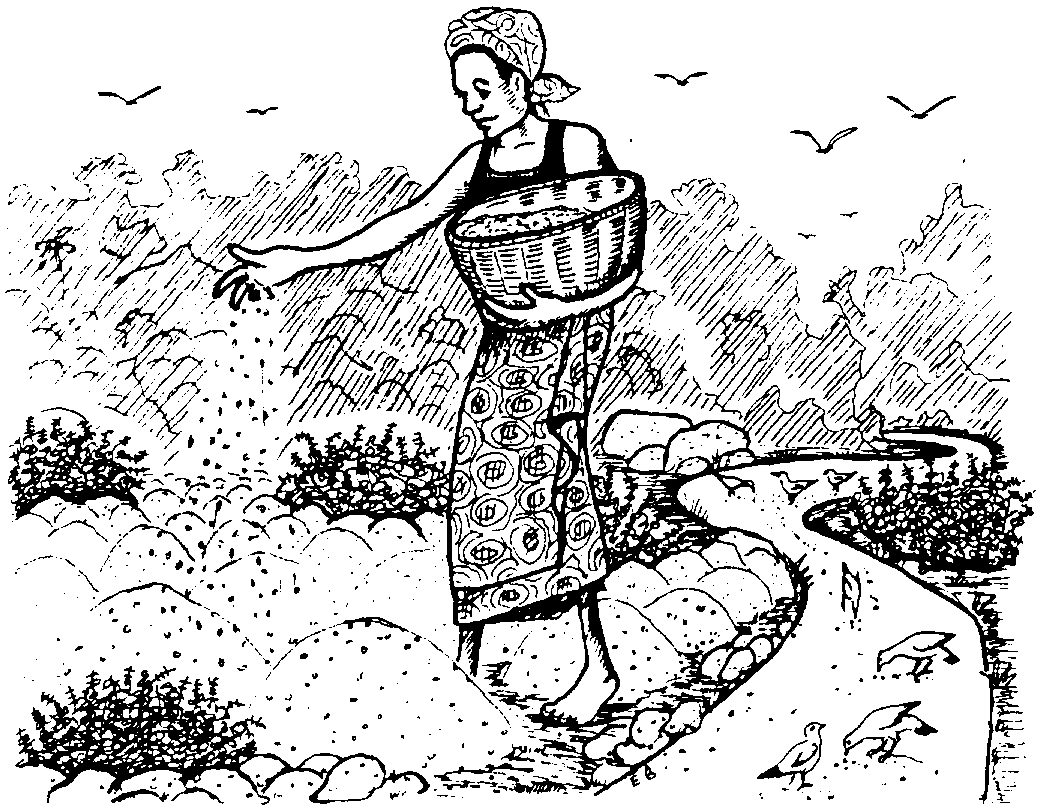
sow: The Greek word that the Berean Standard Bible translates as sow refers to throwing seeds to the side and in front of the farmer. This method allowed the farmer to plant a large area quickly. This was a common way in that culture to plant grain seeds. In that culture, farmers did not plant grain seeds by putting them in the ground one by one. It may be helpful to include a picture of a farmer scattering his seeds.
If your readers know that this is the way the Jews planted seeds, they will more easily understand what the parable means. In languages that do not have a word for sow, you may be able to use a descriptive phrase such as:
plant by throwing/scattering -or-
scatter to plant
This method was the normal way for Jewish farmers to plant. It does not describe a foolish farmer. It may be helpful to include a footnote to explain this. For example:
The Jews planted grain seeds by scattering the seeds over ground that the farmer had plowed, or that he would plow afterwards. In this way, the farmer could plant a large area quickly.
seed: The Greek word that the Berean Standard Bible translates as seed here refers to many individual seeds. In many languages, it will be necessary to use the plural form “seeds.” If you use a plural form here, you will also want to use plural pronouns throughout 8:5–8 and 8:11–15 to refer to these seeds. See, for example, the note on “it” at 8:5c.
If you need to say what kind of seed the farmer was planting, here are some suggestions:
• Use a general word for grain.
• Supply the name of a specific crop that people farmed in Israel in New Testament times, such as wheat or barley.
• If you do not have a general word for grain and do not have wheat or barley in your area, compare this to something that is commonly grown in your area. For example, if rice or millet is common, you could say:
a farmer went out to plant something like rice/millet
8:5b
And as he was sowing: The Greek verb that the Berean Standard Bible translates as sowing is a form of the same verb that is translated as “sow” in 8:5a. It may be helpful in your language to specify what the farmer sowed. However, the Greek text does not specify this, and it may not be necessary in all languages. Other ways to translate this clause are:
As he was scattering the seed (New International Version) -or-
As he scattered it across his field (New Living Translation (2004)) -or-
and while he was sowing (Phillips’ New Testament in Modern English)
some seed fell along the path: The word some refers to some of the grain seeds. These seeds fell by accident on the path. Be careful not to use a word or expression that implies that the farmer intended for some of the seeds to fall on the path. Since he was throwing the seeds around, it was natural for a few of the seeds to fall there.
along the path: The Greek word that the Berean Standard Bible translates as along usually means “near,” “beside,” or “alongside.” In this context, it may also mean “on.” English versions show a similar range of meaning. For example:
some fell beside the road (New American Standard Bible) -or-
some fell on the edge of the path (New Jerusalem Bible) -or-
some seed fell on a footpath (New Living Translation (2004))
Several English versions, including the Berean Standard Bible, have “along,” which can mean either “beside” or “upon.” If you have a similar word in your language, you may use that word here. Otherwise use a word with a more specific meaning that is natural in your language. All these meanings fit the parable equally well.
the path: The Greek word that the Berean Standard Bible translates as the path refers to a footpath through or alongside a field. People who walk there trample on the soil and make it hard.
8:5c
it was trampled: The passive Greek verb that the Berean Standard Bible translates as it was trampled means “people trampled on it” or “people walked on the seeds.” You may wish to use an active expression such as one of those in your translation.
it: If your word for “seeds” or “grain” is plural in form, be sure to use a plural pronoun here. For example:
they were trampled on
This applies to pronouns that refer to the seeds throughout 8:5–8:
• ate it/them up (8:5c)
• when it/they came up (8:6b)
• which grew up with it/them (8:7b)
•It/They came up (8:8b)
the birds of the air: The Greek phrase that the Berean Standard Bible translates as the birds of the air means “birds that fly in the air.” Since most birds fly in the air, in many languages it may not be natural to describe birds in this way. If this is true in your language, you may leave this phrase implied. For example:
birds (Good News Translation)
Another possibility is to say something such as:
the birds?⌊swooped down⌋ from the sky and ate it up
devoured it: The Greek word that the Berean Standard Bible translates as devoured it refers to eating something hungrily and completely. Other ways to say this are:
hungrily ate it all -or-
ate them until they were gone
If you have a specific word or phrase that describes the way that birds eat, such as the English word “pecked,” you could translate in this way:

Leave a Reply
You must be logged in to post a comment.