The name of the father of John the Baptist that is transliterated as “Zechariah” in English is translated in Spanish Sign Language as “beard (the sign for a patriarch)” + “mute.” (Source: John Elwode in The Bible Translator 2008, p. 78ff. )
The following is a stained glass window depicting Mary’s visitation to Elizabeth. It was created by Ateliers Maréchal de Metz between 1848 and 1860 for the Cathédrale Notre-Dame de Luxembourg. Zechariah is shown on the right:
Photo by Marcin Szala, hosted by Wikimedia Commons under a Creative Commons Attribution-Share Alike 3.0 Unported license
Stained glass is not just highly decorative, it’s a medium which has been used to express important religious messages for centuries. Literacy was not widespread in the medieval and Renaissance periods and the Church used stained glass and other artworks to teach the central beliefs of Christianity. In Gothic churches, the windows were filled with extensive narrative scenes in stained glass — like huge and colorful picture storybooks — in which worshipers could ‘read’ the stories of Christ and the saints and learn what was required for their religious salvation. (Source: Victoria and Albert Museum )
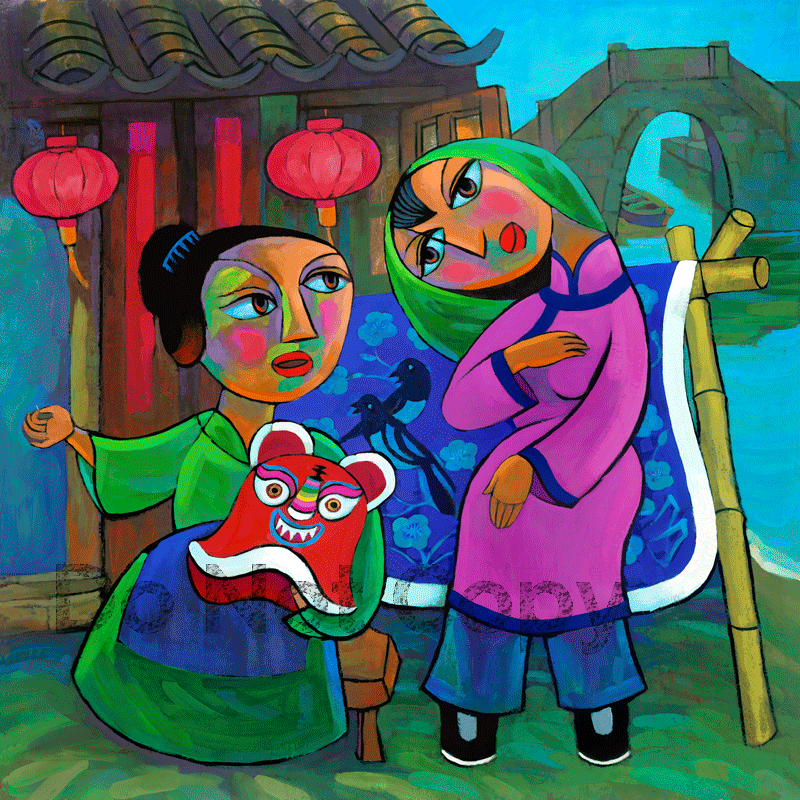
Image taken from He Qi Art . For purchasing prints of this and other artworks by He Qi go to heqiart.com .
For other images of He Qi art works in TIPs, see here.
The following is a stained glass window depicting Mary’s visitation to Elizabeth. It was created by Ateliers Maréchal de Metz between 1848 and 1860 for the Cathédrale Notre-Dame de Luxembourg.
Photo by Marcin Szala, hosted by Wikimedia Commons under a Creative Commons Attribution-Share Alike 3.0 Unported license
Stained glass is not just highly decorative, it’s a medium which has been used to express important religious messages for centuries. Literacy was not widespread in the medieval and Renaissance periods and the Church used stained glass and other artworks to teach the central beliefs of Christianity. In Gothic churches, the windows were filled with extensive narrative scenes in stained glass — like huge and colorful picture storybooks — in which worshipers could ‘read’ the stories of Christ and the saints and learn what was required for their religious salvation. (Source: Victoria and Albert Museum )
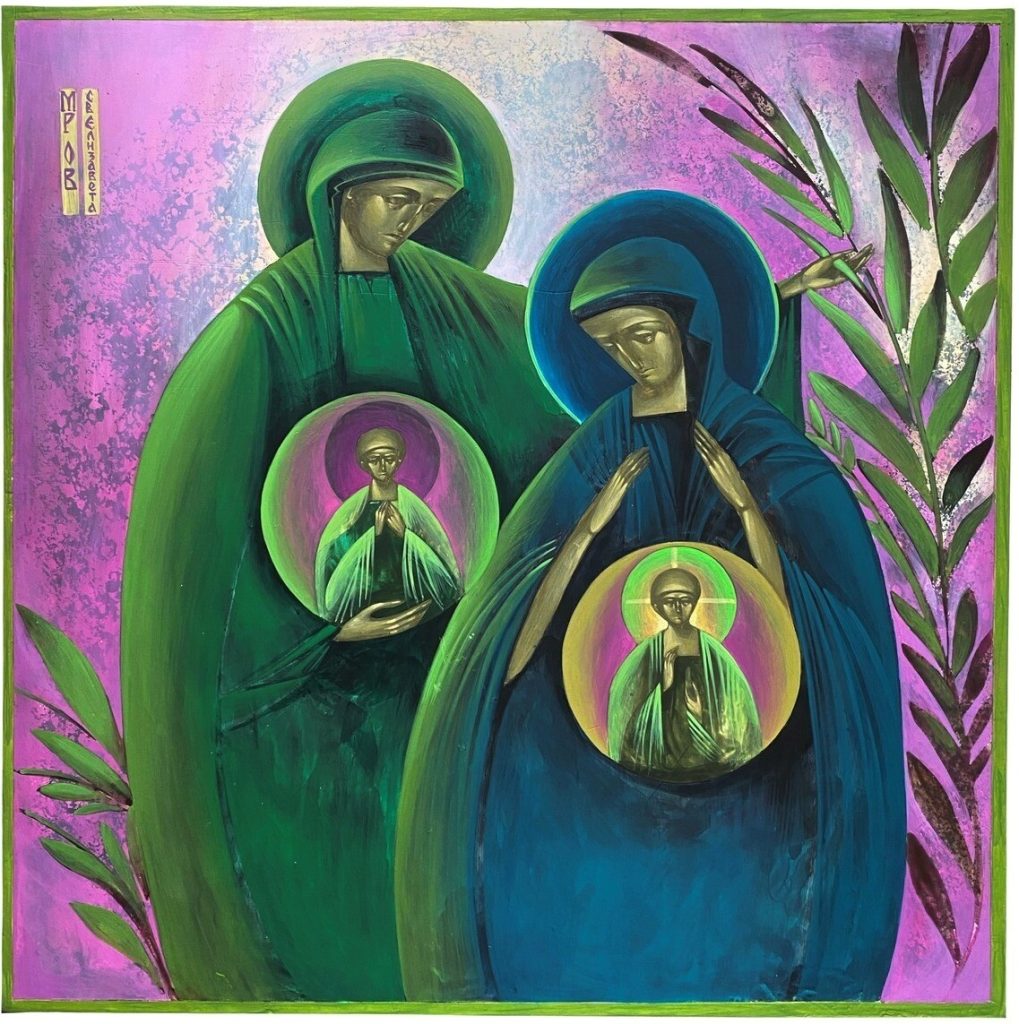
Orthodox Icons are not drawings or creations of imagination. They are in fact writings of things not of this world. Icons can represent our Lord Jesus Christ, the Virgin Mary, and the Saints. They can also represent the Holy Trinity, Angels, the Heavenly hosts, and even events. Orthodox icons, unlike Western pictures, change the perspective and form of the image so that it is not naturalistic. This is done so that we can look beyond appearances of the world, and instead look to the spiritual truth of the holy person or event. (Source )
For purchasing artworks by Kateryna Shadrina go to IconArt Gallery .
In many, if not most of the languages in the Philippines, proper nouns, such as personal names, are tagged with a marker that signals their grammatical role within a sentence. For Tagalog and the Visayan languages , this typically includes si to mark the proper noun as the actor or subject (nominative case), ni to mark the proper noun as an owner (genitive case), and kay to mark the proper noun as as an indirect object, i.e. the one to or toward whom an action is directed (dative case). All of these also have plural forms — sina, nina and kina respectively — and unlike in the biblical languages or in English, the plural form has to be used when only a single proper name is mentioned but implicitly that proper name includes more than just one.
In this verse, where English translates “(the house of) Zechariah,” the Tagalog translation translates “nina Zacarias” because the context of the text makes clear that it’s the house of Elizabeth as well. (Source: Kermit Titrud and Steve Quakenbush)
Following are a number of back-translations of Luke 1:40:
Noongar: “Mary entered the house of Zechariah, and she greeted Elizabeth.” (Source: Warda-Kwabba Luke-Ang)
Uma: “When she arrived at the house of Zakharia, she went in and greeted Elisabet.” (Source: Uma Back Translation)
Yakan: “When she arrived there, she went to the house of Jakariya and said to Elisabet, ‘Assalamu alaikum.'” (Source: Yakan Back Translation)
Western Bukidnon Manobo: “And when she arrived there to Zechariah and Elizabeth, she spoke-in-greeting.” (Source: Western Bukidnon Manobo Back Translation)
Kankanaey: “When she arrived there, she entered their house and greeted Elizabet.” (Source: Kankanaey Back Translation)
Tagbanwa: “On her arrival at the home of Zacarias and spouse, she greeted Elisabet at once.” (Source: Tagbanwa Back Translation)
Living Water is produced for the Bible translation movement in association with Lutheran Bible Translators. Lyrics derived from the ESV® Bible (The Holy Bible, English Standard Version®).
kai ēspasato tēn Elisabet ‘and she greeted Elizabeth.’
aspazomai (also 10.4) ‘to greet,’ here of the person who enters, as the substantive aspasmos in 1.29, 41.
Translation:
And. Because the story leaves untold Mary’s arrival in the city it may be necessary to make the transition less abrupt, e.g. by preparing it in v. 39, cf. .’.. she arrived at a city in Judah, (40) and then she entered’ (Navajo); or by starting v. 40 with, ‘there,’ or, ‘on her arrival there.’
She entered and greeted, or, ‘having entered she greeted,’ ‘on-entering she greeted’ (Balinese). For greeted cf. on v. 29 and on “hail” in v. 28; Tboli has here, ‘called to,’ as one does when coming up the stairs of a house but not seeing anyone right away; Navajo has, ‘said peace/friendship to,’ a common way of reporting a friendly greeting, although ‘peace/friendship’ is not part of the actual formula of greeting.
Quoted with permission from Reiling, J. and Swellengrebel, J.L. A Handbook on the Gospel of Luke. (UBS Handbook Series). New York: UBS, 1971. For this and other handbooks for translators see here . Make sure to also consult the Handbook on the Gospel of Mark for parallel or similar verses.



Leave a Reply
You must be logged in to post a comment.