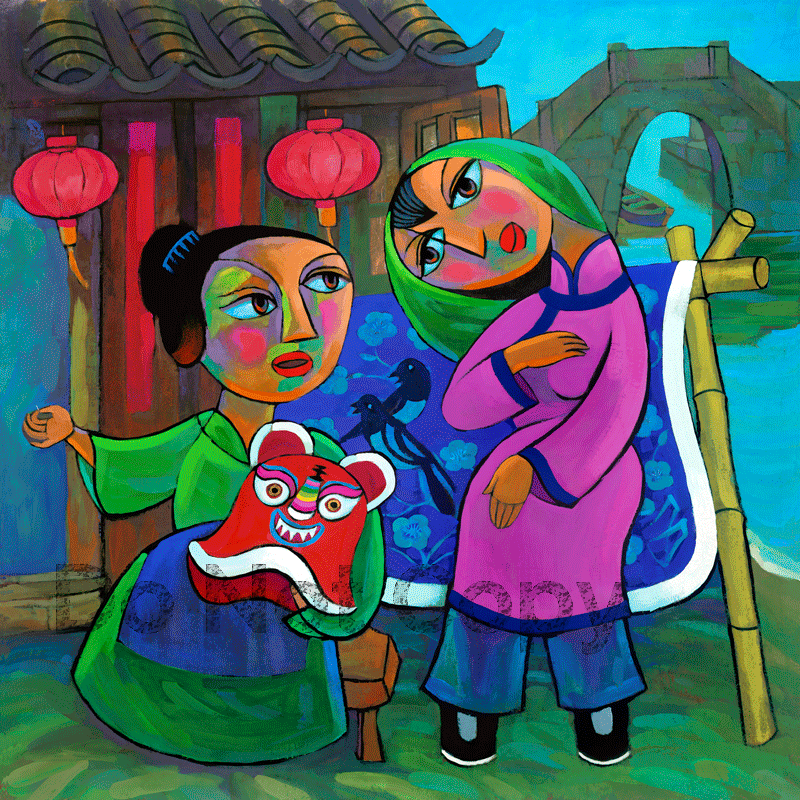
Image taken from He Qi Art . For purchasing prints of this and other artworks by He Qi go to heqiart.com .
For other images of He Qi art works in TIPs, see here.
The following is a stained glass window depicting Mary’s visitation to Elizabeth. It was created by Ateliers Maréchal de Metz between 1848 and 1860 for the Cathédrale Notre-Dame de Luxembourg.
Photo by Marcin Szala, hosted by Wikimedia Commons under a Creative Commons Attribution-Share Alike 3.0 Unported license
Stained glass is not just highly decorative, it’s a medium which has been used to express important religious messages for centuries. Literacy was not widespread in the medieval and Renaissance periods and the Church used stained glass and other artworks to teach the central beliefs of Christianity. In Gothic churches, the windows were filled with extensive narrative scenes in stained glass — like huge and colorful picture storybooks — in which worshipers could ‘read’ the stories of Christ and the saints and learn what was required for their religious salvation. (Source: Victoria and Albert Museum )
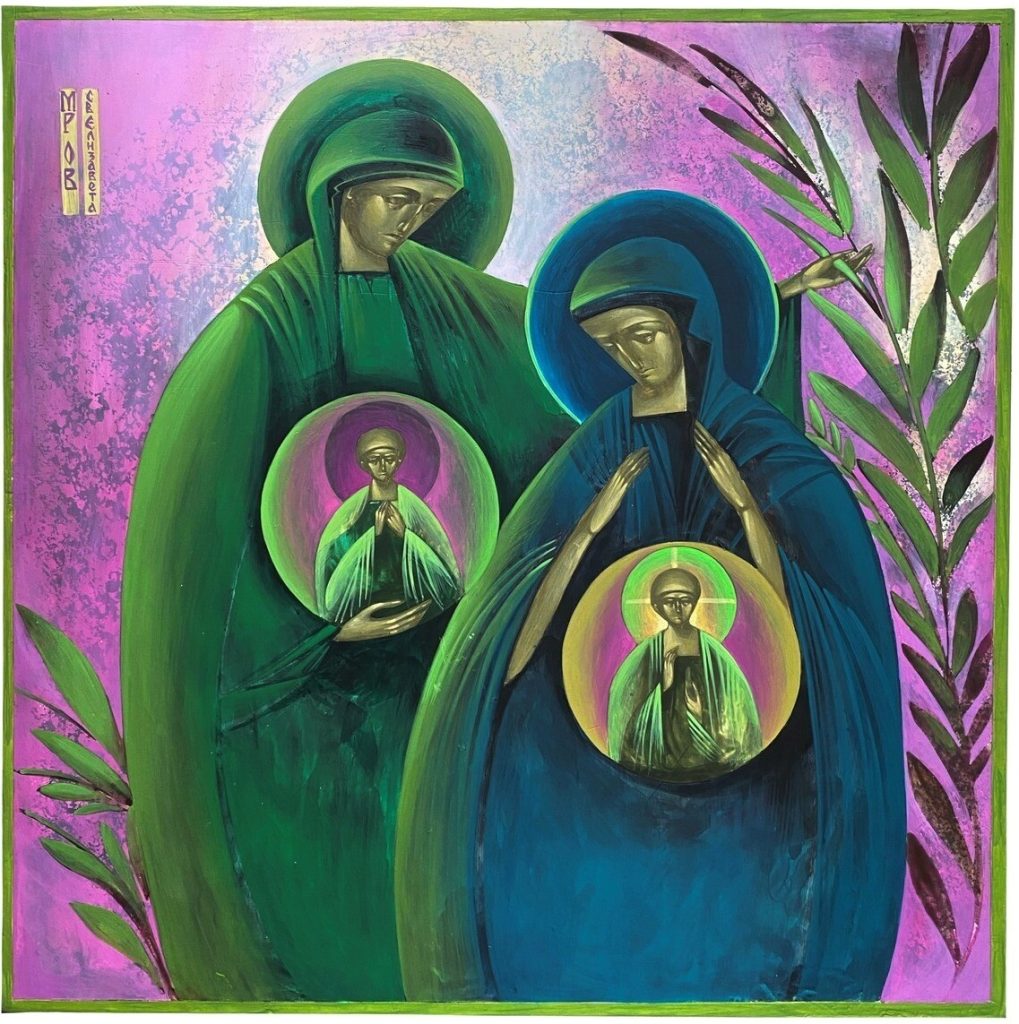
Orthodox Icons are not drawings or creations of imagination. They are in fact writings of things not of this world. Icons can represent our Lord Jesus Christ, the Virgin Mary, and the Saints. They can also represent the Holy Trinity, Angels, the Heavenly hosts, and even events. Orthodox icons, unlike Western pictures, change the perspective and form of the image so that it is not naturalistic. This is done so that we can look beyond appearances of the world, and instead look to the spiritual truth of the holy person or event. (Source )
For purchasing artworks by Kateryna Shadrina go to IconArt Gallery .
Following are a number of back-translations of Luke 1:39:
Noongar: “Afterwards, Mary got ready and she went to a village in the hills of Judea.” (Source: Warda-Kwabba Luke-Ang)
Uma: “From there, Maria left, going to a town in the hills of Yudea land.” (Source: Uma Back Translation)
Yakan: “Not long after that, Mariyam got ready and hurried and went to a place in the hills there in Yahudiya.” (Source: Yakan Back Translation)
Western Bukidnon Manobo: “Now not long after that Mary got ready and quickly left because she was going to another village there in the mountains in the province of Judea.” (Source: Western Bukidnon Manobo Back Translation)
Kankanaey: “When that was so, Maria got-ready and hurried to go to the house of plural Zekarias that was in a town in the mountain-country in Judea.” (Source: Kankanaey Back Translation)
Tagbanwa: “Without anything further, Maria packed-a-few-things. She hurried going to a town in the hilly place of Judea.” (Source: Tagbanwa Back Translation)
The name that is transliterated as “Mary” in English is translated in Spanish Sign Language with arms folded over chest which is the typical pose of Mary in statues and artwork. (Source: John Elwode in The Bible Translator 2008, p. 78ff. )
In American Sign Language it is translated with a sign for the letter M and the sign for “virgin,” which could also be interpreted as “head covering,” referring to the way that Mary is usually portrayed in art works. (Source: Ruth Anna Spooner, Ron Lawer)
“Mary” in American Sign Language, source: Deaf Harbor
In some Semitic languages, the transliteration for “Mary” is identical to the one for the prophetess “Miriam,” testifying to the fact that these names are identical (Arabic and the many translations that are reliant on Arabic: مَرْيَم, Hebrew: מִרְיָם, Ge’ez / Amharic and related languages: ማርያም).
Click or tap here to see the rest of this insight.
Like a number of other East Asian languages, Japanese uses a complex system of honorifics, i.e. a system where a number of different levels of politeness are expressed in language via words, word forms or grammatical constructs. These can range from addressing someone or referring to someone with contempt (very informal) to expressing the highest level of reference (as used in addressing or referring to God) or any number of levels in-between. One way Japanese shows different degree of politeness is through the choice of a benefactive construction as shown here in the widely-used Japanese Shinkaiyaku (新改訳) Bible of 2017.
Here, kiritaoshite (切り倒して) or “cut down” is used in combination with kudasaru (くださる), a respectful form of the benefactive kureru (くれる). A benefactive reflects the good will of the giver or the gratitude of a recipient of the favor. To convey this connotation, English translation needs to employ a phrase such as “for me (my sake)” or “for you (your sake).” (Source: S. E. Doi, see also S. E. Doi in Journal of Translation, 18/2022, p. 37ff. )
Living Water is produced for the Bible translation movement in association with Lutheran Bible Translators. Lyrics derived from the ESV® Bible (The Holy Bible, English Standard Version®).
anistēmi transitive ‘to raise,’ intransitive (with middle forms) ‘to rise,’ often used with weakened basic meaning to indicate the beginning of an action (usually a motion); the verb is especially common of the preparation of a journey as here (cf. 15.18, 20; 17.19).
en tais hēmerais tautais lit. ‘in these days,’ goes with the whole clause. Its meaning is of a very general nature, cf. e.g. New English Bible, ‘about this time,’ but it refers usually to a somewhat shorter period than en tais hēmerais ekeinais (cf. 2.1; 9.36).
eis tēn oreinēn scil. chōran ‘to the hill country,’ of Judea, as v. 65 shows, possibly an echo of the Hebrew ha-har as an indication of the mountainous part of the area of Judah (cf. e.g. Jos. 9.1).
meta spoudēs ‘with haste,’ qualifies eporeuthē; several translators render both words in one expression as e.g. “hurried off” (Phillips, An American Translation).
eis polin Iouda ‘to a town of Judah,’ the territory occupied by the tribe of Judah in the time before the Exile. In the New Testament in this meaning only here and Mt. 2.6 in a quotation from the Old Testament; here it refers to the same area as that meant in v. 65.
Translation:
Arose, or, “set out” (New English Bible, similarly in Sranan Tongo, lit. ‘took path,’ and in Bahasa Indonesia, Tboli), ‘having started-off’ (Navajo), ‘got ready’ (Javanese).
Went … into the hill country, to a city of Judah, or in one phrase, mentioning the more specific first, cf. “went … to a town in the uplands of Judah” (New English Bible). Went, or, ‘journeyed’; distance, and the details such as descending or ascending, may influence the term to be chosen, cf. on 2.4. The hill country here comes near to a proper name, cf. ‘the High-lands’ in Scots. Some versions simply say, ‘the hills/mountains,’ as in Hebrew. For hill cf. also on 3.5.
Quoted with permission from Reiling, J. and Swellengrebel, J.L. A Handbook on the Gospel of Luke. (UBS Handbook Series). New York: UBS, 1971. For this and other handbooks for translators see here . Make sure to also consult the Handbook on the Gospel of Mark for parallel or similar verses.
Soon after the angel visited Mary in Galilee, she went to visit her relative Elizabeth. Elizabeth lived in a town in Judea. Mary probably traveled from three to five days to reach there. The Holy Spirit revealed to Elizabeth that Mary was carrying the Christ/Messiah in her womb. This was confirmed also by Elizabeth’s baby, John, who leaped for joy in her womb. Elizabeth declared that Mary was blessed more than all women because God had chosen her for such an honor.
Some other possible headings for this section are:
Elizabeth affirmed that God had blessed Mary -or-
Elizabeth recognized that Mary would be the mother of the Christ
Paragraph 1:39–45
1:39a
In those days: The Greek phrase that the Berean Standard Bible translates literally as In those days means “at that time.” The word “days” is an idiom for a time period; it does not refer to specific days. After the angel left Mary, she was probably eager to see Elizabeth. She probably left as soon as she could prepare for the journey. Perhaps only a few days passed.
Some other ways to translate this are:
Soon afterward (God’s Word) -or-
A few days later (New Living Translation (2004)) -or-
A short time later (Contemporary English Version)
Mary got ready and hurried: The Greek expression that the Berean Standard Bible translates as Mary got ready and hurried is literally “rising up, Mary went with haste.” Luke often used the verb “rising up” to describe beginning an action or preparing for it. Here it does not refer literally to standing up. Some ways to translate it in this context are:
Mary set out and hurried away (Revised English Bible) -or-
Mary prepared ⌊for a trip⌋ and hurried
In some languages it may not be necessary to translate this idea explicitly. For example:
Mary hurried to a town (Contemporary English Version)
1:39b
to a town in the hill country of Judah: This town was where Elizabeth and Zechariah lived. Luke did not give the name of the town. The distance from Nazareth to that town in the hill country was between 100 and 150 kilometers (70–100 miles). Mary would have walked or traveled by donkey.
Judah:Judah was one of the provinces or districts that Rome ruled. It was one of the areas where Jews lived.
The word Judah occurs both here and in 1:65b, but it is spelled differently in Greek. Some English versions, including the Berean Standard Bible, show the difference in spelling and transliterate this word as “Judah” here and “Judea” in 1:65b. However, since both spellings refer to the same province, it is recommended that you spell it the same way in both places.



Leave a Reply
You must be logged in to post a comment.