49The width of the vestibule was twenty cubits and the depth twelve cubits; ten steps led up to it, and there were pillars beside the posts on either side.
The Hebrew, Aramaic and Greek that is translated as “cubit” or into a metric or imperial measurement in English is translated in Kutu, Kwere, and Nyamwezi as makono or “armlength.” Since a cubit is the measurement from the elbow to the tip of the middle finger, one armlength (measured from the center of the chest to the fingertips) equals two cubits or roughly 1 meter. (Source: Pioneer Bible Translators, project-specific translation notes in Paratext)
Similarly, in Akoose, the translation is “arm distance.” (Source: Joseph Nkwelle Ngome and Marlie van Rooyen & Jacobus A. Naudé in Communicatio 2009, p. 251ff.)
In Klao it is converted into “hand spans” (app. 6 inches or 12 cm) and “finger spans” (app. 1 inch or 2 cm) (source: Don Slager) and in Bariai into leoa or “fathom,” which comprises the distance from a person’s fingertip to fingertip with arms outstretched, app. 6 feet (source: Bariai Back Translation).
The concepts of distance that are translated in English with “long,” “wide,” and “high/tall” are translated in Kwere with one word: utali. (Source: Pioneer Bible Translators, project-specific translation notes in Paratext)
Following are a number of back-translations as well as a sample translation for translators of Ezekiel 40:49:
Kupsabiny: “It (the veranda) had a width of thirty-five feet and nineteen feet going inwards. There were things for climbing up on in order to go up to that veranda and (there were) pillars on this side and that side.” (Source: Kupsabiny Back Translation)
Hiligaynon: “The balcony was 34 feet long and about 20 feet wide. There were ten steps going-up to the balcony, and there was a pillar on each side.” (Source: Hiligaynon Back Translation)
English: “The entry room was 35 feet/10.6 meters wide on each side. There were ten steps up to it, and there were pillars on each side of the entrance.” (Source: Translation for Translators)
Before the time of Abraham at least five breeds of sheep had already been developed in Mesopotamia. From mummified remains (that is, preserved dead bodies) and ancient art it is also known that at least two different breeds had reached Egypt by about 2000 B.C. Thus it is likely that the sheep mentioned in the Bible were of more than one breed.
The Hebrew word kar seems to be used of imported foreign sheep and may refer to a special breed but some scholars think it refers to a wether (castrated ram), since this word is never used in the context of sacrifice. This word is also used for a battering ram, that is, a heavy pole suspended on a rope, used in war for breaking down walls. ’Ayil is the word for a ram or adult male sheep, rachel is a breeding ewe or female sheep, and taleh is a very young lamb, probably still unweaned. The remaining Hebrew words refer to sheep in general.
The Greek word probaton is the general word for sheep, or flocks that may include goats. Krios is the Greek word for a ram or male sheep. Pascha is a technical name for the Passover lamb exclusively, and the remaining Greek words all mean lamb. Ovis is the Latin word for sheep.
Click or tap here for the rest of this entry in United Bible Societies’ All Creatures Great and Small: Living things in the Bible.
The early Hebrews were nomadic shepherds to whom sheep were the most important domestic animal. While goats eat almost any vegetation, sheep are much more selective about the grasses and plants they eat. This meant that suitable grazing for them was not always easy to find, and shepherds had to keep moving their flocks from place to place. This led to a nomadic lifestyle, with movable tents rather than houses being the normal household shelter. It was not until the occupation of Canaan after the Exodus that the lifestyle of the Israelites changed, and they became settled village-dwelling farmers and fruit growers.
However, even then, most households owned sheep, and some family members would function as shepherds, often living away from home for fairly long periods.
Sheep in the Bible were a source of meat, milk, wool, hides, and horns, and it seems likely that various strains were bred selectively to enhance production of these commodities. Wool is mentioned in the Bible as early as the Mosaic Law, which forbade the weaving of cloth containing both wool and plant fibers. The shearing of sheep is mentioned even earlier, in Genesis 31:19. Wool was in fact the most common and available fiber known to the people of Israel.
There was a very extensive wool trade in biblical times, stretching from Egypt to China. In the Middle East wool was cheaper than cotton or linen, which were the other common fibers. (Silk was known by the time of Solomon, but it was extremely expensive as it was produced in China and handled by numerous traders on its way west.) It would be a mistake to think of all wool at that time as being white, as Genesis 30 indicates quite clearly that there were also dark colored sheep and sheep that had dark and light patches, probably varying combinations of black, white, and brown.
We can be fairly sure that one breed of sheep known to the Israelites was the Fat-tailed Sheep Ovis laticaudata and that its fatty tail is referred to in Exodus 29:22, Leviticus 3:9 et al.
Rams’ horns had a variety of uses. Whole ram horns were used as drinking vessels, jars, and trumpets. But pieces of horn were used as handles for knives and other household implements, and for jewelry such as bracelets and beads. Needles too, and probably also arrow heads, were made from horn, as well as from bone and later from bronze and iron.
Sheep were also very important in Israelite religion. They were a very important element in the sacrificial system and in the traditional religious feasts, especially the Feast of Passover.
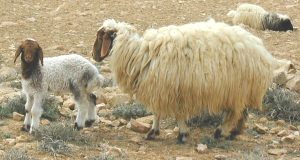
Sheep and goats belong to the same general family. They differ in that sheep produce wool, which is a special type of soft hair, among the ordinary hairs on their bodies. A ram’s horns too differ in shape from a goat’s horns, those of a ram curling down in a tight spiral beside its face, with those of a goat curving more gently back towards its shoulders. The sheep of biblical times produced much shorter wool than is common with wool-bearing breeds of today.
The fat-tailed or broad-tailed sheep is a smallish breed usually brown and white with a very broad tail. Like most other breeds of sheep in the Middle East it has large floppy ears.
Sheep are generally fairly timid animals, lacking the self-confidence and adaptability of goats. While goats will spread out in their search for food and then regroup without much difficulty, sheep become very insecure when they are separated from other sheep and tend to stay bunched together. They thus require a lot of shepherding. In the Middle East the method of shepherding involves training the dominant ram to follow the shepherd. The remaining sheep then follow this dominant ram, which often wears a wooden clapper or a bell. As they feed, the sheep usually keep within earshot of this sound. It is likely that this method is centuries old.
In most modern breeds only male sheep have horns, but in most ancient breeds female sheep had short horns too. This made separating sheep from goats in a single flock more difficult than it is today.
Of all animals the sheep was the most important for the Israelite nation. It had great religious, social, and economic importance.
The metaphor of a lamb is used in the New Testament to refer to Christ, with an emphasis on his being a sacrifice for the sin of the world. This is especially the case in John’s gospel and Revelation. In the latter book the metaphor is introduced in a very striking way. In Revelation 5:5 as the writer is mourning the fact that no one can be found to open the scroll, he is comforted by one of the elders who tells him that “the Lion of the tribe of Judah” has triumphed and can thus open the scroll. Then the writer, expecting to see the Lion, sees instead a Lamb that looks as if it has been killed for sacrifice. The remainder of the book is then concerned with describing the triumph of this Lamb over the forces of evil.
In the gospels Jesus also refers to his disciples as “sheep” and “lambs” (Matthew 10:17; John 10:1 et al.).
The metaphor of the shepherd is extended to God himself who is the ultimate “Shepherd of Israel” (Psalms 23:1; 80:1). Then those who are responsible for the nurture, guidance, ruling, and protection of Israel, be it kings, prophets, or priests, are also likened to shepherds (Isaiah 56:11; Jeremiah 23:4; 49:19; Ezekiel 34:2; Zechariah 10:2).
The Messiah is also called a shepherd (Isaiah 40:11), and Jesus refers to himself as “the good shepherd” (John 10:11). In Hebrews 13:20 he is referred to as “the great shepherd of the sheep” and in 1 Peter 2:25 he is called “the Shepherd and Guardian of your lives”.
In languages that have a word for sheep, it is advisable to translate according to the meanings given above. If possible, the feminine forms should be translated as “female lamb” or “female sheep”. In languages in which sheep are not known, a word has usually been coined or borrowed by the time Bible translation begins, and this word should be used. It is not advisable to substitute another locally well-known animal in this case, since doing so negates the ritual and symbolic importance that sheep had for the biblical cultures.
In translating Psalms 23:1 it is extremely important to make sure that the phrase “my shepherd” preserves the relationship intended by the writer and reflects the psalmist’s theme that Yahweh is his benefactor, protector, and guide. There are really two metaphors involved in the opening verse-the caring shepherd (God) and by clear implication, the dependent sheep (the psalmist). In many languages the literal phrase “my shepherd” depicts a wrong relationship, meaning something like “the one who looks after my sheep” or “the one I employ to watch my sheep.” In many African languages unwary translators have produced a rendering that means “The Chief is (nothing more than) my herdsman.” It is often necessary to restructure the whole verse as something like “I am a sheep, and the lord is my shepherd.”
The length of the vestibule was twenty cubits, and the breadth twelve cubits: The man continued to measure the Temple building. Its porch was twenty cubits, that is, 10 meters (34 feet), wide and twelve cubits, that is, 6 meters (20 feet), from front to back. As the footnotes in Revised Standard Version and Good News Translation show, the Hebrew reads “eleven cubits” (New American Standard Bible, New Jewish Publication Society’s Tanakh; similarly New Living Translation, Complete Jewish Bible, Moffatt) instead of twelve cubits. The number twelve comes from the Septuagint. Despite the recommendation of Hebrew Old Testament Text Project to retain “eleven,” it is necessary to follow the Septuagint to fit the rest of the dimensions of the Temple.
And ten steps led up to it: The number ten comes from the Septuagint (see the Revised Standard Version footnote). The Hebrew for this clause reads literally “and [it was] by the steps that they went up to it” (similarly Good News Translation, Contemporary English Version, New International Version, New International Reader’s Version, New American Standard Bible, New Jewish Publication Society’s Tanakh). This clause in Hebrew means the priests went up to the doorway of the Temple by means of a staircase, but it does not say how many steps there were or how high the staircase was. This is a possible interpretation of the Hebrew text, but Hebrew Old Testament Text Project recommends that translators follow the Septuagint in this instance. The reading in the Septuagint gives the more straightforward meaning in this context, and it does not involve any change to the consonants of the Hebrew text. It is only necessary to change some of the vowels that Jewish scholars later inserted into the text to help people as they read the text.
And there were pillars beside the jambs on either side: There were two pillars or “columns” (Good News Translation, Contemporary English Version, New Living Translation, Complete Jewish Bible, New Jewish Publication Society’s Tanakh) by the entrance of the Temple, one by each doorframe. These pillars were probably very similar to the two pillars that were in front of Solomon’s Temple (see 1 Kgs 7.15-22), but no one knows exactly what they looked like or what their function was. Here their dimensions are not even given. So they may have stood outside the doorway or in the doorway itself, or they may have even been part of the actual doorframes. Translators will need to choose whichever configuration makes most sense to them.
Quoted with permission from Gross, Carl & Stine, Philip C. A Handbook on Ezekiel. (UBS Helps for Translators). Miami: UBS, 2016. For this and other handbooks for translators see here .

Leave a Reply
You must be logged in to post a comment.