The Hebrew, Aramaic and Greek that is translated as “cubit” or into a metric or imperial measurement in English is translated in Kutu, Kwere, and Nyamwezi as makono or “armlength.” Since a cubit is the measurement from the elbow to the tip of the middle finger, one armlength (measured from the center of the chest to the fingertips) equals two cubits or roughly 1 meter. (Source: Pioneer Bible Translators, project-specific translation notes in Paratext)
Similarly, in Akoose, the translation is “arm distance.” (Source: Joseph Nkwelle Ngome and Marlie van Rooyen & Jacobus A. Naudé in Communicatio 2009, p. 251ff.)
In Klao it is converted into “hand spans” (app. 6 inches or 12 cm) and “finger spans” (app. 1 inch or 2 cm) (source: Don Slager) and in Bariai into leoa or “fathom,” which comprises the distance from a person’s fingertip to fingertip with arms outstretched, app. 6 feet (source: Bariai Back Translation).
The Hebrew, Aramaic, Latin, and Greek that is translated in English as “holy” has many translations that often only cover one aspect of its complex meaning. (Note that “holy” as well as related words in other Germanic languages originally meant “whole, uninjured.”)
In an article from 2017, Andrew Case (in The Bible Translator 2017, p. 269ff. ) describes some of the problems of the concept of “holiness” in English as well as in translation in other languages and asks for “a creative effort to turn the tide toward a more biblical understanding. He challenges the standard understanding of God’s holiness as “separation,” “transcendence,” or “infinite purity,” and suggests that in certain contexts it also carries the meaning of “totally devoted.” (Click here to read more of his article.)
“For a long time there has been considerable confusion regarding the meaning of the word ‘holy’. For the limited scope of this paper, we will focus on this confusion and its development within the English-speaking world, which has a widespread influence in other countries. The word for holy in English can be traced back at least to the eleventh century (although there is evidence of its use in Old Norse around A.D. 825). The Oxford English Dictionary describes the use of holy as applied to deities, stating: ‘the development of meaning has probably been: held in religious regard or veneration, kept reverently sacred from human profanation or defilement; (hence) of a character that evokes human veneration and reverence; (and thus, in Christian use) free from all contamination of sin and evil, morally and spiritually perfect and unsullied, possessing the infinite moral perfection which Christianity attributes to the Divine character.’
“Thus ‘infinite moral perfection’ persists as an understood meaning by many in the English-speaking world today. Others gloss this as ‘purity’ or ‘cleanness,’ and the effects of this interpretation can be seen in residual missionary influence in different parts of the world. These effects manifest themselves in people groups who have long-standing traditions of referring to the Holy Spirit as the ‘clean’ Spirit or the ‘pure’ Spirit. And subsequently, their idea of what it means for God to be holy remains limited by a concept of high sinlessness or perfection. After years of this mentality embedding itself into a culture’s fabric, it turns out to be extremely difficult to translate the Bible into their language using any terminology that might differ from the ingrained tradition handed down to them by missionaries who had a faulty understanding of the word holy. One of the purposes of this paper is to offer persuasive biblical evidence that translations and traditions like those mentioned may be limited in what they convey and may often be unhelpful.
“The persistence of this confusion around the word ‘holy’ in our present day stems from various factors, of which two will be mentioned. First, English translations of the Bible have insisted on retaining the term ‘holy’ even though few modern people intuitively understand the meaning of the term. This phenomenon is similar to the use of the word hosts in phrases like ‘LORD of hosts’ or ‘heavenly hosts,’ which most modern people do not know refers to armies. Within much of the English-speaking church there is an assumption that Christians understand the word ‘holy’, yet at the same time authors continue to write books to help explain the term. These varied explanations have contributed to a conceptual muddiness, which is related to the second primary factor: the promotion and proliferation of an etymological fallacy. This etymological fallacy’s roots can be traced back to the influence of W. W. Baudissin, who published The Concept of Holiness in the Old Testament in 1878. In this work he proposed that the Hebrew קדשׁ originally came from קד, which meant ‘to cut’ (Baudissin 1878). This led to the widespread notion that the primary or essential meaning of ‘holy’ is ‘apart, separate.’ This meaning of holy has been further engrafted into the culture and tradition (….) by influential authors and speakers like R. C. Sproul. His book The Holiness of God, which has sold almost 200,000 copies since it was first released in the 1980s, tends to be a staple volume on every pastor’s shelf, and became an immensely popular video series. In it he writes,
“‘The primary meaning of holy is ‘separate.’ It comes from an ancient word meaning ‘to cut,’ or ‘to separate.’ To translate this basic meaning into contemporary language would be to use the phrase ‘a cut apart.’ . . . God’s holiness is more than just separateness. His holiness is also transcendent. . . . When we speak of the transcendence of God, we are talking about that sense in which God is above and beyond us. Transcendence describes His supreme and absolute greatness. . . . Transcendence describes God in His consuming majesty, His exalted loftiness. It points to the infinite distance that separates Him from every creature.’ (Sproul 1985, 37)
“J. I. Packer also contributes to the spread of this idea in his book Rediscovering Holiness: ‘Holy in both biblical languages means separated and set apart for God, consecrated and made over to Him’ (Packer 2009, 18).
“Widely influential author A. W. Tozer also offers a definition:
“‘What does this word holiness really mean? . . . Holiness in the Bible means moral wholeness — a positive quality which actually includes kindness, mercy, purity, moral blamelessness and godliness. It is always to be thought of in a positive, white intensity of degree.’ (Tozer 1991, 34)
“Thus one can imagine the average Christian trying to juggle this hazy collection of abstractions: infinite moral purity and wholeness, kindness, mercy, blamelessness, godliness, transcendence, exalted loftiness, and separateness. Trying to apply such a vast definition to one’s reading of Scripture can be baffling. (. . .)
“In the levitical and priestly tradition of the Pentateuch, the term ‘holy’ is applied to people (priests, Nazirites, the congregation), places (especially the sanctuary), gifts and offerings, occasions (all the feasts), as well as to Yahweh. While we cannot assume that the meaning is totally different when applied to these different categories, neither should we assume that it is the same. This paper does not propose to address the meaning of holy when referring to things. The purpose is to explore how holy should be understood when applied mainly to persons. It is common for a word to carry a different meaning when applied to a human being than when applied to a thing. In English, for example, a person can be ‘tender’ in a way a steak cannot. Context is king. Also, it should be understood that the semantic range of a word is not permanently fixed and may shift considerably over time. It would be linguistically disingenuous to say that a word always means ‘such and such.’ As Nida explains, a word’s meaning is a ‘set of relations for which a verbal symbol is a sign’ (Nida 1975, 14). Words are not infinitely malleable, but they are also not completely static or inextricably bound by their root or history. Thus this paper acknowledges that ‘holy’ may connote other things such as ‘purity, separate, set apart,’ depending on the context. In summary, this paper should be considered a simple beginning to a discussion that may help stir up others to develop the idea further. (…)
“As mentioned at the beginning of this paper, translations that gloss ‘holy’ as ‘pure’ or ‘clean’ in reference to God or the Spirit are limited and potentially misleading. Therefore, what is the alternative way forward? Obviously, when considering the issue of perceived authenticity, many will not be able to change decades or even centuries of tradition within their communities. Once the translation of a name is established, especially a name so pervasive and primal as Holy Spirit, it is exceedingly difficult to reverse the decision. As in all cases with translation of key terms, best practice involves letting the community make an informed decision and test it amongst themselves.
“In all probability, communities who already use terms such as ‘Clean/Pure Spirit’ will opt to maintain them, even after gaining a better understanding as presented in this paper. In those cases it may be helpful to encourage them to include a clarifying discussion of what it means for God to be holy, in a glossary or a footnote.
“In cultures that have assimilated a loan word from English or some other language, there must be corrective teaching on the term, since it will be impossible to change. We are forever stuck with holy in the English-speaking world, but pastors, leaders, and writers can begin to turn the tide towards a better understanding of the term. Likewise, other cultures can begin to resurrect the biblical meaning through offering wise guidance to their congregations.
“In pioneering contexts where no church or Christian terminology has been established, translators have a unique opportunity to create translations that communicate more accurately what Scripture says about God’s holiness. The equivalent of a single abstract term ‘devoted’ or ‘dedicated’ may often be lacking in other languages, but there are always creative and compelling ways to communicate the concept. Even the translation ‘Faithful Spirit’ would be closer to the meaning than ‘pure.’ ‘Committed’ would be better than ‘separate’ or ‘blameless.’ Nevertheless, it should be clearly understood that finding a viable alternative for translation will be a difficult challenge in many languages.
“Although our devotion to God will involve separating ourselves from certain things and striving to be blameless, they are not equal concepts, just as loving one’s wife is not the same as avoiding pornography (even though it should include that). The one is positive and the other negative. What we want to communicate is the positive and fundamental aspect of holiness, wherein God pours himself out for the good of his people, and people offer their hands and hearts to God and his glory.
“A helpful tool for eliciting a proper translation would be to tell a story of a father (or a mother in some cultures) who was totally devoted to the well-being of his children, or of a husband who was totally devoted to the welfare of his wife. After choosing culturally appropriate examples of how the man went above and beyond the normal call of duty because of his devotion, ask, ‘What would you call this man? What was he like?’ This would open up a potentially valuable discussion that may unveil the right word or phrase.
“Ultimately God’s manifestation of his covenantal character in action towards humanity (his people in particular) and his people manifesting the covenantal character of God in their lives — that is, holiness — complements our understanding of the gospel. God poured out the life of his Son as a demonstration not only of his righteousness (Rom 3:25), but also to show his holiness. Jesus himself was obedient unto death for his Father’s chosen ones, and thus it is no surprise that he is referred to by the quaking demons as ‘the Holy One of God’ (Mark 1:24). And it is the Holy Spirit who manifests God’s holiness through the gospel, enabling people to understand it, bringing them to embrace it, and empowering them to live it.
In the 1960s Bratcher / Nida described the difficulty of translation the concept (in connection with “Holy Spirit”) like this:
“An almost equally difficult element in the phrase Holy Spirit is the unit meaning ‘holy,’ which in the Biblical languages involves a concept of separation (i.e. unto God or for His service). In general, however, it is difficult to employ a term meaning primarily ‘separated’, for this often leads to the idea of ‘cast out’. One must make sure that the concept of ‘separated’ implies not merely ‘separated from’ (hence, often culturally ostracized), but ‘separated to’ (in the idea of consecrated, dedicated, or ‘taboo’ — in its proper technical sense). Perhaps the most naive mistakes in rendering Holy have been to assume that this word can be translated as ‘white’ or ‘clean’, for we assume that “Cleanliness is next to godliness,” a belief which is quite foreign to most peoples in the world. Holy may, however, be rendered in some languages as ‘clear’, ‘pure’ (in Toraja-Sa’dan, Pamona and Javanese ‘clean’ or ‘pure’), ‘shining’, or ‘brilliant’ (with the connotation of awesomeness), concepts which are generally much more closely related to ‘holiness’ than is ‘whiteness’ or ‘cleanness’.”
Tboli: “unreserved obedience” (“using a noun built on the expression ‘his breath/soul is conformed'”) (source for this and three above: Reiling / Swellengrebel)
Folopa: “separate (from sin) / pure / distinct” (source: Anderson / Moore 2006, p. 202)
Bariai: “straight” (source: Bariai Back Translation)
Khmer: visoth (វិសុទ្ធ) — “unmixed, exceptional” (rather than Buddhist concept of purity, borisoth (បរិសុទ្ធ), though the translator welcomed the fact that these words rhymed) (source: Joseph Hong in The Bible Translator 1996, p. 233ff. )
Yagaria: “alone, apart, special, separate” but also “strange, unknown” (source: Renck 1990, p. 104)
Lama: “belonging especially to God” or “set apart for God’s purposes” (source: Joshua Ham)
Naro: tcom-tcomsam — “lucky” (“the concept of holiness is unknown”) (source: van Steenbergen)
Makonde: wanaswe or “white” and kuva vya Nnungu or “belonging to God.” These choices became problematic when God is declared as holy (such as in Psalm 22:3). “The second one obviously doesn’t work since it’s God, and the second one could possibly be confused as a white god or maybe saying he’s bright. So, for the idea of holiness here we’re going for the idea of there not being anyone else like him: ‘you alone are God’.” (Source: Pioneer Bible Translators, project-specific notes in Paratext)
Aguaruna: “blameless” (Source: M. Larson / B. Moore in Notes on Translation 1970, p. 1ff.)
Highland Totonac: “that which belongs to God” (source: Waterhouse / Parrott in Notes on Translation October 1967, p. 1ff.)
Mofu-Gudur: pal or “one” (in instances such as Exod. 15:11 or Isaiah 6:3, where the emphasis is on “the idea of ‘alone, only, unique.’ — Source: James Pohlig)
Zulu (and Xhosa): Ngcwele — “smooth,” “beautiful,” “bright” (click or tap here):
“Ngcwele is originally a noun from the Xhosa language, meaning ‘smoothness,’ ‘beauty,’ ’brightness.’ But it is also related to other words of the same stem, some used in Zulu, like cwala, ‘to polish.’ and gcwala, ‘to become full.’ The quality of being exalted and therefore being object for fear is well brought out in ngcwele, the side of brightness expressing the glory, and the fullness expressing the perfection which inspires reverential fear. The moral equality implied in ‘holy’ is then derived from these two meanings. What is full of glory and awe-inspiring also becomes moral perfection.” (Source: O. Sarndal in The Bible Translator1955, p. 173ff. )
Mandara: tamat (“In the Mandara culture, there is a place where only the traditional leaders of high standing can enter, and only during special feasts. This place is tamat, meaning set apart, sacred.” — Source: Karen Weaver)
Awabakal: yirri yirri — Lake (2018, p. 71) describes that choice: “As language historian Anne Keary has explained, yirri yirri meant ‘sacred, reverend, holy, not to be regarded but with awe’. It also had the more concrete meaning of an initiation site, ‘the place marked out for mystic rites, not to be profaned by common use’. As such, yirri yirri was not a generic term for ‘holy’: it invoked a specifically male spiritual domain.”
The use of the word tapu (from which the English word “taboo” derives) in translations of various languages in the South Pacific is noteworthy. The English term “taboo” was first used by Captain Cook in 1785. It does not only mean “forbidden, prohibited, untouchable,” but also “sacred, holy.” This concept is attested in almost all South Pacific islands (see this listing for the use of forms of tapu in many of the languages — for a modern-day definition of tapu, according to Māori usage, see here ).
While some Bible translators working in South Pacific languages did not use tapu for the Hebrew Old Testament term qôdesh/קֹדֶשׁ (“holy” in English translation), many did, including in Tongan (tapuha), Gilbertese (tabu), Tuvalu (tapu), Rarotongan (tapu), and Māori (tapu). (See: Joseph Hong, The Bible Translator 1994, p. 329 .)
In some of those languages, for instance in the Kiribati (Gilbertese) New Version Bible of 2016, other Old (and New) Testament terms that don’t contain a “Holy” marker in the source language, use tabu as a modifier for terms that are rendered in English as “Bread of Presence (shewbread),” “Sabbath,” or “Temple.”
Some South Pacific languages also use forms of tapu in translation of the “Holy” (Hagios/Ἅγιον) in “Holy Spirit.”
In American Sign Language it is translated with a sign that combines “unique,” “set apart,” and “cherished.” (Source: Ruth Anna Spooner, Ron Lawer)
“Holy” in American Sign Language, source: Deaf Harbor
The Hebraist Franz Steiner gave a series of lectures on the topic of “taboo” and the Old Testament idea of “holy” or “sacred” that are now considered classic. Steiner died shortly after giving the lectures and they were published posthumously. While he never actually arrives at an actual definition of “taboo” in his lectures the following excerpts show something of the difficult relationship between “taboo” and “qôdesh/קֹדֶשׁ” (Click or tap here):
“The most common form of the word is tapu. That is the Maori, Tahitian, Marquesan, Rarotongan, Mangarevan and Paumotan pronunciation, which in some cases sounds more like tafu. The Hawaiian form is kapu [today: hoʻāno], the Tongan tabu. Forms like tambu and tampu are not unknown, particularly in the mixed linguistic area or in the Polynesian periphery. The word is used extensively outside Polynesia proper. Thus in Fiji tabu means unlawful, sacred, and superlatively good; in Malagassy, tabaka, profaned, polluted.
“Up to this point my report is straightforward, and I only wish I could continue, as so many have done, with the following words: ‘A brief glance at any compilation of the forms and meanings of this word in the various Polynesian languages shows that in all of them the word has two main meanings from which the others derive, and these meanings are: prohibited and sacred.’ The comparison of these data, however, suggests something rather different to me; namely, (i) that the same kind of people have compiled all these dictionaries, assessing the meaning of words in European terms, and (a) that, with few exceptions, there are no Polynesian words meaning approximately what the word ‘holy’ means in contemporary usage without concomitantly meaning ‘forbidden’. The distinction between prohibition and sacredness cannot be expressed in Polynesian terms. Modern European languages on the other hand lack a word with the Polynesian range of meaning; hence Europeans discovered that taboo means both prohibition and sacredness. Once this distinction has been discovered, it can be conveyed within the Polynesian cultural idiom by the citation of examples in which only one of the two European translations would be appropriate. I have no wish to labor this point, but I do want to stress a difficulty all too seldom realized. It is for this reason that it is so hard to accept uncritically the vocabulary-list classifications of meanings on which so much of the interpretation of taboo has been based. Tregear’s (Tregear Edward: ‘The Maoris of New Zealand,’ 1890) definition of the Maori tapu is an example: ‘Under restriction, prohibited. Used in two senses: (i) sacred, holy, hedged with religious sanctity; (2) to be defiled, as a common person who touches some chief or tapued property; entering a prohibited dwelling; handling a corpse or human bones . . .’ and so forth.
“This sort of classification almost suggests that there was in Polynesian life a time in which, or a group of objects and situations in relation to which, the notion of prohibition was employed while the society did not yet know, or related to a different group of objects and situations, the notion of sacredness. This is not so. Taboo is a single, not an ‘undifferentiated’, concept. The distinction between prohibition and sacredness is artificially introduced by us and has no bearing on the concept we are discussing. (…)
“Before we go on to the meaning of impurity in taboo, I should like to mention the exceptions I alluded to before: when, according to dictionary evidence, taboo means only ‘sacred’ and not ‘prohibited’. As translations of tapu Tregear gives for the island of Fotuna ‘sacred’, and for the island of Aniwan, ‘sacred, hallowed’. There they are, but I think one is entitled to be suspicious of such cases, since they are not accompanied by any examples of non-Christian, non-translatory use, for the word taboo was widely used by missionaries in the translation of the Bible: in the Lord’s Prayer for ‘hallowed’, ‘sacred’, and as an adjective for words like Sabbath. On the other hand, Tregear’s second point is plausible: that the notion of impurity is derived from that of prohibition (or, as one should rather say, prohibition and sacredness). A mere glance into Polynesian dictionaries reaffirms this statement, for while there is no use of a word — with, as I said, a few exceptions — which connotes sacredness without implying prohibition, there are many words meaning dirty, filthy, not nice, putrid, impure, defiled, etc. Thus it was possible to convey a notion of an object’s unfitness for consumption, or unsatisfactory surface or state of preservation, without any reference to sacredness and prohibition. Only some of the notions of impurity were connected with taboo notions. (p. 33-34) (…)
“Qodesh [קדש] is, for the man of the Pentateuch, unthinkable without manifestation. Furthermore, it is a relation, and what is related to God becomes separated from other things, and separation implies taboo behavior. According to taboo concepts, man must behave in a certain way once the relationship has been established, whether or not he is part of the qodesh relationship. For it does not follow from either the behavioral or the doctrinal element of qodesh that (1) in the establishment of the relationship the incipient part must be God, or that (2) man must be the other part.
“The full relationship, including the ritual behavior which it to some extent explains, is basically a triangular one, but two corners of the triangle may coincide. Thus the Pentateuch tells us of qodesh, holiness: (1) when God manifests Himself, then the spot is qodesh for it has been related to Him. Here the notion of contagion operates. (2) When some thing, animal, or human being has been dedicated to Him, then it is qodesh and hence taboo. Contagion, however, is in no way involved in this case. (3) The baruch relationship, the so-called blessing, also establishes holiness. God himself — this comes as a shock to most superficial Bible readers — is never called holy, qodesh, unless and in so far as He is related to something else. He is holy in His capacity as Lord of Hosts, though He is not here related to man. Very often the Bible says. The Holy One, blessed be He, or blessed be His name. The name is, in the framework of the doctrinal logic of the Pentateuch, always qodesh because it establishes a relationship: it has, so we primitives think, to be pronounced in order to exist.” (p. 85-86)
The concepts of distance that are translated in English with “long,” “wide,” and “high/tall” are translated in Kwere with one word: utali. (Source: Pioneer Bible Translators, project-specific translation notes in Paratext)
Following are a number of back-translations as well as a sample translation for translators of Ezekiel 41:1:
Kupsabiny: “Then, the man took me to the holy room. He measured the jambs of the entrance of that room. He found that (they) were ten and a half feet.” (Source: Kupsabiny Back Translation)
Hiligaynon: “Then I was brought by the man to the Holy Place of the temple. He measured both-sides of the stone-wall by the way of the Holy Place, and each stone-wall had a width of 10 feet” (Source: Hiligaynon Back Translation)
English: “Thenin the vision the man brought me to into the Holy Place in the temple and measured the walls on each side of the doorway of that room: They were about 10-1/2 feet/3.3 meters thick.” (Source: Translation for Translators)
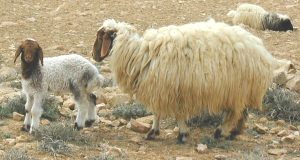
Before the time of Abraham at least five breeds of sheep had already been developed in Mesopotamia. From mummified remains (that is, preserved dead bodies) and ancient art it is also known that at least two different breeds had reached Egypt by about 2000 B.C. Thus it is likely that the sheep mentioned in the Bible were of more than one breed.
The Hebrew word kar seems to be used of imported foreign sheep and may refer to a special breed but some scholars think it refers to a wether (castrated ram), since this word is never used in the context of sacrifice. This word is also used for a battering ram, that is, a heavy pole suspended on a rope, used in war for breaking down walls. ’Ayil is the word for a ram or adult male sheep, rachel is a breeding ewe or female sheep, and taleh is a very young lamb, probably still unweaned. The remaining Hebrew words refer to sheep in general.
The Greek word probaton is the general word for sheep, or flocks that may include goats. Krios is the Greek word for a ram or male sheep. Pascha is a technical name for the Passover lamb exclusively, and the remaining Greek words all mean lamb. Ovis is the Latin word for sheep.
Click or tap here for the rest of this entry in United Bible Societies’ All Creatures Great and Small: Living things in the Bible.
The early Hebrews were nomadic shepherds to whom sheep were the most important domestic animal. While goats eat almost any vegetation, sheep are much more selective about the grasses and plants they eat. This meant that suitable grazing for them was not always easy to find, and shepherds had to keep moving their flocks from place to place. This led to a nomadic lifestyle, with movable tents rather than houses being the normal household shelter. It was not until the occupation of Canaan after the Exodus that the lifestyle of the Israelites changed, and they became settled village-dwelling farmers and fruit growers.
However, even then, most households owned sheep, and some family members would function as shepherds, often living away from home for fairly long periods.
Sheep in the Bible were a source of meat, milk, wool, hides, and horns, and it seems likely that various strains were bred selectively to enhance production of these commodities. Wool is mentioned in the Bible as early as the Mosaic Law, which forbade the weaving of cloth containing both wool and plant fibers. The shearing of sheep is mentioned even earlier, in Genesis 31:19. Wool was in fact the most common and available fiber known to the people of Israel.
There was a very extensive wool trade in biblical times, stretching from Egypt to China. In the Middle East wool was cheaper than cotton or linen, which were the other common fibers. (Silk was known by the time of Solomon, but it was extremely expensive as it was produced in China and handled by numerous traders on its way west.) It would be a mistake to think of all wool at that time as being white, as Genesis 30 indicates quite clearly that there were also dark colored sheep and sheep that had dark and light patches, probably varying combinations of black, white, and brown.
We can be fairly sure that one breed of sheep known to the Israelites was the Fat-tailed Sheep Ovis laticaudata and that its fatty tail is referred to in Exodus 29:22, Leviticus 3:9 et al.
Rams’ horns had a variety of uses. Whole ram horns were used as drinking vessels, jars, and trumpets. But pieces of horn were used as handles for knives and other household implements, and for jewelry such as bracelets and beads. Needles too, and probably also arrow heads, were made from horn, as well as from bone and later from bronze and iron.
Sheep were also very important in Israelite religion. They were a very important element in the sacrificial system and in the traditional religious feasts, especially the Feast of Passover.
Sheep and goats belong to the same general family. They differ in that sheep produce wool, which is a special type of soft hair, among the ordinary hairs on their bodies. A ram’s horns too differ in shape from a goat’s horns, those of a ram curling down in a tight spiral beside its face, with those of a goat curving more gently back towards its shoulders. The sheep of biblical times produced much shorter wool than is common with wool-bearing breeds of today.
The fat-tailed or broad-tailed sheep is a smallish breed usually brown and white with a very broad tail. Like most other breeds of sheep in the Middle East it has large floppy ears.
Sheep are generally fairly timid animals, lacking the self-confidence and adaptability of goats. While goats will spread out in their search for food and then regroup without much difficulty, sheep become very insecure when they are separated from other sheep and tend to stay bunched together. They thus require a lot of shepherding. In the Middle East the method of shepherding involves training the dominant ram to follow the shepherd. The remaining sheep then follow this dominant ram, which often wears a wooden clapper or a bell. As they feed, the sheep usually keep within earshot of this sound. It is likely that this method is centuries old.
In most modern breeds only male sheep have horns, but in most ancient breeds female sheep had short horns too. This made separating sheep from goats in a single flock more difficult than it is today.
Of all animals the sheep was the most important for the Israelite nation. It had great religious, social, and economic importance.
The metaphor of a lamb is used in the New Testament to refer to Christ, with an emphasis on his being a sacrifice for the sin of the world. This is especially the case in John’s gospel and Revelation. In the latter book the metaphor is introduced in a very striking way. In Revelation 5:5 as the writer is mourning the fact that no one can be found to open the scroll, he is comforted by one of the elders who tells him that “the Lion of the tribe of Judah” has triumphed and can thus open the scroll. Then the writer, expecting to see the Lion, sees instead a Lamb that looks as if it has been killed for sacrifice. The remainder of the book is then concerned with describing the triumph of this Lamb over the forces of evil.
In the gospels Jesus also refers to his disciples as “sheep” and “lambs” (Matthew 10:17; John 10:1 et al.).
The metaphor of the shepherd is extended to God himself who is the ultimate “Shepherd of Israel” (Psalms 23:1; 80:1). Then those who are responsible for the nurture, guidance, ruling, and protection of Israel, be it kings, prophets, or priests, are also likened to shepherds (Isaiah 56:11; Jeremiah 23:4; 49:19; Ezekiel 34:2; Zechariah 10:2).
The Messiah is also called a shepherd (Isaiah 40:11), and Jesus refers to himself as “the good shepherd” (John 10:11). In Hebrews 13:20 he is referred to as “the great shepherd of the sheep” and in 1 Peter 2:25 he is called “the Shepherd and Guardian of your lives”.
In languages that have a word for sheep, it is advisable to translate according to the meanings given above. If possible, the feminine forms should be translated as “female lamb” or “female sheep”. In languages in which sheep are not known, a word has usually been coined or borrowed by the time Bible translation begins, and this word should be used. It is not advisable to substitute another locally well-known animal in this case, since doing so negates the ritual and symbolic importance that sheep had for the biblical cultures.
In translating Psalms 23:1 it is extremely important to make sure that the phrase “my shepherd” preserves the relationship intended by the writer and reflects the psalmist’s theme that Yahweh is his benefactor, protector, and guide. There are really two metaphors involved in the opening verse-the caring shepherd (God) and by clear implication, the dependent sheep (the psalmist). In many languages the literal phrase “my shepherd” depicts a wrong relationship, meaning something like “the one who looks after my sheep” or “the one I employ to watch my sheep.” In many African languages unwary translators have produced a rendering that means “The Chief is (nothing more than) my herdsman.” It is often necessary to restructure the whole verse as something like “I am a sheep, and the lord is my shepherd.”
And water you shall drink by measure, the sixth part of a hin: Ezekiel’s water was rationed in the same way as his food. He was allowed the sixth part of a hin, that is, about 0.6 liter (1 pint). Translators should not be too specific here, but the volume chosen should represent a very small amount of water. “A small container” or “two cups” (Good News Translation) is acceptable, but “one liter” (Bible en français courant, Die Bibel im heutigen Deutsch (1982)) is too much.
Once a day you shall drink is literally “from time to time you must drink” (see the comments on verse 10). Like the loaf of bread, Ezekiel had to drink this water once a day at the same time each day.
Models for this verse are:
• And you can drink water only once a day, about two cups and always at the same time.
• Once each day, at the same time, you can drink two small cups of water.
Quoted with permission from Gross, Carl & Stine, Philip C. A Handbook on Ezekiel. (UBS Helps for Translators). Miami: UBS, 2016. For this and other handbooks for translators see here .
Then he brought me to the nave: Next the angelic guide took Ezekiel to the main room of the Temple. For he brought me, see 40.17. A nave is the long narrow central hall of a church that makes up the large main area of the church. Here the word refers to the long main room of the Temple building. Some translations render it in this way by saying “large main room of the Temple” (New Living Translation [1996]), “central room” (Good News Translation), “main room of the temple” (Contemporary English Version), or “great hall” (New Jewish Publication Society’s Tanakh). But most translations include an explanatory interpretation of what the room was for, for example, “Holy Place” (Good News Translation, New Century Version) or “[outer] sanctuary” (New International Version, New Living Translation, New King James Version , Revised English Bible, Christian Community Bible, Complete Jewish Bible). The Hebrew word for nave often refers to the Temple as a whole, not just the large room inside it (compare King James Version “temple”). Jerusalem Bible and New Jerusalem Bible use “Hekal,” which is a transliteration of the Hebrew word here. In this context the best rendering is “sanctuary” or “large main room [of the Temple].” If the expression “Holy Place” is familiar in the church, this is also acceptable.
And measured the jambs; on each side six cubits was the breadth of the jambs: The angelic guide continued to measure the features of the building. The jambs were the doorframes of the sanctuary’s opening. The breadth, that is, the thickness, of each doorframe was six cubits, that is, 3 meters (10 feet). There was one on each side of the doorway opening.
And the breadth of the entrance was ten cubits: The width of the door opening was ten cubits, that is, 5 meters (17 feet).
And the sidewalls of the entrance were five cubits on either side: The sidewalls of the entrance refers to the walls on either side of the opening, where the doorframes were. The width of each sidewall from the doorframe to the outside wall on each side was five cubits, that is, 2.5 meters (8 feet).
And he measured the length of the nave forty cubits, and its breadth, twenty cubits: The Temple’s main room, was forty cubits, that is, 20 meters (68 feet), long and twenty cubits, or 10 meters (34 feet), wide.
At the end of verse 1 there are two Hebrew words whose meaning is difficult to understand. The words are literally “width of the tent.” King James Version renders them as “which was the breadth of the tabernacle” (similarly New King James Version ). The reference to the Tabernacle does not fit the context here, but it may have been a note added by somebody who noticed that this room was the same width as the Tabernacle. It may even have been a comment by Ezekiel himself. Nevertheless, it is probably best to omit these words, as most of the translations do.
Quoted with permission from Gross, Carl & Stine, Philip C. A Handbook on Ezekiel. (UBS Helps for Translators). Miami: UBS, 2016. For this and other handbooks for translators see here .

Leave a Reply
You must be logged in to post a comment.