
The Hebrew and Greek that is translated as “cosmetic (or: beauty) treatments” in English is translated in Newari as “(giving of) grooming materials” (source: Newari Back Translation).
virgin
The Hebrew and Greek that is mostly translated as “virgin” in English can be translated as “woman that is untouched” in Batak Toba or “a woman with a whole (i.e. unopened) body” in Uab Meto.
“Similar words for ‘girl,’unmarried young woman,’ suggesting virginity without explicitly stating it, are found in Marathi, Apache, or Kituba. Cultural features naturally influence connotations of possible renderings, for instance, the child marriage customs in some Tboli areas, where the boy and girl are made to sleep together at the initial marriage, but after that do not live together and may not see each other again for years. Hence, the closest attainable equivalent, ‘female adolescent,’ does not imply that a young girl is not living with her husband, and that she never had a child, but leaves uncertain whether she has ever slept with a male person or not. Accordingly, in Luke one has to depend on Luke 1:34 to make clear that Mary and Joseph had not had sexual intercourse. A different problem is encountered in Pampanga, where birhen (an adaptation of Spanish virgen — ‘virgin’), when standing alone, is a name of the ‘Virgin Mary.’ To exclude this meaning the version uses “marriageable birhen,” thus at the same time indicating that Mary was relatively young.” (Source: Reiling / Swellengrebel, see here)
In Navajo (Dinė), the term that is used is “no husband yet” (Source: Wallis, p. 106) and in Gola the expression “trouser girl.” “In the distant past young women who were virgins wore trousers. Those who were not virgins wore dresses. That doesn’t hold true anymore, but the expression is still there in the language.” (Source: Don Slager)
The term in Djimini Senoufo is katogo jo — “village-dance-woman” (women who have been promised but who are still allowed to go to dances with unmarried women). (Source: Übersetzung heute 3/1995)
In Igbo translations, typically a newly-created, multi-word phrase is used that very explicitly states that there has not been any sexual relations and that translates as “a woman (or: maiden) who does not know a man.” This is in spite of the fact that there is a term (agb͕ọghọ) that means “young woman” and has the connotation of her not having had sexual relations (this is for instance used by the Standard Igbo Bible of the Bible Society of Nigeria for Isaiah 7:14). Incidentally, the euphemistic expression “know” (ma in Igbo) for “having sex” has become a well-known euphemism outside of Bible translation. (Source: Uchenna Oyali in Sociolinguistic Studies Vol. 17 No. 1-3 (2023): Special Issue: Gender and sexuality in African discourses )
In Chichewa, it is translated as namwali which is used to refer to a girl who has reached puberty stage and is ready to get married. Apart from the physical aspect, the word also has social implications in the sense that it is used to recognize the fact that the girl has become responsible enough to make informed decisions and take care of herself and others. (Source: Mawu a Mulungu mu Chichewa Chalero Back Translation)
See also virgins (Revelation 14:4) and complete verse (Matthew 1:23).
myrrh
The Greek and Hebrew that is translated as “myrrh” in English is translated as “bitter medicine” in Michoacán Nahuatl and as “myrrh perfume” in Tzotzil (source: Ronald D. Olson in Notes on Translation January, 1968, p. 15ff.).
In Mark 15:23, Usila Chinantec translates it as “the herb myrrh which is useful so that one not feel pain in his body.” (Source: B. Moore / G. Turner in Notes on Translation 1967, p. 1ff.)
Myrrh is probably the most precious spice in the Bible. It was worth more than its weight in gold. Our experts agree that the Hebrew word mor refers to the resin of one of the Commiphora genus, either myrrha, abyssinica or schimperi, all of which grew in what is now Yemen, Ethiopia, Somalia, and Madagascar. Other kinds of myrrh may have come from India (Commiphora erythraea, Commiphora opobalsamum). A more difficult question is the meaning of the word deror in Exodus 30:23. In the other places where it occurs it means “freedom” or “liberty.” This is the basis for the word “liquid” in some versions, but there is no certainty that “free” means “liquid.” The fact that myrrh was sometimes mixed with wine may suggest that deror means “liquid” here, but on the other hand, the weight of the myrrh is given in dry measure rather than liquid measure, which argues against it.
The myrrh plant is a bush or shrub with thick thorny branches that project and bend at odd angles. The leaves come in sets of three. The fruit is oval like a plum. The wood and bark have a pleasant smell. The gum oozes naturally from the branches, though some harvesters incise the branches to increase the flow. The sap or gum is clear or yellowish brown when it comes out, but gets darker as it dries. The taste of the gum is bitter (note the similarity of mor to the Hebrew word mar meaning “bitter”). In markets the gum is often found mixed with that of the kataf bush (bisabol).
God prescribed myrrh as an ingredient of the holy anointing oil (Exodus 30:23), and it is used as perfume in Esther, Psalms, Proverbs, and eight times in Song of Songs. It was brought as an expensive gift by the Magi to the new King (Matthew 2:11). As Jesus was dying on the cross, sympathetic bystanders may have offered it to him mixed with wine (Mark 15:23; see the parallel account in Matthew 27:34). Joseph of Arimathea and Nicodemus brought a mixture of myrrh and aloes to prepare Jesus’ body for burial (John 19:39). In ancient Egypt myrrh was burned on the altars of the sun god, and in Persia it was attached to the crowns of kings when they appeared in public. Romans burned myrrh at funerals and cremations, which helps to explain its inclusion in the list of spices in Revelation 18:13. Today it is used in perfumes, lotions, and even in toothpaste.
Varieties of myrrh grow in the Horn of Africa and Madagascar, so people from those areas should have no difficulty finding words for it. As to whether the myrrh in Exodus 30:23 was liquid or solid, there seems to be no consensus, and the translator may be forgiven for simply ignoring the Hebrew word deror . Possible transliterations are Hebrew mor, Arabic mar, French mireh, and Spanish/Portuguese mirra.
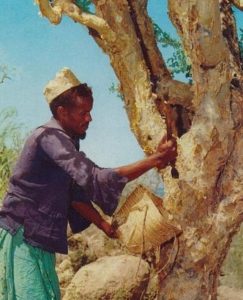

Source: Each According to its Kind: Plants and Trees in the Bible (UBS Helps for Translators)
See also mixture of myrrh with aloes.
dove / pigeon
The Hebrew, Latin and Greek that is translated as “dove” or “pigeon” in English is translated in Pijin with the onomatopoeia kurrukurru. (Source: Bob Carter)
In Matumbi is is translated as ngunda, a kind of dove that has the reputation to be monogamous. (Source: Pioneer Bible Translators, project-specific notes in Paratext)
In the fifteenth century the English word “pigeon” meant a young dove, the word “dove” being reserved for the adult birds. In modern English the words are used almost interchangeably. As a general rule, “pigeon” is used for domesticated forms of these birds, and for the larger variety of wild forms, while “dove” is used mainly for wild varieties. However, there are many exceptions to this general rule.
Pigeons and doves are both included in a bird family known scientifically as the Colombidae, consisting of well over two hundred species. In Israel and the Middle East are found the true Colombidae, which are easily distinguished from the genus Stretopelia, that is, the turtle doves.
The most common of the true Colombidae in the Middle East is most certainly the Asiatic Rock Dove Columba livia. This bird was first domesticated around 4500 B.C. in Mesopotamia. By 2500 B.C. it was kept as a domestic bird in Egypt, and by 1200 B.C. there is evidence that its homing abilities were already well known. It is this bird that is the ancestor of the domestic homing pigeons that people keep, some of which have escaped, returned to the wild, and now populate city streets all over the world. The ledges of modern buildings are a good substitute for the rock ledges that were its original nesting sites. It is likely that the Canaanites and the Israelites also kept these birds for both food and sacrifice. It is this bird that is called yonah in the Hebrew Bible and peristera in the Greek New Testament.
There are also three types of turtledove found in the land of Israel, two of which are resident species; the third is a migrant that arrives in spring and spends the summer in Israel. This migrant, the true Turtle Dove Streptopelia turtur, and one of the species now resident, the Collared Dove Streptopelia decaocto, are what the Bible writers called tor in Hebrew and trugōn in Greek. (Both the Hebrew and Greek names are based on the sound the turtledove makes.)
In biblical Hebrew the word gozal generally refers to a nestling of any bird species. In Genesis 15:9 it obviously refers specifically to a young pigeon. Nestling rock pigeons were collected from the rock ledges. Pigeons and doves were kept in cages and dovecotes, and wild ones were trapped in nets. This enabled the Jews to have a handy stock of birds for sacrificial purposes.
The rock pigeon is a blue-gray color with a pinkish sheen to the neck feathers. It has a black tip on its tail. Its call is a repeated moaning oom (the Hebrew name yonah is related to a verb meaning “to moan”) or a rapid cooing coo-ROO-coo-coo, usually repeated two or three times. The call is uttered with the beak closed, into the chest. The male’s sexual display starts with flying wing claps, and then when it lands next to the female, it begins bowing and turning with chest puffed and tail spread.
This type of pigeon lives in large colonies, and when a group is in flight, they maneuver as a single unit, often gliding short distances together with their wings held in a V shape.
The turtledove is a smaller blue-gray bird with a pinkish chest. It arrives in Israel in April, and its rhythmic call yoo-ROO-coo, yoo-ROO-coo, yoo-ROO-coo, repeated for two or three minutes at a time on sunny days, can be heard all over.
Doves are seed eaters, and this fact may be significant in the Flood narrative. The raven, a carrion eater, does not return to the ark, since food is available. The dove returns at first, and when it finally stays away, this is an indication that seeds of some sort are once again available to it, and the earth is again dry.
As seed-eaters, doves and pigeons are ritually clean birds for Jews. Their swift flight means that they are symbolic of speed in some biblical contexts, especially in Psalms. The fact that these birds court, mate, and nest repeatedly throughout the year resulted in their being a symbol of affection, sexuality, and fertility in the ancient Egyptian, Canaanite, and Hebrew cultures. This symbolism is important in the Song of Solomon.
A very ancient belief that the dove has no bile and is therefore devoid of anger led to its becoming a symbol of peace and gentleness. (In actual fact doves and pigeons are aggressive, often attacking other birds, especially at food sources.)
The name yonah for the pigeon and dove is associated with moaning and groaning in pain or sorrow. This is often the symbolism in prophetic poetry.
Pigeons and doves are found worldwide, except in some snow-bound regions and on some remote islands. Almost everywhere they live there is more than one species, and in almost all locations the domestic pigeon is one of these species. As a general rule, the word for the smaller wild dove should be used wherever possible, but in those contexts where both pigeons and doves are mentioned in connection with sacrifices, the word for the domestic pigeon can be used as well as the one for the wild dove.
In 2 Kings 6:25 there is a Hebrew expression that literally means “dove’s dung”. This seems to be a reference to some kind of food that is eaten only in emergencies. Suggestions about what this may refer to have varied from “chickpeas” (which do look somewhat like a dove’s droppings) to “locust-beans”, “wild onions”, and the roots of certain wild flowers. In view of the lack of certainty, it is probably best to translate it literally as “dove’s dung” and include the footnote, “This is probably some kind of wild food eaten only in emergencies.”
Source: All Creatures Great and Small: Living things in the Bible (UBS Helps for Translators)
opobalsamum (balsam; balm)
The Hebrew word bosem, which is often rendered “balm” (derived from “balsam”), can refer to any type of aromatic healing substance, but it also designates the product of a particular tree, the balsam or opobalsamum Commiphora gileadensis. Arabs call it balasam or balasham. In the Talmud it is called afarsimon. Excavations near En Gedi have uncovered an ancient processing plant for balsam oil.
The opobalsamum tree likes a desert or semi-desert climate. It grows to 2‑3 meters (7‑10 feet) tall and has small, wrinkled, three-part leaves, white flowers, and pea-sized red berries that have a fragrant yellow seed inside. The bark of younger branches is gray, turning brown with age. The resin appears by itself in green droplets from the stems and branches, but collectors also make cuts in the branches to speed the process. The droplets turn from green to brown, clump together, and fall to the ground, where they are collected.
In Bible times, balsam oil was used in holy anointing oil, as medicine, and as an ingredient of perfume.
A generic word or phrase for sweet-smelling substances is appropriate to render bosem, although where a specific name for the balsam tree is available, as in southwestern Arabia and Somalia, this could also be used. At least one hundred species of the genus Commiphora are spread throughout dry areas of the world. Translators in some areas will know the plants; others may know only the dried resin of Commiphora sold in spice markets.

Source: Each According to its Kind: Plants and Trees in the Bible (UBS Helps for Translators)
fat, oil
The different Hebrew and Greek terms that are translated as “(olive) oil” and “(animal) fat” in English are translated in Kwere with only one term: mavuta. (Pioneer Bible Translators, project-specific translation notes in Paratext)
complete verse (Esther 2:12)
Following are a number of back-translations as well as a sample translation for translators of Esther 2:12:
- Kupsabiny: “Before any girl who had been made to live in that house of women would go to meet the king, she was required to prepare/beautify herself for one year. In the first six months of that year, she was required/supposed to be smearing herself with a sweet smelling oil/perfume, and in the other six months that would follow/next, she would continue to smear herself with other oils/perfumes which would make the body smooth/soft.” (Source: Kupsabiny Back Translation)
- Newari: “Before a woman would be taken to the great king Ahasuerus, she would be given [a supply] of various cosmetics for up to a year, for instance, for up to six months oil of myrrh would be applied, and for up to six months perfume and oil would also be applied. Then, one at a time, turn by turn, [they] would be taken to the great king’s place.” (Source: Newari Back Translation)
- Hiligaynon: “Before a woman is-caused-to-face the king she should had-completed first one year (procedure) of becoming-beautiful: for a period/[lit. inside] of six months she is-to-rub her body with myrrh oil, and for a period/[lit. inside] of another six months she is-to-put her body with perfume and some other kinds of that-which-causes-beautifying.” (Source: Hiligaynon Back Translation)
- Eastern Bru: “All the women had to spend a year in that house before they were taken to King Xerxes. For six months they were massaged with oil of myrrh. And for six more months they rubbed things on them to make them beautiful and also sweet smelling perfume.” (Source: Bru Back Translation)
- English: “Before these women were taken to the king, they put ointments on the bodies of these women for one year to make them more beautiful. For six months they rubbed olive oil mixed with myrrh on their bodies each day. For the next six months they rubbed ointments and perfumes on their bodies.” (Source: Translation for Translators)
king
Some languages do not have a concept of kingship and therefore no immediate equivalent for the Greek, Hebrew, Aramaic, and Latin that is translated as “king” in English. Here are some (back-) translations:
(Click or tap here to see details)
- Piro: “a great one”
- Highland Totonac: “the big boss”
- Huichol: “the one who commanded” (source for this and above: Bratcher / Nida)
- Ekari: “the one who holds the country” (source: Reiling / Swellengrebel)
- Una: weik sienyi: “big headman” (source: Kroneman 2004, p. 407)
- Pass Valley Yali: “Big Man” (source: Daud Soesilo)
- Ninia Yali: “big brother with the uplifted name” (source: Daud Soesilio in Noss 2007, p. 175)
- Nyamwezi: mutemi: generic word for ruler, by specifying the city or nation it becomes clear what kind of ruler (source: Pioneer Bible Translators, project-specific translation notes in Paratext)
- Ghomála’: Fo (“The word Fo refers to the paramount ruler in the kingdoms of West Cameroon. He holds administrative, political, and religious power over his own people, who are divided into two categories: princes (descendants of royalty) and servants (everyone else).” (Source: Michel Kenmogne in Theologizing in Context: An Example from the Study of a Ghomala’ Christian Hymn))
Faye Edgerton retells how the term in Navajo (Dinė) was determined:
“[This term was] easily expressed in the language of Biblical culture, which had kings and noblemen with their brilliant trappings and their position of honor and praise. But leadership among the Navajos is not accompanied by any such titles or distinctions of dress. Those most respected, especially in earlier days, were their headmen, who were the leaders in raids, and the shaman, who was able to serve the people by appealing for them to the gods, or by exorcising evil spirits. Neither of these made any outward show. Neither held his position by political intrigue or heredity. If the headman failed consistently in raids, he was superceded by a better warrior. If the shaman failed many times in his healing ceremonies, it was considered that he was making mistakes in the chants, or had lost favor with the gods, and another was sought. The term Navajos use for headman is derived from a verb meaning ‘to move the head from side to side as in making an oration.’ The headman must be a good orator, able to move the people to go to war, or to follow him in any important decision. This word is naat’áanii which now means ‘one who rules or bosses.’ It is employed now for a foreman or boss of any kind of labor, as well as for the chairman of the tribal council. So in order to show that the king is not just a common boss but the highest ruler, the word ‘aláahgo, which expresses the superlative degree, was put before naat’áanii, and so ‘aláahgo naat’áanii ‘anyone-more-than-being around-he-moves-his-head-the-one-who’ means ‘the highest ruler.’ Naat’áanii was used for governor as the context usually shows that the person was a ruler of a country or associated with kings.”
(Source: Faye Edgerton in The Bible Translator 1962, p. 25ff. )
See also king (Japanese honorifics).
Leave a Reply
You must be logged in to post a comment.