
The Greek that is translated as “those eighteen who were killed when the tower of Siloam fell on them” or similar in English is translated in the German New Testament translation by Berger / Nord (publ. 1999) with “those eighteen who recently were killed when the tower of Siloam collapsed.”
Annunciation (image)

Image taken from the Wiedmann Bible. For more information about the images and ways to adopt them, see here . For other images of Willy Wiedmann paintings in TIPs, see here.
Following is a contemporary tempera / gouache on leather painting by an unknown Ethiopian artist:

Source: Sacred Art Pilgrim website .
Following is a painting (“Annunciation”) by He Qi:

He Qi © 2021 All Rights Reserved.
Image taken from He Qi Art . For purchasing prints of this and other artworks by He Qi go to heqiart.com . For other images of He Qi art works in TIPs, see here.
Annunciation to Mary (icon)
Following is a Serbian Orthodox icon of the Annunciation to Mary from the 14th century (found in the Church of Theotokos the Perivleptos, Ohrid, today in the National Museum of Serbia).
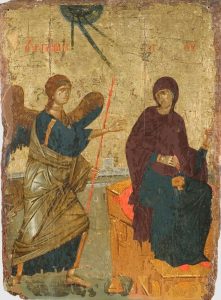

Orthodox Icons are not drawings or creations of imagination. They are in fact writings of things not of this world. Icons can represent our Lord Jesus Christ, the Virgin Mary, and the Saints. They can also represent the Holy Trinity, Angels, the Heavenly hosts, and even events. Orthodox icons, unlike Western pictures, change the perspective and form of the image so that it is not naturalistic. This is done so that we can look beyond appearances of the world, and instead look to the spiritual truth of the holy person or event. (Source )
angel
The Greek, Hebrew and Aramaic that is translated as “angel” in English versions is translated in many ways:
- Pintupi-Luritja: ngaṉka ngurrara: “one who belongs in the sky” (source: Ken Hansen quoted in Steven 1984a, p. 116.)
- Tetela, Kpelle, Balinese, and Mandarin Chinese: “heavenly messenger”
- Shilluk / Igede: “spirit messenger”
- Mashco Piro: “messenger of God”
- Batak Toba: “envoy, messenger”
- Navajo (Dinė): “holy servant” (source for this and above: Bratcher / Nida 1961; Igede: Andy Warren-Rothlin)
- Central Mazahua: “God’s worker” (source: Ronald D. Olson in Notes on Translation January, 1968, p. 15ff.)
- Saramaccan: basia u Masa Gaangadu köndë or “messenger from God’s country” (source: Jabini 2015, p. 86)
- Mairasi: atatnyev nyaa or “sent-one” (source: Enggavoter 2004)
- Shipibo-Conibo: “word bringer” (source: James Lauriault in The Bible Translator 1951, p. 32ff. )
- Apali: “God’s one with talk from the head” (“basically God’s messenger since head refers to any leader’s talk”) (source: Martha Wade)
- Michoacán Nahuatl: “clean helper of God” (source: B. Moore / G. Turner in Notes on Translation 1967, p. 1ff.)
- Noongar: Hdjin-djin-kwabba or “spirit good” (source: Warda-Kwabba Luke-Ang)
- Wè Northern (Wɛɛ): Kea ‘a “sooa or “the Lord’s soldier” (also: “God’s soldier” or “his soldier”) (source: Drew Maust)
- Iwaidja: “a man sent with a message” (Sam Freney explains the genesis of this term [in this article ): “For example, in Darwin last year, as we were working on a new translation of Luke 2:6–12 in Iwaidja, a Northern Territory language, the translators had written ‘angel’ as ‘a man with eagle wings’. Even before getting to the question of whether this was an accurate term (or one that imported some other information in), the word for ‘eagle’ started getting discussed. One of the translators had her teenage granddaughter with her, and this word didn’t mean anything to her at all. She’d never heard of it, as it was an archaic term that younger people didn’t use anymore. They ended up changing the translation of ‘angel’ to something like ‘a man sent with a message’, which is both more accurate and clear.”)
Like a number of other East Asian languages, Japanese uses a complex system of honorifics, i.e. a system where a number of different levels of politeness are expressed in language via words, word forms or grammatical constructs. These can range from addressing someone or referring to someone with contempt (very informal) to expressing the highest level of reference (as used in addressing or referring to God) or any number of levels in-between. One way to do this is through the usage (or a lack) of an honorific prefix as shown here in the widely-used Japanese Shinkaiyaku (新改訳) Bible of 2017. When the referent is God, the “divine” honorific prefix mi- (御 or み) is used as in mi-tsukai (御使い) or “messenger (of God).” (Source: S. E. Doi, see also S. E. Doi in Journal of Translation, 18/2022, p. 37ff. )
See also angel (Acts 12:15) and this devotion on YouVersion .
complete verse (Luke 1:34)
Following are a number of back-translations of Luke 1:34:
- Noongar: “Mary said to the angel, ‘I am a virgin. How will this happen?'” (Source: Warda-Kwabba Luke-Ang)
- Uma: “Maria said saying to the angel: ‘How can what you (sing.) say happen? Because I am not yet married.'” (Source: Uma Back Translation)
- Yakan: “Mariyam said to the angel, ‘How can this be possible and-what’s-more I haven’t a husband yet.'” (Source: Yakan Back Translation)
- Western Bukidnon Manobo: “And then Mary said to the angel, she said, ‘How can this be? Because I am a virgin and I have never been approached by a man.’ (euphemism for sexual relations)” (Source: Western Bukidnon Manobo Back Translation)
- Kankanaey: “Whereupon Maria said to the angel, ‘Yes, but how perhaps can it be, because absolutely no one has touched me?'” (Source: Kankanaey Back Translation)
- Tagbanwa: “Maria spoke, saying, ‘How is that, since I haven’t yet had experience with any man?'” (Source: Tagbanwa Back Translation)
Mary (mother of Jesus)
The name that is transliterated as “Mary” in English is translated in Spanish Sign Language with arms folded over chest which is the typical pose of Mary in statues and artwork. (Source: John Elwode in The Bible Translator 2008, p. 78ff. )
“Mary” in Spanish Sign Language, source: Sociedad Bíblica de España
In American Sign Language it is translated with a sign for the letter M and the sign for “virgin,” which could also be interpreted as “head covering,” referring to the way that Mary is usually portrayed in art works. (Source: Ruth Anna Spooner, Ron Lawer)
“Mary” in American Sign Language, source: Deaf Harbor
For more information on translations of proper names with sign language see Sign Language Bible Translations Have Something to Say to Hearing Christians .
In the Burmese Common Language Version (publ. 2005), Mary is described as a king’s mother by using the royal noun suffix taw / တော် with the word “mother” in Matthew 1:16 and Luke 2:33. This is done to highlight the status of Jesus as a king or the divine Son. Othjer passages where taht is used include Matthew 2:11, 13, 14, 20, and 21. (Source: Gam Seng Shae in The Bible Translator 2002, p. 202ff. ) See also Jesus’ human vs. divine nature in modern Burmese translation.
In some Semitic languages, the transliteration for “Mary” is identical to the one for the prophetess “Miriam,” testifying to the fact that these names are identical (Arabic and the many translations that are reliant on Arabic: مَرْيَم, Hebrew: מִרְיָם, Ge’ez / Amharic and related languages: ማርያም).
Learn more on Bible Odyssey: Mary in Latin America and the Caribbean and Mary, the Mother of Jesus .
Jerusalem
The name that is transliterated as “Jerusalem” in English is signed in French Sign Language with a sign that depicts worshiping at the Western Wall in Jerusalem:
“Jerusalem” in French Sign Language (source: La Bible en langue des signes française )
While a similar sign is also used in British Sign Language, another, more neutral sign that combines the sign “J” and the signs for “place” is used as well. (Source: Anna Smith)
“Jerusalem” in British Sign Language (source: Christian BSL, used with permission)
Learn more on Bible Odyssey: Jerusalem .
Leave a Reply
You must be logged in to post a comment.