
The Greek that is translated as “reveal” in English is translated in Maan with the expression “take the leaf from it.” (Source: Don Slager)
complete verse (2 Thessalonians 2:6)
Following are a number of back-translations of 2 Thessalonians 2:6:
- Uma: “As for this time, the evil person has not yet appeared, because there is something that blocks him. Surely you remember what it is that blocks him. So, when the time that God set comes, the evil person will appear.” (Source: Uma Back Translation)
- Yakan: “And you know what opposes/stops him now the reason why he hasn’t come out/appeared yet. Because before he will come out/appear, his appointed time ought/has to have been reached. (when his appointed time has come)” (Source: Yakan Back Translation)
- Western Bukidnon Manobo: “You know what it is that restrains that greatest transgressor so that he cannot yet be revealed until the proper time.” (Source: Western Bukidnon Manobo Back Translation)
- Kankanaey: “Therefore you also know who/what is hindering/blocking that-aforementioned one-who-opposes all God’s laws in order that he won’t appear until the time that God has established arrives.” (Source: Kankanaey Back Translation)
- Tagbanwa: “And you indeed know what is hindering this, so that he won’t appear on the scene until the determined time has been reached.” (Source: Tagbanwa Back Translation)
- Tenango Otomi: “Now you know what it is that is restraining now so that it suddenly does not appear before the day which is determined when it will appear who this evil person is.” (Source: Tenango Otomi Back Translation)
formal 2nd person plural pronoun (Japanese)
Click or tap here to see the rest of this insight.
Like a number of other East Asian languages, Japanese uses a complex system of honorifics, i.e. a system where a number of different levels of politeness are expressed in language via words, word forms or grammatical constructs. These can range from addressing someone or referring to someone with contempt (very informal) to expressing the highest level of reference (as used in addressing or referring to God) or any number of levels in-between.
One way Japanese shows different degree of politeness is through the choice of a formal plural suffix to the second person pronoun (“you” and its various forms) as shown here in the widely-used Japanese Shinkaiyaku (新改訳) Bible of 2017. In these verses, anata-gata (あなたがた) is used, combining the second person pronoun anata and the plural suffix -gata to create a formal plural pronoun (“you” [plural] in English).
(Source: S. E. Doi, see also S. E. Doi in Journal of Translation, 18/2022, p. 37ff. )
Translation commentary on 2 Thessalonians 2:6
The Greek sentence begins “and now.” “And,” common at the beginning of sentences in Hebrew and biblical Greek, is omitted in most translations since Revised Standard Version, including Bible de Jérusalem, but not Jerusalem Bible Translator’s New Testament Traduction œcuménique de la Bible. “And now” here, followed by already in verse 7, suggests a certain amount of repetition between verses 6 and 7. The same Greek words are used more closely together in 1 John 4.3 (Good News Translation “and now it is here in the world already”).
Now sometimes has a purely logical meaning, for example, “now let me mention something else” (cf. Bijbel in Gewone Taal “thus”), and this would make good sense, since verse 6 probably begins a new paragraph. However, “now” in Greek usually indicates time, and this seems the more important factor here.
How is now related to the rest of the sentence? Does Paul mean (1) “you know now what is keeping this from happening” (cf. New English Bible “you must now be aware of the restraining hand”; similarly Moffatt Phillips Biblia Dios Habla Hoy Zürcher Bibel); or (2) “you know what is restraining him now” (Revised Standard Version cf. Knox Good News Translation Barclay Translator’s New Testament Bible en français courant Die Bibel im heutigen Deutsch Luther 1984 Bible de Jérusalem)? It is likely that Paul is moving on to teaching which is at least partly new to the Christians at Thessalonica. However, the main contrast between verses 1-4 and 6-10 lies in the difference of time perspective. In verses 1-4 Paul is concerned to say that the Day of the Lord will not come until certain other events have first taken place. In verses 6-10 he says positively and in more detail what these events are and in what order they will occur. This concern with order in time is shown by the use of such expressions as now, at the proper time (v. 6), already (v. 7), and then (v. 8). Paul distinguishes three groups of events: the first group are already occurring; the second are still in the future, but will happen before the Day of the Lord; and the last will take place on the Day of the Lord. However, Paul does not distinguish between the order of events within each group, and probably thinks of them as happening together. The following diagram compares the order in which Paul expects events to happen (first column) with the order in which he mentions them in successive verses. Figures in parentheses refer to verses; the other figures refer to the order in which the events are mentioned.
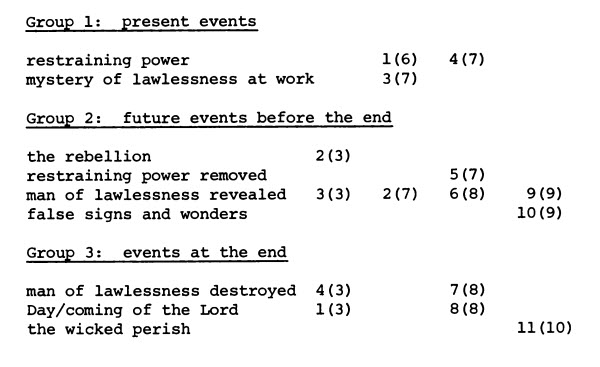
This diagram illustrates several points about the development of Paul’s thought in this passage. (1) It confirms that he is more concerned in verses 6-10 than in verses 1-4 with the order of events in time. (2) Although there is some repetition, additional details are added at every stage. (3) Paul connects the present, in which the mystery of lawlessness is already at work, through the future period before the end, in which the man of lawlessness will be revealed, to the end, when he will be destroyed. Paul places the Christian hope within the setting of his readers’ present experience. (4) Paul is most concerned, not with the restraining power, but with the man of lawlessness.
Languages differ in the way in which they express successions of events. Translators in some languages may need to alter the order in which Paul mentions the various items, to make it agree more closely with the order in which he expects them to happen.
Yet there is something that keeps this from happening now, and you know what it is is much shorter in Greek. Literally it is “and now the restraining (thing) you know.” Most translations expand this brief statement in order to make the meaning clear. The “restraining (thing)” (neuter) becomes a “restraining (man)” (masculine) in verse 7, and Good News Translation‘s something that becomes the one who in the next verse. In both places, Paul uses the definite article “the.” This suggests that the readers are supposed to have heard of this power (or person) already. If they had not, Paul would surely have explained in more detail what it was. However, we do not know this today. Best ends a careful seven-page summary of the various theories by saying “we must acknowledge our ignorance” (p. 301).
The verb which Good News Translation translates keeps … from (v. 6) and holds … back (v. 7) is used in various ways in the New Testament: (1) in a good sense, of retaining (Luke 8.15) or holding on to a message (1 Corinthians 15.2, cf. 11.2; see notes on 1 Thess. 5.21), or to one’s confidence (Hebrews 3.14) or hope (Hebrews 10.23, cf. Hebrews 3.6); (2) neutrally, of owning possessions (1 Corinthians 7.30, cf. 2 Corinthians 6.10), occupying a seat (Luke 14.9), or of Paul keeping Onesimus with him (Philemon 13); and (3) negatively, of the truth being held captive (Romans 1.18), the Law holding men prisoner (Romans 7.6), or a disease holding someone in its grip (John 5.4). A number of scholars believe that the third sense seems to fit the present context best, though this is not as clear in Greek as in most translations. The Greek verb normally has an object, but not here. There is nothing in the original text corresponding to Good News Translation‘s this in verse 6 and it in verse 7. The power which holds … back could in theory be an evil power holding men prisoners (as in Romans 7.6), but it is difficult to see why this power should be taken out of the way if another evil power, the Wicked One, is to take its place.
The conjunction yet indicates contrast, but this is not a contrast between the last sentence of verse 5 and the first sentence of verse 6. The contrast is suggested by what Paul affirms will happen, but which has not happened as yet; that is to say, between the contents of verses 3-4 and the statement of verse 6. To express this contrast appropriately, it may be necessary to use a conjunction such as “nevertheless” or “despite what is going to happen.”
In some languages a literal rendering of something would suggest a particular object as being the instrument or means which keeps the rebellion and the desecration of the Temple from taking place. Accordingly, some translators render something as “someone” in order to make the statement in verse 6 parallel to what occurs in verse 7. Other translators employ a phrase like “for some reason,” in order to indicate that a more general factor is involved in preventing the appearance of the Wicked One. Thus one may translate, for example, “nevertheless for some reason these happenings have not occurred as yet,” but it may be better to imply that Paul himself knew the reasons involved and therefore to translate, “nevertheless, for these reasons….”
The words you know seem to state clearly that the Thessalonians knew who or what the power which keeps … from was. Some translators understand the phrase in this way: Moffatt “you can recall,” Knox “(you know what I mean),” Barclay “you know about.” More probably, the words mean “you are experiencing for yourselves the activity of this restraining power.” This is a meaning of know close to that in which Paul spoke of those who “do not know God” (2 Thess. 1.8), indicating much more than that they did not know of God’s existence (cf. New English Bible “you must now be aware of”). If one is to interpret know in the sense of “experience,” it may be possible to translate you know what it is as “you know personally what it is,” or “… what is doing this,” or even, “… what is keeping this from happening.”
Like the first part of the verse, at the proper time, then, the Wicked One will appear is very concise in Greek. Literally it is “so that he will be revealed in his own time.” Some manuscripts have “in his time,” which means practically the same thing, unless someone else’s time (just possibly, but not likely, God’s time) is meant. The pronoun “he” almost certainly refers to “the man of lawlessness,” that is, the Wicked One, who is Paul’s main concern in this passage.
In a number of languages the proper time must be expressed by some kind of modal element in the verb, for example, “at the time when it should happen.” In other instances proper must be expressed as “correct,” that is to say, “at the correct time.” It may, however, be difficult to speak of a correct or proper time unless there is an indication of the person in whose judgment the time is proper. Therefore one may be obliged to say “at the time that God decides is right.”
Since the appearance of the Wicked One is essentially determined by his own initiative, one may say in some languages “the Wicked one will show himself,” or “… will cause himself to be known.”
If the two halves of this verse are read as a whole, it becomes clear that Paul can only mean: “You are experiencing the power which holds the Wicked One back now, so that he will be revealed at the proper time, and not before.” The words “in his own time” are emphasized in Greek by being placed at the end of the sentence. Barclay “not … until” is entirely justified: “so that the Wicked One will not burst upon the world until his own proper time” (cf. Die Bibel im heutigen Deutsch “God’s enemy can only appear when the time is ripe for him”; Bijbel in Gewone Taal Bible de Jérusalem Traduction œcuménique de la Bible).
Quoted with permission from Ellingworth, Paul and Nida, Eugene A. A Handbook on Paul’s Second Letter to the Thessalonians. (UBS Handbook Series). New York: UBS, 1976. For this and other handbooks for translators see here .
SIL Translator's Notes on 2 Thessalonians 2:6
2:6a
And you know what is now restraining him: In Greek it is not clear which word nun (now) is connected to. There are two possibilities:
(1) It goes with the expression to katechon, “the restraining/holding-back (thing).”
(Berean Standard Bible, Good News Translation, God’s Word, New American Standard Bible, SSA)
(2) It goes with the verb oida, “to know.” For example:
And now you know what is holding him back. (New International Version (2011 Revision))
(King James Version, New English Bible, Contemporary English Version, New Century Version)
It is recommended that you follow the first option (1).
what is now restraining him: As mentioned above, the Greek is literally “the restraining (thing).” Paul did not explain what was holding back or restraining the Wicked Person (“man of lawlessness”). The point is that something was preventing the Wicked Person (“man of lawlessness”) from appearing before the proper time (2:6b). (For some suggestions about who or what is holding him back, see Marshall, pp. 197–200; Bruce, pp. 171–172; or Best, pp. 296–301.)
The Greek text also does not say what is being held back. Some English versions make clear that this is referring to the man of lawlessness by saying:
restraining him (Berean Standard Bible, English Standard Version, New Revised Standard Version)
The Greek also does not say what the man of lawlessness is being restrained from doing. The next part of this verse makes it clear that he is being held back from appearing before “the proper time.”
2:6b
so that: This indicates the purpose of 2:6a.
he may be revealed: See the note on 2:3d. The Greek (like many English versions) again uses a passive here, but it does not imply that someone else (for example, the devil) caused him to appear. So if you cannot use a passive in your translation, you should use an active verb. For example:
he may appear
at the proper time: That is, at the time that God decides is right.
© 2002 by SIL International®
Made available under the terms of a Creative Commons Attribution-ShareAlike 4.0 License (CC BY-SA) creativecommons.org/licenses/by-sa/4.0
All Scripture quotations in this publication, unless otherwise indicated, are from The Holy Bible, Berean Standard Bible. BSB is produced in cooperation with Bible Hub, Discovery Bible, OpenBible.com, and the Berean Bible Translation Committee.
Leave a Reply
You must be logged in to post a comment.