myrrh

The Greek and Hebrew that is translated as “myrrh” in English is translated as “bitter medicine” in Michoacán Nahuatl and as “myrrh perfume” in Tzotzil (source: Ronald D. Olson in Notes on Translation January, 1968, p. 15ff.).

In Mark 15:23, Usila Chinantec translates it as “the herb myrrh which is useful so that one not feel pain in his body.” (Source: B. Moore / G. Turner in Notes on Translation 1967, p. 1ff.)


Myrrh is probably the most precious spice in the Bible. It was worth more than its weight in gold. Our experts agree that the Hebrew word mor refers to the resin of one of the Commiphora genus, either myrrha, abyssinica or schimperi, all of which grew in what is now Yemen, Ethiopia, Somalia, and Madagascar. Other kinds of myrrh may have come from India (Commiphora erythraea, Commiphora opobalsamum). A more difficult question is the meaning of the word deror in Exodus 30:23. In the other places where it occurs it means “freedom” or “liberty.” This is the basis for the word “liquid” in some versions, but there is no certainty that “free” means “liquid.” The fact that myrrh was sometimes mixed with wine may suggest that deror means “liquid” here, but on the other hand, the weight of the myrrh is given in dry measure rather than liquid measure, which argues against it.

The myrrh plant is a bush or shrub with thick thorny branches that project and bend at odd angles. The leaves come in sets of three. The fruit is oval like a plum. The wood and bark have a pleasant smell. The gum oozes naturally from the branches, though some harvesters incise the branches to increase the flow. The sap or gum is clear or yellowish brown when it comes out, but gets darker as it dries. The taste of the gum is bitter (note the similarity of mor to the Hebrew word mar meaning “bitter”). In markets the gum is often found mixed with that of the kataf bush (bisabol).

God prescribed myrrh as an ingredient of the holy anointing oil (Exodus 30:23), and it is used as perfume in Esther, Psalms, Proverbs, and eight times in Song of Songs. It was brought as an expensive gift by the Magi to the new King (Matthew 2:11). As Jesus was dying on the cross, sympathetic bystanders may have offered it to him mixed with wine (Mark 15:23; see the parallel account in Matthew 27:34). Joseph of Arimathea and Nicodemus brought a mixture of myrrh and aloes to prepare Jesus’ body for burial (John 19:39). In ancient Egypt myrrh was burned on the altars of the sun god, and in Persia it was attached to the crowns of kings when they appeared in public. Romans burned myrrh at funerals and cremations, which helps to explain its inclusion in the list of spices in Revelation 18:13. Today it is used in perfumes, lotions, and even in toothpaste.

Varieties of myrrh grow in the Horn of Africa and Madagascar, so people from those areas should have no difficulty finding words for it. As to whether the myrrh in Exodus 30:23 was liquid or solid, there seems to be no consensus, and the translator may be forgiven for simply ignoring the Hebrew word deror . Possible transliterations are Hebrew mor, Arabic mar, French mireh, and Spanish/Portuguese mirra.
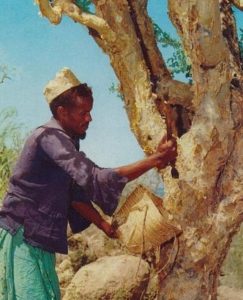
Harvesting myrrh, Wikimedia Commons

Source: Each According to its Kind: Plants and Trees in the Bible (UBS Helps for Translators)

See also mixture of myrrh with aloes.

lips (sweetness of)

The Hebrew in Song of Songs 5:13 that is translated as “lips are lilies, distilling liquid myrrh” in English is emphasized in Gbaya with the ideophone (a word that expresses what is perceived by the five senses) ɓisisi. (Source: Philip Noss in Noss / Houser 2019, p, 503)

opobalsamum (balsam; balm)

The Hebrew word bosem, which is often rendered “balm” (derived from “balsam”), can refer to any type of aromatic healing substance, but it also designates the product of a particular tree, the balsam or opobalsamum Commiphora gileadensis. Arabs call it balasam or balasham. In the Talmud it is called afarsimon. Excavations near En Gedi have uncovered an ancient processing plant for balsam oil.

The opobalsamum tree likes a desert or semi-desert climate. It grows to 2‑3 meters (7‑10 feet) tall and has small, wrinkled, three-part leaves, white flowers, and pea-sized red berries that have a fragrant yellow seed inside. The bark of younger branches is gray, turning brown with age. The resin appears by itself in green droplets from the stems and branches, but collectors also make cuts in the branches to speed the process. The droplets turn from green to brown, clump together, and fall to the ground, where they are collected.

In Bible times, balsam oil was used in holy anointing oil, as medicine, and as an ingredient of perfume.

A generic word or phrase for sweet-smelling substances is appropriate to render bosem, although where a specific name for the balsam tree is available, as in southwestern Arabia and Somalia, this could also be used. At least one hundred species of the genus Commiphora are spread throughout dry areas of the world. Translators in some areas will know the plants; others may know only the dried resin of Commiphora sold in spice markets.

Balsam tree, Photo by Nigel Hepper

Source: Each According to its Kind: Plants and Trees in the Bible (UBS Helps for Translators)

fat, oil

The different Hebrew and Greek terms that are translated as “(olive) oil” and “(animal) fat” in English are translated in Kwere with only one term: mavuta. (Pioneer Bible Translators, project-specific translation notes in Paratext)

complete verse (Song of Solomon 5:13)

Following are a number of back-translations as well as a sample translation for translators of Song of Solomon 5:13:

  • Kupsabiny: “His cheeks smell sweet
    like fields that are filled with flowers.
    His mouth is sweet
    like the ointment that smells sweet.” (Source: Kupsabiny Back Translation)
  • Newari: “His cheeks are like a garden filled with many fragrant spices and medicinal herbs.
    His lips are like a lily, dripping with the resin of myrrh.” (Source: Newari Back Translation)
  • Hiligaynon: “His face (is) fragrant/sweet-smelling like a garden/field which (is) full of plants that are-made into perfume. His lips (are) just like lilies/[liryo] that flow with myrrh/[mira].” (Source: Hiligaynon Back Translation)
  • English: “His cheeks are like a garden full of spice trees
    that produce sweet-smelling perfume.
    His lips are like lilies
    that have myrrh/perfume dripping from them.” (Source: Translation for Translators)

Translation commentary on Song of Songs 5:13

His cheeks: refer to comments on 1.10; 4.3 (see also 6.7).

Are like beds of spices, yielding fragrance: whereas in 1.10 the young woman’s cheeks were beautiful because of the decorative ornaments she wore, here the young man’s face is described. It is likened to beds of spices. Behind this phrase lies a Hebrew term that is singular in form, but which almost certainly should be read as plural. Manuscript evidence supports this view. We meet the phrase again in 6.2, on which occasion beds is parallel to “garden,” and clearly that is its meaning here also. Good News Translation fills out the comparison, suggesting that the young man’s cheeks are “as lovely as a garden.” We may question this choice of an adjective, however, since the point of the comparison is that the garden is fragrant, not that it is lovely. It is better, then, to say “His face smelled sweet like a garden full of spices” or “His face is [or, His cheeks are] fragrant, like a garden where spices grow.”

On spices refer to comments on 4.10.

Yielding fragrance is the Revised Standard Version rendering of a very difficult expression. The Hebrew text is literally “towers of fragrance.” Fox takes the expression to mean “His cheeks are like beds of spices, [fragrant like] towers of spices.” Pope and others, however, suggest that, rather than meaning “towers,” it is a participle, “growing,” used of plants, children, and hair (Psa 144.12; Num 6.5). We note that the Septuagint also interprets the word as a participle, “producing.” Pope’s translation, “His cheeks like spice beds, burgeoning aromatics,” seems to suggest a sweet-smelling beard. This suggestion makes good sense, but we are still faced with the difficulty of deciding whether the phrase describes the young man’s cheeks or the bed of spices. It is likely that yielding fragrance is an extended metaphor, so we can fill out the metaphor: “The beard on his cheeks is like a sweet-smelling garden.”

His lips are lilies: on the significance of lips, see comments at 4.3, 11. The term lily is discussed in 2.1-2. Although lacking the preposition “like,” it is nevertheless obvious that this is what is being said; “His lips are like lilies” (as Good News Translation). If Pope is correct, then the flower in question, whichever variety it is, is reddish in color. However, the point here is not the color of the young man’s lips but rather the delight his kisses give his lover.

Distilling liquid myrrh: in verse 5 a similar expression was used of perfume dripping from the woman’s hands onto the handles of the door. The verb distilling is literally “drip,” so the picture is of lips that are wet and moist. This can be translated “his lips are as delightful as lilies; they are moist with the finest myrrh,” or for the second clause “… they are like the finest spices to me.”

For the entire verse we can suggest:

• The beard on his cheeks is like
A sweet-smelling garden.
His lips are like the sweetest lilies,
Wet with dripping myrrh.

Quoted with permission from Ogden, Graham S. and Zogbo, Lynell. A Handbook on the Book of Song of Songs. (UBS Helps for Translators). New York: UBS, 1998. For this and other handbooks for translators see here .

SIL Translator’s Notes on Song of Songs 5:13

5:13

In 5:11–12 the author described what the woman saw. Here in 5:13 he describes what she smelled. In 5:13a–b, he used a simile, and in 5:13c–d he used a metaphor.

5:13a–b

His cheeks are like beds of spice, towers of perfume: Here the woman compared the man’s cheeks to beds of spice. The word cheeks also occurred in 1:10, where it referred to the woman’s cheeks. It can refer to various parts of the sides of a person’s face. Here the woman described the perfume of the man’s cheeks. They smelled like sweet-smelling spices. The woman probably did not imply that the man’s beard looked like a garden of spice plants.

Some other ways to translate the comparison are:

His face is a garden of sweet-smelling spices (Contemporary English Version)
-or-
His cheeks ⌊smell as sweet⌋ as a garden filled with spice ⌊plants⌋.
-or-
His cheeks are like a garden of spices, a garden that produces scented herbs. (God’s Word)

beds of spice: The Hebrew word that the Berean Standard Bible translates as beds is singular. It refers to a garden or part of a garden. The word spice refers to herb plants that have a pleasing smell. The phrase beds of spice can also be translated as “garden of spices.” See the preceding note for translation examples.

spice: The word spice was also used in 4:16. There it also referred to spice plants.

towers of perfume: There are two ways to interpret the phrase that the Berean Standard Bible translates as towers of perfume. The difference of interpretation is based on a textual issue.

(1) The phrase means “yielding fragrance.” For example:

yielding perfume… (New International Version)

(2) The phrase means “banks/towers of perfume.” For example:

Banks of perfume… (Tanakh: The Holy Scriptures)

It is recommended that you follow interpretation (1). Interpretation (2) is not natural in many languages, since perfume does not form banks or towers. English versions that follow interpretation (2) usually do not translate “tower” literally because of this difficulty. The ancient Greek version (LXX) also follows interpretation (1).

5:13c

His lips are like lilies: Here the woman used a simile. She compared the man’s lips to lilies. The simile implies that the man’s lips are like sweet-smelling lilies. The thought of the sweet smell of his lips probably reminded the woman of his kisses. Some other ways to translate this figure of speech are:

Use a metaphor. For example:

His lips are lilies

Use a simile and indicate the meaning. For example:

His lips ⌊smell as sweet⌋ as lilies

Translate the meaning more directly. For example:

His lips smell sweet

Translate the meaning in a natural way in your language.

lilies: The Hebrew word that the Berean Standard Bible translates as lilies also occurred in 2:16 and 4:5. It occurred in the singular form in 2:1–2. Refer to how you translated it in those verses.

5:13d

dripping with flowing myrrh: The phrase dripping with flowing myrrh is a hyperbole. Here it probably refers to the man’s lips being moist. It is similar to the phrase “my fingers ⌊dripped⌋ with flowing myrrh” in 5:5c.

However, since the context here is lips (instead of fingers), you may need to translate the phrase in a slightly different way here. For example:

wet with liquid myrrh (Good News Translation)
-or-
that drip with myrrh (God’s Word)
-or-
they are/smell ⌊as sweet as⌋ fine perfume

flowing myrrh: The Hebrew phrase that the Berean Standard Bible translates as flowing myrrh is literally “myrrh flowing,” as in 5:5c. The man’s lips were like lilies and myrrh because of the pleasure that his lips gave the woman. This way that the woman compared his lips to myrrh is similar to the way he compared her lips to dripping honey in 4:11. Translate this phrase in the same way here and in 5:5.

© 2017 by SIL International®
Made available under the terms of a Creative Commons Attribution-ShareAlike 4.0 License (CC BY-SA) creativecommons.org/licenses/by-sa/4.0.
All Scripture quotations in this publication, unless otherwise indicated, are from The Holy Bible, Berean Standard Bible.
BSB is produced in cooperation with Bible Hub, Discovery Bible, OpenBible.com, and the Berean Bible Translation Committee.