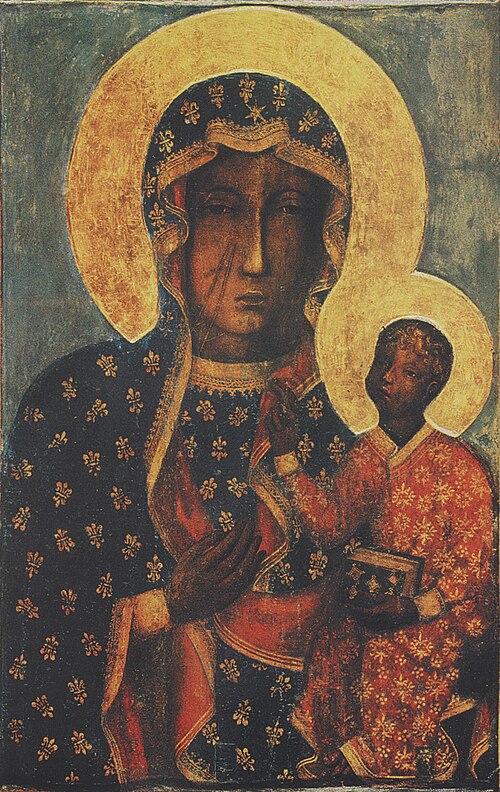
The first line in Song of Songs 1:5 has served as an inspiration for the so-called Black Madonnas in the catholic and Orthodox churches.
Peppard (2024, p. 176) explains: “One of the first things the beloved says in the poem is ‘Black am I, and beautiful.’ Due to the typological connections between this bride and Mary, the textual bride’s blackness seems to have influenced the artistic tradition of ‘Black Madonnas’ (or ‘Black Virgins’) throughout the Catholic world. These are sculptures or painted icons — some dating to the medieval period — that depict Mary (or Mary and Jesus together) carved of dark material or painted with dark skin tones. One catalog of Black Madonnas attests almost two hundred examples, mostly in Europe, with some in Africa, Southeast Asia, and the Americas. Among the most famous in Europe are Our Lady of Einsiedeln (fifteenth century, Austria) and Our Lady of Częstochowa (ninth – fourteenth century, Poland), the latter of which is among the most popular pilgrimage destinations in Europe. Most of them have mysterious origins and wondrous effects on individual pilgrims and national identities.”
Image of the Black Madonna of Częstochowa (source: Wikimedia ):
Icons are not drawings or creations of imagination. They are in fact writings of things not of this world. Icons can represent our Lord Jesus Christ, the Virgin Mary, and the Saints. They can also represent the Holy Trinity, Angels, the Heavenly hosts, and even events. Icons, unlike Western pictures, change the perspective and form of the image so that it is not naturalistic. This is done so that we can look beyond appearances of the world, and instead look to the spiritual truth of the holy person or event. (Source )
The name that is transliterated as “Jerusalem” in English is signed in French Sign Language with a sign that depicts worshiping at the Western Wall in Jerusalem:
While a similar sign is also used in British Sign Language, another, more neutral sign that combines the sign “J” and the signs for “place” is used as well. (Source: Anna Smith)
“Jerusalem” in British Sign Language (source: Christian BSL, used with permission)
The Hebrew, Latin and Greek that is transliterated as “Solomon” in English is translated in Spanish Sign Language with the sign for “wise” referring to 1 Kings 3:12. (Source: Steve Parkhurst)
Following are a number of back-translations as well as a sample translation for translators of Song of Solomon 1:5:
Kupsabiny: “Girls of Jerusalem, I have become dark, I am completely dark like the tents of Kedar, and I am like the curtains of Solomon. Even so, I am still very beautiful!” (Source: Kupsabiny Back Translation)
Newari: “I am dark, but I am very beautiful, oh you women of Jerusalem. I am dark skin like the tents of Kedar, but as beautiful as the curtains of Solomon’s Temple.” (Source: Newari Back Translation)
Hiligaynon: “Women of Jerusalem, I (am) dark like the tents of Kedar, but I (am) beautiful like the curtains in the palace of Solomon.” (Source: Hiligaynon Back Translation)
English: “You women of Jerusalem, I am dark but beautiful; my dark skin is like the tents in Kedar, or like the beautiful curtains in Solomon’s palace.” (Source: Translation for Translators)
I am very dark, but comely: the adjective given in Revised Standard Version as very dark and in Good News Translation as “dark” is simply the word “black.” In 5.11 the same word describes the color of the raven, a large black bird. The translator will have to choose a term that refers to people and the color of their skin. Some, especially those who think the young woman was a foreign princess, see this term as indicating a person of African origin. In view of verse 6, however, others see it as describing skin darkened by the sun, and this is probably more correct. Our interpretation will affect the way we translate.
Most languages make a distinction between people with a darker complexion and those with fair skin. In many parts of Africa darker-skinned people are described as “black,” while fair-skinned people are described as “red.” In such cultures it is best to use the literal “black.”
The phrase but comely seems to make a contrast between black and comely. Even though she is black, she is nevertheless beautiful. Note, however, that the Hebrew conjunction can be rendered either by but or “and.” Which is intended here?
Those sensitive to and proud of their blackness will almost certainly wish to render the conjunction as “and”: “I am black and beautiful.” However, it is important to note that in many cultures in Africa, Southeast Asia, and the Middle East, being light-skinned is a sign of beauty. Contrary to the Western ideal, being tan or darkened by the sun is viewed in a negative light. This description may mean, for example, that the young woman was forced to work in the sun—a sign of low social status. Indeed, in verse 6 this view in confirmed. She says she is dark “because the sun has scorched me.” In translating faithfully we need to choose terms that accurately reflect the culture of biblical times. In this context but seems to be a more faithful rendering. This is how Good News Translation, New American Bible, New English Bible, New Jerusalem Bible, and others understand it, though Contemporary English Version, New Revised Standard Version, and Revised English Bible use “and.”
The adjective comely appears often in descriptions of the young woman’s physical beauty (see 1.10; 2.14; 4.3; 6.4), mostly with reference to her facial features. Comely therefore means “lovely,” “beautiful.” In cultures that have one particular adjective to describe facial beauty, it will be appropriate here. Of course many languages use verbs in the place of adjectives, but this should pose no problem to the translator.
O daughters of Jerusalem is a phrase that appears in 2.7; 3.5, 10, 11; 5.8, 16; and 8.4. We understand the daughters to be the same group as is identified by the term “maidens” in verse 3 and by “they” in verse 4. As noted in the introduction, opinions vary greatly as to the role this group plays. Some see them as a group of privileged young women—“city girls”—who are light-skinned because they don’t have to work hard in the sun. Some detect a teasing attitude in their speech and so see them as possible rivals of the young woman. We have already noted that they are not actual actors or participants in the poem, but that they function more like a Greek chorus, whose role is to move the drama along. They may also be thought of as imaginary persons to whom the young woman addresses her inner thoughts. This may be rather unnatural in the translation, but we have little choice other than to render the text as it appears. As noted in our introductory remarks, if we explain the function of these “daughters” in the introduction, it will help the reader understand their role in the poem.
Revised Standard Versiondaughters of Jerusalem translates the Hebrew literally, but we need not use the term daughters if this is not appropriate. We can say “young women,” “girls,” or “women of Jerusalem.” Some languages have suffixes or markers to attach to the word Jerusalem to show they are feminine inhabitants. The call to these women is in the second line of this verse, but there is no reason that it must remain in this position. It may be preferable to place this vocative phrase at the beginning of the verse.
Like the tents of Kedar, like the curtains of Solomon: two questions arise about these parallel comparisons. One has to do with their relationship one with the other; the second is what they refer to and whether they both speak of the same object. We note that Kedar is one of the Ishmaelite tribes associated with Arabia (see Gen 25.13; Isa 21.16-17; Psa 120.5). This tribe typically lived in black tents. Kedar thus refers to the young woman’s black skin. In the case of the curtains of Solomon, this seems to be a reference to the curtains in Solomon’s Temple. The focus is on beauty. Thus each simile applies to one of the two claims the young woman makes about herself. She is as black as the nomads’ tents, and as beautiful as the elaborate curtains of Solomon’s Temple. Pope and Fox suggest we change the name Solomon to “Salmoh,” as there was an ancient tribe by this name in what came to be known later as Edom. Jerusalem Bible, New American Bible, and New English Bible accept this suggestion and so have “Salmoh” or “shalmah” (Revised English Bible) as parallel to Kedar. This appears a neat arrangement, but there is no textual support for the change.
Good News Translation gives translators a good model here by repeating the point of the illustration in each case: “dark as the desert tents of Kedar, but beautiful as the curtains in Solomon’s palace.” To make the point clearer we can repeat the subject pronoun as well: “I am dark like the [black] tents of the tribes in Kedar, and as beautiful as the curtains of Solomon’s Temple.”
Again we note a defensive tone in the young woman’s speech. She may mean “Unlike you, young women of Jerusalem, I am dark,” but this may be overtranslating. If we want to push the point, we can use a contrastive “but”: “I am dark like the tents of the tribes of Kedar, but as beautiful as the curtains….”
The writer of the Song often uses proper nouns or geographical names in the text as a poetic feature. These names may represent exotic or faraway places. Each name carries many associated ideas with it, and certainly they were known and appreciated by the audience that first heard them. However, it may be especially difficult to render these in a poetic context in the translation. In a narrative, for example, we can easily explain, “the ethnic group called Kedar,” but such long explanatory clauses will make our text heavy and lose the beauty of the poetic form. Translators should reflect, then, on how best to render these proper nouns. One way is to transliterate “Kedar” without explanation in the text. A footnote can identify these people and state that their tents are black. Another possibility is to leave out the proper noun and use a noun substitute giving the same idea; for example, “desert-people.” Bible en français courant uses a known word “bedouin.” This may be a good solution, since many readers may have even seen pictures of people today living in black tents.
As noted above, the comparison to the curtains in Solomon’s palace is based on the common feature of beauty. Bible en français courant here translates “like luxurious tapestries [or, cloth].” This translation has the advantage of treating the two lines in the same way, rendering them by a meaningful modern equivalent. In the present case, however, this may not be the best solution—first, because most readers will know Solomon, and second, because the word “Solomon” is a keyword in this poem. It is recommended, then, that in this instance the name Solomon be preserved.
Quoted with permission from Ogden, Graham S. and Zogbo, Lynell. A Handbook on the Book of Song of Songs. (UBS Helps for Translators). New York: UBS, 1998. For this and other handbooks for translators see here .
1:5–6 The woman spoke about herself to the young women of Jerusalem
In these two verses, the woman spoke to the women of Jerusalem. They were the same women who spoke in 1:3–4. She asked the women not to disapprove of her because her skin was darkened by the sun. Then she explained that her brothers became angry with her and made her work in the vineyards.
1:5a
I am dark: The word translated dark is literally “black” in Hebrew. It describes the color of the woman’s skin after she worked in the sun for some time, as 1:6 explains. It does not describe the natural color of her skin. The women who worked in the fields often had darker skin than other people, because the hot sun darkened it. The woman implied here that she did not think that her darkened skin was a sign of beauty.
Use a natural way in your language to describe skin that has been darkened by the sun.
yet lovely:
The Hebrew word that the Berean Standard Bible translates as lovely means “beautiful,” and it refers to beauty that is especially appropriate. When it describes a beautiful woman, as it does here, it implies that she is just what a man desires.
The word yet in the Berean Standard Bible translates the Hebrew conjunction w -. It connects the two descriptions “dark” and lovely. Scholars have two different views about the connection between the descriptions:
(1) The descriptions contrast with each other. The woman implied that even though she was dark, she was still attractive. In that culture, people did not normally consider dark skin to be beautiful. For example:
I am dark, but comely… (Tanakh: The Holy Scriptures)
(2) The second description adds to the first. The woman meant that she was both dark and beautiful. Her darkness added to her beauty. For example:
My skin is dark and beautiful… (Contemporary English Version)
It is recommended that you follow interpretation (1). The majority of versions and many commentaries follow this option. It seems to be the best interpretation in the context of 1:6 and the way the woman explained why her skin was dark.
1:5b
O daughters of Jerusalem: Here the phrase daughters of Jerusalem probably refers to the same women who were already mentioned as “the maidens” in 1:3c and in 1:4e in the phrase “they adore you.” You should refer to them in a clear way here, so that readers will know that the text refers to the same group of women.
The word O is not in the Hebrew text here. It is a way to indicate in English that the woman spoke directly to the Jerusalem women. Use a natural way in your language to speak directly to a group of women. Some other ways to translate this in English are:
Young women of Jerusalem (God’s Word) -or-
⌊ I tell you,⌋Jerusalem girls
In some languages it is more natural to put the phrase daughters of Jerusalem in a different place in the sentence. See the General Comment on 1:5a–d at the end of the notes for 1:5c–d for examples.
General Comment on 1:5a–b
In some languages, a direct address comes first or last in a sentence, or it may come in a different place in the sentence. Put it in a natural place in your language. For example:
5b O daughters of Jerusalem,
5a I am dark, yet lovely. -or-
Though I have dark skin, I am beautiful, you Jerusalem women. -or-
I have dark skin, daughters of Jerusalem, but I am beautiful.
1:5c–d
like the tents of Kedar, like the curtains of Solomon: Here the woman compared her dark beauty (1:5a) to tents and curtains. Scholars have two views about how the tents of Kedar and the curtains of Solomon are related in this verse:
(1) The tents and curtains are different. For example:
dark as the desert tents of Kedar, but beautiful as the draperies in Solomon’s palace. (Good News Translation)
(2) The tents and curtains are similar : both are dark (and possibly lovely). For example:
dark as the tents of Kedar, dark as the curtains of Solomon’s tents. (New Living Translation (2004))
It is recommended that you follow option (1). Most English versions are ambiguous, but the context suggests a contrast. The woman’s skin was darkened by the sun, yet she was still lovely. See the General Comment on 1:5a–d for another translation suggestion.
1:5c
like the tents of Kedar: The name Kedar refers to one or more nomadic tribes in the Arabian desert. These tribes lived in tents that had a dark color. People used the hair of black goats to weave the tents. The woman thought that her skin was dark and rough like the tents of Kedar. Some other ways to translate the phrase like the tents of Kedar are:
like the tents of the people of Kedar -or-
like the tents where the Kedar ⌊people⌋ live
1:5d
like the curtains of Solomon: The curtains of Solomon contrast with the dark weather-beaten “tents of Kedar.” The fine curtains that Solomon had (possibly in his palace) were elegant and beautiful. They may also have been dark, as some versions suggest. However, the focus is on the beauty of Solomon’s curtains in contrast to the dark weather-worn tents of Kedar.
Solomon: When the Song was first written, only the Hebrew consonants were written, not the vowels. The consonants of the words Solomon and “Shalmah” were the same. (Shalmah was another tribe that also lived in tents.) Only the context where the name was used indicated whether it referred to Solomon or “Shalmah.” Vowels were later supplied by Hebrew scholars to help people read the text. The vowels in this context identify the name as Solomon. When you spell the name, you should follow the spelling rules of your language.
General Comment on 1:5a–d
Consider how to translate the comparisons in this verse in a natural way in your language. In some languages it may be necessary to reorder some of the information. It may also be necessary to supply some implied information to make complete sentences or clauses. For example:
5b Young women of Jerusalem, 5a I am dark but attractive/lovely. 5c ⌊My skin is dark⌋ like the tents of Kedar, 5d ⌊but I am attractive/lovely⌋ like the curtains of Solomon.


Leave a Reply
You must be logged in to post a comment.