
The Greek in Revelation 9:18 that is translated as “smoke and sulfur” or similar in English is translated in the German New Testament translation by Berger / Nord (publ. 1999) as erstickender Qualm und ätzender, giftiger Schwefel or “suffocating smoke and acrid, toxic sulphur.”
The sixth angel blew his trumpet (image)
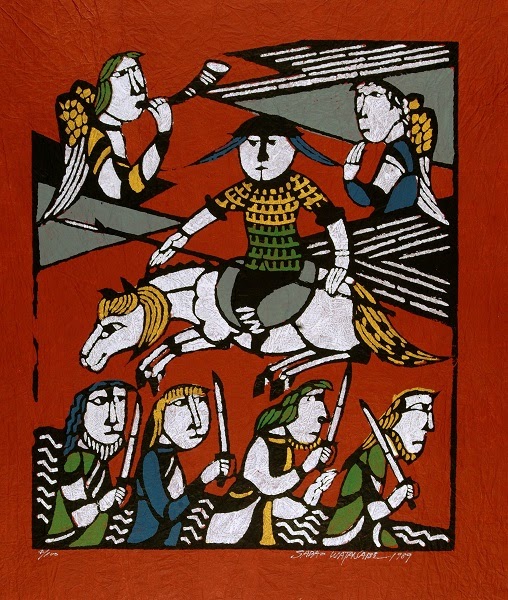
Hand colored stencil print on momigami by Sadao Watanabe (1998).
Image taken with permission from the SadaoHanga Catalogue where you can find many more images and information about Sadao Watanabe.
For other images of Sadao Watanabe art works in TIPs, see here.
plague
complete verse (Revelation 9:18)
Following are a number of back-translations of Revelation 9:18:
- Uma: “One third of mankind died killed by those three kinds of plagues/tormentings: fire, smoke and sulfur rock that appeared from the mouths of those horses.” (Source: Uma Back Translation)
- Yakan: “One part of the people on earth died. Two parts didn’t. The people died through/by the fire, the smoke and the flaming sulphur, the three things that came out of the horses mouths.” (Source: Yakan Back Translation)
- Western Bukidnon Manobo: “And by means of this fire, smoke, and sulphur which comes out of the mouths of horses, they killed the third part of all mankind.” (Source: Western Bukidnon Manobo Back Translation)
- Kankanaey: “A third of the people died because of those death-producing-things which were the fire, smoke and sulfur that were-coming-out of their mouths.” (Source: Kankanaey Back Translation)
- Tagbanwa: “Well the third part of the people truly did die because of these three epidemics, that fire, smoke and asupri which were coming out of the mouths of those horses.” (Source: Tagbanwa Back Translation)
- Tenango Otomi: “People were killed by these three deaths of fire, smoke and sulphur which came out of the horses mouths. But it didn’t come up to half of the people who were killed.” (Source: Tenango Otomi Back Translation)
Translation commentary on Revelation 9:18
These three plagues: a plague is a very great disaster that injures and kills many people. In the Bible, plagues are seen as God’s punishment (as in the case of the ten plagues sent upon the Egyptians). The word means simply “a blow” and is used of the strike of a sword (13.14). If a specific word for plagues is not available, something like “calamities” or “disasters” may be used. In languages that have a general word which covers all kinds of trouble, one may say “terrible (or, fearful) trouble.”
A third of mankind: as specified in verse 15.
The fire and smoke and sulphur: it is understood, of course, that the sulfur is coming from the horses’ mouths (or nostrils) in the form of vapor, together with the flames and the smoke.
An alternative translation model for this verse is:
• These three plagues, which were the fire, the smoke, and the sulphur coming out of the horses’ mouths, killed one third of all humans.
Quoted with permission from Bratcher, Robert G. and Hatton, Howard A. A Handbook on The Revelation to John. (UBS Handbook Series). New York: UBS, 1993. For this and other handbooks for translators see here .
SIL Translator’s Notes on Revelation 9:18
9:18
A third of mankind was killed by the three plagues of fire, smoke, and sulfur that proceeded from their mouths: This clause is passive. Some languages must use an active clause. For example:
The three plagues of fire, smoke, and sulfur that came out of their mouths killed a third of mankind
A third of mankind: Here the word third means “one part out of three parts.” See how you translated this phrase in 9:15.
plagues: This word refers to disasters that harm a lot of people. Here it refers to the fire, smoke, and sulfur. Use a word that can refer to the fire, smoke, and sulfur. It should indicate harm or death. For example:
calamities/disasters that cause people to suffer
-or-
things that cause much death
See how you translated this word in 6:8.
© 2020 by SIL International®
Made available under the terms of a Creative Commons Attribution-ShareAlike 4.0 License (CC BY-SA) creativecommons.org/licenses/by-sa/4.0.
All Scripture quotations in this publication, unless otherwise indicated, are from The Holy Bible, Berean Standard Bible.
BSB is produced in cooperation with Bible Hub, Discovery Bible, OpenBible.com, and the Berean Bible Translation Committee.
Leave a Reply
You must be logged in to post a comment.