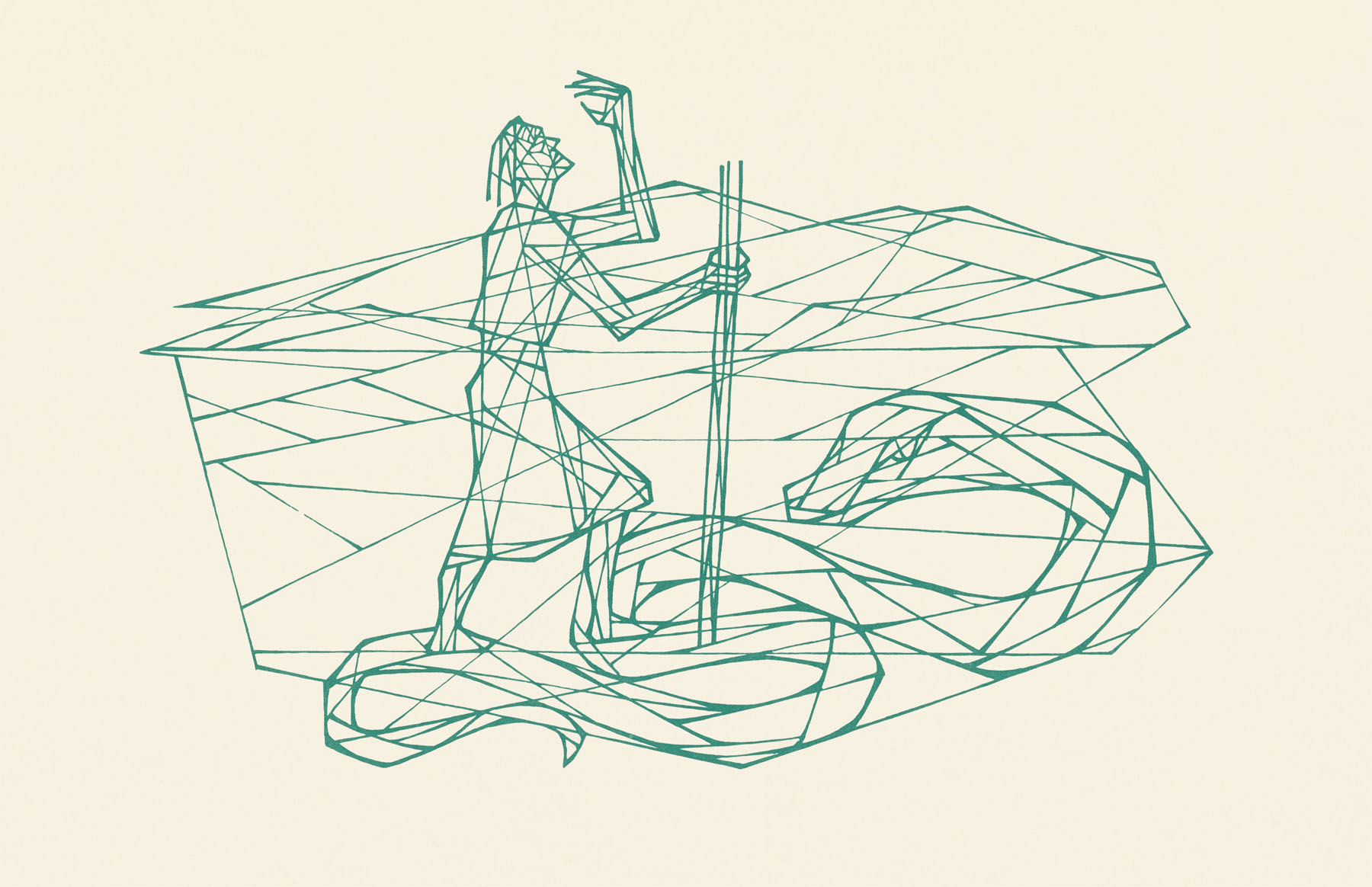
Drawing by Ismar David from The Psalms: A new English translation, linked with permission from Ismar David Archive .
For other images of Ismar David drawings, see here.

עַל־שַׁ֣חַל וָפֶ֣תֶן תִּדְרֹ֑ךְ תִּרְמֹ֖ס כְּפִ֣יר וְתַנִּֽין׃
13You will tread on the lion and the adder;
the young lion and the serpent you will trample under foot.
Drawing by Ismar David from The Psalms: A new English translation, linked with permission from Ismar David Archive .
For other images of Ismar David drawings, see here.
There is general agreement among modern scholars that the word pethen refers to the cobra, since the word is closely associated with snake charming, which requires a snake that can raise the front part of its body vertically, something a viper cannot do. The words tsif‘oni and tsefa‘ are also probably references to a type of cobra. This can be well supported by the contexts in which the word occurs, in which reference is made to the fact that it lives in holes and lays eggs. These contexts would rule out any of the vipers.
There is some evidence that pethen was the earlier name for the cobra, and tsefa‘ and tsif‘oni were later names. Something similar is the case with English, where “cobra” has been in use only for the last one hundred years, and previously “asp” was used.
“Adder” is used as the name for some of the subspecies of viper and is probably not the best word to translate these three Hebrew words.
Cobras are characterized by their ability to spread the ribs in their neck area, so as to form a broad flat profile called the hood. This makes the snake look much thicker than it really is. Cobras also have short fixed fangs in the front of their mouths. The cobra that is found in the land of Israel is the Desert Cobra or Walter Innes’s snake (Walterinnesia aegyptia), while the cobra found in Egypt is the Egyptian Cobra Naja haje. The cobra is a large snake, reaching 2 meters (6 feet) in length, and about 50 millimeters (2 inches) in diameter. It is dark brown with a yellowish underside. In some areas where it is found it has broad yellowish bands, which give it its alternative English name, banded cobra. When it rears up and spreads its hood, the hood has a yellowish background, but displays a broad dark brown horizontal stripe.
Its bite is very poisonous, and it takes quick effect, acting on the nervous system. The cobra feeds on mice, gerbils, birds, bird’s eggs, lizards, frogs, and other snakes. It hunts by following scent trails, which it senses with its tongue. When within range of its prey, it raises its head slowly vertically, and suddenly strikes at the unsuspecting victim. It lives mainly in grassland and where the vegetation is fairly thick. It takes cover in rat holes, holes in eroded banks, hollow trees, under logs, and among exposed roots. It may lay its eggs in any of these sheltered places. In cold weather it coils itself up to preserve its body heat.
The cobra, besides being a symbol of lurking danger, was also closely associated with Egypt. In some poetic passages, therefore, it is a metaphor for the enemies of Israel, Egypt in particular.
The Egyptian cobra is found all over Africa, and a local word should not be difficult to find. In South and Southeast Asia a word for the King Cobra Naja hannah or one of the other cobras would be a good equivalent. In areas where these cobras are symbols of good luck and the presence of a deity, the Hebrew symbolism might need to be explained in a footnote. In other parts of the world, if cobras are unknown, the name of a local long poisonous snake of a type different from vipers and adders is a possible choice.
In passages where snakes are referred to as “stinging”, it is not necessary to use a verb meaning literally “to sting”. This is just the Hebrew way of referring to the bite of a snake. In many languages the verb used for a snake’s bite is different from the one used to refer to the bite of something else, such as a dog.


Source: All Creatures Great and Small: Living things in the Bible (UBS Helps for Translators)
See also flying fiery serpent, adder / serpent / asp / viper, and serpent.
Following are a number of back-translations as well as a sample translation for translators of Psalm 91:13:
The Hebrew and Greek that is translated as “adder,” “asp,” “viper,” or “serpent” in English is translated in Lambya as chipili or “puff adder “, a highly poisonous local snake species. (Source: project-specific notes in Paratext)
There are a large number of snake species belonging to the viper family in Israel. From the contexts it is possible in one or two places to identify the particular species, and it is possible that the various Hebrew words actually refer to particular species. However, associating the various words with the corresponding species is largely conjecture, even though based on careful deduction.
The most common vipers in Israel are the Palestinian Viper Viper palaestina, the Carpet Viper Echis coloratus, the Sand Viper Cerastes vipera, and the Horned Viper Cerastes cerastes cerastes. The Palestinian viper is the largest of these vipers and is found in a variety of habitats, from the woods of the north to the desert’s edge. Since this is the most inhabited area, people are bitten by this snake more than any other. The other four vipers mentioned are found in desert areas, but in slightly different habitats. The sand viper and the horned viper live in the sand, while the carpet viper lives in gravelly areas and among rocks. It often camouflages itself among dried leaves.
The desert vipers, when moving in sand, cannot move in the normal way, so they adopt a movement known as “sidewinding”. They do this by moving a coil sideways to a position in front of the head, then the snake moves its head and the front part of its body in the air, arching over the sand as far as it can reach before falling back onto the sand. Then it repeats the movement again. This is done at some speed, and the snake moves diagonally across the sand surprisingly quickly, although not as quickly as another snake moving normally. The parallel elongated S-shaped marks it leaves in the sand look as though it has moved in a series of jumps, since they seem not to be connected. It is generally accepted that this motion caused the biblical writers to refer to these snakes as “flying” (see flying fiery serpent).
Vipers are different from other snakes mainly in that they give birth to live offspring. The females retain their eggs in a special sac in their bodies, and when the eggs hatch the small snakes emerge from the mother. The larger vipers produce as many as sixty young snakes at a time, while the smaller sand vipers have smaller broods of about twelve to fifteen. This is what John the Baptist refers to by his well-known phrase “brood of vipers”.
The vipers have long hinged fangs located in the front of their mouths. These fangs fold back as they close their mouths. When striking, vipers have to open their mouths very wide in order to get these fangs into the required position.
The carpet viper (also known as the saw-scaled viper) was very numerous in biblical Israel, and in most other areas of its range (it is found in a broad continuous band from West Africa to South and Central Asia). It is likely that this was the saraf, a name derived from a finite verb meaning “to burn something,” a reference to the burning effect of its poisonous bite.
Vipers have the same basic significance in the Bible as other snakes, with one additional feature. Since the young are carried alive inside the female viper, which then gives birth to large numbers of well-developed young, all at the same time, the viper was associated with fertility. This was also their significance in the Egyptian and Canaanite religious systems.
Although vipers are found widely all over the world, not all languages distinguish them from other types of snake. As mentioned above, the carpet viper is found across Central Africa, from the west to east coasts, and into Central and South Asia. In these areas the name for this snake can be used in all the verses that refer to vipers. In southern Africa the Puff Adder Bitis arietans is probably the best equivalent.
In order to retain the relationship of the word saraf with the verb “to burn something,” translators often try to use expressions such as “vipers that burn [people]” or “fiery serpents”. This is only possible where the word used for “burn” means “to cause a wound with something hot.” One should not convey the idea of “a viper that sets people on fire” or “a viper that is burning.” Often it is better to use a phrase meaning simply “poisonous vipers”.
See also vipers, You brood of vipers!, and cobra.
Among the English versions there seems to be a great deal of confusion and inconsistency in the translation of the various Hebrew words. This is due in large part to the fact that the English translators and the commentators who have guided them have had many mistaken ideas about lions and their behavior. To take Amos 3:4 as an example, Smalley and de Waard (A Handbook on Amos. New York, 1979), commenting on this verse and echoing many others, claim: “The lion’s roar in the first picture is the ferocious roar with which the lion attacks an animal he is going to kill and eat. When someone hears this roar, he knows that the lion has found his victim. In the second picture, however, it is the lion’s contented growl when he has dragged the food to his den.” (see here)
However, lions do not roar as they attack their prey, (in fact they kill very silently as a rule), and lions do not normally live in dens. Moreover, they do not growl contentedly when eating. Instead they growl and snarl at the other lions in the pride who are trying to share the meal.
In case there are readers who react by thinking that it is unlikely that unsophisticated ancient peoples would have known these details, it should be pointed out that unsophisticated people all over Africa, who live in areas where there are lions, are very familiar with lion behavior, and it is highly likely that the Jewish writers were too. The problem would seem to lie with the mistaken presuppositions of western biblical scholars, rather than those of the Jewish writers. Later in this section evidence will be given that the biblical writers were very familiar with lion behavior.
In a similar vein, it is likely that the many Hebrew words for lions each have a slightly different meaning from one another. A closer study of lions and their behavior may help to define these meanings.
In biblical times lions were found all over the Middle East, in Mesopotamia, in Egypt, and in the area of Sudan and Ethiopia called Cush.
The Greek word leōn and the Latin leo are general words for lion, while the Greek leontēdon means something like “fierce lion”.
In order to dispel many of the wrong presuppositions about lions that are current among biblical scholars, the description of this animal will be more detailed and extensive than for other animals in this book.
Lions Panthera leo are the largest of the great cats, often being about 2.8 meters (9 feet) from nose to tip of tail, standing as high as 1 meter (3 feet 3 inches) at the shoulder. However, the difference in size between lions and Bengal Tigers Panthera tigris is minimal. An adult lion is at least half a meter (20 inches) longer than a Leopard Panthera pardus and weighs twice as much, often reaching 250 kilograms (550 pounds) in weight; it is about 30 centimeters (1 foot) longer and 100 kilograms (220 pounds) heavier than a Jaguar Panthera onca or Mountain Lion (Puma) Puma concolor. Lions are a pale yellowish brown, but at birth they have spots that usually disappear gradually as they grow. Around the neck and shoulders of adult males grows a mane that is darker than the rest of their fur. Some even have black manes. Females and young males do not have manes and look very similar to each other.
Lions live in family groups called “prides”, which are made up of a dominant male lion (often called “the pride male”), plus a group of adult and sub adult females and young males. Males may leave the pride, and occasionally one or two females may go off with a wandering male, but normally the females continue in the pride and develop very close bonds with one another that last a lifetime. The dominant male will often make ritual attacks on the younger males of the pride, who roll over in submission rather than fight.
However, adult males from within and outside the pride challenge the dominant male and one another when a female is in season and will try to mate with her. This results in serious fights. If the dominant male is defeated from within the pride, he leaves the pride to wander alone, but the remainder of the pride remains intact. If a male from outside the pride takes over from the pride male, he usually chases away the other males, which then wander singly or in small groups of three or four. These wandering males will try to take over other prides or steal females from them. Ousted pride males, since they are alone and have no help in hunting, are often hungry, thin, undernourished, and dangerous.
About two or three days before a pregnant female is about to give birth to cubs, she digs a temporary den under a rock or fallen log and visits it with one or two of the other females. After she gives birth in the den, one of the other females will bring her meat from a kill. This enables the mother to remain with her newborn cubs continuously for the first week or two of their lives. The mother lioness moves the newborn cubs to a new den every three or four days. When the cubs are about two weeks old, the mother carries the cubs to where the other pride members are, and the pride makes their acquaintance by licking them. Thereafter the cubs belong to the pride and suckle on any lactating lioness that happens to be near.
Until they are old enough to hunt, cubs hide in thickets while the pride hunters do their work. At a later stage they accompany the hunting lions, but watch the killing from the sidelines. Finally the mother will help them kill small animals, until they are able to kill efficiently. Then they join the pride hunts.
A pride lives together in the same territory. Bushes and tree trunks are marked by spraying a liquid from a gland next to the anus. This marked territory is defended against intruding lions. The pride will come together at feeding time and remain together after a feed, but will scatter across the territory prior to hunting.
Lions utter a variety of sounds, and this should be borne in mind when translating Scripture passages that refer to the noises lions make. The Hebrew words are usually not very specific, but the context will indicate the type of noise intended.
Roaring is the loudest of the lion sounds and is usually produced by the males. It is believed to be territory-marking behavior and a means of maintaining pride solidarity. It is usually done before hunting begins and also functions to help the pride locate the positions of scattered members. This is important for hunting. Roaring consists of a long, very loud moaning sound followed by shorter rhythmic panting moans, which are repeated as many as twenty times, while becoming softer and softer. No two lions roar in exactly the same way, and they can be identified from their roars. Roaring is also a means by which wandering male lions make known their availability as potential mates. Hungry lions roar more frequently than well-fed ones, and this is an indication of how hungry they are.
Growling is a warning sound. It is a very deep rumbling repeated with each breath. It is intended to chase away strange lions or other potential enemies, such as leopards, hyenas, or humans. When a lion or lioness growls, it usually advances towards its enemy. If growling does not have the desired effect, it is replaced with snarling, which is similar to growling but is more intense and is produced with exposed teeth, the body in a low crouch, and ears laid back flat. This behavior is usually the prelude to an attack. When the attack is actually made on an enemy, a deep trembling moan is uttered, and the ensuing fight takes place with a lot of loud snarling and growling.
When lions are feeding together on one carcass, there is usually a lot of growling, snarling, and snapping among the feeding lions.
Other types of sound made by lions are:
Hunting and feeding behavior: After lions have fed well, they rest and relax together for two or three days. Towards the end of this time some of the pride members will begin to move away from the others in the direction of places where prey animals are likely to be grazing. Then, before they begin to hunt, they signal their locations by roaring on and off for an hour or two. They then fall silent and begin to hunt in earnest. Hunting usually takes one of two forms. If there is good cover near the prey, two or three lionesses and young males will stalk the prey using the cover. When they get close enough, one or two will break cover and charge at the prey, while the others maneuver to cut off any escape.
If the terrain is more open, the lionesses and young males will take up ambush positions downwind of the prey animals. Adult males then move fairly openly into upwind positions. They then run toward the prey uttering loud grunts with each breath. With either method, at the first charge the lions try to disable the animal by seizing a leg or by biting the spine. Once they have slowed down the prey, one lion will seize the animal by the throat and suffocate it. Thus death is usually fairly slow and drawn out. If the animal is large, the kill takes a considerable amount of energy, and the lions rest, usually standing, before they begin to feed.
Single wandering male lions are at a great disadvantage in hunting and often go hungry. They thus roar more frequently than pride lions. They often begin to kill domestic animals and sometimes humans.
Among the lions present at the time of the kill, there is a type of seniority, with age being important. The most senior lion or lioness present will begin to feed, and this will be a signal for the others to join in. If the kill is large, they feed in relative silence, but if the prey is small, there is a lot of snarling, growling, and snapping. Whenever a dominant pride male arrives, however, the feeding lions withdraw and leave him to feed alone. A dominant male will sometimes allow an immature cub to feed with him but no mature lions. The pride members will only resume feeding when the dominant male is satisfied. Dominant males are very seldom involved in the chase or the kill. At most they make the charge that drives the prey towards lionesses and young males in ambush.
In the Bible the lion is a symbol of danger and destruction, often being paired with the bear. The lion is also a symbol of great political power and regal majesty.
Before discussing specific passages in detail, it is useful first to try and identify the various Hebrew words with likely lion types. If we examine the verbs and adjectives with which the Hebrew nouns co-occur, we find the following:
In some English versions of Maccabees the Greek word skumnos is incorrectly translated as “cub” or “whelp”. The context refers to this creature roaring, which lion cubs do not do. The word seems rather to refer to a virile young adult lion. It is better translated as lion in its prime.
In areas where lions are completely unknown, it is better to borrow a word from a dominant language or from Hebrew or Greek, rather than to try and find a local equivalent. This is because the biblical references to the behavior of lions are fairly specific, and if a word for a local animal is used, it will not fit the behavior mentioned in the text. This is especially so because the lion is the only great cat (apart from the cheetah) that lives and hunts in large family groups.
Some attempt should be made to maintain the slight differences in meaning of the various Hebrew words for lions, when the context requires this. This can often be done by using short, natural-sounding descriptive phrases. Often, however, in contexts where only one of the Hebrew words for lion is used, there is no need to maintain a difference, and a simple word for lion or lioness will suffice.
The most common Hebrew phrases used for the sounds lions make are sha’ag, (natan) qol, naham. When sha’ag is used in contexts of human vocal behavior, it indicates cries of pain or distress. In contexts of animal vocal behavior, however, it can signal pain and distress but can also be an aggressive sound and can be translated “bellow, roar, moan, snarl, growl” or sometimes “bark”. A similar Arabic word usually refers to the lowing of cattle or the bleating of goats. For lions English translators have consistently chosen “roar”, because of their mistaken preconception that a lion’s “roar” is an aggressive sound. In most contexts it is best interpreted as “growl” or “snarl”.
(Natan) qol, on the other hand, is a more general expression and can mean any sort of vocalization, from calling, to groaning or singing. English translators of Amos 3:4 have chosen “growl” and “cry out”. In this text this word is the parallel of sha’ag, so the reason for these interpretations is plain. However, a neutral translation, such as “make a sound”, would be equally valid. Of all the Hebrew expressions for lion sounds, this is the one most likely to mean roar, especially in contexts where the noun shachal occurs for “lion”, as for example in Job 4:10.
Naham means to moan in sorrow or pain when used of humans and is usually translated as to growl when used of animals.
Lion habitats and the meaning of ma‘on in the context of lions: Generally the word ma‘on means dwelling place, hiding place, or refuge. In one or two places it refers to a military refuge or fortress. When used of animals, it can mean “lair” (as for jackals), “hiding place”, “territory”, or simply “place where the animals are found”. The choice in translating this Hebrew word has been either “lair” or “den” in all English translations. This choice again seems to be related to the misconceptions about the behavior of lions. Lions do not usually live in dens or lairs, and it is better to translate ma‘on as “territory” or “place where lions live”.
Source: All Creatures Great and Small: Living things in the Bible (UBS Helps for Translators)
There are no lions in Bawm country, so the Bawm Chin translation uses “a tiger with a mane” and in Kahua it becomes a “fierce animal.”
In 1 Peter 5:8, the “roaring lion” is a krasi tigri or “aggressive tiger” in Sranan Tongo and in Uripiv “a hungry shark.”
Sources: David Clark for Bawm Chin and Kahua, Japini 2015, p. 33, for Sranan Tongo, and Ross McKerras for Uripiv.
For the use of “lion” for “Lord” or “lord” in Hdi, see Lord.
The language in this verse is symbolic, the various animals representing enemies and other dangers. The two lines are synonymous; for lion … young lion see Fauna and Flora of the Bible, pages jmp 50-51|fig:ffb_Lion.htmjmp*; for adder … serpent see Fauna and Flora of the Bible, pages jmp 72-73|fig:ffb_Serpent.htmjmp*. It should be noted that the word in verse 13b for serpent is tannin (see its use and meaning in 74.13b). In verse 13b the psalmist has chosen not to parallel line a syntactically. Because there are only two lines in most parallel verses, the result of not paralleling line a produces a form of chiasmus. Therefore, while the meaning of the two lines is nearly the same, the word order makes them different. In some languages the chiastic form will not be possible, and thus the parallel meaning plus the parallel word order may strike the reader as unnecessarily repetitive, and the translator may prefer in such a case to reduce the two lines to one. Biblia Dios Habla Hoy has “You will be able to walk among lions, among wild animals and snakes.”
New English Bible translates all the animals in verse 13 as snakes: “asp … cobra … snake … serpent.” This is possible, and a translator may choose to do the same, if there are four different words for “snakes” in the receptor language.
In Luke 10.19 there seems to be an allusion to the language of this verse.
Quoted with permission from Bratcher, Robert G. and Reyburn, William D. A Handbook on the Book of Psalms. (UBS Helps for Translators). New York: UBS, 1991. For this and other handbooks for translators see here .
The following is a presentation by the Psalms: Layer by Layer project, run by Scriptura .
Copyright © Scriptura
No comments yet.


Leave a Reply
You must be logged in to post a comment.