The Greek and Hebrew that is translated in English as “anoint” is translated in Lakota with azilyA: “to smudge.”
Steve Berneking (in Beerle-Moor / Voinov, p. 121) tells the story of that translation:
“During one visit with the Lakota team, we were reading texts and discussing key biblical terms and how they are best rendered into Lakota. Reference was made to the ritual we label ‘anointing.’ When the Lakota word that had been glossed as ‘anoint’ was read aloud, I heard giggling among the reviewers. Knowing that this reaction called for some explanation, I asked.
“The people there told me that the Lakota verb that was used to translate ‘anoint’ was funny in that context. It is not that the verb is an uncommon one; quite the contrary. Lakota uses that verb frequently, but almost exclusively as a verb of food preparation; the verb belongs to the culinary domain. In other words, the Lakota verb used for ‘anoint’ actually referred to rubbing oil on something that was to be cooked or grilled, in this case, the apostles. The Lakota verb ipáṫaŋṫtaŋ ‘to apply oil on something’ was used quite innocently by the missionaries. The linguistic transfer was understandable: the missionaries needed a verb to translate ‘putting oil on something’; Lakota has a verb; they used that verb. The result was comical. So, during that conversation with the Lakota community, I encouraged the translators to come up with a Lakota verb that is used not simply in ‘the application of oil,’ but more pointedly in the consecration of something or somebody for a special task, or in the appointment of someone for a special purpose. Their response was almost immediate: azilyA or wazílyA ‘to smudge.’ That is how, they told me, warriors and messengers and tribal leaders have always been consecrated (or blessed) before being sent out on a special mission. Sage grass was burned, and the smoke was waved over the person or object. The trans-cultural process of using the traditional Lakota verb azilyA for the biblical notion of ‘anoint’ became, at that moment, part of the Lakota Bible.”
In Bashkir, it is translated as masekhlay (мәсехләү), when used in a ritual context. Masekhlay has the same root than masikh (мәсих), which is used both for “anointed one” in the Old Testament and in its capitalized form (Мәсих) for Μεσσίας (engl. “Messiah”) and Χριστός (engl. “Christ”) in the New Testament. For more information about this, see anointed one.
In Vidunda it is translated as “smear oil.” (Source: Pioneer Bible Translators, project-specific translation notes in Paratext)
Click or tap here to see a short video clip showing how anointing was done in biblical times (source: Bible Lands 2012)
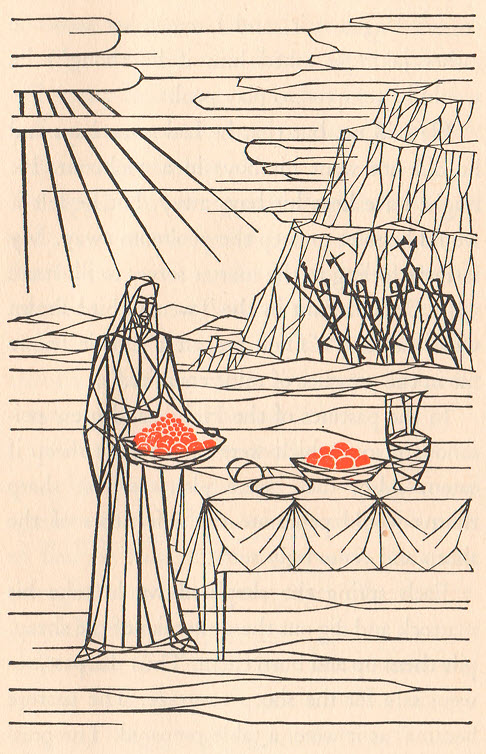
The Hebrew that is translated in English as “You prepare a table before me in the presence of my enemies” or similar is translated in Una as “While my enemies over whom you have gained the victory watch, you make a big feast meal for me.” (Source: Kroneman 2004, p. 408)
The Hebrew that is translated as “overflow” or similar in English is translated in Sar with the ideophone (a word that expresses what is perceived by the five senses) rerep which “means well adjusted, the right measure for objects that join. Examples: the pants are just right for her, he is sitting on her legs (folded up) properly, she has a falling garment that just touches the ground.” (Source: Ngarbolnan Riminan in Le Sycomore 2000, p. 20ff. )
The Hebrew, Greek, and Latin that is translated as “cup” in English is translated in Sar with “calabash” (see here ) (source: Ngarbolnan Riminan in Le Sycomore 2000, p. 20ff. ) and in Bariai with “coconut shell” (source: Bariai Back Translation)
The different Hebrew and Greek terms that are translated as “(olive) oil” and “(animal) fat” in English are translated in Kwere with only one term: mavuta. (Pioneer Bible Translators, project-specific translation notes in Paratext)
Following are a number of back-translations as well as a sample translation for translators of Psalm 23:5:
Chichewa Contempary Chichewa translation, 2002/2016:
“You prepare food for me
while my enemies are seeing.
You anoint my head with oil;
my cup overflows.” (Source: Mawu a Mulungu mu Chichewa Chalero Back Translation)
Chichewa interconfessional translation, 1999:
You prepare food for me, as my enemies look on.
You welcome me well by anointing my head with oil,
you fill my cup to overflowing.” (Source: Wendland 1998, p. 148f.)
Chichewa poetic translation in the traditional ndakatulo genre to encourage oral and musical performances:
“Talk about food, ha! I’m a what-can-the-child-cry-for.
You’ve prepared me a feast, my enemies can just STARE! [tong’oo! — an ideophone, i.e. a literary device that expresses what is perceived by the five senses]
My cup of blessings is full-up BRIM-BRIM-BRIMMING! [ideophone nde-nde-nde!]
At your home you’ve welcomed me with two hands.” (Source: Ernst Wendland)
Kupsabiny:
“You prepared for me a banquet,
in the presence of my enemies.
You anointed me with oil of honour
and filled my cup until it over flowed.” (Source: Kupsabiny Back Translation)
Adilabad Gondi:
“While my enemies are watching, you served a feast to me.
Having applied oil on my head, you provide hospitality to me.
You fill into my bowl/cup more than I need.” (Source: Adilabad Gondi Back Translation)
Newari:
“You will prepare a feast for me, in the presence of my enemies
You have anointed my head with oil,
My cup overflows.” (Source: Newari Back Translation)
Hiligaynon:
“You (sing.) prepare me a feast while my enemies are-staring.
You (sing.) poured oil on my head to honor me.
And you (sing.) satisfied me with drinks.” (Source: Hiligaynon Back Translation)
Eastern Bru:
“God has prepared a feast (lit. very big meal) for me before the eyes of people who hate me in order for them to see. And God welcomes me like a guest who has great authority coming to visit. Good things, blessings, he gives me like liquid that overflows (lit. liquid full greater than level).” (Source: Bru Back Translation)
Laarim:
“You had prepare for me big feast
in middle of my enemies.
You smear my head with the oil of blessing,
and you allowed my cup filled up until it overflow.” (Source: Laarim Back Translation)
Nyakyusa-Ngonde (back-translation into Swahili):
“Unaniandalia chakula,
mbele ya maadui zangu.
Unanipaka mafuta kichwani pangu,
kikombe changu kinarefuka.” (Source: Nyakyusa Back Translation)
English:
“You prepare a great feast for me, in a place where my enemies can see me.
You joyfully receive me, as people joyfully receive the guests they have invited
by pouring olive oil over their heads.
You have given me very many blessings!” (Source: Translation for Translators)

Leave a Reply
You must be logged in to post a comment.