
The Hebrew in Psalm 23:4 that is translated as “rod” or similar in English is translated in the Contemporary Chichewa translation (2002/2016) with chibonga which means “club.” In Chewa culture, a “chibonga” is a stick of about 75cm long with a round head of the size of a fist of an adult on one end used for hunting animals (Source: Mawu a Mulungu mu Chichewa Chalero Back Translation)
your rod and your staff – they comfort me (image)
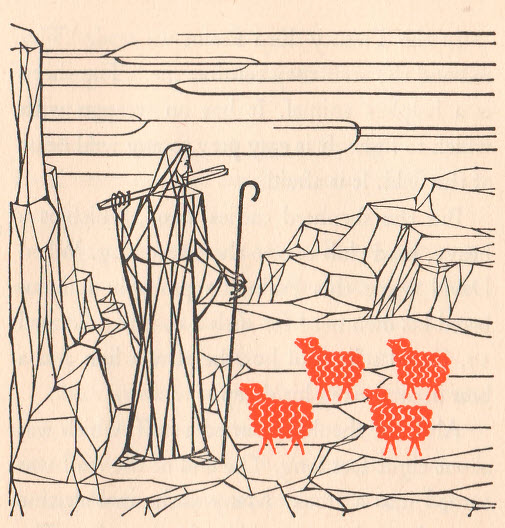
Drawing by Ismar David from Charles L. Allen, 1961.
For other images of Ismar David drawings, see here.
female 2nd person singular pronoun in Psalms
In Garifuna the second person singular pronoun (“you” in English) has two forms. One is used in women’s speech and one in men’s speech. In the Garifuna Bible the form used in men’s speech is typically used, except when it’s clear that a woman is quoted or in Psalms where the women on the translation team insisted that the form used in women’s speech (buguya) would be used throughout the whole book.
Ronald Ross (in Omanson 2001, p. 375f.) tells the story: “Throughout most of the translation, [the distinctions between the different forms of the pronouns] presented no problem. Whenever the speaker in the text was perceived as a man, the male speech forms were used; and when a woman was speaking, the female speech forms were used. True, the women members of the translation team did object on occasion to the use of the male forms when the author (and narrator) of a book was unknown and the men translators had used the male speech forms as the default. Serious discord arose, however, during the translation of the Psalms because of their highly devotional nature and because throughout the book the psalmist is addressing God. The male translators had, predictably, used the male form to address God, and the male form to refer to the psalmist, even though women speakers of Garifuna never use those forms to address anyone. The women contended that they could not as women read the Psalms meaningfully if God and the psalmist were always addressed as if the readers were men. The men, of course, turned the argument around, claiming that neither could they read the Psalms comfortably if the reader was assumed to be a woman.
“Initially there seemed to be no way out of this impasse. However a solution was found in the ongoing evolution of the language. There is a strong propensity for male speech and female speech to merge in favor of the latter, so the few remaining male forms are gradually dying out. Moreover, male children learn female speech from their mothers and only shift to the male speech forms when they reach adolescence to avoid sounding effeminate. However they use the female form buguya when addressing their parents throughout life. So the women wielded two arguments: First, the general development of the language favored the increasing use of the female forms. Secondly, the female forms are less strange to the men than the male forms are to the women, because the men habitually use them during early childhood and continue to use them to address their parents even in adulthood. Therefore, the female pronominal forms prevailed and were adopted throughout the book of Psalms, though the male forms remained the default forms in the rest of the translation.”
See also female first person singular pronoun in Psalms and addressing God.
Psalm 23 in Southern Altai throat singing
The following is a representation of Psalm 23 in Southern Altai by Aidin Kurman with traditional throat singing:
Provided by Bronwen Cleaver
See also Psalm 90 in Southern Altai throat singing and Jonah in Southern Altai throat singing.
complete verse (Psalm 23:4)
Following are a number of back-translations as well as a sample translation for translators of Psalm 23:4:
- Chichewa Contempary Chichewa translation, 2002/2016:
“Even though I may walk
in the valley of deep darkness,
I will fear no evil,
for You are with me;
your club and your staff
they comfort me.” (Source: Mawu a Mulungu mu Chichewa Chalero Back Translation) - Chichewa interconfessional translation, 1999:
“It may be that I walk in a ravine of black darkness,
but I will not fear any kind of evil,
for You Lord you stay with me.
Your warclub and walking stick protect me.” (Source: Wendland 1998, p. 148f.) - Chichewa poetic translation in the traditional ndakatulo genre to encourage oral and musical performances:
“If in a deep dark valley BLACK! [bii! — an ideophone, i.e. a literary device that expresses what is perceived by the five senses] I happen to walk,
All [my] fear GONE! [ideophone balala!] since Chauta is right there.
O Herdsman, you’re close by with weapons for defense,
As for my heart, it’s completely QUIET! [ideophone phee!] at all times.” (Source: Ernst Wendland) - Kupsabiny:
“Though I pass through utter darkness,
I am not frightened
for I am together with you, oh God.
Keep/Guard me with your staff
and comfort me with your shepherd staff.” (Source: Kupsabiny Back Translation) - Adilabad Gondi:
“Even if I walk in the valley of extreme darkness, I will not fear anything.
Because you (emph.) stay/are with me.
Your axe and shepherd’s-stick give me courage.” (Source: Adilabad Gondi Back Translation) - Newari:
“No matter how dark the path is on which I have to go
I will not be at all afraid, O Lord.
For You will be with me,
Your rod and Your staff will cause me to prosper.” (Source: Newari Back Translation) - Hiligaynon:
“Even-though I will-walk through the valley where there-is a danger of death, I will- not -be-afraid,
because you (sing.) (are) my companion.
Your (sing.) protection and guidance of me causes- me -to-be-happy and strengthens me.” (Source: Hiligaynon Back Translation) - Eastern Bru:
“Even though I meet misfortune or excessive trouble, I am no longer afraid of anything, because God is continually with me. Like a keeper carries in his hand a staff/club and a walking stick in order to care for his sheep, like that also God continually watches over and encourages me.” (Source: Bru Back Translation) - Laarim:
“Even though I walk
in very great darkness of death,
there will be nothing bad that I am fearing,
because I am staying with you,
your walking stick gives
my heart to be strong.” (Source: Laarim Back Translation) - Nyakyusa-Ngonde (back-translation into Swahili):
“Hata kama natembea katika bonde la giza ya kifo,
sitaogopa kitu chochote,
kwa sababu uko pamoja na mimi.
Gongo lako na ni fimbo yako vinanifariji.” (Source: Nyakyusa Back Translation) - English:
“Even when I am walking through very dangerous dark ravines
where I might be killed,
I will not be afraid of anything because you are with me.
You protect me like a shepherd protects his sheep.
He uses his club and his walking stick to protect them from being attacked by wild animals.” (Source: Translation for Translators)
AntiPsalm 23
David Powlison (1949–2019) once inverted Psalm 23 in English to portray what life feels like and looks like whenever God vanishes from sight. He called it AntiPsalm 23.
I’m on my own.
No one looks out for me or protects me.
I experience a continual sense of need. Nothing’s quite right.
I’m always restless. I’m easily frustrated and often disappointed.
It’s a jungle — I feel overwhelmed. It’s a desert — I’m thirsty.
My soul feels broken, twisted, and stuck. I can’t fix myself.
I stumble down some dark paths.
Still, I insist: I want to do what I want, when I want, how I want.
But life’s confusing. Why don’t things ever really work out?
I’m haunted by emptiness and futility — shadows of death.
I fear the big hurt and final loss.
Death is waiting for me at the end of every road,
but I’d rather not think about that.
I spend my life protecting myself. Bad things can happen.
I find no lasting comfort.
I’m alone . . . facing everything that could hurt me.
Are my friends really friends?
Other people use me for their own ends.
I can’t really trust anyone. No one has my back.
No one is really for me — except me.
And I’m so much all about ME, sometimes it’s sickening.
I belong to no one except myself.
My cup is never quite full enough. I’m left empty.
Disappointment follows me all the days of my life.
Will I just be obliterated into nothingness?
Will I be alone forever, homeless, free-falling into void?
Sartre said, “Hell is other people.”
I have to add, “Hell is also myself.”
It’s a living death,
and then I die.
Quoted by Justin Taylor
addressing God
Translators of different languages have found different ways with what kind of formality God is addressed. The first example is from a language where God is always addressed distinctly formal whereas the second is one where the opposite choice was made.
Click or tap here to see the rest of this insight
Like many languages (but unlike Greek or Hebrew or English), Tuvan uses a formal vs. informal 2nd person pronoun (a familiar vs. a respectful “you”). Unlike other languages that have this feature, however, the translators of the Tuvan Bible have attempted to be very consistent in using the different forms of address in every case a 2nd person pronoun has to be used in the translation of the biblical text.
As Voinov shows in Pronominal Theology in Translating the Gospels (in: The Bible Translator 2002, p. 210ff. ), the choice to use either of the pronouns many times involved theological judgment. While the formal pronoun can signal personal distance or a social/power distance between the speaker and addressee, the informal pronoun can indicate familiarity or social/power equality between speaker and addressee.
In these verses, in which humans address God, the informal, familiar pronoun is used that communicates closeness.
Voinov notes that “in the Tuvan Bible, God is only addressed with the informal pronoun. No exceptions. An interesting thing about this is that I’ve heard new Tuvan believers praying with the formal form to God until they are corrected by other Christians who tell them that God is close to us so we should address him with the informal pronoun. As a result, the informal pronoun is the only one that is used in praying to God among the Tuvan church.”
In Gbaya, “a superior, whether father, uncle, or older brother, mother, aunt, or older sister, president, governor, or chief, is never addressed in the singular unless the speaker intends a deliberate insult. When addressing the superior face to face, the second person plural pronoun ɛ́nɛ́ or ‘you (pl.)’ is used, similar to the French usage of vous.
Accordingly, the translators of the current version of the Gbaya Bible chose to use the plural ɛ́nɛ́ to address God. There are a few exceptions. In Psalms 86:8, 97:9, and 138:1, God is addressed alongside other “gods,” and here the third person pronoun o is used to avoid confusion about who is being addressed. In several New Testament passages (Matthew 21:23, 26:68, 27:40, Mark 11:28, Luke 20:2, 23:37, as well as in Jesus’ interaction with Pilate and Jesus’ interaction with the Samaritan woman at the well) the less courteous form for Jesus is used to indicate ignorance of his position or mocking (source Philip Noss).
In Dutch and Western Frisian translations, however, God is always addressed with the formal pronoun.
Metrical translations of Psalm 23 from the British Isles
Following are a number of translations of Psalm 23 into metre from a number of languages in the British Isles.
The English translation by George Herbert (publ. 1633)
The God of love my shepherd is,
And He that does me feed:
While He is mine, and I am His,
What can I want or need?
He leads me to the tender grass,
Where I both feed and rest;
Then to the streams that gently pass:
In both I have the best.
Or if I stray, He does convert
And bring my mind in frame:
And all this not for my dessert,
But for His holy name.
Yea, in death’s shady black abode
Well may I walk, not fear:
For You are with me; and Your rod
To guide, Your staff to bear.
Nay, you do make me sit and dine,
Ev’n in my enemies’ sight:
My head with oil, my cup with wine
Runs over day and night.
Surely Your sweet and wondrous love
Shall measure all my days;
And as it never shall remove,
So neither shall my praise.
The Welsh translation by Edmund Prys (publ. 1621) (click or tap here)
Yr Arglwydd yw fy ’mugail clau,
ni âd byth eisiau arnaf:
Mi a gâf orwedd mewn porfa frâs,
ar lan dwfr gloywlas araf.
Fe goledd f’enaid,
ac a’m dwg rhyd llwybrau diddrwg cyfion,
Er mwyn ei enw mawr dilys
Fo’m tywys ar yr union.
Pe rhodiwn (nid ofnwn am hyn)
yn nyffryn cysgod angau,
Wyd gyda mi, a’th nerth,
a’th ffon, ond tirion ydyw’r arfau:
Gosodaist fy mwrdd i yn frâs,
lle’r oedd fy nghâs yn gweled:
Olew i’m pen, a chwppan llawn,
daionus iawn fu’r weithred.
O’th nawdd y daw y doniau hyn
i’m canlyn byth yn hylwydd:
A minnau a breswyliaf byth
a’m nyth yn nhy yr Arglwydd.
© British and Foreign Bible Society
The Irish translation by Norman McLeod (publ. 1836) (click or tap here)
Is é Dia féin is áodhaire dhamh,
Aon easbhuidh orm ni bhíaidh.
Do bheir se orm go luighím sios,
A ninbhir fhéir mhínlígh:
A’s fós re taobh na nuisgeadhuidh,
Ag siubhal sios go mall,
Ata se do mo threórughadh,
Go mín réidh ann ’sgach ball.
Aiseógair m’anam dhamh air ais:
Treorochuigh se mo chéim
A slighe ghlan na fíréuntacht,
Do bhrigh dheagh‐anma féin.
Seadh fós, da siubhlóchuin eadhon thríd,
Glean dhorcha sgáil’ an bháis,
Aon olc na urchóid theacht oram,
Ni heagal liom ’sní cás;
Do bhrigh go bhfuil tu leam do ghnáth;
Do lorg ’sdo mhaide tréun,
Atáid ag tabhárt cómhfhurtacht
A’s fuasgladh dhamh a m’fheidhm.
Gléusfa tu bórd a radhárc mo nam’d:
Le hola d’úng mo cheann;
A taosgadh ta mo chupán fós,
Ag meud an lainn tá ann.
Ach leanfuidh maith a’s trócair diom,
A’n fhaid a bhias me beó;
A’s cómhnochad a náras Dé,
Air feadh mo ré, ’smo ló.
Digitized by Bible Societies in Ireland with the help of MissionAssist
The Manx translation by Mark, Sodor and Mann (publ. 1761) (click or tap here)
Yn Chiarn eh-hene nee mish y rere,
Tra ta mee huggey geam;
Yn bochill mie nee goaill kiarail,
Nagh bee’m dy bragh ayns feme.
Ayns faiyr meenure as lane dy vlaa,
T’eh kinjagh fassagh mee;
Reesht m’y leeideil gys fynneraght,
Yn raad ta geillyn roie.
My chree waggântagh t’eh chyndaa,
Er graih e ennym hene;
As gynsagh mee cre’n aght dy hooyl,
Ayns raaidyn jeeragh, glen.
Ga dy beïn shooyl ayns coan y vaaish,
Cha bee’m ayns dooyt erbee;
Dty ’latt, dty lorg nee m’y endeil,
As kinjagh gerjagh mee.
Neayr’s ta my Yee jeh mooad’s e ghraih,
Er reayll my vea ass gaue;
Yn vea shen neem’s y hymney da,
As ayns e hiamble ceau.
© British and Foreign Bible Society
The Scottish Gaelic translation (publ. 1992) (click or tap here)
Is e Dia fhèin as buachaill dhomh,
cha bhi mi ann an dìth.
Bheir e fa-near gu’n laighinn sìos
air cluainean glas’ le sìth:
Is fòs ri taobh nan aibhnichean
thèid seachad sìos gu mall,
A ta e ga mo threòrachadh,
gu mìn rèidh anns gach ball.
Tha ’g aisig m’anam dhomh air ais:
’s a treòrachadh mo cheum
Air slighean glan’ na fìreantachd,
air sgàth dheagh ainme fhèin.
Seadh, fòs ged ghluaisinn eadhon trìd
ghlinn dorcha sgàil a’ bhàis,
Aon olc no urchuid a theachd orm
chan eagal leam ’s cha chàs;
Air son gu bheil thu leam a-ghnàth,
do lorg, ’s do bhata treun,
Tha iad a’ tabhairt comhfhurtachd
is fuasglaidh dhomh am fheum.
Dhomh dheasaich bòrd air beul mo nàmh:
le ola dh’ung mo cheann;
Cur thairis tha mo chupan fòs,
aig meud an làin a th’ann.
Ach leanaidh maith is tròcair rium,
an cian a bhios mi beò;
Is còmhnaicheam an àros Dhè,
ri fad mo rè ’s mo lò.
© 1992, 2016 Comann Bhìoball na h-Alba (Scottish Bible Society)
The Scots translation by T.T. Alexander (publ. 1928) (click or tap here)
E’en as a shepherd tents his sheep,
The Lord for me doth fend;
He mak’s me rest, whaur pasture’s best,
And wimplin’ waters wend.
Sood my soul ail, He mak’s it hale
And airts my feet to gang,
For His name’s sake, the bonny gait,
Whaur’s nocht o’ ill or wrang.
Whaun I am boon to traivel doon
The mirky Glen o’ Daith,
Nae dreid I bruik, His stave and crook
Sal haud me free o’ skaith.
Wi’ ample fare Thou dost prepare
My board, while faemen glow’r;
Wi’ eintment fine my heid dis shine,
My bicker’s skailin’ ow’re.
Guidness and mercy a’ my days
Are siccar at my side;
And in God’s hame I’ll be fu’ fain
For evermair to bide.
Digitized by MissionAssist
Leave a Reply
You must be logged in to post a comment.