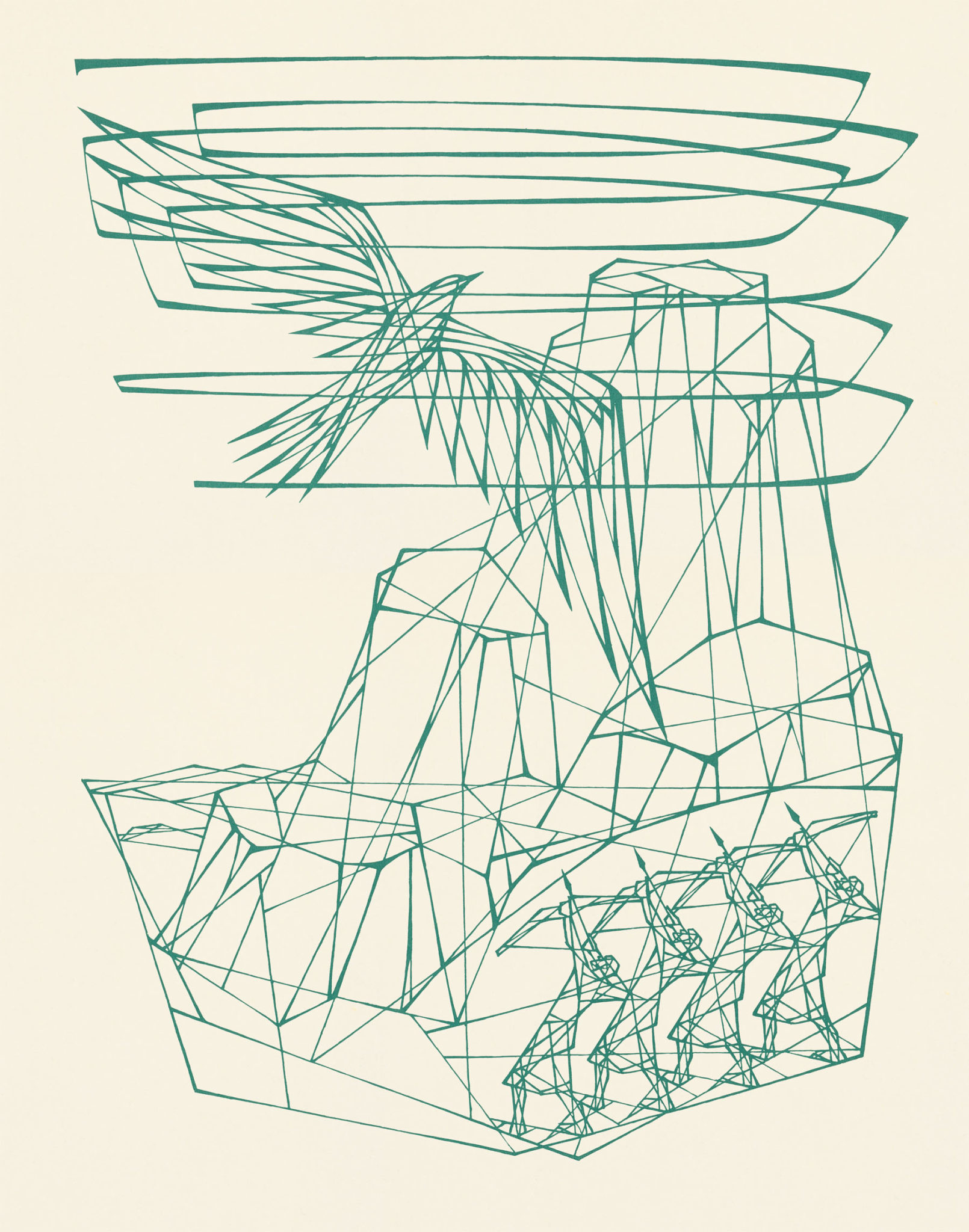
Drawing by Ismar David from The Psalms: A new English translation, linked with permission from Ismar David Archive .
For other images of Ismar David drawings, see here.

כִּ֤י הִנֵּ֪ה הָרְשָׁעִ֡ים יִדְרְכ֬וּן קֶ֗שֶׁת כּוֹנְנ֣וּ חִצָּ֣ם עַל־יֶ֑תֶר לִיר֥וֹת בְּמוֹ־אֹ֝֗פֶל לְיִשְׁרֵי־לֵֽב׃
2for look, the wicked bend the bow,
they have fitted their arrow to the string,
to shoot in the dark at the upright in heart.
Drawing by Ismar David from The Psalms: A new English translation, linked with permission from Ismar David Archive .
For other images of Ismar David drawings, see here.
The Hebrew that is translated as “upright in heart” in English is translated in Dazaga idiomatically as “white-hearted.” (Source: Andy Warren-Rothlin)
See also Paasaal in righteous / righteousness, Northwestern Dinka in saint, Mískito in mercy, and Uma in grace.
Following are a number of back-translations as well as a sample translation for translators of Psalm 11:2:
For the verb translated take refuge, see comments at 2.12; most translations in English are like Revised Standard Version (see also 31.1; 71.1). The interrogative how? is a rebuke: “How dare you…?” or, as Good News Translation, “How foolish of you!” The psalmist knew that his safety lay in trusting Yahweh, not in running away, as his friends (you) had suggested. Line b in verse 1 may be taken as an exclamation, as in Good News Translation, or as a question, as in Revised Standard Version. In some languages the exclamatory force will require a strong statement; for example, “You are very wrong when you say to me.” In some languages you of line b is inappropriate, since no antecedent has been introduced as a referent. One may then say “How foolish my friends are to advise me and say….”
To me is in Hebrew “to my nefesh” (see discussion at 3.2).
The last part of verse 1 in the Masoretic text is “fly (imperative, second person singular) to your (plural) mountain, bird.” The second person singular form is the qere, supported by ancient versions and many Hebrew manuscripts; the ketiv is the second person plural. Hebrew Old Testament Text Project prefers the qere, “you (singular) flee,” and takes the singular “bird” to be collective, meaning “birds.” The possessive pronominal suffix “your” with “mountain” is plural: “your (plural) mountain.” So Hebrew Old Testament Text Project recommends the following translation: “flee (imperative plural) to your mountains, birds.” But in the context this doesn’t make much sense, since this command is directed to the psalmist. Most translations, like Revised Standard Version and Good News Translation, follow the ancient versions, making a slight change in the Hebrew text.
In some languages the simile Flee like a bird may not suggest the elements of silence and speed. In such cases it will be better to say “Escape silently to the mountains as a bird flies.”
For lo in verse 2a, Revised Standard Version, is an obsolete English phrase. The Hebrew phrase introduces the reason for the preceding command: “You must do this because….” Some, like New International Version and New Jerusalem Bible, try to retain the Hebrew by translating “For look,” but this is not a natural expression in English.
The threats of the wicked are likened to the actions of hunters, who prepare to shoot their arrows at animals (see 7.12). The figure here is quite elaborate: they bend their bows, they have fitted the arrows to the bowstring, in order to shoot at the upright in heart. The bending of the bow in Revised Standard Version refers to stringing the bow, readying it for shooting. In order to fit the string onto the bow, the string was first attached to one end of the bow. Then, with that end of the bow on the ground, the hunter pressed his foot against the lower part of the bow, to bend it so that he could slip the other end of the string over the upper notched end of the bow. When the bent bow was released, the string was pulled tight. In order to avoid giving the impression that bend the bow meant drawing or pulling back the string with fitted arrow, it may be necessary to say, for example, “the wicked string their bows” or “wicked people bend their bows to string them.” Good News Translation does not speak of bending the bow but says “have drawn their bows,” which refers to tensing the bow with fitted arrow. The psalmist is using here a three-clause parallelism which is somewhat of a narrative, in that it depicts a process; they first string the bow, fit the arrow to it, and then shoot. In languages in which this process is commonly known, no problem should arise. However, in cases where the translator must use long, descriptive phrases to describe the process, the images run the risk of being obscure and so emphasized that the reader may lose track of their relation to the rest of the poem. In languages in which bow and arrow are unknown, the translator may have to supply an equivalent weapon. If no such figure is available, the translator will have to say something like “wicked people are always ready to secretly harm good people” or “evil people are always waiting in hiding to injure good people.”
In the dark: the wicked, hiding in a dark place (Dahood “ambush”), shoot their arrows at “good men” (literally upright in heart, as in 7.10). The word translated upright is used often in Psalms of pious, godly, law-abiding people.
Quoted with permission from Bratcher, Robert G. and Reyburn, William D. A Handbook on the Book of Psalms. (UBS Helps for Translators). New York: UBS, 1991. For this and other handbooks for translators see here .
The following are presentations by the Psalms: Layer by Layer project, run by Scriptura . The first is an overview, the second an introduction into the poetry, and the third an introduction into the exegesis of Psalm 11.
Copyright © Scriptura
Copyright © Scriptura
Copyright © Scriptura
John Wu Ching-hsiung (1899-1986) was a native of Ningbo, Zhejiang, a renowned jurist who studied in Europe and the United States, and served as a professor of law at Soochow University, as a judge and the Acting President of the Shanghai Provisional Court, and as the Vice President of the Commission for the Drafting of the Constitution of the Republic of China, before becoming the Minister of the Republic of China to the Holy See. Wu has written extensively, not only on law but also on Chinese philosophy, and has also written his autobiography, Beyond East and West, in English. Wu was a devout Catholic and had a personal relationship with Chiang Kai-shek (1887-1975). Wu began translating the the Psalms in 1938, and was encouraged by Chiang to translate the entire New Testament, which he corrected in his own handwriting. (…) John Wu Ching-hsiung’s translation of the Psalms (first draft in 1946, revised in 1975) was translated into Literary Chinese in the form of poetic rhyme, with attention paid to the style of writing. According to the content and mood of the different chapters of the original psalm, Wu chose Chinese poetic forms such as tetrameter, pentameter, heptameter [4, 5 or 7 syllables/Chinese characters per stanza], and the [less formal] Sao style, and sometimes more than two poetic forms were used in a single poem. (Source: Simon Wong)
“Nothing could have been farther from my mind than to translate the Bible or any parts of it with a view to publishing it as an authorized version. I had rendered some of the Psalms into Chinese verse, but that was done as a part of my private devotion and as a literary hobby. When I was in Hongkong in 1938, I had come to know Madame H. H. Kung [Soong Ai-ling], and as she was deeply interested in the Bible, I gave her about a dozen pieces of my amateurish work just for her own enjoyment. What was my surprise when, the next time I saw her, she told me, “My sister [Soong Mei-ling] has written to say that the Generalissimo [Chiang Kai-shek] likes your translation of the Psalms very much, especially the first, the fifteenth, and the twenty-third, the Psalm of the Good Shepherd!”
“In the Autumn of 1940, when I was in Chungking, the Generalissimo invited me several times to lunch with him and expressed his appreciation of the few pieces that he had read. So I sent him some more. A few days later I received a letter from Madame Chiang [Soong Mei-ling], dated September 21, 1940, in which she said that they both liked my translation of the few Psalms I had sent them. ‘For many years,’ she wrote, ‘the Generalissimo has been wanting to have a really adequate and readable Wen-li (literary) translation of the Bible. He has never been able to find anyone who could undertake the matter.’ The letter ends up by saying that I should take up the job and that ‘the Generalissimo would gladly finance the undertaking of this work.’
“After some preliminary study of the commentaries, I started my work with the Psalms on January 6, 1943, the Feast of the Epiphany.
“I had three thousand years of Chinese literature to draw upon. The Chinese vocabulary for describing the beauties of nature is so rich that I seldom failed to find a word, a phrase, and sometimes even a whole line to fit the scene. But what makes such Psalms so unique is that they bring an intimate knowledge of the Creator to bear upon a loving observation of things of nature. I think one of the reasons why my translation is so well received by the Chinese scholars is that I have made the Psalms read like native poems written by a Chinese, who happens to be a Christian. Thus to my countrymen they are at once familiar and new — not so familiar as to be jejune, and not so new as to be bizarre. I did not publish it as a literal translation, but only as a paraphrase.
“To my greatest surprise, [my translation of the Psalms] sold like hot dogs. The popularity of that work was beyond my fondest dreams. Numberless papers and periodicals, irrespective of religion, published reviews too good to be true. I was very much tickled when I saw the opening verse of the first Psalm used as a headline on the front page of one of the non-religious dailies.”
A contemporary researcher (Lindblom 2021) mentions this about Wu’s translation: “Wu created a unique and personal work of sacred art that bears the imprint of his own admitted love and devotion, a landmark achievement comparable to Antoni Gaudi’s Basilica of the Sagrada Família in Barcelona, Spain. Although its use is still somewhat limited today, it continues to attract readers for the aforementioned qualities, and continues to be used in prayers and music by those who desire beauty and an authentic Chinese-sounding text that draws from China’s ancient traditions.”
The translation of Psalm 11 from the 1946 edition is in the classical questions-and-answer scheme that is used by many Confucian and Taoist classics (the 1946 edition did not have verse numbers either):
答客難
友人勸我學飛鳥。飛入深山避災殃。 君不見群小彎弓箭在絃。欲於暗中射賢良。 國家根基已崩潰。賢人焉能獨支撐。 我答友人言。此語何荒唐。一生恃主得無恙。何必入山去自藏。 雅瑋坐天廷。雙目炯炯察世人。 賢良蒙鍛鍊。所以玉其成。惟彼兇與暴。乃為主所憎。 為惡嬰天羅。雷霆作杯羹。 為善邀天眷。常得承歡欣。
Transcription into Roman alphabet:
dá kè nán
yǒu rén quàn wǒ xué fēi niǎo 。 fēi rù shēn shān bì zāi yāng 。 jūn bù jiàn qún xiǎo wān gōng jiàn zài xián 。 yù yú àn zhōng shè xián liáng 。 guó jiā gēn jī yǐ bēng kuì 。 xián rén yān néng dú zhī chēng 。 wǒ dá yǒu rén yán 。 cǐ yǔ hé huāng táng 。 yī shēng shì zhǔ dé wú yàng 。 hé bì rù shān qù zì cáng 。 yǎ wěi zuò tiān tíng 。 shuāng mù jiǒng jiǒng chá shì rén 。 xián liáng mēng duàn liàn 。 suǒ yǐ yù qí chéng 。 wéi bǐ xiōng yǔ bào 。 nǎi wéi zhǔ suǒ zēng 。 wéi è yīng tiān luó 。 léi tíng zuò bēi gēng 。 wéi shàn yāo tiān juàn 。 cháng dé chéng huān xīn 。
With thanks to Simon Wong.
No comments yet.
Leave a Reply
You must be logged in to post a comment.