
In Nepali society, cousin marriage is regarded as incest, so the Nepali translation “cousins” in Numbers 36:11 was translated less specifically as “relative on father’s side.”
Noah
The Hebrew, Latin and Greek that is transliterated as “Noah” in English is translated in Spanish Sign Language with a sign that combines the letter N + “boat.” (Source: Steve Parkhurst)
“Noah” in Spanish Sign Language, source: Sociedad Bíblica de España
For more information on translations of proper names with sign language see Sign Language Bible Translations Have Something to Say to Hearing Christians .
The following is a stained glass window depicting Noah by Endre Odon Hevezi and Gyula Bajo from 1965 for the Debre Libanos Monastery, Oromia, Ethiopia:
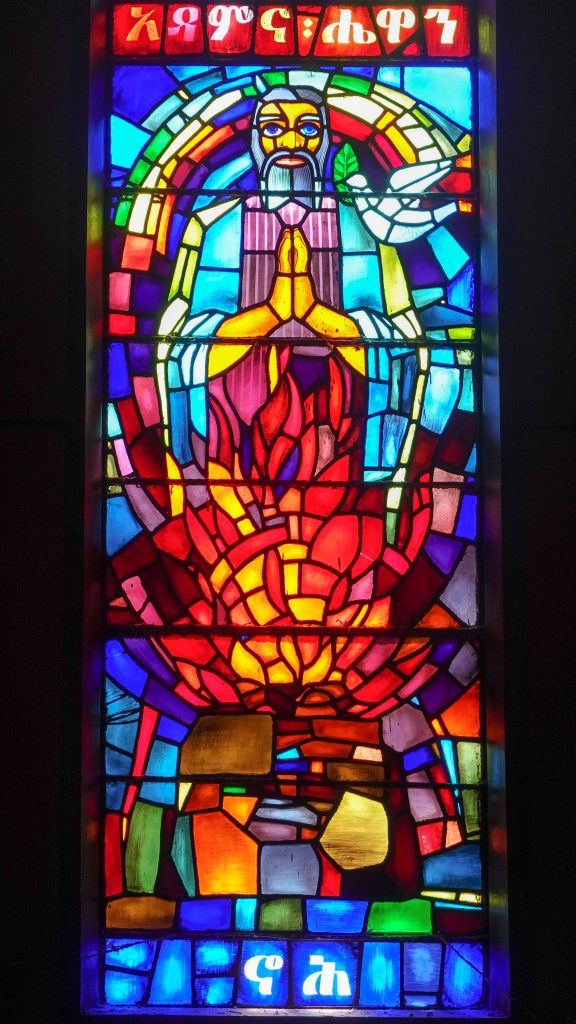
Photo by Timothy A. Gonsalves, hosted by Wikimedia Commons under a Creative Commons Attribution-Share Alike 4.0 International license

Stained glass is not just highly decorative, it’s a medium which has been used to express important religious messages for centuries. Literacy was not widespread in the medieval and Renaissance periods and the Church used stained glass and other artworks to teach the central beliefs of Christianity. In Gothic churches, the windows were filled with extensive narrative scenes in stained glass — like huge and colorful picture storybooks — in which worshipers could ‘read’ the stories of Christ and the saints and learn what was required for their religious salvation. (Source: Victoria and Albert Museum )
Learn more on Bible Odyssey: Noah .
complete verse (Numbers 36:11)
Following are a number of back-translations as well as a sample translation for translators of Numbers 36:11:
- Kupsabiny: “Then Mahlah, Tirzah, Hoglah, Milcah and Noah, those daughters of Zelophehad were married into the clan of the house/family of their father.” (Source: Kupsabiny Back Translation)
- Newari: “Mahlah, Tirzah, Hoglah, Milcah and Noah, daughters of Zelohehad, married the sons of their father’s elder and younger brothers.” (Source: Newari Back Translation)
- Hiligaynon: “The female children/(daughters) of Zelofehad were Mala, Tirza, Hogla, Milca and Noa. And the ones-who- they -married were their first-cousins from the side of their father,” (Source: Hiligaynon Back Translation)
- English: “The five daughters—Mahlah, Tirzah, Hoglah, Milcah and Noah—married their cousins, their father’s relatives.” (Source: Translation for Translators)
Translation commentary on Numbers 36:10 - 36:11
Translators may insert a paragraph break here since the text moves from direct speech to a narrative report.
The daughters of Zelophehad did as the LORD commanded Moses is literally “As the LORD commanded Moses, thus the daughters of Zelophehad did,” so there is emphasis on the clause as the LORD commanded Moses in Hebrew. Good News Translation avoids the repetition of the daughters of Zelophehad by combining verses 10-11. It may be helpful to do this, but Good News Translation‘s model reduces the emphasis on the fact that the LORD had commanded Zelophehad’s daughters to marry within their tribe. This problem can be solved in Good News Translation by beginning verses 10-11 with “So as the LORD had commanded Moses….”
For Mahlah, Tirzah, Hoglah, Milcah, and Noah, the daughters of Zelophehad, were married to sons of their father’s brothers: For renders the Hebrew waw conjunction (literally “And”). It does not introduce a reason here, but a result, so it is better translated “so.” The order of the names of Zelophehad’s daughters differs from that in 26.33; 27.1; and Josh 17.3 (noted by Rashi). However, translators should keep the order that is here. Were married to is literally “became wives to” (see verse 3). The Hebrew word for father’s brothers (“uncles” in Contemporary English Version) often refers specifically to a father’s brother. Some languages (for example, many Bantu patrilineal societies) will have a specific term to refer to a father’s brother. Good News Translation renders sons of their father’s brothers as “their cousins,” which wrongly suggests that the daughters might have married relatives on their mother’s side also. New International Version and New Living Translation are more accurate with “[their] cousins on their father’s side,” and so is Reina-Valera revisida with “sons of their paternal uncles.”
Quoted with permission from de Regt, Lénart J. and Wendland, Ernst R. A Handbook on Numbers. (UBS Helps for Translators). Miami: UBS, 2016. For this and other handbooks for translators see here .
Leave a Reply
You must be logged in to post a comment.