The Greek, Latin and Hebrew that is translated as “naked” in English is translated in Enlhet with a figure of speech: “(one’s) smoothness.” (Source: Jacob Loewen in The Bible Translator 1969, p. 24ff. )
In Elhomwe the word for “naked” is “shameful to use, and would never be used by a preacher in church.” Therefore “without clothes” is used. (Source: project-specific translation notes in Paratext)
The Hebrew that is translated as “jackal” in English was translated in the 1900 Kalaallisut (Greenlandic) translation (a newer version was published in 2000) as qimmit nujuartat or “wild dogs.” (Source: Lily Kahn & Riitta-Liisa Valijärvi in The Bible Translator 2019, p. 125ff.)
Owls are found worldwide except in the Antarctic and on some islands. They are active at night and are characterized by flat faces and short hooked beaks that they can open very wide. They swallow their prey whole and later regurgitate the undigested parts as small balls. They also have the ability to turn their heads more than 180 degrees.
There are two basic owl families, both of which are found in the land of Israel. One family is the Tytonidae, which are the Barn and Grass Owls. They have heart-shaped whitish faces, usually outlined by a dark line, and small dark eyes. The other family is the Strigidae, the typical owls. This family contains a large variety of species, all of which have large eyes that may vary in color from light brown through orange to yellow. This family includes the eared or horned owls, the fairly rare fishing owls, and owls that vary in size from the midget scops owl (less than 20 centimeters [8 inches]) through to the giant eagle owl (over 70 centimeters [28 inches]).
Eight species of owl are fairly common in the land of Israel. Most are very seldom seen by humans, but they are quite well known by their different and distinct calls. In biblical times the nights would have been much quieter than in most modern places, and the strange night sounds probably would have interested people, causing some speculation about what was making the sound. The different owls would thus probably have had different names even if people had never seen them. In fact it is unlikely that they would have been able to associate most of the calls with the owls that were seen.
Some scholars have linked bath ya‘anah with the word ya‘en, which is the ostrich. In view of the contexts in which the word occurs, however, it does not seem that this is a likely interpretation. In the biblical contexts it can be seen that the bath ya‘anah is linked with jackals, deserted ruins, and wailing sounds. It also seems to be reliant on water (compare Isaiah 43:20). None of these are contexts into which the ostrich would fit easily. Furthermore, while it is easy to see the reason why certain birds are listed as unclean, from their diet or association with foreign deities, it is not easy to see why ostriches would be included in the list. They are basically vegetarian, like domestic fowls. The only possible reason would be that since they cannot fly, they were considered somehow “unnatural,” as was the bat.
Other scholars have derived the name from an Arabic word meaning “desert,” and still others from an Aramaic word meaning “greedy.” Hasting’s Dictionary of the Bible suggests that it refers to the eagle owl, and from its position in the list of unclean birds this seems a distinct possibility. The “desert-owl” of New English Bible and Revised English Bible is not a distinct species but a general word for owls that live away from towns.
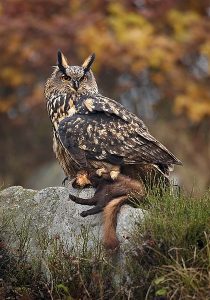
Eagle owls are the giants in the owl family. The European Eagle Owl Bubo bubo is the largest owl in the Middle East, standing over 75 centimeters (30 inches) tall. The corresponding owl in the land of Israel is a pale fawn color, spotted, has ear tufts, and is best known by its loud, deep hooting at night. It roosts by day in deep shade in acacia trees, caves, tombs, and ruined buildings. It feeds on small mammals, including hares, baby gazelles, lambs, rats and mice, and large roosting birds, especially wild and domestic ducks. It is sometimes seen when it is roosting during the day, or when disturbed in a cave or old tomb, but it is seldom seen at night, except in modern times when it is sometimes seen on roads late at night.
In the Bible this owl is associated with death, mourning, and ruin, as well as being listed as an unclean bird.
Eagle owls of one species or another are found in southern and eastern Europe and throughout Africa and South and Southeast Asia. Large owls of a slightly different kind are found in Australasia. The two most common African eagle owls are the Spotted Eagle Owl Bubo africanus and the Giant Eagle Owl Bubo lacteus (known as Verreaux’s eagle owl in East Africa). The Asian Eagle Owl Bubo indicus is found in hilly wooded or forested country away from towns. The largest Australian owl is the Great Scrub Owl Ninox strenua. A word for any of these owls, or a phrase meaning “giant owl”, would be a close local equivalent to use in the lists of unclean birds. In other contexts, a phrase such as “large owls” would be sufficient.
The Hebrew, Latin, and Greek that is translated as “mourn” or similar in English is translated in Newari as “have one’s heart broken” or “have a bursting heart” (source: Newari Back Translation).
Following are a number of back-translations as well as a sample translation for translators of Micah 1:8:
Kupsabiny: “So, please, I shall grieve and mourn. I shall walk around without clothes and shoes. I shall howl like a wild dog/jackal and moan like an owl.” (Source: Kupsabiny Back Translation)
Newari: “Therefore, I will weep and lament. I will go about barefoot and naked and I will howl like a jackal and moan like an owl.” (Source: Newari Back Translation)
Hiligaynon: “Micas said, ‘Because of the destruction of Samaria, I will-cry/weep and will-lament. I will-roam-around/stroll-around going-barefoot and without clothes to show my mourning. I will-cry-out the-same-as the howling of a wild-country dog and sound/noise of an owl.” (Source: Hiligaynon Back Translation)
In biblical times and even today there are three species of fox found in Israel and one type of jackal. An additional type of fox was found in Egypt. In the Bible the Hebrew word shu‘al and its Greek equivalent alōpēx refer to any of these animals. These are members of the same animal family which includes the wolf and the dog. The word “jackal” was borrowed from the Arabic jakal which is from the same Semitic root as the Hebrew word shu‘al. In the days of the King James Version the word “jackal” had not yet been introduced into the English language and so in that version “fox” is used throughout for shu‘al.
Click or tap here for the rest of this entry in United Bible Societies’ All Creatures Great and Small: Living things in the Bible
Modern scholars are almost unanimous in agreeing that the word ’iyim (plural of ’iy) is derived from a root meaning “to howl” and that it refers to howling jackals in particular. The word usually occurs in conjunction with the word tsiyim (“hyenas”) which is derived from a root meaning “to wail”. The pair together could justifiably be interpreted as “wild animals wailing and howling.” This is usually taken to refer to hyenas and jackals.
The context will usually indicate which animal is being referred to in a particular passage. It is possible that the fox was known as the small shu‘al and the jackal as the large one.
In early Hebrew the plural form tanin from tan meant a type of snake. This usage is found in Exodus 7:9 et al. The same word was the name of a mythical monster or sea serpent. This usage occurs in Genesis 1:21 et al. However, it is well accepted now that, in later Hebrew, tan is a poetic name for the jackal. It derives from a stem meaning to recite, or lament. In the passages where snakes or the monster tanin is referred to the context usually indicates that it cannot refer to jackals.
Fox: All foxes look like small, long-haired dogs with pointed noses. The Red Fox Vulpes vulpes (also Vulpes flavescens) is now very common all over Europe, North Africa, the Middle East, Central Asia, China, Japan, North America, and Australasia, having been introduced into the latter two continents to be hunted on horseback with packs of dogs. The red fox is a smallish animal, about 1 meter (3 feet) from nose to tip of the tail. It is usually reddish with white underparts and a bushy tail. Red foxes feed mainly on mice and rats but also eat chickens, game birds, and fallen fruit. They may occasionally eat carrion (dead animals), but are not scavengers in the usual sense of the word.
The Desert Fox Vulpes ruppelli and the Egyptian Fox Vulpes nilotica are slightly smaller and yellowish brown, but they are otherwise very similar to the red fox. The Fennec Vulpes zerda is a very small fox with large ears. It is now found in the Middle East and Egypt and was probably found in Israel also in earlier times. It feeds on insects and mice.
Foxes live in pairs, singly or in small family groups when they have young. During the day they live in holes in the ground usually dug by some other animal and come out at night to feed. When chased by dogs they are very clever at escaping, often doubling back on their tracks and then jumping sideways and heading in a new direction, thus confusing the scent trail. They also run up streams and thus avoid laying a scent trail altogether.
Jackal: The jackal found in Israel is the Golden or Oriental Jackal Canis aureus. It is also sometimes referred to as the Indian jackal. This animal is larger than the fox. It is yellowish brown with black tips to the long fur on its back.
Jackals eat almost anything and are great opportunists moving very fast with clever tactics when they have to. They have been known to steal bread from people’s houses and baby animals even from dangerous wild pigs. They are scavengers, eating household rubbish as well as carrion, especially the remains of carcasses killed by lions, but they also eat beetles and birds’ eggs and kill small mammals game birds and domestic chickens and ducks.
In some of the literature there is reference to the fact that jackals live in packs. This is not strictly correct. They live in pairs or small family groups but they may associate temporarily in larger groups when many pairs are attracted to the same burrows, carrion, refuse dumps, or potential prey. In these larger temporary groups they may cooperate and act together like a pack.
Jackals live in burrows made by other animals or in abandoned human houses or shelters and emerge to feed at night. They yap, howl, and wail at great length at the entrance to their burrow, especially on moonlit nights, with one pair triggering a response from neighboring pairs.
Both foxes and jackals are extremely intelligent animals, and their quick-witted, crafty opportunism is legendary in the Middle East, Africa, and Europe. The fables of Aesop, a North African philosopher and storyteller, which feature the crafty fox, date from about the time of Daniel. The fox also figures in Greek and Roman fables. Similar fables about opportunistic jackals have been widespread in Africa and the Middle East for centuries.
In ancient Arabic literature and in the Talmud and Midrash the word “lion” stands for a truly great and powerful person. In contrast “jackal” is used to designate an insignificant but self-important person. Since this figurative usage of “lion” (or “lioness”) is also common in the Bible there is a strong probability that the term “jackal” or “fox” used as a metaphor in the Bible for a person carries the connotation of self-important insignificance.
However the main symbolism associated with the jackal in the Bible is related to its habit of living among ruins and feeding on carcasses. To say that a certain place would become the dwelling place of jackals meant that the place would become deserted and lie in ruins, as the result of war. The jackal was thus a symbol of death and desolation as well as insignificance and opportunistic craftiness.
In areas where jackals are known, but not foxes, the word for jackal can be used for both. Similarly, if foxes are known but not jackals, the one word will suffice. In areas where neither foxes nor jackals are found, there may be related animals such as the Coyote Canis latrans or various types of wild dog or small wolf. In those few areas where even these are not found, one may use an expression such as “wild dog” or a transliteration.
Isaiah 13:21f.: In this verse there are four words for howling wild animals that inhabit deserted buildings: tsiyim, ’ochim, ’iyim, tanim . All except tsiyim probably mean “jackal”; however, to maintain the parallelism of the Hebrew poem, it is better to translate both tsiyim and ’iyim as “hyenas”. These verses will then be translated as:
Wailing hyenas will settle there,
Howling jackals will fill their houses.
Hyenas will wail in their fortresses,
And jackals howl in their luxurious palaces.
The word ’ochim occurs only here in the Bible. It is derived from a Hebrew word meaning “to howl”. “Owls” is a possibility, but “jackals” fits the context better, as it then preserves the parallelism of “jackals” and “hyenas”.
Judges 15:4: Since jackals are easier to trap because they are more easily attracted to baits of meat, most modern translations interpret shu‘al as jackal in this passage.
Nehemiah 4:3: Since the fox is smaller and lighter than the jackal, fox is the preferred interpretation here. The meaning is thus something like “Even if a little fox were to climb on these walls they would collapse.” Where foxes or jackals are not known, an expression for a small dog could be used in this context.
Psalms 63:10: Since the reference is to the enemy soldiers dying in battle and becoming carrion (that is, lying unburied), the interpretation of shu‘al should be “jackals”.
Song of Songs 2:15: This verse is very difficult to interpret. While foxes may occasionally eat fallen grapes, or grapes low down on a vine, they cannot accurately be described as “ruiners of vineyards”. It seems more likely that what is in focus is the fact that for Israelites jackals symbolize ruin.
Jeremiah 51:34 : Although many English versions translate tan in this verse as “dragon” or “serpent”, it seems likely that “jackal” is better; jackals often swallow their food in a great hurry without chewing properly, and then vomit it later when they are under cover and eat it a second time more slowly.
Though this verse and the next continue to use the first person, as in verses 6 and 7, there is a change of speaker. This change is signaled in Good News Translation by the introductory words Then Micah said. It will usually be necessary to include in a translation some indication of the change of speaker, because otherwise it will sound as though God himself is still talking. However, in some languages it may be more natural to solve this problem by indicating in some way that God’s speech is finished. If this can be done, it may not be necessary to mention Micah here. In some ways it will be better not to mention Micah, since he is the author of the book, and in other places where he speaks we do not put in his name.
Because of this refers not to the loss of the idols just mentioned, but to the punishment and destruction of Samaria in the whole of verses 6-8. Some scholars take this to refer not to what has preceded, but to the description of the enemy invasion in verses 10-16. (See for instance the way Jerusalem Bible divides the paragraphs.) However, this analysis seems unlikely because there is so much text in between.
Mourn and lament are terms commonly associated with grief for the dead. It is not necessary to use two terms here if there is only one appropriate term in the translator’s language.
To walk about barefoot and naked is also a gesture that symbolizes sorrow (compare 2 Sam 15.30), and Good News Translation makes this explicit with the words To show my sorrow. To walk barefoot and naked also reminds people of prisoners of war and is perhaps intended to show what will happen to the inhabitants of Samaria. Barefoot means “without shoes (or other footwear).” The Hebrew word for naked usually means having no outer garments and wearing only a loincloth. This is probably the meaning here, though in Assyrian reliefs male prisoners are often shown completely naked. (Compare with the reference to nakedness in verse 11.) It is not likely that Micah went about fully unclothed. A similar situation is spoken of in Isa 20.2-4. In many languages the usual word for naked will mean that Micah was wearing nothing at all. If this is not too offensive to the readers, it is possible to use this word, although it is unlikely that this is what Micah did. Otherwise it can be translated as “with nothing on but a loincloth.”
If walking around barefoot and naked is a way of mourning in the culture of the translation, then of course it is not necessary to add To show my sorrow.
A jackal is an animal like a wild dog or a fox. Jackals go about in packs, mostly at night, and have a long and unpleasant howl. The ostrich used to be widespread in the Middle East but is now found only in Africa. Ostriches rarely make a noise, and some scholars believe that the Hebrew word really means a kind of owl that does screech. New English Bible has “desert owl,” and for many translators it may be easier to find an equivalent for owl than for ostrich. The context makes it clear that some bird that does make a loud and harsh noise is in mind.
Howl and wail are used to describe the cries of mourning, or of sorrow for the dead, or for some terrible thing that has happened. If a language does not have two words that can be compared to the sounds of jackals and ostriches (or owls), then one word is enough: “I will howl like jackals and ostriches.”
Quoted with permission from Clark, David J. et al. A Handbook on Micah. (UBS Helps for Translators). New York: UBS, 1978, 1982, 1993. For this and other handbooks for translators see here .
Micah mourned because an enemy army will invade Judah and take many people into exile
In 1:5, Micah mentioned the sins of the people in Samaria and Jerusalem. In 1:6–7, he predicted that the LORD would destroy Samaria. Here in 1:8–16, he predicted that the LORD would also punish the people in Judah, including Jerusalem. He would punish them by causing an enemy army to invade Judah.
This section has two paragraphs: 1:8–9 and 1:10–16. In the first paragraph, Micah said that he would “lament and wail” (Berean Standard Bible). He described the way that he would mourn and then gave the reason. In the second paragraph, he mentioned several cities in Judah that an enemy army would soon attack on its way to Jerusalem. Some versions have separate section headings for each paragraph. The Notes will include both paragraphs as part of the same section. Here are some other examples of section headings for the entire section (1:8–16):
Lament for Jerusalem and the lowland towns (New Jerusalem Bible) -or-
Judah Is Doomed (Contemporary English Version) -or-
The Doom of the Cities of Judah (New Revised Standard Version) -or-
Micah mourned the disaster that will happen to various cities in Judah
If you choose to use separate section headings for 1:8–9 and 1:10–16, here are some examples for 1:8–9:
Weeping and Mourning (New International Version, Berean Standard Bible) -or-
Micah’s Great Sadness (New Century Version)
Either the Contemporary English Version or New Revised Standard Version headings above will be appropriate for 1:10–16. Here is another example:
Disaster will happen to various cities in Judah
Paragraph 1:8–9
In this paragraph, Micah described the sadness that he felt because of the disaster that would happen to Samaria (1:8a–c, 9a). Then he described the disaster that would also happen to Judah and Jerusalem (1:9b–c).
In 1:6–7, the LORD was the speaker. But here in 1:8–9, Micah is the speaker. In some languages, it may be helpful to make this explicit. For example:
Then Micah said, “Because of this I will mourn and lament. (Good News Translation)
1:8a
Because of this: This phrase refers back to the LORD’s statement in 1:6–7 that he will punish the people of Samaria severely. For this reason, Micah will lament and wail. Here are some other ways to translate this phrase:
For this… (New Revised Standard Version) -or-
And so,… -or-
That is the reason why…
I will lament and wail: Most versions translate these verbs as future tense (will). Here are some other ways to express the meaning of the Hebrew verb tense here:
I lament and wail (New American Bible) -or-
I must lament and wail (New American Standard Bible) -or-
I have decided to lament and wail
lament and wail: These verbs have almost the same meaning. They both refer to the Jewish custom of weeping in a loud voice and wailing loudly to show their sorrow. Micah used both verbs here to emphasize his sorrow. Here are some other examples of versions that use two similar verbs to express loud mourning:
I will weep and wail (New International Version) -or-
I shall howl and wail (New Jerusalem Bible)
In some languages, it may be more natural to express this emphasis in a different way. For example:
I will mourn greatly -or-
I will mourn and mourn
1:8b
I will walk barefoot and naked: This is a symbolic action. Micah said he will walk around barefoot and naked to show that he was very sad. In some languages, it may be helpful to make the meaning of Micah’s actions explicit. For example:
To show my sorrow, I will walk around barefoot and naked. (Good News Translation)
In other languages, it may be appropriate to supply a footnote that clarifies the meaning of the symbolic action. Here is an example:
Micah did this to show how sad he was that the LORD planned to punish his people.
barefoot: In Hebrew, there are two ways to interpret the word barefoot :
(1) It means that Micah would not wear any shoes or sandals on his feet. For example:
I will walk around barefoot (Good News Translation)
(2) It means that Micah would not wear any jewelry or good clothing. For example:
I will go stripped (Revised Standard Version)
It is recommended that you follow interpretation (1) along with most versions and commentaries. Here are some other ways to translate barefoot :
I will not wear/use any shoes/sandals -or-
I will wear nothing on my feet
naked: In Hebrew, there are two ways to interpret the word naked :
(1) It means “to not wear an outer garment” but “to wear only a loincloth.” For example:
I will walk around barefoot and without my outer garments. (NET Bible)
(2) It means “completely naked,” without any clothes. Almost all English versions translate this as “naked.”
It is recommended that you follow interpretation (1) along with almost all commentaries.
Here are some other ways to translate interpretation (1):
I will walk around barefoot and wearing only a loincloth. -or-
I will walk around with no shoes and no shirt or sarong.
1:8c
In 1:8a, Micah said that he would “lament and wail.” Here in 1:8c, he used two similes to compare his lamenting and wailing to the noises made by two kinds of animals: jackals and ostriches. The following note on “howl” applies to both similes.
I will howl: In Hebrew, the word the Berean Standard Bible translates as howl is a noun that is related to the verb “lament” in 1:8a. In some languages, it may be more natural to use a verb here in 1:8c too, as the Berean Standard Bible does. For example:
I will cry loudly… (New Century Version)
like a jackal: In Hebrew, the word jackal is plural. Some versions translate it as plural, others as singular. Translate it in a way that is natural in your language.
A jackal is a wild animal that resembles a wild dog. Jackals often howl at night. If there is no word for jackal in your language, you may be able to use the word for a similar kind of animal that makes a sad/lonely howling noise. For example:
like a wolf (Revised English Bible) -or-
like the wild dogs (New Century Version) -or-
like a pack of coyotes/hyenas
and mourn like an ostrich: There are two main ways to interpret the meaning of the Hebrew word for ostrich :
(1) It refers to an ostrich. This very large bird used to be found in Israel but is now found mainly in Africa. For example:
I will…wail like an ostrich. (Good News Translation)
(2) It refers to a kind of owl. For example:
I shall shriek like the owls (New Jerusalem Bible)
TN will follow interpretation (1). You may follow either interpretation. Choose an interpretation that fits the terminology of your language and also has cultural associations with a loud, shrill, or harsh noise. Both interpretations are almost equally supported by translations and commentaries.
Here are some questions to ask in deciding on an interpretation to follow:
• How do the major translations in your area or country translate the name of this bird?
• What birds in your area are known for making loud, shrill, or harsh cries?
Be sure to test your translation carefully for unexpected meanings. For example, in some parts of the world, people believe that owls are a sign (omen) of bad luck or disaster. In such areas, it may be better to refer to a different bird.
Here are some other options for translating jackal or ostrich (or “owls”):
• Borrow words from a language of wider communication. Then supply a footnote that explains the meaning. Here is an example footnote that explains jackals and owls:
In the thinking of the Jews, jackals and owls made loud, sad noises.
• Translate the meaning without using similes. Then supply the similes in a footnote. Here is an example:
I will wail and make sad noises. (Footnote: In Hebrew, it says: I will howl like the jackals and moan loudly like the ostriches.)
If possible, use similes to keep the vividness that these figures of speech conveyed to the original audience.



.jpg)


Leave a Reply
You must be logged in to post a comment.