The Greek that is translated as “(I will make you) fishers of men (or: people)” in English is rendered in Martu Wangka as “before you used to work getting fish for people, now i think you should do another work getting people and teaching them to be my relatives” (source: Carl Gross).
In Galela it is translated as “. . . you teach people to follow me, which is similar to you netting fish to gather them in” (source: Howard Shelden in Kroneman 2004, p. 501).
“Fisherman spent their time finding fish to feed their family and sold what was left. It is not common for fishermen to be interested in or qualified for a study of the dharma but Jesus called them anyway.”
The Ghari translation uses different terms for “fishing”: with nets when fishing for fish and with a line when fishing for men. (Source: David Clark)
The translation for “fishing” (when referring to catching fish) in Ojitlán Chinantec is “catching water animals” and in Aguaruna “killing fish.” (Source: M. Larson / B. Moore in Notes on Translation February 1970, p. 1-125.)
Click or tap here to see a short video clip showing the different kinds of fishing with a net in biblical times (source: Bible Lands 2012)
The Greek that is translated as “Follow me” in English is translated as “Be my disciple” in Ojitlán Chinantec and “Don’t forsake me” in Tenango Otomi (the latter is used in John 21). (Source: M. Larson / B. Moore in Notes on Translation February 1970, p. 1-125.)
In Kaingang it is translated as “run with me and do as I do.” (Source Ursula Wiesemann in Holzhausen / Riderer 2010, p. 65).
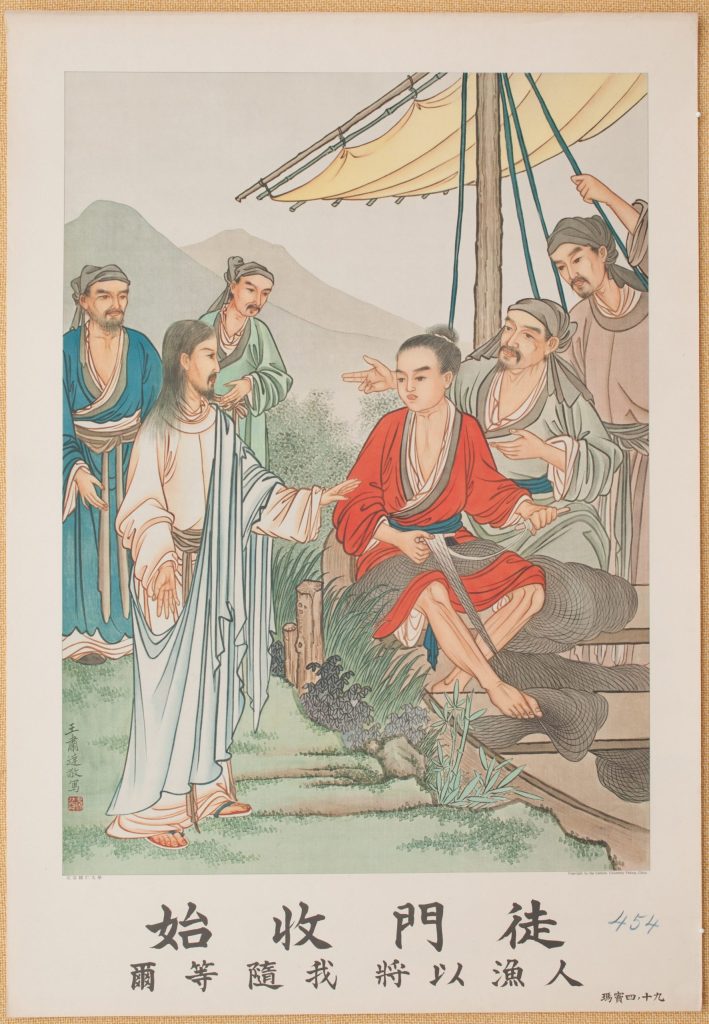
Painting by Wang Suda 王肅達 (1910-1963),
Copyright by the Catholic University Peking, China
Text under painting translated from Literary Chinese into English:
Calling of the Disciples
Come, follow me, and I will make you fishers of men
Image taken from Chinese Christian Posters . For more information on the “Ars Sacra Pekinensis” school of art, see this article , for other artworks of that school in TIPs, see here.
Kim Ki-chang (pen name: Unbo) (1913-2001) had been deaf and partially mute since the age of 7. He painted a series of 30 paintings for the “Life of Christ” cycle in 1952 during the Korean War. Kim portrayed Jesus as a seonbi / 선비, or a Joseon Period (1392-1910) gentleman scholar, wearing a gat / 갓 (hat) and dopo / 도포 (robe).
For other images of Kim Ki-chang art works in TIPs, see here.
Living Water is produced for the Bible translation movement in association with Lutheran Bible Translators. Lyrics derived from the ESV® Bible (The Holy Bible, English Standard Version®).
Following are a number of back-translations of Matthew 4:19:
Uma: “Yesus said to them: ‘Come follow me! You will no longer fish, searching for fish. From now on I give you the work of teaching people to believe in me.'” (Source: Uma Back Translation)
Yakan: “So-then Isa said to them, ‘Come and follow me. Your work is to get/catch fiish. But if/when you follow me, I will teach you to get people to follow me.'” (Source: Yakan Back Translation)
Western Bukidnon Manobo: “Jesus said to them, ‘So you are catchers of fish? Come with me and people (by contrast) you will be able to get so that they will follow (-as-disciples) me.'” (Source: Western Bukidnon Manobo Back Translation)
Kankanaey: “He said to them, ‘Until now, you have been net-fishing fish. Become my disciples so I will teach you to persuade people.'” (Source: Kankanaey Back Translation)
Tagbanwa: “Jesus said to them, ‘Come with me, for I will make you to be like it’s now men you’re fishing for.'” (Source: Tagbanwa Back Translation)
Tenango Otomi: “Upon seeing them, Jesus said: ‘Listen men, let’s go together. Now it will not be fish that you meet up with, rather I will teach you to meet up with people,’ he said.” (Source: Tenango Otomi Back Translation)



Leave a Reply
You must be logged in to post a comment.