18As he walked by the Sea of Galilee, he saw two brothers, Simon, who is called Peter, and Andrew his brother, casting a net into the sea—for they were fishers.
“Fisherman spent their time finding fish to feed their family and sold what was left. It is not common for fishermen to be interested in or qualified for a study of the dharma but Jesus called them anyway.”
The Greek that is translated as “who is called Peter” or similar in English is translated in the German New Testament translation by Berger / Nord (publ. 1999) with der später Petrus hieß or “who was later called Peter.”
The Ghari translation uses different terms for “fishing”: with nets when fishing for fish and with a line when fishing for men. (Source: David Clark)
The translation for “fishing” (when referring to catching fish) in Ojitlán Chinantec is “catching water animals” and in Aguaruna “killing fish.” (Source: M. Larson / B. Moore in Notes on Translation February 1970, p. 1-125.)
Click or tap here to see a short video clip showing the different kinds of fishing with a net in biblical times (source: Bible Lands 2012)
Many languages have terms for siblings that define whether one is younger or older in relation to another sibling.
In the case of Peter (Simon) and Andrew, Simon was assumed to be the older of the two brothers in Navajo (Dinė) because he typically is mentioned first (see Wallis 2000, p. 103f.) The same choice was made in Biangai (source: Larson 1998, p. 40).
The Chilcotin translators tried to circumvent specifying who of the two is older, even though the language also uses age-specific terms for siblings. In Mark 1:16, they have used the generic term ˀelhcheliqi (“brother” without specifying who is older). (Source: Quindel King)
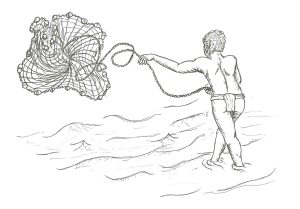
The Greek that is translated as “casting a net” in English has an immediate equivalent in Muna with buani: “to cast a (circular) net.” René van den Berg: “In this instance the Muna translation is possibly more graphic than the English, which leaves the nature of the net rather vague.”
This is illustrated for use in Bible translations in East Africa by Pioneer Bible Translators like this:
Image owned by PBT and Jonathan McDaniel and licensed with the Creative Commons Attribution 3.0 Unported License.
Kim Ki-chang (pen name: Unbo) (1913-2001) had been deaf and partially mute since the age of 7. He painted a series of 30 paintings for the “Life of Christ” cycle in 1952 during the Korean War. Kim portrayed Jesus as a seonbi / 선비, or a Joseon Period (1392-1910) gentleman scholar, wearing a gat / 갓 (hat) and dopo / 도포 (robe).
For other images of Kim Ki-chang art works in TIPs, see here.
Living Water is produced for the Bible translation movement in association with Lutheran Bible Translators. Lyrics derived from the ESV® Bible (The Holy Bible, English Standard Version®).



Leave a Reply
You must be logged in to post a comment.