Mark 8:31-33 in Russian Sign Language

Following is the translation of Mark 8:31-33 into Russian Sign Language with a back-translation underneath:


Source: Russian Bible Society / Российское Библейское Общество

Jesus began to teach the disciples and spoke openly to them:

— I am the son of God who became a man. I will have to suffer many things. The rulers, the chief priests and the teachers of the law have all rejected me, they hate me, they are plotting to kill me. I am to die, but three days afterward I will be alive again.

Jesus said this clearly and directly, but the disciples were surprised. One of the disciples, Peter, stood up and said to Jesus:

— Why do you speak like this? Do not say that you are going to die.

Jesus looked at the disciples and said to Peter:

— You are not thinking about God! You talk about what people think is important. Satan has put this into your head. Go away!

Original Russian back-translation (click or tap here):

Иисус начал учить учеников и говорил им открыто:

— Я, сын Бога, ставший человеком. Я должен буду много пострадать. Начальники, первосвященники и учителя закона — они все отвергли меня, они ненавидят меня, они замышляют убить меня. Мне предстоит умереть, но через три дня после этого я снова стану живым.

Иисус говорил об этом ясно и прямо, ученики же этому удивлялись. Один из учеников, Петр, встал подошел и сказал Иисусу:

— Зачем ты так говоришь? Не говори о том, что ты умрешь.

Иисус поглядел на учеников и сказал Петру:

— Ты не думаешь о Боге! Ты рассуждаешь о том, что люди считают важным. Сатана тебе внушил это. Уходи!

Back-translation by Luka Manevich

<< Mark 8:27-30 in Russian Sign Language
Mark 8:34-91 in Russian Sign Language >>
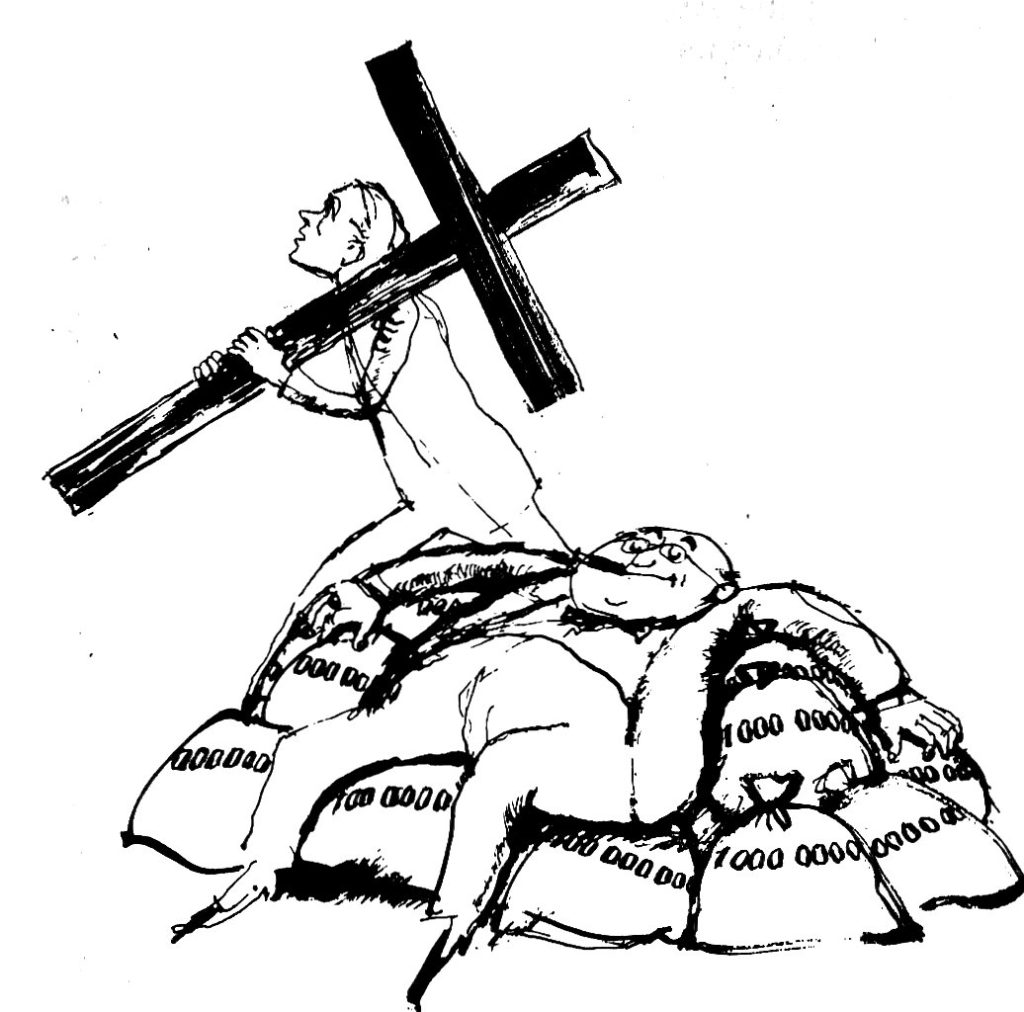
Son of Man

The Greek that is translated as “Son of Man” and is mostly used by Jesus to refer to himself is translated in the following languages as (click or tap for details):

  • San Miguel El Grande Mixtec: “One who is a person”
  • Tzotzil: “I who am equal with men” or “The Older Brother of Everybody” (“expressing the dignity and authority of the Messiah and the universality of his work”)
  • Chuj: “One who became human”
  • Terêna: “The True Man”
  • Tenango Otomi: “The Man Appointed” (i.e. the man to whom authority has been delegated) (source for this and preceding: Beekman, p. 189-190, see also Ralph Hill in Notes on Translation February 1983, p. 35-50)
  • Huehuetla Tepehua: “Friend of all men”
  • Aguaruna: “One who was born becoming a person” (source for this and two above: M. Larson / B. Moore in Notes on Translation February 1970, p. 1-125.)
  • Western Bukidnon Manobo: “Older Sibling of Mankind” (source: Western Bukidnon Manobo Back Translation)
  • Kankanaey: “Child of a Person” (source: Kankanaey Back Translation)
  • Tagbanwa: “One From Heaven Born of Man/human?” (source: Tagbanwa Back Translation)
  • Tenango Otomi: “Man who came from heaven” (source: Tenango Otomi Back Translation)
  • Yatzachi Zapotec: “One who God sent, who was born a human” (a direct translation would have suggested “that the father is unknown due to the indiscretions of the mother” and where “he is the son of people” is used when one wants to disclaim responsibility for or relationship with a child caught in some mischief — source: Reiling / Swellengrebel)
  • Kâte: Ŋic Fâri Wâtuŋne or “the man who is a true support” (source: Renck, p. 106)
  • Mezquital Otomi: “The son who became a person” (Source: B. Moore / G. Turner in Notes on Translation 1967, p. 1ff.)
  • Alekano: “The true man who descended from heaven” (source: Ellis Deibler in Notes on Translation June 1986, p. 36ff.)
  • Central Tarahumara: “One who has been stood up to help” (“This suggests that Christ has been given authority to some appointed task. A very generic word, help, was selected to fill in the lexically obligatory purpose required by the word which means to appoint or commission. Usually this word is used of menial tasks but not exclusively. The choice of this generic term retains the veiled reference to the character of Christ’s work which He intended in using the ‘Son of Man’ title.”)
  • Chicahuaxtla Triqui: “He who is relative of all people.” (“The Triqui word for relative is a rather generic term and in its extended sense sometimes is diluted to neighbor and friend. But the primary meaning is relative.”)
  • Xicotepec De Juárez Totonac: “Sibling of All People”
  • Tepeuxila Cuicatec: “The Person who Accompanies All People” (“The literal equivalents ‘son of man’ and ‘son of people’ were both rejected because of the false inference of natural birth involving a human father. Furthermore, it was necessary to expand any translation of the Bible by the addition of the pronoun ‘I’ so as to clarify the fact that Jesus is using the third person in referring to Himself. A common expression used by the Cuicatecos when difficulties befall someone, is to say to that one, ‘don’t worry, we are accompanying you.’ By this they mean they share that person’s sorrow. When wedding guests arrive at the home of a son who has just been married, they say to the father, ‘We have come to accompany you.’ By this they mean that they have come to share the father’s joy. These expressions do not refer to ordinary physical accompaniment, which is expressed by a set of different verbs. For example, visits are always announced by some such greeting as, “I have come to visit you,’ ‘I have come to see you,’ or ‘I have come to ask you something.’ The desire to accompany a friend on a journey is expressed by saying, ‘I will go with you.’ Translation helpers used the verb ‘accompany’ in constructing the phrase ‘I, the Person who Accompanies All People.'(…) It reflects the fact that Jesus closely identified Himself with all of us, understands our weaknesses, shares our burdens, rejoices with us in times of gladness, etc.”) (source for this and the three preceding: Beekman in Notes on Translation January 1963, p. 1-10)
  • Guhu-Samane: “Elder-brother-man” (“Since the term denotes an elder brother in every way such as honor, power, leadership, representation of the younger, etc. it is a meaningful and fitting — though not ostentatious — title.” Source: Ernest Richert in The Bible Translator 1965, p. 198ff. )
  • Avaric: “Son of Adam” (“from Islam, which means ‘human'”) (source: Magomed-Kamil Gimbatov and Yakov Testelets in The Bible Translator 1996, p. 434ff. )
  • Navajo (Dinė): Diné Silíi’ii — “Man he-became-the-one-who” (“This terra presented a difficulty not only in Navajo but also one peculiar to all the Athapaskan languages. It lies in the fact that all these languages, so far as we know, have a word phonetically similar to the Navajo diné which has three meanings: ‘man, people in general,’ ‘a man,’ ‘The People’ which is the name the Navajos use for themselves. (The name Navajo was first used by the Spanish explorers.) Although it seemed natural to say diné biye’ ‘a-man his-son,’ this could also mean ‘The-People their-son’ or ‘a-Navajo his-son,’ in contrast to the son of a white man or of another Indian tribe. Since the concept of the humanity of Christ is so important, we felt that diné biye’ with its three possible meanings should not be used. The term finally decided on was Diné Silíi’ii ‘Man he-became-the-one-who.’ This could be interpreted to mean ‘the one who became a Navajo,’ but since it still would impart the idea of Christ’s becoming man, it was deemed adequate, and it has proven acceptable to the Navajos.”) (Source: Faye Edgerton in The Bible Translator 1962, p. 25ff. )
  • Toraja-Sa’dan: “Child descended in the world” (“using a poetic verb, often found in songs that [deal with] the contacts between heaven and earth”) (source: Reiling / Swellengrebel)
  • Obolo: Gwun̄ Ebilene: “Child of Human” (source: Enene Enene).
  • Mairasi: Jaanoug Tat: “Person Child” (source: Enggavoter 2004)
  • Morelos Nahuatl: “Christ who became man”
  • Teutila Cuicatec: “One Who Accompanies all people”
  • Isthmus Mixe: “Jesus Christ, the one who is a person” (source for this and two above: Viola Waterhouse in Notes on Translation August 1966, p. 86ff.)
  • Northern Puebla Nahuatl: “Son of men” (source: B. Moore / G. Turner in Notes on Translation 1967, p. 1ff.)
  • Inga: ” . . .: “One who became Man” (source: S. Levinsohn in Journal of Translation 18/2022, p. 67ff. )
  • Costa Rican Sign Language: “It was impossible to translate the expression ‘Son of Man.’ The son-man sign simply means ‘male child.’ The Costa Rican Sign Language (LESCO) team opted for an interpretation of the term and translated it ‘Jesus.'” (Source: Elsa Tamez (in The Bible Translator 2008, p. 59ff. )
  • Lokạạ: wẹẹn wạ ọnẹn or “son of a person.” “This translation is symbolic in that it uses indigenous Lokạạ words. However, since the publication of the New Testament in 2006, this phrase has gained popularity within contemporary Lokạạ society as an expression to describe an important person whose career is going well. In the New Testament, the phrase ‘son of man’ is used to describe Jesus as prototypically human, but the Lokạạ phrase is now being used to describe an exceptional person in Lokạạ society.” (Source: J.A. Naudé, C.L. Miller Naudé, J.O. Obono in Acta Theologica 43/2, 2023, p. 129ff. )

In many West African languages, using a third person reference as a first person indicator is common practice with a large range of semantic effects. Languages that use the exact expression “son of man” as a self-reference or reference to another person include Lukpa, Baatonum, Mossi (“son of Adam”), Yoruba (“son of person”), Guiberoua Béte, or Samo. (Source: Lynell Zogbo in: Omanson 2000, p. 167-188.)

In Swahili the expression Mwana wa Mtu or mwana wa mtu or “son/daughter of human person,” which is used by several Bible translations, also has “the idiomatic meaning of ‘a human being’” (source: Jean-Claude Loba-Mkole in An Intercultural Criticism of New Testament Translations 2013, see here). The same is true for the Lingala expression Mwana na Moto — “son/daughter of human person.” (Ibid.)

In Balinese “we are again bordering on theological questions when we inquire as to which vocabulary shall be used to translate the texts where Jesus speaks of himself as ‘the Son of man.’ One of the fixed rules governing the use of these special vocabularies is that one may never use the deferential terms in speaking of oneself. This would be the extreme of arrogance. Now if one considers the expression ‘Son of man’ primarily as a description of ‘I,’ then one must continually indicate the possessions or actions of the Son of man by Low Balinese words. In doing this the mystery of the expression is largely lost. In any case the vocabulary used in most of the contexts would betray that Jesus means the title for himself.

“However, a distinction can actually be made in Balinese between the person and the exalted position he occupies. For example, the chairman of a judicial body may employ deferential terms when referring to this body and its chairman, without this being taken as an expression of arrogance. Considered from this standpoint, one may translate in such a way that Jesus is understood as using such deferential words and phrases in speaking of himself. The danger is, however, that the unity between his person and the figure of “the Son of man” is blurred by such usage.

“On request, the New Testament committee of the Netherlands Bible Society advised that ‘the sublimity of this mysterious term be considered the most important point and thus High Balinese be used.'”

Source: J.L. Swellengrebel in The Bible Translator 1950 , p. 124ff.

In Malay, Barclay Newman (in The Bible Translator 1974, p. 432ff. ) reports on the translation of “Today’s Malay Version” (Alkitab Berita Baik) of 1987:

“One of the first things that we did in working through the earlier part of the New Testament was to decide on how we would translate some of the more difficult technical terms. It was immediately obvious that something must be done with the translation of ‘the Son of Man,’ since the literal rendering anak manusia (literally ‘child of a man’) held absolutely no meaning for Malay readers. We felt that the title should emphasize the divine origin and authority of the one who used this title, and at the same time, since it was a title, we decided that it should not be too long a phrase. Finally, a phrase meaning ‘the One whom God has ordained’ was chosen (yang dilantik Allah). It is interesting to note that the newly-begun Common Indonesian (Alkitab Kabar Baik, published in 1985) has followed a similar route by translating ‘the One whom God has chosen’ (yang depilih Allah).”

In Libras (Brazilian Sign Language) it is translated with a sign that brings together three concepts: God, Son and human. (Source: Missão Kophós )


“Son of Man” in Libras (source )

See also Son of God.

See also Translation commentary on Matthew 8:20 and learn more on Bible Odyssey: The Son of Man .

complete verse (Mark 8:31)

Following are a number of back-translations of Mark 8:31:

  • Uma: “After that, Yesus began to teach his disciples who must happen to him. He said to them: ‘I the Child of Mankind must get much suffering. The village elders, leading priests and the religion teachers will repudiate me. They will kill me, but three days after that I will come back alive.'” (Source: Uma Back Translation)
  • Yakan: “Na, Isa began to teach his disciples about himself. ‘I,’ he said, ‘the Son of Mankind, I have to endure/suffer much persecution and I will not be recognised/accepted by the elders and the leaders of the priests and the teachers of the religious law. I will be killed and after three days (bahangi) I will be alive again.'” (Source: Yakan Back Translation)
  • Western Bukidnon Manobo: “Then Jesus taught his disciples, he said, ‘I, the older brother of mankind, there are many tortures that I will be caused to suffer. I will be rejected by the elders of the Jews, and the Pharisees, and the teachers of the law. They will kill me and in three days from then I will rise again.'” (Source: Western Bukidnon Manobo Back Translation)
  • Kankanaey: “Then Jesus began to make-clear to his disciples what would happen to him in the future (lit. addition of days). He said, ‘I who am Child of a Person, it is necessary that I undergo much hardship/suffering. The elders (lit. fathers) and the leaders of the priests and the teachers of the law, they will reject me and they will have-me-killed, but I will come-alive again on the third day.'” (Source: Kankanaey Back Translation)
  • Tagbanwa: “Without anything further, Jesus began to make known to his disciples that, as for him who was the One From Heaven Born of Man/human, he would experience very-many hardships. He would be insulted/belittled by the important tribal-leaders, the chiefs of the priests and the explainers of law, and he would even be killed. But on the third day, he would indeed be made alive again.” (Source: Tagbanwa Back Translation)
  • Yagaria: “And then he began to tell them thus: ‘The Great Man will suffer great pain, and the overseers and the great religion leaders and the preachers will turn their backs on him, and will kill him, and he will die, and after three days he will become alive again, and rise.'” (Source: Renck, p. 94)

Honorary "rare" construct denoting God (“start”)

Click or tap here to see the rest of this insight.

Like a number of other East Asian languages, Japanese uses a complex system of honorifics, i.e. a system where a number of different levels of politeness are expressed in language via words, word forms or grammatical constructs. These can range from addressing someone or referring to someone with contempt (very informal) to expressing the highest level of reference (as used in addressing or referring to God) or any number of levels in-between.

One way Japanese shows different degree of politeness is through the usage of an honorific construction where the morpheme rare (られ) is affixed on the verb as shown here in the widely-used Japanese Shinkaiyaku (新改訳) Bible of 2017. This is particularly done with verbs that have God as the agent to show a deep sense of reverence. Here, hajime-rare-ru (始められる) or “start” is used.

(Source: S. E. Doi, see also S. E. Doi in Journal of Translation, 18/2022, p. 37ff. )

Translation commentary on Mark 8:31

Exegesis:

dei (9.11; 13.7, 10, 14; 14.31) ‘it is necessary,’ ‘it is needed’: the verb denotes compulsion of some sort. What this compulsion is only the total context can indicate. A translation should not convey the idea that an impersonal fate or destiny is the determining factor, as though ‘the Son of man is fated to….’ Rather this is the God-appointed mission of the Son of man. Lagrange: une nécessité, imposée d’en haut.

ton huion tou anthrōpou (cf. 2.10) ‘the Son of man.’

polla pathein (cf. 5.26) ‘to suffer much’ (Translator’s New Testament) or ‘to suffer many things’ (Revised Standard Version).

apodokimasthēnai (12.10) ‘be rejected,’ ‘be spurned.’

hupo tōn presbuterōn kai tōn archiereōn kai tōn grammateōn (cf. 7.3) ‘by the elders and the chief priests and the scribes’: the three groups which composed the Sanhedrin (cf. Lagrange).

hoi presbuteroi (cf. 7.3) ‘the elders’: these were laymen.

hoi archiereis (10.33; 11.18, 27; 14.1, 10, 43, 53, 55; 15.1, 3, 10, 11, 31; cf. 2.26) ‘the chief priests’: high priests, present and past, and members of the high-priestly families in Jerusalem.

hoi grammateis (cf. 1.22) ‘the scribes,’ ‘the interpreters of the Law.’

apoktanthēnai (cf. 3.4) ‘to be killed.’

meta treis hēmeras (9.31; 10.34; cf. dia triōn hēmerōn 14.58; en trisin hēmerais 15.29) ‘after three days’: as Field has abundantly demonstrated meta treis hēmeras means ‘on the third day after this one,’ what we should call ‘the day after tomorrow,’ meaning exactly the same thing as tē tritē hēmera ‘on the third day’ in Matthew and Luke.

anastēnai (cf. 1.35) ‘rise’: here meaning ‘rise again,’ ‘rise from the dead.’ With this meaning the verb anistēmi appears in the active voice further in 9.9, 10, 31; 10.34; 12.23; 16.9 (for egeirō ‘rise’ with this meaning in Mark – 7 times – cf. 1.31).

Translation:

Teach them that … may require adjustment to the direct form, ‘teach them, The Son of man….’

For Son of man see 2.10, but note also that in languages in which one cannot speak of himself in the third person, it is usually necessary to add ‘I,’ e.g. ‘teach them, I who am the Son of man….’ Without such an addition the only alternative for the reader is to assume that Jesus was speaking about someone other than himself.

Suffer many things may be, as in Tzeltal, ‘go through much trouble.’ In other languages the equivalent may be ‘endure much pain’ or ‘hurt much’; cf. Toraja-Sa’dan ‘feel much pain’; Indonesian ‘taste much suffering’; Batak Toba ‘his suffering would be great.’

In some languages there are problems resulting from the fact that the shifts from active (suffer) to passive (be rejected and be killed) and back again to active (rise again) cannot be employed in a single sentence. This may mean either changes from passives to actives, with resulting problems of shifts in subject expressions, or the splitting of this sentence into several clause units, e.g. ‘he began to teach them, The Son of man must suffer much. The elders and the chief priests and the scribes will repudiate him and kill him. On the third day he will come to life again.’

The elders are either ‘the old men’ or ‘the important men.’ In most languages there are convenient terms for the elder statesmen – the counselors of the tribes and henchmen of the chief; so Toraja-Sa’dan ‘those to whom one says father.’

For priests see 1.40. The chief priests are ‘the important priests,’ ‘the big priests,’ or ‘the priests who have the power.’ For scribes see 1.22.

Rejected may be translated as ‘repudiated,’ ‘denounced,’ or ‘refused,’ depending upon the closest cultural equivalent.

Rise again cannot be translated literally in many languages, for the meaning is essentially figurative, i.e. ‘to come to life again,’ ‘to live again,’ or ‘to arise from among the dead.’

Quoted with permission from Bratcher, Robert G. and Nida, Eugene A. A Handbook on the Gospel of Mark. (UBS Handbook Series). New York: UBS, 1961. For this and other handbooks for translators see here .

SIL Translator's Notes on Mark 8:31

Section 8:31–33

Jesus told his disciples that he must suffer, die, and live again

In the preceding section, Peter declared that Jesus was the Messiah, the Christ. In this section, Jesus explained to the disciples what would happen to him as the Messiah. In contrast to what the disciples thought that Jesus would do as their Messiah, God had planned for him to suffer, die, and live again.

It is good to translate this section before you decide on a heading for it.

Here are some other possible headings for this section:

Jesus tells his disciples about his coming death and resurrection
-or-
Jesus told his disciples that people would kill him but he would live again after three days
-or-
Jesus speaks about his death

There are parallel passages for this section in Matthew 16:21–23 and Luke 9:22–23.

Paragraph 8:31–33

8:31a

Then: In Greek, this verse begins with the common conjunction that is often translated as “and.” The Berean Standard Bible translates it as Then. However, some English versions, such as the New International Version, do not translate this conjunction. In this context it introduces what Jesus did next. Connect this verse to 8:30 in a natural way in your language.

He began to teach them: The phrase He began to teach them indicates that Jesus began to teach his disciples about a new topic. Because this is the start of a new section and a new paragraph, it may be natural to refer explicitly to Jesus and his disciples:

Jesus began to teach his disciples

8:31b

that the Son of Man must suffer many things: The Greek clause that the Berean Standard Bible translates as the Son of Man must suffer is literally “it is necessary for the Son of Man to suffer.” This statement implies that the suffering was necessary because it was God’s will or plan. It was something that must happen that was beyond the control of human beings.

the Son of Man: The Greek phrase that the Berean Standard Bible translates as the Son of Man is literally “the Son of the human/person.” Jesus used this phrase as a title for himself. He used this title to imply that:

(a) he was a true human being, and he represented all people.

(b) he came from God and had authority from God.

Try to use an expression that implies both meanings. Here are some other expressions that translators have used:

the Man whom God Sent
-or-
the True Man from God/Heaven
-or-
the Representative of Mankind
-or-
The Older Brother of All People

In some cases, an unusual title may correctly suggest a deeper meaning. For example:

the Child of a Person
-or-
the One who was Born as a Human

Translators have also used expressions that are more literal. These more literal expressions may be appropriate where readers are familiar with a literal title in another version.

In some languages it may be necessary to use a form like “I” or “me” to indicate that Jesus was referring to himself. For example:

me, the Son of Man
-or-
who became man/human

See how you translated Son of Man at 2:10a and 2:28.

must: The Greek word that the Berean Standard Bible translates as must applies to all the following verbs in this verse: “suffer,” “be rejected,” “be killed,” and “rise again.” The verb indicates that it was necessary for all these things to happen because God had planned for them to happen. Be sure to indicate that in some way in your language.

suffer many things: In this context the Greek word that the Berean Standard Bible translates as suffer many things indicates that Jesus would have to suffer in various ways. It also implies that the suffering was terrible and was not just for a short time.

Here are some other ways to translate this phrase:

suffer a lot (God’s Word)
-or-
undergo many sufferings
-or-
suffer many terrible things (New Living Translation)

8:31c

be rejected: To be rejected means to “(someone) refuses to accept (something).” In this verse it means that the groups of Jewish leaders would refuse to believe that Jesus was their Messiah.

by the elders, chief priests, and scribes: These three groups together represented all the leaders of the Jews. The elders were the civil leaders or rulers. They were generally older men. The chief priests were the leading priests, and the scribes were the experts in the religious law.

chief priests: A Jewish priest was a man who offered sacrifices to God on behalf of the people. He also performed other rituals for them. The phrase the…chief priests refers to the leaders among these priests.

Here are some other ways to translate chief priests:

the leading/ruling priests
-or-
the elders among the Jewish sacrificers
-or-
the most prominent priests

See how you translated “priest” in 1:44b.

scribes: The Greek word that the Berean Standard Bible translates as scribes is sometimes translated as “teachers of the law,” as in the New International Version. The original work of these men was to copy the laws of Moses by hand. In New Testament times, their main task was to study, interpret, and teach the law of Moses and related Jewish laws and traditions.

Here are some other ways to translate this term:

the teachers of the Law of Moses (Contemporary English Version)
-or-
the teachers of religious law (New Living Translation)
-or-
the experts in the law (NET Bible)

See how you translated this in 1:22c and 7:5a. Also, see teacher of the law in the Glossary for more information.

8:31d

He must be killed: This is a passive clause. The pronoun He refers to Jesus as the Son of Man, and the focus is still on him. In some languages it may be necessary to use an active verb. If this is true in your language, you may have another way to indicate that the focus is on Jesus. For example:

he must die by the hand/action of men
-or-
it must happen that people will kill him

killed: The Greek verb that the Berean Standard Bible translates as killed means “to cause a person to die.” In this context people would kill Jesus. They would execute him, though he had done nothing wrong. Use an appropriate verb for this in your language. For example, the Good News Bible and New Jerusalem Bible say:

put to death

8:31e

and after three days: The expression after three days refers to three days after Jesus’ death. The Jews counted any part of a day as a whole day. The day on which Jesus died was counted as one day. The complete day that he was in the tomb was counted as the second day. The part of the day before he rose from the dead was counted as the third day.

rise again: The phrase rise again refers to the Son of Man (Jesus) becoming alive again after he died. Be sure that the expression you use does not imply that Jesus did not really die but revived after almost dying. Use an expression that clearly refers to literal death and to a real return to life.

Here are some other ways to translate rise again:

he will rise to life (Good News Bible)
-or-
and then rise from the dead (New Century Version)

In some languages it will not be possible to use a word such as “rise,” because it may refer only to standing up.

Here are some other ways to translate the correct meaning:

he will live again
-or-
he will become alive again

Use an expression that communicates this meaning clearly in your language.

General Comment on 8:31a–c

It may be more natural in your language to put what Jesus taught his disciples into direct speech, as the Good News Bible has done:

Then Jesus began to teach his disciples: “The Son of Man must suffer much and be rejected by the elders, the chief priests, and the teachers of the Law. He will be put to death, but three days later he will rise to life.”

© 2008 by SIL International®

Made available under the terms of a Creative Commons Attribution-ShareAlike 4.0 License (CC BY-SA) creativecommons.org/licenses/by-sa/4.0

All Scripture quotations in this publication, unless otherwise indicated, are from The Holy Bible, Berean Standard Bible.
BSB is produced in cooperation with Bible Hub, Discovery Bible, OpenBible.com, and the Berean Bible Translation Committee.