
The Greek that is translated as “tomb” in English is translated in the German New Testament translation by Berger / Nord (publ. 1999) as Felsengrab or ” tomb hewn out of rock” at every first mention in each of the gospels.
taking down the body (image)
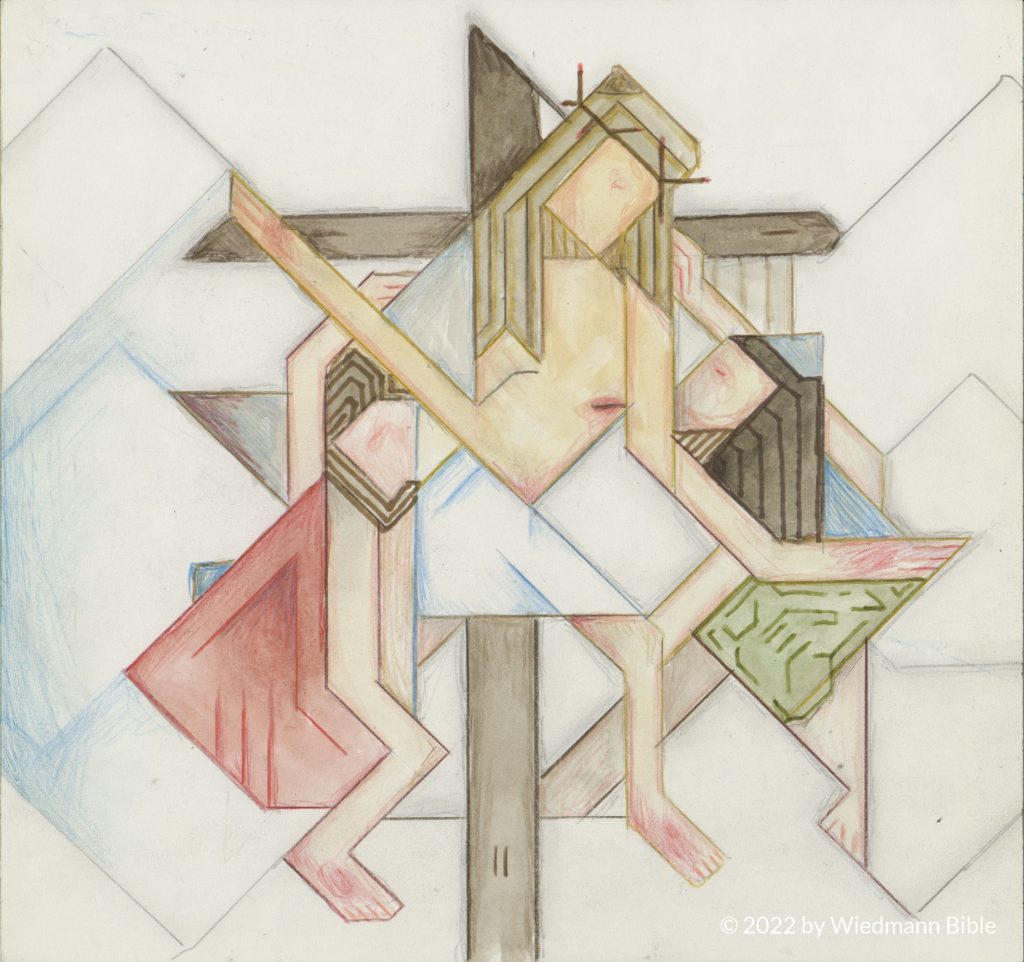
Image taken from the Wiedmann Bible. For more information about the images and ways to adopt them, see here .
For other images of Willy Wiedmann paintings in TIPs, see here.
Following is a hand colored stencil print on momigami by Sadao Watanabe (1980):
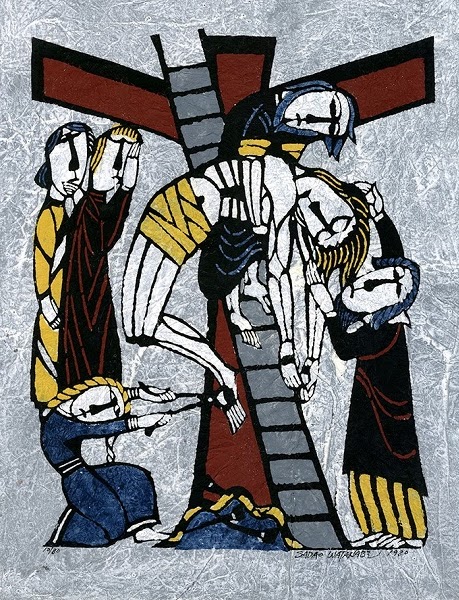
Image taken with permission from the SadaoHanga Catalogue where you can find many more images and information about Sadao Watanabe.
For other images of Sadao Watanabe art works in TIPs, see here.
Descent from the Cross (icon)
Following is a contemporary Ukrainian Orthodox icon of Christ’s descent from the cross by Kateryna Shadrina.
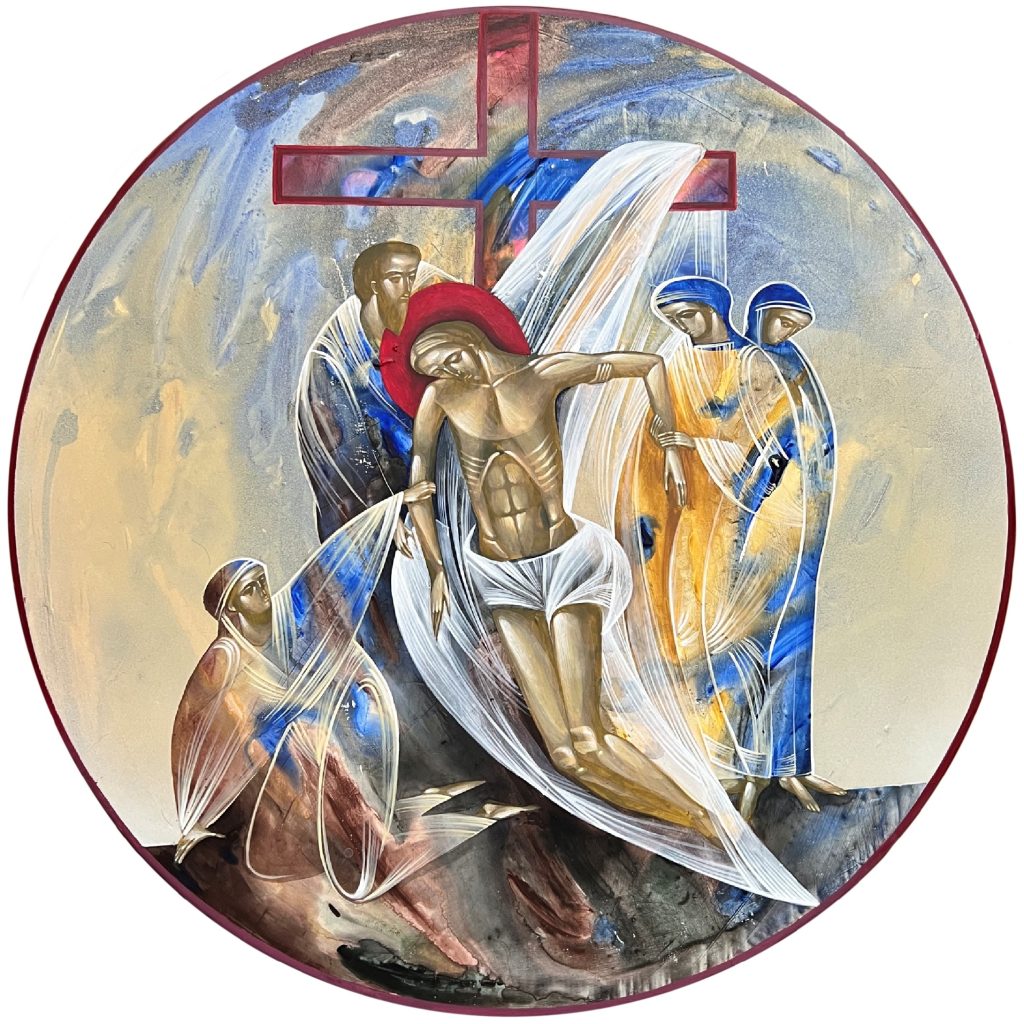
Orthodox Icons are not drawings or creations of imagination. They are in fact writings of things not of this world. Icons can represent our Lord Jesus Christ, the Virgin Mary, and the Saints. They can also represent the Holy Trinity, Angels, the Heavenly hosts, and even events. Orthodox icons, unlike Western pictures, change the perspective and form of the image so that it is not naturalistic. This is done so that we can look beyond appearances of the world, and instead look to the spiritual truth of the holy person or event. (Source )
For purchasing artworks by Kateryna Shadrina go to IconArt Gallery .
Mark 15:42 - 47 in Mexican Sign Language
Following is the translation of Mark 15:42-47 into Mexican Sign Language with back-translations into Spanish and English underneath:
© La Biblia en LSM / La Palabra de Dios
Retrotraducciones en español (haga clic o pulse aquí)
Segun el costumbre de los judíos el sábado era el día de descanso y las persona siempre lo preparaban antes, el viernes en la tarde.
Un hombre, José, un anciano y líder superior del lugar de Arimatea, creía, deseaba y esperaba que viniera el reino de Dios.
El viernes en la tarde este mismo hombre, José de Arimatea en fe fue ante el gobernador romano y dijo a Pilato: “¿Puedo obtener permiso para llevar el cuerpo de Jesús?”
Pilato estaba sorprendido que Jesús ya estaría muerto. (Dijo): “Un momento” y llamó a que viniera el capitán romano. Cuando se había acercado (preguntó): “¿Jesús ya está muerto?” El capitán (dijo): “Si está muerto.”
Pilato (dijo): “Sí, tienes permiso, vete” y José de Arimateo se fue a comprar sábanas finas y después fue a Jesús, colgado en la cruz, y José tendió las sábanas y bajó el cuerpo de Jesús y lo envolvió en las sábanas y lo llevó.
Allá antes había un acantilado y habían cavado uns entrada para una tumba.
José de Arimatea, cargando el cuerpo, entró y tendió el cuerpo y salió y rodó una piedra grande tapando (la entrada de la tumba).
Ambas las mujeres María Magdalena y María lo vieron.
According to the custom of the Jews Saturday was a day of rest and the people always prepared before, Friday afternoon.
A man, Joseph, an elder and prominent leader from the place of Arimathea, believed in, and desired and waited for the coming of the kingdom of God.
On Friday afternoon this same man, Joseph of Arimathea, in faith went before the roman governor and said to Pilate: “Could I have permission to take the body of Jesus?”
Pilate was surprised that Jesus would already be dead. (He said): “Just a moment” and called the roman captain to him. When he had approached him (he asked): “Is Jesus already dead?” and the captain (said): “Yes, he is dead.”
Pilate (said): “Yes, you have permission, off you go” and Joseph of Arimathea went to buy fine sheets and afterwards went to Jesus hanging on the cross, and Joseph spread out the sheets and took down the body of Jesus and wrapped it in the sheets and carried it away.
There was a rock there into which they had dug an entrance for a tomb.
Joseph of Arimathea, carrying the body, went int and lay down the body and went out, and he rolled a big stone covering (the entrance to the tomb).
Both women, Mary of Magdalene and Mary, saw it.
Source: La Biblia en LSM / La Palabra de Dios
<< Mark 15:33-41 in Mexican Sign Language
Mark 16:1-9 in Mexican Sign Language >>
Mark 15:33-47 in Russian Sign Language
Following is the translation of Mark 15:33-47 into Russian Sign Language with a back-translation underneath:
Source: Russian Bible Society / Российское Библейское Общество
At noon it became as dark as night over the whole land. The darkness lasted until three o’clock in the afternoon. Jesus on the cross cried out loudly:
— My God, my God, why have you forsaken me?
There were people near the cross. Some people began to say that Jesus was probably calling the prophet Elijah to come. One man came up, took a sponge, soaked it in vinegar. He pierced it with a stick and brought it to Jesus’ face for Jesus to drink. This man said,
— Now let’s see if the prophet will come and take Jesus down from the cross.
Jesus on the cross cried out loudly and died. His head drooped. Inside the temple there is a curtain. And this curtain, at the moment Jesus died, was torn in two. Near the cross stood a Roman general, a commander over a hundred soldiers. He saw Jesus die. And this general said,
— Truly, Jesus was the son of God!
There were also many women standing there, looking at the cross and Jesus from afar. Among them were three women: Mary Magdalene, another Mary, who was the mother of James and Joses, and Salome. They had always followed Jesus before, served him, helped him when he was in Galilee. There were many other women. They had followed Jesus to Jerusalem before.
The evening was approaching. It was Friday. It was ending, and soon after that the Sabbath would begin. There was a man named Joseph, he lived in the city of Arimathea. And he was not an ordinary man, he was a member of the Supreme Court, and he himself was waiting for the imminent coming of the Kingdom of God. He gathered his courage and went to Pilate. Joseph decided to ask Pilate for permission to take the body of Jesus, wrap it in clothes, and bury it right now, before the Sabbath. Joseph came to Pilate and turned to him:
— Let me take the body of Jesus and bury it.
Pilate was very surprised:
— How? Jesus has already died?
Pilate called the Roman commander and asked:
— Has Jesus already died? When was that?
The commander answered:
— Yes, Jesus has already died.
Pilate gave permission to take the body. Joseph bought and prepared a large cloth for wrapping, came to the cross, took down the body of Jesus, wrapped it and carried it to the rock, inside which a tomb had been made. There he laid the body, and blocked the entrance with a large stone. Nearby were two women, Mary Magdalene and Mary, who was the mother of Joses. And they looked at everything and saw how they buried Jesus and where.
Original Russian back-translation (click or tap here):
В полдень по всей земле стало темно, как ночью. Тьма продолжалась до трех часов дня. Иисус на кресте громко воскликнул: «Бог мой, Бог мой, почему ты меня оставил?» Возле креста были люди. Некоторые люди стали говорить, что, наверное, Иисус зовёт пророка Илию, чтобы он пришел. Один человек подошел, взял губку, намочил её в уксусе. Палкой проткнул ее и поднёс к лицу Иисусу, чтобы Иисус выпил. Этот человек сказал:
— Сейчас посмотрим, придет ли пророк и снимет ли Иисуса с креста?
Иисус на кресте громко вскрикнул и умер. Голова его поникла. В храме внутри есть завеса. И эта завеса, в тот момент, когда Иисус умер, разорвался на две части. Возле креста стоял один римский военачальник, командир над ста воинами. Он видел, как Иисус умер. И этот военачальник сказал:
— Воистину, Иисус он был сыном Божьим!
Также там стояло много женщин, которые издали смотрели на крест и Иисуса. Среди них были три женщины: Мария Магдалина, еще одна Мария, которая была мать Иакова и Иосета, а также Саломея. Они раньше всегда следовали за Иисусом, служили, помогали ему, когда он был в Галилее. Ещё были многие другие женщины. Они раньше последовали за Иисусом в Иерусалим.
Приближался вечер. Это была пятница. Она кончалась, скоро после этого начиналась суббота. Был один человек именем Иосиф, он жил в городе Аримафея. И он был непростым человеком, он был членом Верховного суда, и он сам ждал скорого наступления Царства Бога. Он набрался смелости пришел к Пилату. Иосиф решил попросить у Пилата разрешение забрать тело Иисуса, запеленать его, чтобы похоронить прямо сейчас, до наступления субботы. Иосиф пришел к Пилату и обратился к нему:
— Разреши мне забрать тело Иисуса и похоронить его.
Пилат очень удивился:
— Как? Иисус уже умер?
Пилат позвал римского военачальника и спросил:
— Что, Иисус уже умер? Когда это было?
Военачальник ответил:
— Да, Иисус уже умер.
Пилат разрешил забрать тело. Иосиф купил и приготовил большую ткань для пеленания, пришел к кресту, снял тело Иисуса, запеленал и отнес его к скале, внутри которой была сделана гробница. Там оно положил тело, а вход загородил большим камнем. Недалеко были две женщины, это Мария Магдалина и Мария, которая мать Иосета. И они на все смотрели и видели, как похоронили Иисуса и где.
Back-translation by Luka Manevich
<< Mark 15:16-32 in Russian Sign Language
Mark 16:1-8 in Russian Sign Language >>
complete verse (Mark 15:46)
Following are a number of back-translations of Mark 15:46:
- Uma: “Yusuf bought white cloth to use as a burial-item for him. He took his body off the cross and wrapped it with the cloth. After that he put it in a grave that was dug into the side of a rock mountain, and he rolled a rock to close up the door of the grave.” (Source: Uma Back Translation)
- Yakan: “So-then Yusup bought white-cloth (kakana’) and after he had taken Isa down from the post, he shrouded him with the white-cloth. Then he laid him in a burial cave, a hollowed out stone. Then he rolled a stone to close-off the entrance of the cave.” (Source: Yakan Back Translation)
- Western Bukidnon Manobo: “Joseph bought a white banket and took the body of Jesus and wrapped it in the blanket. There was a burial cave cut out of a limestone cliff. He put the body of Jesus there, and he rolled a large stone to cover the grave.” (Source: Western Bukidnon Manobo Back Translation)
- Kankanaey: “That being so, Jose went to go buy white cloth. Then he went and lowered Jesus’ body from the cross, and he wrapped it in that-aforementioned cloth, after which he placed-(it)-in a cave that was chipped-from rock. That being finished, he rolled a large stone in order that the cave would be closed (lit. doored).” (Source: Kankanaey Back Translation)
- Tagbanwa: “Therefore Jose went-and-bought first-class cloth. And then having removed the body of Jesus from the cross, he wrapped it in that. He put it in a grave which was hollowed out of rock. After-laying- Jesus -out inside, he caused a big rock to be rolled to block off the mouth of that grave.” (Source: Tagbanwa Back Translation)
flax / linen
Flax Linum usitatissimum, from which linen cloth is made, was cultivated in the Middle East, including Canaan, at least as early as 5000 B.C. A document from Gezer (in Israel) from around King Saul’s time (1000 B.C.) refers to the cultivation of flax and states that flax and wool were the main materials for making cloth. According to Joshua 2:6, the Israelite spies were hidden under flax stalks by Rahab. Flax was grown extensively in Egypt and made into cloth and mats.
Pesheth and pishtah are probably the original Hebrew words for flax, if indeed the plant was domesticated in the Holy Land, as Zohary (Plants of the Bible. Cambridge University Press, 1982) proposes. They may be related to the word pashat, meaning “to strip off” or “to flay,” or to the word pasas, meaning “to disintegrate.” Pesheth and pishtah are used twenty times in the Old Testament, twice referring clearly to the plant itself (Exodus 9:31; Joshua 2:6). Other references are to the processed flax (Judges 15:14 et al.). A few cases refer to finished products, namely wicks (Isaiah 42:3 et al.), cords (Ezekiel 40:3), and items of clothing (Jeremiah 13:1 et al.).
It is likely that the Hebrews acquired the word shesh from the Egyptians during their sojourn in Egypt, since flax was cultivated there also. The Egyptian word for flax was shent (via shen-suten). Shesh is used thirty-eight times in the Old Testament: for the material that Pharaoh put on Joseph, for the Tabernacle curtains and hangings in Exodus, for the ephod, and for the priests’ tunics. The wise woman of Proverbs 31:22 wears it. In Ezekiel 16:10 et al. it is paired with silk, and in Ezekiel 27:7 “shesh from Egypt” is spoken of as material for the sails of ships.
Several references to linen use the Hebrew word bad. In Exodus 28:42 the priests’ underwear are made from bad, and it is used thereafter in Leviticus to describe various items of clothing—coat, breeches, girdle, and turban. It turns up again in Samuel’s and King David’s “ephods” and then again in Ezekiel and Daniel, where we see visions of “a man clothed in bad.”
Linen is referred by the Hebrew word buts in 1‑2 Chronicles, Esther, and Ezekiel, where the robes of the Temple choir, kings, and rich men are described.
The Old Testament has some references to the Hebrew word sadin (“linen garment”): Judges 14:12 (Samson promises them to his opponents), Proverbs 31:24 (the wise woman makes them), and Isaiah 3:23 (the rich women of Jerusalem wear them). The Septuagint uses the Greek word bussos or sindōn in these passages.
The Hebrew word ’etun occurs only in Proverbs 7:16, where it refers to a linen bedspread from Egypt.
In the New Testament there are three primary Greek words for linen: linon/linous, sindōn, and othonē/othonion. Linon is used to refer to garments of the angels in Revelation 15:6 as well as to the “smoldering wick” in Matthew 12:20. The synoptic Gospel writers refer to the linen cloth that Joseph and Nicodemus used to wrap Jesus’ body as a sindōn. Mark uses the same word to refer to the cloth that was worn by the unidentified young man at the time of Jesus’ arrest (Mark 14:51f.). John uses a different Greek word for Jesus’ burial cloths: othonion.
The rich man referred to in the Lazarus story (Luke 16:19) is clothed in “fine linen” (bussos). The Greek word bussos is the root word for bussinos, which refers to tunics, robes and turbans made from linen fabric (Revelation 18:12 et al.).
Flax is a little taller than a sesame plant, about a meter (3 feet) tall. Its leaves are narrow and the flowers are bright blue with five petals. The seed capsule contains oil that is used for cooking and also for thinning paint. After flax ripens, the plants are uprooted and the stalks are left to dry for a while. The stalks are then soaked, dried, and beaten to separate the fibers, which are then combed and woven into cloth.
Linen cloth was relatively costly in Israel, and being light and easy to dye it was highly valued. Their priests wore linen garments to combat sweating (see Ezekiel 44:18). They had to remove these holy garments when they left the Temple, “lest they communicate holiness to the people” (Ezekiel 44:19). The high esteem given to linen by the Jews is shown also by the fact that they used it for burying the dead, and we are told that the Dead Sea Scrolls were wrapped in linen cloths. However, the flax plant was special in other ways. The crushed stalks of flax plants were also used for making rope and lamp wicks. The seed was used for oil.
Today flax is raised more for the oil that comes from the seeds (called linseed oil) than for the fibers, although flax stalks are also made into special kinds of paper.
Metaphorical uses of flax are relatively few in the Bible, and all suggest the weakness of the material. In Judges 15:14 flax fiber is used as a simile for Samson’s fetters (they snapped like linen thread). Isaiah 42:3 says the Messiah will be gentle with weak people (“a dimly burning wick [pishtah] he will not quench”), in contrast to the typical iron-fisted tyrants of the day. Isaiah 43:17 describes the fate of the Babylonian enemies: they will be snuffed out “like a wick [pishtah].”
Linen cloth (or other cloth with a similar name) is surprisingly widespread. Cloth merchants in the translators’ area may know it under a trade language name, and if so, that can be used.In some places it is used only for burying people. In that case, if it is used in translation at all, the difference in culture should be explained in a footnote. Since linen is bleached white, a generic phrase such as “beautiful white cloth” can be considered in many places. In the three metaphorical passages mentioned above, an appropriate cultural image may be substituted, or an adverb expressing weakness or fragility.


Source: Each According to its Kind: Plants and Trees in the Bible (UBS Helps for Translators)
Se also linen.
Leave a Reply
You must be logged in to post a comment.