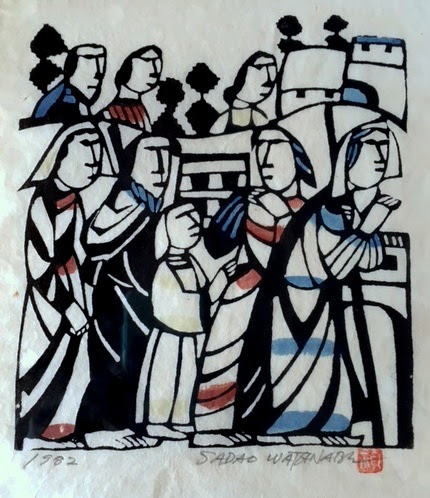
Hand colored stencil print on washi by Sadao Watanabe (1982).
Image taken with permission from the SadaoHanga Catalogue where you can find many more images and information about Sadao Watanabe. For other images of Sadao Watanabe art works in TIPs, see here.
Image taken from He Qi Art . For purchasing prints of this and other artworks by He Qi go to heqiart.com . For other images of He Qi art works in TIPs, see here.
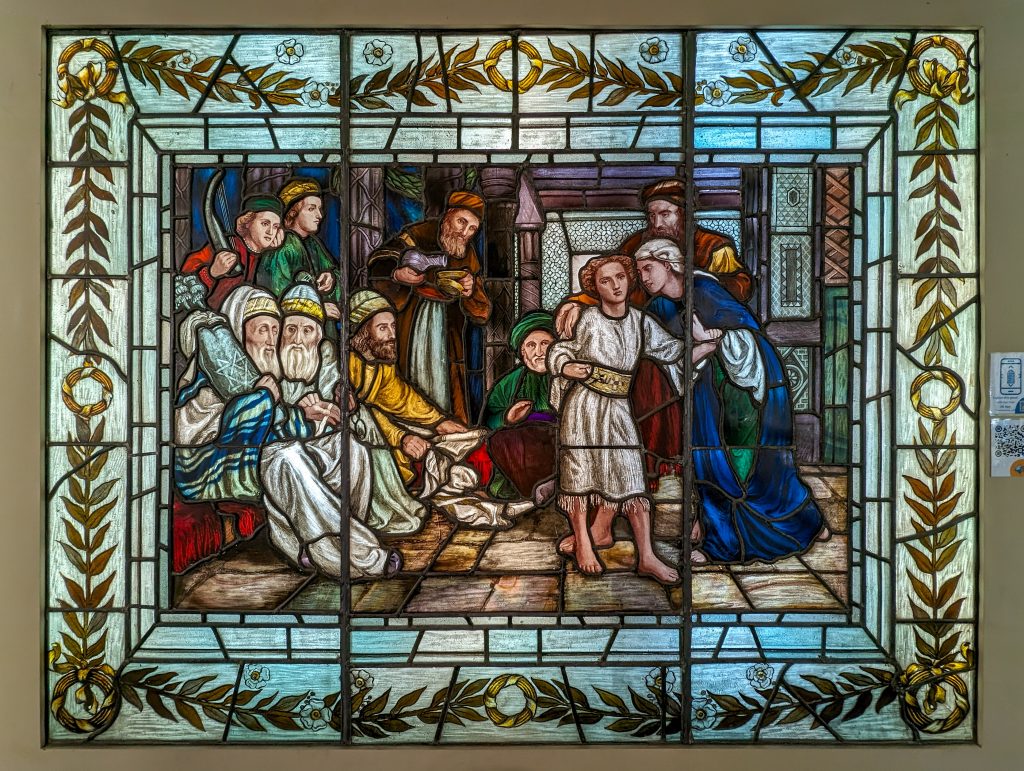
The following is a stained glass window from Mary Lowndes after William Holman Hunt, made by Lowndes and Drury, 1910. From St Martin & All Saints Church, Oxford:
Photo by the wub, hosted by Wikimedia Commons under a Creative Commons CC0 1.0 Universal Public Domain Dedication license
Stained glass is not just highly decorative, it’s a medium which has been used to express important religious messages for centuries. Literacy was not widespread in the medieval and Renaissance periods and the Church used stained glass and other artworks to teach the central beliefs of Christianity. In Gothic churches, the windows were filled with extensive narrative scenes in stained glass — like huge and colorful picture storybooks — in which worshipers could ‘read’ the stories of Christ and the saints and learn what was required for their religious salvation. (Source: Victoria and Albert Museum )
The Greek in Luke 2:46 that is often translated in English as “on the third day” is translated in Saint Lucian Creole French as apwé dé jou or “after two days,” taking into account the traditional way of including the day when counting starts as a full day. (Source: David Frank)
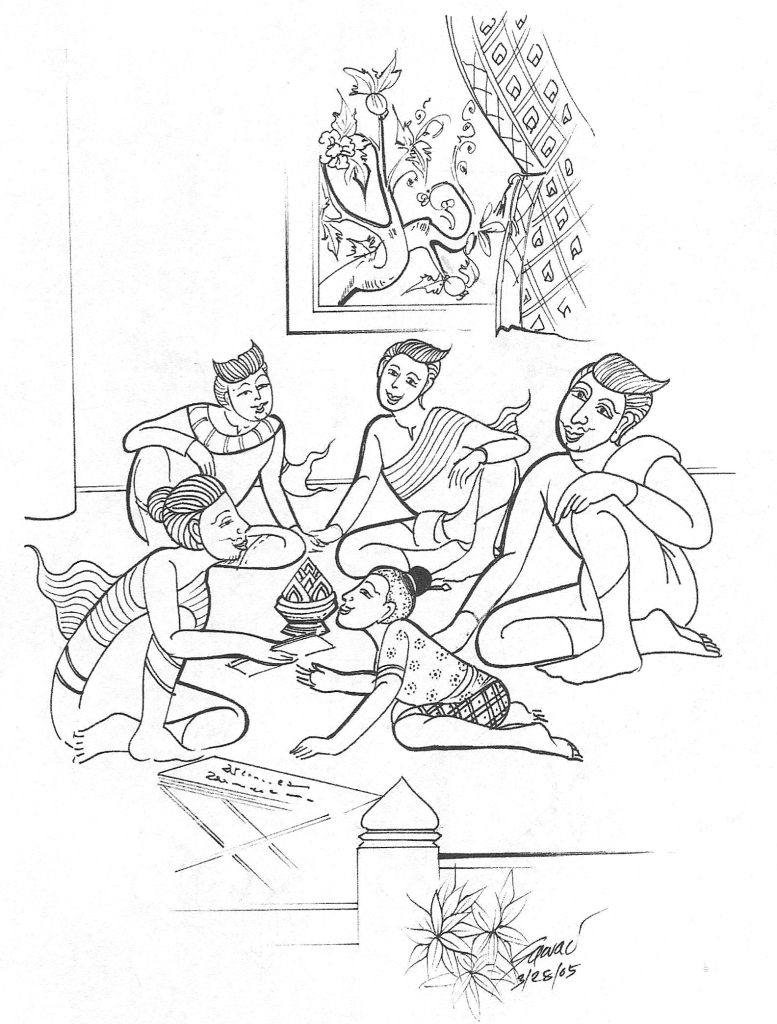
“The elders are both religious and political as indicated by their clothing. Thai scripture is written on folded palm leaf manuscripts and raised on small tables. The object in the bowl is used for ceremonial purposes. The boy’s hair will be cut at age twelve when, according to Thai tradition, he becomes a complete person. This makes his young wisdom all the more amazing.”
There are three different levels of speech in Burmese: common language, religious language (addressing and honoring monks, etc.), and royal language (which is not in active use anymore). Earliest Bible translations used exclusively royal and religious language (in the way Jesus is addressed by others and in the way Jesus is referred to via pronouns), which results in Jesus being divine and not human. Later editions try to make distinctions.
In the Common Language Version (publ. 2005) the human face of Jesus appears in the narrative of the angel’s message to Joseph and what Joseph did in response (Matthew 1:21-25). The angel told Joseph that Mary was going to give birth to a son, not a prince.
Likewise in Luke 2:6-7 the story of Jesus’ birth in Bethlehem is told simply using the Common language. Again in the description of the shepherds’ visit to the baby Jesus (Mark 1:21-25), in the story of Jesus’ circumcision (Luke 2:6-2:7), and in the narrative of the child Jesus’ visit to Jerusalem (Luke 2:46-51), the human face of Jesus comes to the forefront.
On the other hand, the child Jesus is clearly depicted as a royal or a divine child in the story of the wise men (Matthew 2:9-12), the story of the flight to Egypt (Matthew 2:13-14), and the return to Nazareth (Matthew 2:20-21).
In many English translations the Greek terms “hieron” (the whole “temple” in Jerusalem or specifically the outer courts open to worshippers) and “naos” (the inner “shrine” or “sanctuary”) are translated with only one word: “temple” (see also for instance “Tempel” in German [for exception see below] and “tempel” in Dutch, Danish, or Afrikaans).
Other languages make a distinction: (Click or tap here to see more)
Navajo (Dinė): “house in which worship is carried out” (for naos)
Balinese: “inner part of the Great Temple” (“the term ‘inner part’ denoting the hindmost and holiest of the two or three courts that temples on Bali usually possess”) vs. “Great Temple”
Telugu: “womb (i.e. interior)-of-the-abode” vs. “abode”
Thai: a term denoting the main audience hall of a Buddhist temple compound vs. “environs-of-the-main-audience-hall”
Kituba: “place of holiness of house-God Lord” vs. “house-God Lord”
Shipibo-Conibo: “deep in God’s house” vs. “God’s house” (source: Reiling / Swellengrebel)
Germandas Buch translation by Roland Werner (publ. 2009-2022): “inner court of the temple” (Tempelinnenhof) vs. “temple”
Languages that, like English, German, Dutch, Danish, or Afrikaans, don’t make that distinction include:
Toraja-Sa’dan: “house that is looked upon as holy, that is sacred, that is taboo and where one may not set foot” (lit. “house where-the-belly-gets-swollen” — because taboo is violated — using a term that is also applied to a Muslim mosque) (source for this and the three above: Reiling / Swellengrebel)
Aguaruna: “the house for talking to God” (source for this and above: M. Larson / B. Moore in Notes on Translation February 1970, p. 1-125.)
Guhu-Samane: “festival longhouse of God” (“The biiri, ‘festival longhouse’, being the religious and social center of the community, is a possible term for ‘temple’. It is not the ‘poro house’ as such. That would be too closely identified with the cult of poro. The physical features of the building, huge and sub-divided, lend it further favor for this consideration. By qualifying it as ‘God’s biiri’ the term has become meaningful and appropriate in the context of the Scriptures.”) (Source: Ernest Richert in The Bible Translator, 1965, p. 81ff. )
Enga: “God’s restricted access house” (source: Adam Boyd on his blog )
Another distinction that tends to be overlooked in translations is that between hieron (“temple” in English) and sunagógé (“synagogue” in English). Euan Fry (in The Bible Translator 1987, p. 213ff. ) reports on this:
“Many older translations have simply used transliterations of ‘temple’ and ‘synagogue’ rather than trying to find equivalent terms or meaningful expressions in their own languages. This approach does keep the two terms separate; but it makes the readers depend on explanations given by pastors or teachers for their understanding of the text.
“Translators who have tried to find meaningful equivalents, for the two terms ‘temple’ and ‘synagogue’ have usually made a distinction between them in one of two ways (which focus on the contrasting components of meaning). One way takes the size and importance of the Temple to make a contrast, so that expressions such as ‘sacred meeting/ worship house of the Jews’ and ‘big sacred meeting/worship house of the Jews’ are used. The other way focuses on the different nature of the religious activity at each of the places, so that expressions such as ‘meeting/worship house of the Jews’ and ‘sacrifice/ceremony place of the Jews’ are used.
“It is not my purpose in this article to discuss how to arrive at the most precise equivalent to cover all the components of meaning of ‘temple’. That is something that each translator really has to work through for himself in the light of the present usage and possibilities in his own language. My chief concern here is that the basic term or terms chosen for ‘temple’ should give the reader of a translation a clear and correct picture of the location referred to in each passage. And I am afraid that in many cases where an equivalent like ‘house of God’ or ‘worship house’ has been chosen, the readers have quite the wrong picture of what going to the Temple or being in the Temple means. (This may be the case for the word ‘temple’ in English too, for many readers.)”
Here are some examples:
Bambara: “house of God” (or: “big house of worship”) vs. “worship house” (or: “small houses of worship”)
Toraja-Sa’dan: “house where-the-belly-gets-swollen” (see above) vs. “meeting house for discussing matters concerning religious customs” (and “church” is “house where one meets on Sunday”)
Navajo (Dinė): “house in which worship is carried out” vs. “house of gathering” (source for all above: Bratcher / Nida)
Click or tap here to see a short video clip about Herod’s temple (source: Bible Lands 2012)Click or tap here to see a short video clip showing synagogues in New Testament times (source: Bible Lands 2012)
Following are a number of back-translations of Luke 2:46:
Noongar: “After three days, the couple saw Jesus sitting inside the Temple, beside the Law Men, listening to them and questioning them.” (Source: Warda-Kwabba Luke-Ang)
Uma: “They looked for him three days, only then did they find him in the House of God. He was sitting the midst of the religion teachers, listening and asking questions.” (Source: Uma Back Translation)
Yakan: “When three days had gone by they found him in the temple sitting with the religious-teachers, listening to them and asking them questions.” (Source: Yakan Back Translation)
Western Bukidnon Manobo: “And after they had looked for three days, they spied him in the church, the house of God, in discussion with the teachers of the Law. He was listening to the words of the teachers and he also had questions for them.” (Source: Western Bukidnon Manobo Back Translation)
Kankanaey: “On the third day (lit. its third), then they came-upon him in the Temple sitting-with the teachers listening to and questioning them.” (Source: Kankanaey Back Translation)
Tagbanwa: “It was the third day and then they found Jesus there in the Templo, sitting with the teachers of the law. He was listening and asking them questions too.” (Source: Tagbanwa Back Translation)
God transcends gender, but most languages are limited to grammatical gender expressed in pronouns. In the case of English, this is traditionally confined to “he” (or in the forms “his,” “him,” and “himself”), “she” (and “her,” “hers,” and “herself”), and “it” (and “its” and “itself”).
Modern Mandarin Chinese, however, offers another possibility. Here, the third-person singular pronoun is always pronounced the same (tā), but it is written differently according to its gender (他 is “he,” 她 is “she,” and 它/牠 is “it” and their respective derivative forms). In each of these characters, the first (or upper) part defines the gender (man, woman, or thing/animal), while the second element gives the clue to its pronunciation.
In 1930, after a full century with dozens of Chinese translations, Bible translator Wang Yuande (王元德) coined a new “godly” pronoun: 祂. Chinese readers immediately knew how to pronounce it: tā. But they also recognized that the first part of that character, signifying something spiritual, clarified that each person of the Trinity has no gender aside from being God.
While the most important Protestant and Catholic Chinese versions respectively have opted not to use 祂, some Bible translations do and it is widely used in hymnals and other Christian materials. Among the translations that use 祂 to refer to “God” were early versions of Lü Zhenzhong’s (呂振中) version (New Testament: 1946, complete Bible: 1970). R.P. Kramers (in The Bible Translator 1956, p. 152ff. ) explains why later versions of Lü’s translation did not continue with this practice: “This new way of writing ‘He,’ however, has created a minor problem of its own: must this polite form be used whenever Jesus is referred to? Lü follows the rule that, wherever Jesus is referred to as a human being, the normal tā (他) is written; where he is referred to as divine, especially after the ascension, the reverential tā (祂) is used.”
In that system one kind of pronoun is used for humans (male and female alike) and one for natural elements, non-liquid masses, and some spiritual entities (one other is used for large animals and another one for miscellaneous items). While in these languages the pronoun for spiritual entities used to be employed when referring to God, this has changed into the use of the human pronoun.
Lynell Zogbo (in The Bible Translator 1989, p. 401ff. ) explains in the following way: “From informal discussions with young Christians especially, it would appear that, at least for some people, the experience and/or concepts of Christianity are affecting the choice of pronoun for God. Some people explain that God is no longer ‘far away,’ but is somehow tangible and personal. For these speakers God has shifted over into the human category.”
In Kouya, God (the Father) and Jesus are referred to with the human pronoun ɔ, whereas the Holy Spirit is referred to with a non-human pronoun. (Northern Grebo and Western Krahn make a similar distinction.)
Eddie Arthur, a former Kouya Bible translation consultant, says the following: “We tried to insist that this shouldn’t happen, but the Kouya team members were insistent that the human pronoun for the Spirit would not work.”
In Burmese, the pronoun ko taw (ကိုယ်တော်) is used either as 2nd person (you) or 3rd person (he, him, his) reference. “This term clearly has its root in the religious language in Burmese. No ordinary persons are addressed or known by this pronoun because it is reserved for Buddhist monks, famous religious teachers, and in the case of Christianity, the Trinity.” (Source: Gam Seng Shae in The Bible Translator 2002, p. 202ff. )
In Thai, the pronoun phra`ong (พระองค์) is used, a gender-neutral pronoun which must refer to a previously introduced royal or divine being. Similarly, in Northern Khmer, which is spoken in Thailand, “an honorific divine pronoun” is used for the pronoun referring to the persons of the Trinity (source: David Thomas in The Bible Translator 1993, p. 445 ). In Urak Lawoi’, another language spoken in Thailand, the translation often uses tuhat (ตูฮัด) — “God” — ”as a divine pronoun where Thai has phra’ong even though it’s actually a noun.” (Source for Thai and Urak Lawoi’: Stephen Pattemore)
The English “Contemporary Torah” addresses the question of God and gendered pronouns by mostly avoiding pronouns in the first five books of the Hebrew Bible/Old Testament (unless God is referred to as “lord,” “father,” “king,” or “warrior”). It does that by either using passive constructs (“He gave us” vs. “we were given”), by using the adjective “divine” or by using “God” rather than a pronoun.
Some Protestant and Orthodox English Bibles use a referential capitalized spelling when referring to the persons of the Trinity with “He,” “His,” “Him,” or “Himself.” This includes for instance the New American Standard Bible or The Orthodox New Testament, but most translations do not. Two other languages where this is also done (in most Bible translations) are the closely related Indonesian and Malay. In both languages this follows the language usage according to the Qur’an, which in turn predicts that usage (see Soesilo in The Bible Translator 1991, p. 442ff. and The Bible Translator 1997, p. 433ff. ).
Like a number of other East Asian languages, Japanese uses a complex system of honorifics, i.e. a system where a number of different levels of politeness are expressed in language via words, word forms or grammatical constructs. These can range from addressing someone or referring to someone with contempt (very informal) to expressing the highest level of reference (as used in addressing or referring to God) or any number of levels in-between.
One way Japanese shows different degree of politeness is through the usage of an honorific construction where the morpheme rare (られ) is affixed on verbs as shown here in the widely-used Japanese Shinkaiyaku (新改訳) Bible of 2017. This is particularly done with verbs that have God as the agent to show a deep sense of reverence. Here, shitsumonshitarishiteo-rare-ru (質問したりしておられる) or “doing things such as asking questions” and o-rare-ru (おられる) or “is/be present” are used.



Leave a Reply
You must be logged in to post a comment.