The Greek in Luke 2:1 that is typically translated in English as “in those days” or “at that time” is translated by the ItalianLa Sua Parola è Vita translation as Qualche tempo dopo la nascita di Giovanni or “Some time after the birth of John.” Cotrozzi (2019) explains: “After a short summary of John’s youth (1:80) the story goes back in time. The shift, however, is not marked clearly in the original, and formal translations suggest that the events introduced in 2:1 followed those narrated in 1:80. The Greek phrase ἐν ταῖς ἡμέραις ἐκείναις (2:1) is best understood as referring back to the time of Herod the Great and more specifically the time after the birth of John the Baptist.”
The name that is transliterated as “Augustus” in English is translated in Libras (Brazilian Sign Language) with a sign that combines “C” (for Caesar, the title of the powerful ruler of Rome) and “adopted” since he was adopted by Julius Caesar (Source: Missão Kophós )
Following are a number of back-translations of Luke 2:1:
Noongar: “Now King Augustus wanted to see how many people were living in his country.” (Source: Warda-Kwabba Luke-Ang)
Uma: “At that time, a command came from Kaisar Agustus, commanding that people in all the kingdom of Roma have their names written so that they know their manyness/number.” (Source: Uma Back Translation)
Yakan: “At that time Agustus was the leader-king of the tribe of Roma. So-then he gave an order that all the people in all places under his rule should register.” (Source: Yakan Back Translation)
Western Bukidnon Manobo: “While Augustus was still king in the village of Rome, he made a law that all the people in the kingdoms which were subject to him should register themselves in a census.” (Source: Western Bukidnon Manobo Back Translation)
Kankanaey: “At that time, Emperor (loan Emperador) Augustus in Rome commanded that all the people in his jurisdiction go to register (lit. get-themselves-listed).” (Source: Kankanaey Back Translation)
Tagbanwa: “At that time, the Romano Impiradur who was Agusto ordered that all the people under the rule of Roma should be censused.” (Source: Tagbanwa Back Translation)
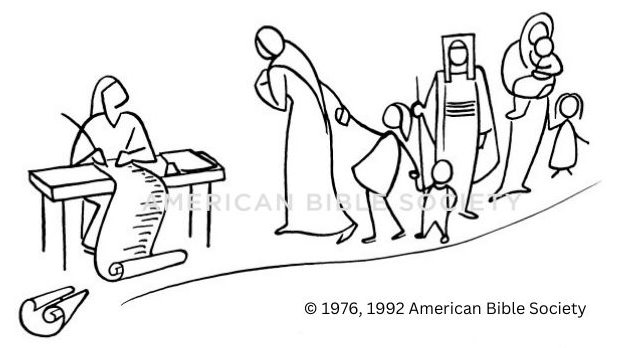
Illustration by Horst Lemke (1922-1985) for the GermanGute Nachricht für Sie – NT68, one of the first editions of the Good News Bible in German of 1968. Lemke was a well-known illustrator who illustrated books by Erich Kästner , Astrid Lindgren and many others.
Living Water is produced for the Bible translation movement in association with Lutheran Bible Translators. Lyrics derived from the ESV® Bible (The Holy Bible, English Standard Version®).
egeneto de … exēlthen ‘and it happened that … went out,’ cf. on 1.8.
en tais hēmerais ekeinais ‘in those days’ (cf. on 1.39) serves to bring out the temporal relationship between the narratives of ch. 1 and ch. 2 and is best understood as pointing back to en tais hēmerais Hērōdou in 1.5.
exēlthen dogma para Kaisaros Augoustou ‘a decree went out from Caesar Augustus,’ a general expression, not official language.
dogma ‘decree,’ usually of one issued by a person of unquestionable authority.
Kaisar, representing Latin Caesar, originally a name which the first Roman emperor acquired by adoption as the son of Julius Caesar, soon became a title. Since Kaisar Augoustos (here) and Tiberios Kaisar (3.1) are in accordance with the official Roman form of the names of both emperors Kaisar is best understood as a part of the name.
apographesthai pasan tēn oikoumenēn ‘that the whole world should have itself registered,’ indicating the content of the imperial decree in the form of an accusative and infinitive.
apographō ‘to register,’ here either in the middle ‘to have oneself registered,’ or, in the passive ‘to be enrolled,’ preferably the former. Here apographesthai refers to registration for tax purposes (cf. on v. 2, apographē).
oikoumenē scil. gē lit. ‘the inhabited earth,’ hence ‘mankind’; it refers here to the inhabitants of the Roman empire as in Acts 17.6; the equation of oikoumenē to the Roman empire or its inhabitants was not uncommon.
Translation:
In those days, or, ‘in that time/period also’; care should be taken not to suggest a connexion with the day of John’s manifestation to Israel (1.80).
A decree went out from Caesar Augustus, or, ‘came down from C. A.’ (Tagalog), ‘was given by C. A.,’ cf. “a proclamation was made by C. A.” (Phillips); or, ‘C. A. posted a placard (Sranan Tongo), put-out strong word (i.e. order)’ (Ekari); or again, shifting to a possessive, ‘there-was a proclamation of C. A.’ (cf. Javanese, and Bible de Jérusalem). A decree. Where no specific term exists one may use ‘order,’ ‘command.’ Tboli uses a term that points to civil law in contrast to customary law. Caesar Augustus. If taken as part of the proper name (see Exegesis) “Caesar” will have to be transliterated. In some languages the use of a name qualifier or title is required with the proper name; hence e.g. ‘big chief Kaisali Angustu’ (Kituba), ‘King-of-kings Kaisar Augustus’ (cf. Balinese).
That, introducing the contents of the decree, may have to be rendered, ‘saying/commanding/ordering,’ or, ‘(in it) he said/commanded/ordered,’ followed by direct or indirect discourse.
All the world, preferably, ‘the whole kingdom’ (Kannada, Ekari), ‘all his subjects’ (Tae,’ the same in Tboli, lit. ‘all persons holding to-him’), ‘all people in all countries of his empire’ (Kituba), ‘all the people included in the Roman empire’ (Cuyono).
Should be enrolled, preferably, ‘should have itself/themselves enrolled.’ The middle voice is sometimes expressed by a causative, e.g. ‘that all his subjects should cause-to-have-written (i.e. cause someone to write down) their name’ (Tboli), or it may have to be circumscribed, e.g. ‘that in the whole kingdom people should come to those who would register them.’ To enroll, or, ‘to hold a census (lit. listing of souls)’ (Bahasa Indonesia KB), ‘to write names’ (East and Toraja-Sa’dan, Kituba, Tboli), ‘to write names in a book’ (Dan), ‘to make a list of’ (Huanuco Quechua), ‘to record the number of’ (Telugu), ‘to count’ (Ekari).
Quoted with permission from Reiling, J. and Swellengrebel, J.L. A Handbook on the Gospel of Luke. (UBS Handbook Series). New York: UBS, 1971. For this and other handbooks for translators see here . Make sure to also consult the Handbook on the Gospel of Mark for parallel or similar verses.
In this section the things that the angel told Mary about in 1:31–37 happened. In those verses the angel told Mary that she would give birth to a son through the power of the Holy Spirit. This would happen even though she was a virgin. In this section, that prophecy was fulfilled. Mary gave birth to Jesus in Bethlehem. This section begins about six months after John the Baptizer was born (1:26).
It is good to translate this section before you decide on a heading for it. Some other possible headings for this section are:
The Birth of Jesus (Good News Translation) -or-
Mary gave birth to the Savior
Paragraph 2:1–3
This paragraph is the introduction to this section. It tells when the events happened. It also tells about an event that was background information for the main events of the section.
2:1a–b
Now: Here Greek conjunction that the Berean Standard Bible translates as Now introduces background information. Many English versions do not have a conjunction here. Introduce this information in a way that is natural in your language.
in those days: The phrase in those days refers back to 1:57–79. It refers to around the time that John the Baptizer was born. He was born about six months before Jesus was born. The phrase in those days does not refer to 1:80, which talks about John becoming a man. Other ways to translate this phrase are:
At that time -or-
At about the time when John was born
a decree went out from Caesar Augustus: The Greek clause that the Berean Standard Bible translates literally as a decree went out from Caesar Augustus refers to a command/order that this emperor issued. It is a figure of speech that describes the decree as if it went out by itself. Some ways other to translate this clause are:
a command came from Caesar Augustus -or-
Caesar Augustus ordered/commanded -or-
Augustus Caesar sent an order (New Century Version)
Caesar probably gave this command directly to his officials. Then they told this order to the people so that people would come for the officials to write their names. Describe this situation in a natural way in your language. If you need to say whom he ordered, you can say:
Caesar ordered his people -or-
Caesar ordered the people that he ruled
See the General Comment on 2:1a–b at the end of the notes on 2:1b for another translation suggestion.
Caesar: The word Caesar was a title for the great king of the city of Rome and of the Roman empire. He ruled many countries and kings that the people of Rome had conquered. The title Caesar means “Emperor.” Other ways to translate this are:
high king -or-
paramount chief
Augustus: The title Augustus means “exalted.” It is a title that the Senate of Rome gave to the emperor who was ruling when Jesus was born. Many English versions transliterate the word Augustus. You may also decide to translate the meaning of both Caesar and Augustus. For example:
the exalted high king -or-
the emperor called great
2:1b
that a census should be taken: The Greek word that the Berean Standard Bible translates as that a census should be taken is literally “to be registered/enrolled.” This word indicates that government officials would have to write the names of people in a book. Then the officials would count the names so that the emperor would know how many people were living in the empire. The Romans would also know where these people lived and which of them had to pay taxes.
Some other ways to translate a census should be taken are:
⌊government officials must⌋ write people’s names in a book ⌊and count them⌋
the whole empire: The phrase that the Berean Standard Bible translates as the whole empire is literally “all the world.” This does not mean all the nations on the whole earth at that time. Rather, it refers here to all the countries that the Roman emperor ruled.
Some English versions translate this phrase literally. For example:
all the world (New Revised Standard Version)
Some other English versions translate the meaning that this phrase had at the time, “the entire Roman world.” Other ways to translate this are:
all the empire (NET Bible) -or-
throughout the Roman empire (Good News Translation) -or-
all people in the countries under Roman rule (New Century Version)
General Comment on 2:1a–b
In some languages, it may be more natural to put Caesar’s words in direct speech. For example:
In those days, Caesar Augustus gave this order: “Everyone in the empire must be registered.”


Leave a Reply
You must be logged in to post a comment.