
The Greek in Luke 16:21 that is translated as “lick his sores” or similar in English is translated in the German New Testament translation by Berger / Nord (publ. 1999) with an seinen Wunden leckten und sie weiter verunreinigen or “licked at his wounds and further contaminated them.”
The poor man (image)
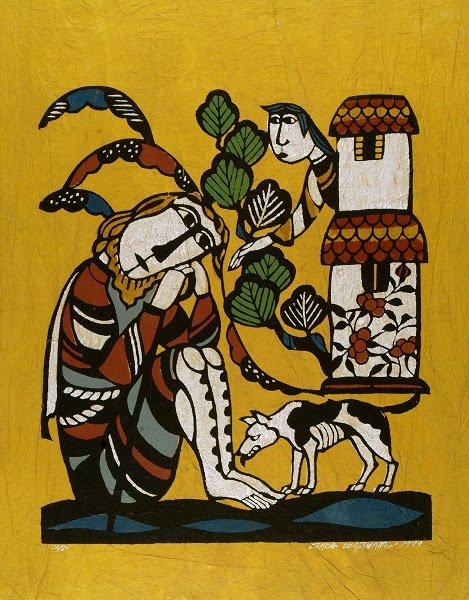
Hand colored stencil print on momigami by Sadao Watanabe (1979).
Image taken with permission from the SadaoHanga Catalogue where you can find many more images and information about Sadao Watanabe.
For other images of Sadao Watanabe art works in TIPs, see here.
The Rich Man and Lazarus (image)
The parable of The Rich Man and Lazarus is illustrated for use in Bible translations in West Africa by Wycliffe Cameroon like this:
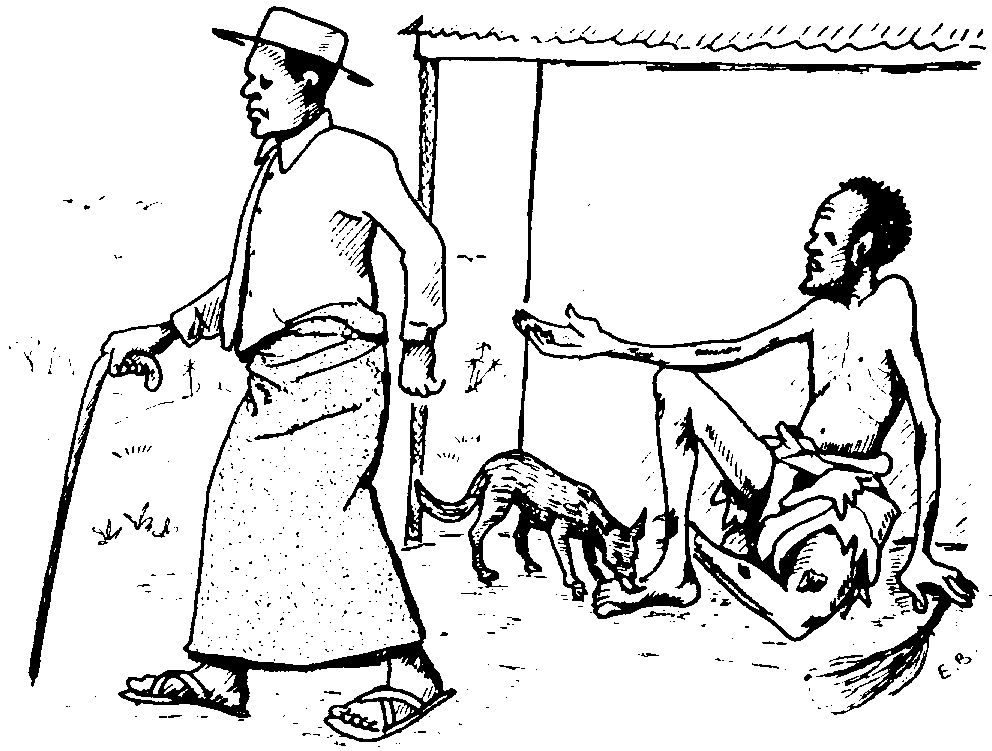
Illustration 1999 Mbaji Bawe Ernest, © Wycliffe Bible Translators, Inc. Used with permission.
complete verse (Luke 16:21)
Following are a number of back-translations of Luke 16:21:
- Noongar: “Lazarus wanted to eat the crumbs of food which fell from the rich man’s eating place. Dogs always came and licked his sores.” (Source: Warda-Kwabba Luke-Ang)
- Uma: “He wanted to eat the crumbs that fell/scattered from the table of that rich man. Thus (emphatic) was his poverty/pitifulness, dogs also came to lick his sores.” (Source: Uma Back Translation)
- Yakan: “For he wished/wanted if he only would be given the left-over food of the rich man so that he could eat. Even the dogs came and licked his sores.” (Source: Yakan Back Translation)
- Western Bukidnon Manobo: “because he hoped that he might be given even the crumbs that fell from the table of the rich man, so that his stomach might be filled with them. And the dogs there, they licked these ulcers of Lazarus.” (Source: Western Bukidnon Manobo Back Translation)
- Kankanaey: “because he wanted to eat koma from what the rich-man was throwing away. And that’s not all, because even the dogs, they went and licked his sores.” (Source: Kankanaey Back Translation)
- Tagbanwa: “He was waiting for something hopefully that he could eat of whatever was left over which would fall from the table/eating-place of that rich person. What’s more, dogs were gathering around him licking his sores.” (Source: Tagbanwa Back Translation)
dog
Dogs were domesticated very early and were used for hunting and as watchdogs in the ancient world. In Egypt as early as 4000 B.C. people made pottery images that indicate that sleek fast hunting dogs were bred which looked like the modern greyhound. From Babylonian sculpture we know that around 2500 B.C. large hunting dogs that looked like the modern bull-mastiff were kept by people in the Mesopotamian civilizations.
Among the Jews however while dogs were kept mainly as watch-dogs they were held in contempt and left to feed themselves by scavenging. This habit of scavenging and the fact that dogs were possibly associated with some Egyptian gods meant that dogs were seen as very unclean animals by the Jews. The dog found in Jewish settlements in Bible times was probably the pariah dog Canis familiaris putiatini which looked something like a small light brown Alsatian or German shepherd. This type of dog in its wild and domesticated forms is found all over the Middle East and on the mainland coasts of South and Southeast Asia (where it is known as the crab-eating dog). The Australian dingo is also very similar.
Small pet dogs were kept in homes in the Greek and Roman civilizations by gentiles but not by Jews. This is probably the type of dog referred to by the Greek word kunarion in Matthew 15:26 and Mark 7:27.
As mentioned above dogs were held in contempt as unclean. To call someone a dog was therefore very derogatory and to refer to someone as a “dead dog” was even more so. Israelites viewed dogs as second only to pigs as unclean animals. Dogs as scavengers around the villages ate anything from household refuse to animal carcasses and human excreta. They even ate human corpses that lay unburied after battles. Furthermore the dog was possibly one of the symbols of the Egyptian god Anubis (although many modern scholars believe the symbol to be the jackal).
With all of the above in mind it is understandable that dying and then being eaten by unclean dogs was seen as the worst of all possible fates.
In the first century A.D. gentiles were considered to be unclean and were referred to by Jews in a derogatory way as “dogs.” There is therefore strong irony in the expression in Philippians 3:2 where Judaizing Christians are referred to as dogs.
One additional connotation associated with dogs in the Bible is sexual perversion and promiscuity a connotation probably arising from the fact that sexually aroused male dogs do not always differentiate between sexes as they seek to mate and the fact that dogs of both sexes mate repeatedly with different partners.
Source: All Creatures Great and Small: Living things in the Bible (UBS Helps for Translators)
Sung version of Luke 16
SIL Translator’s Notes on Luke 16:21
16:21a
longing to be fed with the crumbs that fell from the rich man’s table: The poor man very much wanted to eat some of the food scraps that were thrown away after the rich man ate. The text does not say whether he ever received any of these leftover scraps.
the crumbs that fell from the rich man’s table: The Greek phrase that the Berean Standard Bible translates fairly literally as the crumbs that fell from the rich man’s table probably refers to:
(a) the chunks of bread on which people wiped their hands—they then threw this bread under the table;
(b) the food that remained after the rich man and his guests had finished eating.
Servants probably gathered both kinds of food scraps along with bits of food that had fallen to the floor and threw them away. In your translation you may use an expression that refers to any of these kinds of food scraps. For example:
the small pieces of food that fell from the rich man’s table (New Century Version)
-or-
scraps from the rich man’s table (New Living Translation (2004))
-or-
food that they/servants threw away after the rich man finished eating
Be careful not to imply that Lazarus was lying under or near the table ready to eat the bits of food that fell. He was outside by the gate that led into the property.
16:21b
Even the dogs came and licked his sores: The Greek phrase that the Berean Standard Bible translates as Even in this context introduces another detail that describes the poor man’s miserable condition. He was not only hungry and covered with sores. He was also not able to drive away the dogs that came to lick the sores. Other ways to introduce this detail are:
In addition, the dogs came… (NET Bible)
-or-
These were not his only difficulties, because even the dogs that came to where he was…
the dogs: The phrase the dogs refers to the wild street dogs that lived in ancient Palestine. They were not tame dogs, and people feared and disliked them.
© 2009, 2010, 2013 by SIL International®
Made available under the terms of a Creative Commons Attribution-ShareAlike 4.0 License (CC BY-SA) creativecommons.org/licenses/by-sa/4.0.
All Scripture quotations in this publication, unless otherwise indicated, are from The Holy Bible, Berean Standard Bible.
BSB is produced in cooperation with Bible Hub, Discovery Bible, OpenBible.com, and the Berean Bible Translation Committee.
Leave a Reply
You must be logged in to post a comment.