The Greek that is transliterated as “Lazarus” in English is translated in Spanish Sign Language with a sign depicting licking sores on arm, referring to Luke 16:21. (Source: Steve Parkhurst)
Following are a number of back-translations of Luke 16:20:
Noongar: “Lazarus, a poor man, also lived in that town, always covered in sores. Every day people brought him to the gate, the rich man’s gate.” (Source: Warda-Kwabba Luke-Ang)
Uma: “At his door was put/placed a poor man, named Lazarus. His whole body was all sores.” (Source: Uma Back Translation)
Yakan: “And there was also a poor man whose name was Lasarus. His whole body was covered with sores. Every day he was brought to the gate of the house of the rich man.” (Source: Yakan Back Translation)
Western Bukidnon Manobo: “There was also a man who was poor, whose name was Lazarus. As for this Lazarus, his body was covered with ulcers and every day his companions delivered him there to the eaves of the house of that rich man,” (Source: Western Bukidnon Manobo Back Translation)
Kankanaey: “There was also a poor-man named Lazarus whose body was covered-with-sores. They placed him by the doorway of the rich-man,” (Source: Kankanaey Back Translation)
Tagbanwa: “And there was also a beggar whose name was Lazaro. He really was covered with itching-skin-disease, for his body had sores all over. And now there he was lying in the gateway of that rich person.” (Source: Tagbanwa Back Translation)
Living Water is produced for the Bible translation movement in association with Lutheran Bible Translators. Lyrics derived from the ESV® Bible (The Holy Bible, English Standard Version®).
ptōchos de tis onomati Lazaros ‘a beggar named Lazarus.’ For ptōchos cf. on 4.18. The religious connotation is also present here. No special meaning is to be attached to the name Lazarus even though this is the only time that a personal name occurs in a parable.
ebeblēto pros ton pulōna autou lit. ‘had been laid at his gate.’ The pluperfect tense of ebeblēto denotes the result of laying down, rather that the act, “(had been prostrated and) lay”.
pulōn ‘gate,’ ‘entrance,’ of the gate of a large house or palace.
heilkōmenos ‘covered with sores,’ past participle of helkoō ‘to cause sores.’
(V. 21) epithumōn chortasthēnai apo tōn piptontōn apo tēs trapezēs tou plousiou ‘longing to satisfy himself with that which fell from the rich man’s table.’ epithumōn is syntactically co-ordinate with heilkōmenos. ta piptonta lit. ‘that which falls’ refers to that which was thrown away after the meals, or to that which fell from the table during the meals, preferably the former.
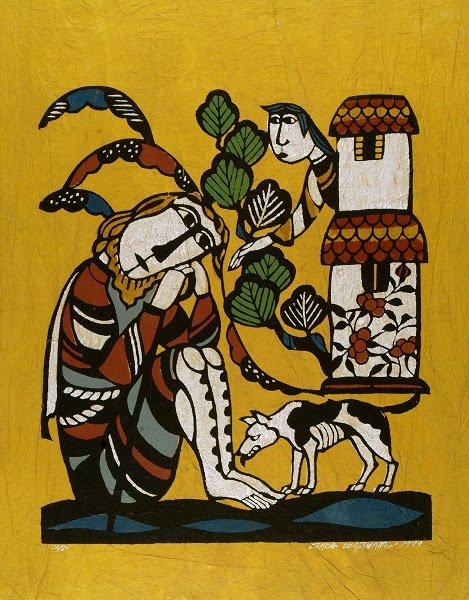
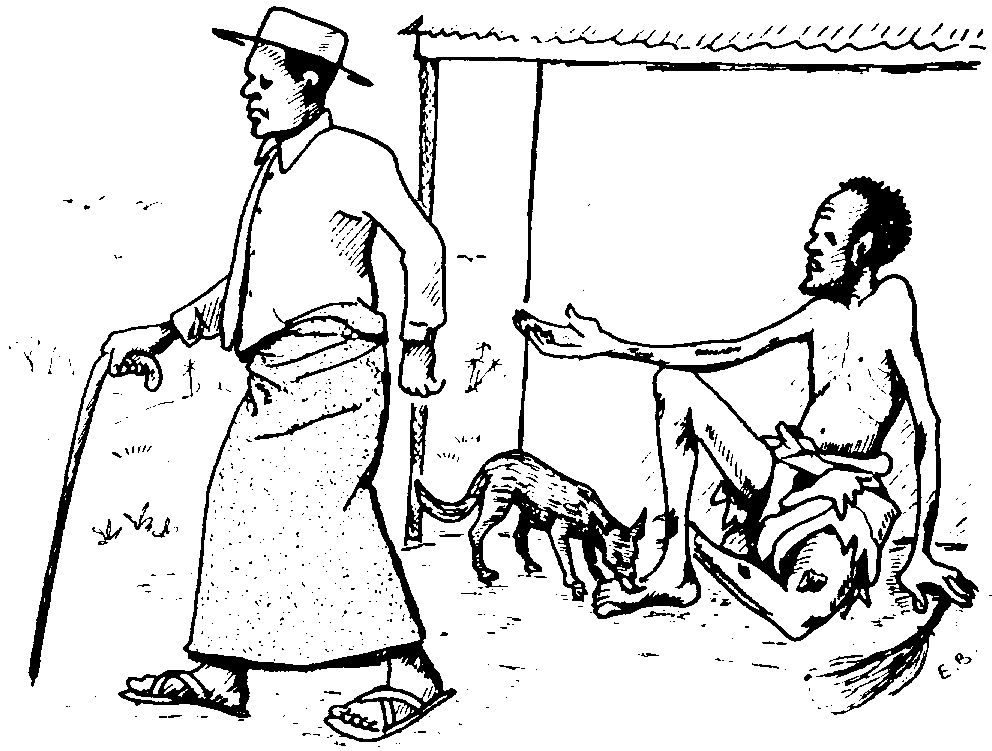
alla kai hoi kunes erchomenoi epeleichon ta helkē autou ‘but (not only) that,’ ‘even the dogs used to come and lick his sores,’ adding another touch of sorrow to the picture of the poor man’s situation.
epileichō ‘to lick.’ The imperfect tense points to a habitual situation.
helkos ‘sore,’ ‘abscess.’
Translation:
At his gate lay a poor man…, who…, introducing a second character, which may require something like ‘there was (also) a poor man…, lying at his (or, the rich man’s) gate/door. He….’ At his gate, or, ‘at the entrance of his house,’ ‘in the front of his house (lit. at his opening)’ (West Nyanja). In other cultural situations one may have to say e.g. ‘at the lower-end of the rich man’s stairs,’ or, ‘at the place where-one-steps-inside (i.e. the upper end of the stairs)-of-him’ (East or Toraja-Sa’dan, where the houses are built on poles), ‘at the gate of the fence around his house’ (Thai 1967, similarly Shona 1966), ‘at the entrance of the other’s compound’ (Zarma).
Full of sores. For full of see 5.12; for sores, or, ‘ulcers.’
(V. 21) Desired to be fed with, or, ‘desired to be given (to eat),’ ‘longed to receive (for food),’ ‘wished to satisfy his hunger with.’
What fell from the rich man’s table, i.e. ‘scraps/bits (thrown away) from the … table/meal,’ ‘what the servants threw away from the … meal,’ ‘the leftovers from the rich man’s food’ (Batak Toba).
Moreover the dogs came …, the climax in this description of Lazarus’ misery, as brought out in ‘he was even forced to put up with the dogs who used to come…’ (cf. The Four Gospels – a New Translation).
Quoted with permission from Reiling, J. and Swellengrebel, J.L. A Handbook on the Gospel of Luke. (UBS Handbook Series). New York: UBS, 1971. For this and other handbooks for translators see here . Make sure to also consult the Handbook on the Gospel of Mark for parallel or similar verses.
And a beggar named Lazarus: The Greek word that the Berean Standard Bible translates as beggar refers to a very poor person. It is not a specific word for a professional beggar. The Berean Standard Bible probably uses the word beggar here because Lazarus was clearly placed at the rich man’s gate in the hopes that he would receive food or money. Most versions translate this word as:
a poor man
lay: The Greek verb that the Berean Standard Bible translates as lay is passive and is literally “had been laid.” There are three ways to interpret this verb:
(1) It indicates that people had brought him there and left him. For example:
was laid (New American Standard Bible)
(New International Version, New American Standard Bible, New Century VersionContemporary English Version, King James Version, English Standard Version, Phillips’ New Testament in Modern English)
(2) It indicates only that he was lying there. For example:
lay (Revised Standard Version)
(Berean Standard Bible, Revised Standard Version, New Living Translation (2004), NET Bible, Revised English Bible)
(3) It indicates that people brought him there regularly. For example:
was regularly brought (God’s Word)
(God’s Word, Good News Translation)
It is recommended that you follow interpretation (1). The passive verb implies that he was too crippled or sick to get there himself. This helps to show the contrast between the rich man’s luxurious lifestyle and the poor man’s miserable condition.
If it is necessary to use an active verb in your language, you should supply a general subject. For example:
people had placed him at the gate of the rich man’s house
at his gate: The phrase his gate probably refers to the main gate that led into the courtyard of the rich man’s house. It does not refer to the door of the house itself.
16:20b
covered with sores: The Greek word that the Berean Standard Bible translates as covered with sores means “with sores all over his body.” This man suffered from a bad skin disease. These sores may have been ulcers or boils. In some languages it may be more natural to translate this phrase with a separate sentence. For example:
His body was full of sores. -or-
He had sores on his entire body.
General Comment on 16:20a–b
Several English versions give the name of this poor man later in this verse. For example:
At his gate was laid a beggar named Lazarus, covered with sores. (New International Version)
In some languages it may be more natural to tell the man’s name and describe his condition earlier in the verse. For example:
20aThere was also a poor man whose name was Lazarus. 20bHe had sores all over his body. 20aPeople had left him at the gate of the house of the rich man.
Lazarus is the second main person in this story. Introduce him in a natural way in your language.

Leave a Reply
You must be logged in to post a comment.