The Greek that is translated into English versions as “throne” is translated into Naro as ntcõó-q’oo: “he will rule.” The figure of the “throne” cannot be translated in the egalitarian Naro culture, so the idea had to be expressed more explicitly. (Source: Gerrit van Steenbergen)
In other languages it is translated as “stool/seat of the king” (Marathi), “seat of commanding/chieftainship” (Highland Totonac, Kituba), “seat of the Supreme one (lit. of-him-who-has-the umbrella)” (Toraja-Sa’dan — the umbrella being a well-known symbol of power in various parts of South and South-East Asia), “glorious place to sit” (Ekari) (source: Reiling / Swellengrebel), “where God sits and rules” (Estado de México Otomi), “where God reigns” (Central Mazahua) (source: John Beekman in Notes on Translation, March 1965, p. 2ff.), or “bed of kingship” (Kafa) (source: Loren Bliese).
In Elhomwe it is translated as “seat of the king,” unless it refers to the throne of God (such as in Matthew 19:28. Then the translation is the “seat of God.”) (Source: project-specific translation notes in Paratext)
Teutila Cuicatec: “God who has a great rule” (source for this and above: Viola Waterhouse in Notes on Translation August 1966, p. 86ff.)
Sa’a: “God, the Surpassing One” (source: Carl Gross)
Elhomwe: Mulluku Muullupalli or “God the Great” (source: project-specific translation notes in Paratext)
Chichewa: Wammwambamwamba: A name of God. While this word is difficult to translate into English, its sense implies that God is highly above everything in his power and greatness. (Source: Mawu a Mulungu mu Chichewa Chalero Back Translation)
Image taken from the Wiedmann Bible. For more information about the images and ways to adopt them, see here . For other images of Willy Wiedmann paintings in TIPs, see here.
Following is a contemporary tempera / gouache on leather painting by an unknown Ethiopian artist:
Image taken from He Qi Art . For purchasing prints of this and other artworks by He Qi go to heqiart.com . For other images of He Qi art works in TIPs, see here.
The Hebrew and Greek that is translated in English as “Lord God” or “Lord God” encountered an issue in Tok Pisin. Norm Mundhenk explains why (in The Bible Translator 1985, p. 442ff. ):
“I am not aware of any serious objections to either the word God [for “God”] or Bikpela [for YHWH] alone. However, when trying to translate the expression ‘the Lord God,’ the translators first tried to use Bikpela God. But Bikpela is also an adjective meaning ‘big’ and in the expression Bikpela God, it would usually be understood as “Big God,’ as though there were other smaller gods around also.
“In the Old Testament, as the recent articles have clearly pointed out, the English word ‘Lord‘ often stands for the Hebrew name of God, YHWH, which is usually spelled these days as Yahweh. With this in mind, the name Yawe was tried in Tok Pisin, but it was felt that most readers did not connect this strange name with God. Eventually, we decided to keep Bikpela, but to translate ‘Lord God’ as God, Bikpela, literally ‘God, the Lord.’
“The reason for this decision was really only that the words could be used naturally in this order, without the problem of giving a wrong meaning which we had when putting Bikpela first. It was not until some people asked if it was right to ‘turn around’ the name and the title in this way that we realized that there was really a deeper reason for doing what we did. In fact, for most speakers of Tok Pisin, God is the only God they know, and it seems likely that God is understood as the personal name of God, rather than as a class name. Bikpela, on the other hand, is a class name — there can be more than one Bikpela, though it is recognized that God is the greatest of them and there is no confusion when he is referred to simply as Bikpela. Thus, in Hebrew an expression like ‘YHWH, the God of Israel,’ has the personal name first, followed by the class name explaining who he is. And we have exactly the same situation in Tok Pisin when we say God, Bikpela bilong Isrel. I suspect that in many other languages which have borrowed the word ‘God,’ we might find that it has been borrowed basically as a personal name, rather than as a class name.”
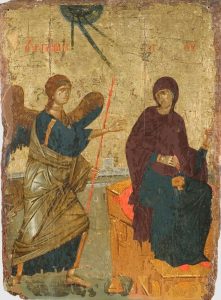
Following is a Serbian Orthodox icon of the Annunciation to Mary from the 14th century (found in the Church of Theotokos the Perivleptos, Ohrid, today in the National Museum of Serbia).
Orthodox Icons are not drawings or creations of imagination. They are in fact writings of things not of this world. Icons can represent our Lord Jesus Christ, the Virgin Mary, and the Saints. They can also represent the Holy Trinity, Angels, the Heavenly hosts, and even events. Orthodox icons, unlike Western pictures, change the perspective and form of the image so that it is not naturalistic. This is done so that we can look beyond appearances of the world, and instead look to the spiritual truth of the holy person or event. (Source )
The Greek that is translated as “sinner” in English is translated in various ways:
“people with bad hearts” (“it is not enough to call them ‘people who do bad things,’ for though actions do reflect the heart, yet it is the hearts with which God is primarily concerned — see Matt. 15:19“) in Western Kanjobal
“people who are doing wrong things in their hearts” in San Blas Kuna (source for this and above: Nida 1952, p. 148)
Following are a number of back-translations of Luke 1:32:
Noongar: “He will be great. He will be called the ‘Son of God’. God says this. He will stand up as King, like his ancestor David.” (Source: Warda-Kwabba Luke-Ang)
Uma: “He will become an important person [lit., big life], and he is called the Son of God that is in heaven. And the Lord God lifts him to become a King like King Daud, his ancestor long ago.” (Source: Uma Back Translation)
Yakan: “He will be really great and he will be called the Child/Son of God the Most High. And God will make him king like his forefather King Da’ud ley.” (Source: Yakan Back Translation)
Western Bukidnon Manobo: “His rank will be very great, and he will be called the Son of the Very Highest God, and the Lord God will make it be that this one you will give birth to will rule just like his ancestor long ago David ruled.” (Source: Western Bukidnon Manobo Back Translation)
Kankanaey: “He will be great and will be called the Child of the Highest God. God will moreover make-him -king like his ancestor King David long ago,” (Source: Kankanaey Back Translation)
Tagbanwa: “He is really great/important, and is called the Son of God who is Exceedingly the Greatest/Most-important. God will give to him the kingship which is like that of his ancestor David.” (Source: Tagbanwa Back Translation)
God transcends gender, but most languages are limited to grammatical gender expressed in pronouns. In the case of English, this is traditionally confined to “he” (or in the forms “his,” “him,” and “himself”), “she” (and “her,” “hers,” and “herself”), and “it” (and “its” and “itself”).
Modern Mandarin Chinese, however, offers another possibility. Here, the third-person singular pronoun is always pronounced the same (tā), but it is written differently according to its gender (他 is “he,” 她 is “she,” and 它/牠 is “it” and their respective derivative forms). In each of these characters, the first (or upper) part defines the gender (man, woman, or thing/animal), while the second element gives the clue to its pronunciation.
In 1930, after a full century with dozens of Chinese translations, Bible translator Wang Yuande (王元德) coined a new “godly” pronoun: 祂. Chinese readers immediately knew how to pronounce it: tā. But they also recognized that the first part of that character, signifying something spiritual, clarified that each person of the Trinity has no gender aside from being God.
While the most important Protestant and Catholic Chinese versions respectively have opted not to use 祂, some Bible translations do and it is widely used in hymnals and other Christian materials. Among the translations that use 祂 to refer to “God” were early versions of Lü Zhenzhong’s (呂振中) version (New Testament: 1946, complete Bible: 1970). R.P. Kramers (in The Bible Translator 1956, p. 152ff. ) explains why later versions of Lü’s translation did not continue with this practice: “This new way of writing ‘He,’ however, has created a minor problem of its own: must this polite form be used whenever Jesus is referred to? Lü follows the rule that, wherever Jesus is referred to as a human being, the normal tā (他) is written; where he is referred to as divine, especially after the ascension, the reverential tā (祂) is used.”
In that system one kind of pronoun is used for humans (male and female alike) and one for natural elements, non-liquid masses, and some spiritual entities (one other is used for large animals and another one for miscellaneous items). While in these languages the pronoun for spiritual entities used to be employed when referring to God, this has changed into the use of the human pronoun.
Lynell Zogbo (in The Bible Translator 1989, p. 401ff. ) explains in the following way: “From informal discussions with young Christians especially, it would appear that, at least for some people, the experience and/or concepts of Christianity are affecting the choice of pronoun for God. Some people explain that God is no longer ‘far away,’ but is somehow tangible and personal. For these speakers God has shifted over into the human category.”
In Kouya, God (the Father) and Jesus are referred to with the human pronoun ɔ, whereas the Holy Spirit is referred to with a non-human pronoun. (Northern Grebo and Western Krahn make a similar distinction.)
Eddie Arthur, a former Kouya Bible translation consultant, says the following: “We tried to insist that this shouldn’t happen, but the Kouya team members were insistent that the human pronoun for the Spirit would not work.”
In Burmese, the pronoun ko taw (ကိုယ်တော်) is used either as 2nd person (you) or 3rd person (he, him, his) reference. “This term clearly has its root in the religious language in Burmese. No ordinary persons are addressed or known by this pronoun because it is reserved for Buddhist monks, famous religious teachers, and in the case of Christianity, the Trinity.” (Source: Gam Seng Shae in The Bible Translator 2002, p. 202ff. )
In Thai, the pronoun phra`ong (พระองค์) is used, a gender-neutral pronoun which must refer to a previously introduced royal or divine being. Similarly, in Northern Khmer, which is spoken in Thailand, “an honorific divine pronoun” is used for the pronoun referring to the persons of the Trinity (source: David Thomas in The Bible Translator 1993, p. 445 ). In Urak Lawoi’, another language spoken in Thailand, the translation often uses tuhat (ตูฮัด) — “God” — ”as a divine pronoun where Thai has phra’ong even though it’s actually a noun.” (Source for Thai and Urak Lawoi’: Stephen Pattemore)
The English “Contemporary Torah” addresses the question of God and gendered pronouns by mostly avoiding pronouns in the first five books of the Hebrew Bible/Old Testament (unless God is referred to as “lord,” “father,” “king,” or “warrior”). It does that by either using passive constructs (“He gave us” vs. “we were given”), by using the adjective “divine” or by using “God” rather than a pronoun.
Some Protestant and Orthodox English Bibles use a referential capitalized spelling when referring to the persons of the Trinity with “He,” “His,” “Him,” or “Himself.” This includes for instance the New American Standard Bible or The Orthodox New Testament, but most translations do not. Two other languages where this is also done (in most Bible translations) are the closely related Indonesian and Malay. In both languages this follows the language usage according to the Qur’an, which in turn predicts that usage (see Soesilo in The Bible Translator 1991, p. 442ff. and The Bible Translator 1997, p. 433ff. ).



Leave a Reply
You must be logged in to post a comment.