The Hebrew and Greek that is translated as “bear (a child)” or “give birth to” is translated in Mairasi as “go to the forest,” reflecting the traditional place of childbirth for Mairasi women. (Source: Enggavoter 2004)
In Spanish it is translated as dar a luz, literally “to give to light.” Likewise, in Portuguese (dar à luz) and Italian (dare alla luce). (Source: Mark Terwilliger)
Image taken from the Wiedmann Bible. For more information about the images and ways to adopt them, see here . For other images of Willy Wiedmann paintings in TIPs, see here.
Following is a contemporary tempera / gouache on leather painting by an unknown Ethiopian artist:
Image taken from He Qi Art . For purchasing prints of this and other artworks by He Qi go to heqiart.com . For other images of He Qi art works in TIPs, see here.
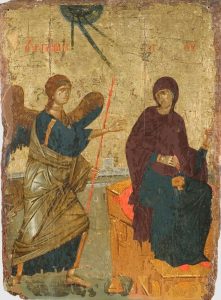
Following is a Serbian Orthodox icon of the Annunciation to Mary from the 14th century (found in the Church of Theotokos the Perivleptos, Ohrid, today in the National Museum of Serbia).
Orthodox Icons are not drawings or creations of imagination. They are in fact writings of things not of this world. Icons can represent our Lord Jesus Christ, the Virgin Mary, and the Saints. They can also represent the Holy Trinity, Angels, the Heavenly hosts, and even events. Orthodox icons, unlike Western pictures, change the perspective and form of the image so that it is not naturalistic. This is done so that we can look beyond appearances of the world, and instead look to the spiritual truth of the holy person or event. (Source )
Following are a number of back-translations of Luke 1:31:
Noongar: “You will become pregnant and bear a son, and you will name him ‘Jesus’.” (Source: Warda-Kwabba Luke-Ang)
Uma: “You (sing.) will become pregnant, and you (sing.) will give birth to a male child. You (sing.) must name that child Yesus.” (Source: Uma Back Translation)
Yakan: “You will soon become pregnant and will give birth to a boy. Call him Isa.” (Source: Yakan Back Translation)
Western Bukidnon Manobo: “You will become pregnant and you will give birth to a male, and you must name him Jesus.” (Source: Western Bukidnon Manobo Back Translation)
Kankanaey: “You (sing.) will become pregnant, and you (sing.) will give-birth to a male and you (sing.) will name him Jesus.” (Source: Kankanaey Back Translation)
Tagbanwa: “Listen to what I will tell you. You will conceive. A male will be born. Jesus is what you are to name him.” (Source: Tagbanwa Back Translation)
Living Water is produced for the Bible translation movement in association with Lutheran Bible Translators. Lyrics derived from the ESV® Bible (The Holy Bible, English Standard Version®).
kai idou ‘and behold’; cf. on v. 20. Here it emphasizes that Mary’s pregnancy is proof that she has found grace with the Lord.
sullēmpse en gastri ‘you will become pregnant’; sullambanō ‘to become pregnant’ occurs with or without en gastri ‘in the womb,’ without difference in meaning. en gastri also 21.23.
kai kaleseis cf. on v. 13.
Iēsoun the Greek transliteration of the Hebrew name Jeshua, and of its older form Joshua or Jehoshua, ‘Yahweh saves’ or ‘Yahweh is saviour’; the name was both in its Hebrew and in its Greek form very common among the Jews.
Translation:
The rendering of conceive in your womb often will coincide with that of “conceive” in v. 24, but it is stylistically preferable, of course, when the two can be differentiated, as is done e.g. in Uab Meto, which can use a parallelism here, ‘you will conceive and become pregnant.’
Bear a son, see on v. 13, where a synonymous verb is used in the Greek.
In languages which, in addressing and referring to persons, have to differentiate words in accordance with status, the position Jesus has and the one Mary has in relation to Gabriel, and the ensuing decisions as to the use of honorific and less or non-honorific words may form a problem. To solve it the translator should investigate more or less comparable cases in ordinary life (e.g. in Bali the case of a low caste girl married to a noble-man, a not uncommon and legitimate situation), or in folktales (where heavenly announcements to maidens about supernatural sons are not exceptional). Such a comparison will at least constitute a valid frame of reference for the discussion of the linguistic and cultural problems, and at its best may suggest an acceptable, sometimes quite unexpected, solution. Thus in Balinese the verse is in non-honorifics up to ‘bear a son,’ but the clause “you shall call his name Jesus” is rendered in honorifics. In Thai, which has a highly developed system of honorifics and reckons with different degrees of highness, one has to take into account that Gabriel is speaking for God; this makes it unnecessary and undesirable to refer to the infant Jesus with terms of the highest level, such as would be proper for subjects to use in referring to their king’s son. Whatever solution the translator chooses, however, somewhere it will probably have to be in conflict with normal usage in the receptor language, for the simple reason that the facts to be told do not fit in the normal experience of men. When the message requires it, he must be ready to give theology precedence over linguistics, but in doing so he should exactly know to what extent and at what cost he deviates from usage, lest what he thinks to be a theologically sound rendering turn out to be a nonsensical one.
For versions made in languages of predominantly Muslim countries, ‘Isa,’ the Arabic form of the name, as found already in the Koran, has been advocated (cf. ibid., 83-86). Older versions have used it, some modern ones still do so. It is significant, though, that in course of time ‘Isa’ or a form based on it, has often been changed into (a form based on) ‘Jesus,’ but that examples of the contrary procedure are less conspicuous. At least two objections can validly be made against the use of the Arabic form of the name. (1) The connotation of ‘Isa’ in Islam is very different from that of ‘Jesus’ in Christianity. It goes back to teachings of the Koran containing several statements about ‘Isa,’ which are in open and intentional controversy with the Christian creed: he is held to be simply a prophet, one amongst many colleagues of whom Mohammed is the highest, “the seal”; it is stressed that he was nothing more than a servant, having no divine rights, and certainly not being the Son of God; he is said not to have died on the cross in his own body but in effigy only (cf. Sura 33.7, 40; 43.59; 5.116; 9.30f and 4.157). The name ‘Isa,’ therefore, must be said to stand for the negation of much that ‘Jesus Christ’ means. (2) The choice of ‘Isa’ tends to isolate its users from the rest of the Church, because ‘Jesus,’ or forms based on it, are widely accepted all over the world.
Quoted with permission from Reiling, J. and Swellengrebel, J.L. A Handbook on the Gospel of Luke. (UBS Handbook Series). New York: UBS, 1971. For this and other handbooks for translators see here . Make sure to also consult the Handbook on the Gospel of Mark for parallel or similar verses.
Behold: The Greek word that the Berean Standard Bible translates as Behold literally means “look” or “see.” It focuses attention on what follows and indicates that this is important or amazing. Here Gabriel used it to introduce his amazing message to Mary that she would give birth to Jesus.
Some ways to translate the word in this context are:
look/listen -or-
take note of this -or-
pay attention to this
The same Greek word occurred at 1:20a (where the Berean Standard Bible translated it as “now”).
you will conceive: The Greek expression that the Berean Standard Bible translates as you will conceive is literally “you will conceive in your womb/belly.” It means, “You will become pregnant.” In some languages you may have an idiom to express this. The text implies that Mary would become pregnant very soon, before she married Joseph. Some ways to translate this in English are:
You will be with child (New International Version) -or-
You will become pregnant (NET Bible)
give birth to a son: Two other ways to say this are:
have a baby boy -or-
bear a male child
1:31b
you are to give Him the name Jesus: The Greek verb in the clause that the Berean Standard Bible translates as you are to give Him the name Jesus is literally “you will call his name Jesus.” In this context it functions as a command. It implies that Mary should or must give him the name Jesus. See the similar expression at 1:13d.



Leave a Reply
You must be logged in to post a comment.